The morning after the family barbecue felt almost unreal.
The house was quiet in a way that did not feel peaceful. It felt like everyone was trying too hard to pretend nothing serious had happened. My mother moved around the kitchen carefully, avoiding my eyes. My father spoke in short, gentle sentences, as if volume alone could make things better. Even Derek, my brother, stayed out of sight.
But silence did not erase what had happened.
The night before, I had walked into the backyard and frozen when I saw my son Lucas’s toys melting in the fire pit.
His favorite action figure was half-buried in ash. A small plastic dinosaur had curled into a twisted shape from the heat. The little truck he carried everywhere was blackened and warped, its wheels gone soft from the flames.
And Derek had been laughing.
“He needs to toughen up,” he said, tossing another toy toward the fire like it meant nothing. “You baby him too much.”
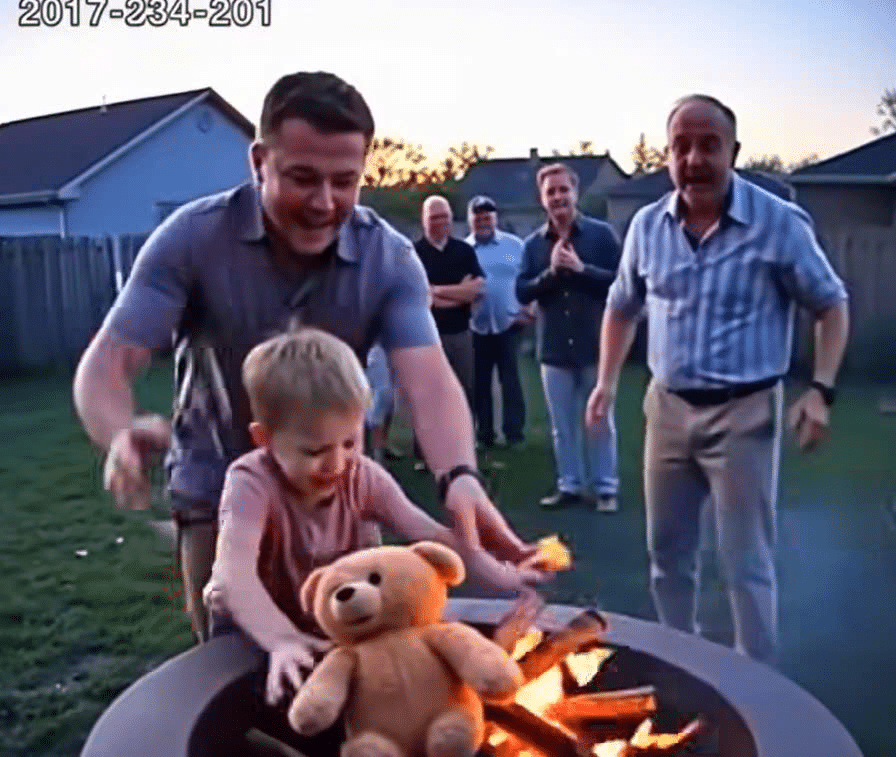
Lucas had stood beside me, staring at the fire with wide, devastated eyes.
He did not scream at first. He did not understand. Children often need a few seconds to process cruelty when it comes from someone they were taught to trust.
Then his face crumpled.
That sound — my son crying as his uncle mocked him — is something I will never forget.
I wanted to explode. Every part of me wanted to shout, shove Derek away from the fire pit, and demand that everyone finally admit what he was. A bully. A grown man who hid his insecurity behind jokes about toughness.
But Lucas was watching me.
So I chose control.
I picked him up, held him close, and walked inside. Behind me, I heard my mother saying Derek’s name in a weak, scolding tone. My father muttered something about how he had gone too far. But no one stopped him before the damage was done.
That was the pattern in our family.
Derek crossed lines.
Everyone else softened the consequences.
The next morning, Lucas sat at the kitchen table with swollen eyes, pushing cereal around his bowl. He barely spoke. Every few minutes, his gaze drifted toward the small pile of toys he had left, as if he were checking to make sure they were still there.
I sat beside him and kept my voice calm.
“We’ll replace them,” I promised.
He looked down. “They won’t be the same.”
I knew he was right.
Adults sometimes forget that children do not love toys because of price or appearance. They love them because those toys become part of their stories. They carry memories, comfort, imagination, and safety. Derek had not just thrown plastic into a fire. He had taken something meaningful from a child and called it a lesson.
A lesson in what?
That people who love you can hurt you and expect forgiveness?
That cruelty becomes acceptable when someone calls it toughness?
No. I refused to let Lucas learn that.
Later that morning, the doorbell rang.
My father stood on the porch, looking older than usual. His shoulders were tense, and he kept rubbing one hand over the other.
“Virgil,” he said quietly, “we need to talk.”
I stepped outside and closed the door behind me.
He sighed. “Derek’s in trouble at work.”
I stared at him.
Apparently, news of the incident had spread faster than expected. Someone at the barbecue had taken a video. Derek worked for a company that handled family-oriented community programs, and the footage of him laughing while burning a child’s toys had reached his employer.
Now he was facing serious consequences.
“He could lose his job,” Dad said. “I know things are bad between you two, but maybe you could speak up. Tell them it was just a family misunderstanding.”
For a moment, I simply looked at him.
A family misunderstanding.
That phrase was everything wrong with us.
I let out a slow breath. “Dad, Lucas watched his uncle destroy his toys and laugh about it. That wasn’t a misunderstanding.”
“He was wrong,” Dad said quickly. “I know that. But he’s your brother.”
“And Lucas is my son.”
Dad’s face tightened.
“He needs help,” he said.
“Yes,” I answered. “He does. But not the kind where everyone rushes in to save him from consequences.”
My father looked stunned, as if I had broken some unspoken family agreement.
For years, Derek had been allowed to act however he wanted because everyone excused it as confidence, humor, or stress. When he insulted people, he was “just being honest.” When he mocked someone, they were “too sensitive.” When he crossed a boundary, the rest of us were expected to move on for the sake of peace.
But peace built on silence is not peace.
It is surrender.
“I’ll talk to him,” I finally said. “But not to protect him from what he did.”
Dad nodded slowly, though I could tell he did not fully understand.
That afternoon, I met Derek at a small café near his office.
He was already sitting at a corner table when I arrived, arms crossed, jaw tight. He tried to look annoyed, but I could see the fear underneath. For once, his usual swagger did not quite hold.
“You really doing this to me?” he asked as soon as I sat down.
I raised an eyebrow. “Doing what?”
“Letting people think I’m some kind of monster.”
I leaned back. “Did you burn my son’s toys?”
His eyes flickered.
“That’s not the point,” he muttered. “It was a joke.”
“No,” I said. “A joke is supposed to be funny to more than one person. Lucas was crying. You were laughing. That is not a joke.”
Derek scoffed, but it sounded weaker than usual.
“You’re raising him soft,” he said. “The world is hard. Kids need to toughen up.”
I looked at him for a long moment.
“You think toughness means not caring,” I said. “But all you did was prove that you don’t know how to handle gentleness without trying to destroy it.”
He looked away.
For the first time, I wondered if Derek truly believed the things he said, or if he had spent so long hiding behind them that he no longer knew how to stop.
I continued, keeping my voice steady.
“Lucas doesn’t need to become hard to survive the world. He needs to become strong. There’s a difference. Strength includes kindness. Strength includes self-control. Strength includes knowing when you’ve hurt someone and taking responsibility for it.”
Derek’s face flushed.
“So what do you want from me?” he asked.
“I want you to apologize to Lucas. A real apology. Not one of those ‘sorry you got upset’ apologies. I want you to replace what you destroyed. And I want you to stop calling cruelty a lesson.”
He stared at the table.
“And my job?”
“That’s between you and your employer,” I said. “I’m not lying for you. I’m not minimizing what happened. If you want people to see you differently, start acting differently.”
For once, Derek had no quick comeback.
The silence between us was uncomfortable, but necessary.
When I stood to leave, he said my name.
I turned.
His voice was lower now. “Do you really think Lucas hates me?”
The question surprised me.
“No,” I said honestly. “But he’s hurt. And if you keep choosing pride over love, one day he may stop wanting to know you.”
That landed.
I saw it in his face.
When I got home, Lucas ran into my arms. He hugged me tightly, the way children do when they are still trying to feel safe again. I held him and silently promised that I would never ask him to accept harm just because it came from family.
That evening, Derek came over.
He looked uncomfortable standing in our doorway, holding a bag from the toy store. Lucas stayed behind my leg, unsure and cautious.
Derek knelt down.
“I’m sorry,” he said quietly. “I was wrong. I hurt you, and I should not have done that. Your toys mattered to you, and I treated them like they didn’t. That was cruel.”
Lucas did not run to him. He did not smile right away. He simply listened.
Then Derek held out the bag.
“I tried to replace them,” he said. “I know they’re not the same.”
Lucas looked up at me. I nodded gently, letting him decide.
He took the bag but stayed close to my side.
That was enough for one day.
Healing does not happen instantly. Trust does not return because someone says sorry once. But accountability had finally entered the room, and that mattered.
What happened at the barbecue was about more than toys. It exposed a pattern our family had ignored for too long. Derek had mistaken intimidation for strength, and the rest of us had mistaken silence for keeping peace.
I will not make that mistake again.
Lucas learned something painful that night, but I hope he also learned something powerful afterward: love should protect, not humiliate. Family should be safe, not cruel. And real strength is not measured by how much pain you can cause.
It is measured by whether you have the courage to make things right.


