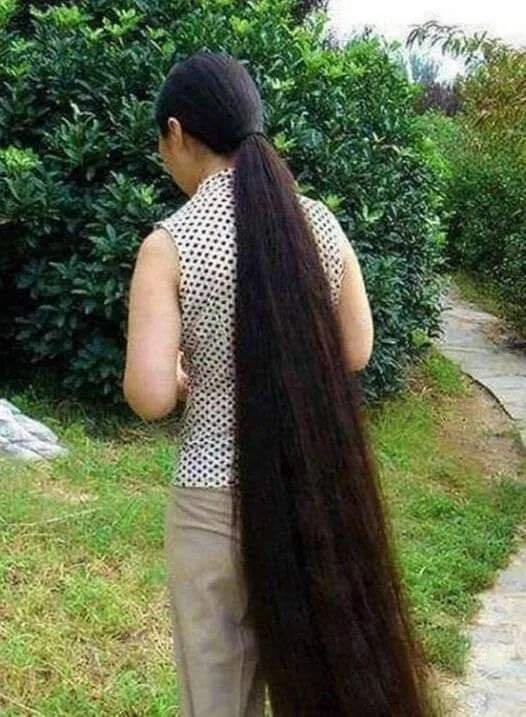
Her hair eventually extended close to the floor, becoming such a familiar part of her appearance that friends repeatedly asked whether she would ever consider cutting it. Then, in 2015, Ramirez finally entered a salon in Birmingham, Michigan, and made a dramatic change: she removed roughly four feet of hair and replaced her floor-length locks with a short bob and side-swept bangs.
The transformation was striking, but the haircut was not simply about trying a new style.
Ramirez decided to donate the hair to Locks of Love, an organization that provides custom hair prostheses to financially disadvantaged children experiencing medical hair loss. The organization says its hairpieces are supplied to eligible recipients free of charge.
Her decision turned a personal makeover into an act of generosity.
The Viral Headline Does Not Tell the Full Story
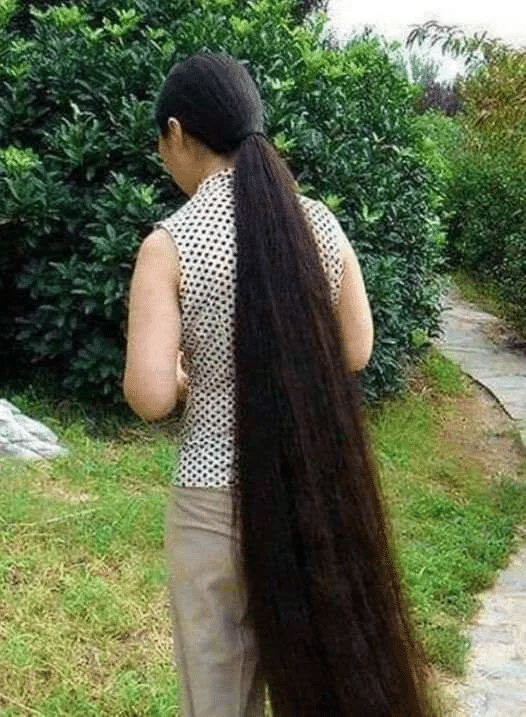
Recent social media captions often claim that Ramirez refused to cut her hair even though her husband repeatedly begged her to do so.
The available account of the original story does not establish that version.
Contemporary coverage reported that her friends had encouraged her to change her hairstyle and that the salon owner was accustomed to seeing Ramirez with the same long look. The widely circulated husband detail appears to be an added social media hook rather than a confirmed part of the original report.
The phrase “what she looks like today” can also be misleading. The makeover occurred in 2015, so images from the haircut show her appearance at that time—not necessarily her current hairstyle in 2026.
The verified story remains compelling without those exaggerations.
A woman who had not cut her hair in a quarter-century made a dramatic transformation and used the moment to support children experiencing hair loss.
A Hairstyle That Had Become Part of Her Identity
Keeping the same hairstyle for 25 years is about more than avoiding a salon appointment.
Over that length of time, hair can become deeply connected to a person’s identity. It appears in family photographs, marks different stages of life, and becomes part of how friends and relatives recognize someone.
A dramatic haircut can therefore feel emotional, even when the person has chosen it willingly.
For Ramirez, her hair had grown long enough to create practical problems. Reports said she sometimes stepped on it, and it could blow out of the car window while she was driving. Despite those inconveniences, deciding to remove several feet of hair still represented a major personal change.
The salon visit closed one chapter of her life while opening another.
Four Feet of Hair Came Off
Ramirez visited Papillon Blanc Hair and Lounge in Birmingham, Michigan, for the transformation.
The stylist first gathered and secured the long hair so it could be preserved rather than swept onto the salon floor. Approximately four feet were removed before the remaining hair was shaped into a polished bob with bangs.
The difference was immediate.
Without the extraordinary length pulling downward, her face became more visible and the shorter style created an entirely new silhouette. It was the kind of makeover that caused viewers to look twice—not because Ramirez had become a different person, but because one of her most recognizable features had changed so dramatically.
She reportedly explained that she hoped the donation would brighten the day of someone dealing with a serious illness.
Where Donated Hair Goes
Locks of Love describes its mission as providing custom hair prostheses to financially disadvantaged children affected by hair loss.
The organization distinguishes its prostheses from ordinary retail wigs. According to its official information, the custom pieces are created to fit an individual recipient and are provided without charge to qualifying children.
Recipients may experience hair loss for several reasons. Locks of Love says many live with alopecia areata, while others have lost hair because of radiation therapy, chemotherapy, burns, trauma, or genetic and dermatological conditions.
The organization’s work is not limited to cancer-related hair loss, despite the way donation stories are sometimes summarized online.
That distinction matters because childhood hair loss can have many medical causes, and each family’s circumstances are different.
One Ponytail Does Not Usually Become One Hairpiece
A common misunderstanding is that a single donor’s hair is turned directly into one wig for one specific child.
Locks of Love says approximately eight to 10 donated ponytails may be required for one hairpiece. Donors are not generally connected with individual recipients, partly because the organization protects the privacy of the children it serves.
This means Ramirez’s four feet of hair may have been combined with donations from several other people during manufacturing.
That does not reduce the value of her contribution.
Each acceptable donation becomes part of a larger collective effort. One person supplies a ponytail, another gives financial support, and specialists complete the custom prosthesis.
The final result depends on many people participating.
Current Hair Donation Rules Matter
People inspired by Ramirez’s story should review the receiving organization’s latest guidelines before scheduling a haircut.
Locks of Love currently requires a minimum of 10 inches measured from tip to tip. Hair must be clean, fully dry, and secured in a ponytail or braid before it is cut. Loose hair collected from the floor cannot be used.
Layered hair can be divided into multiple ponytails, while curly hair may be gently pulled straight for measurement. Colored and permed hair may be accepted, but bleached hair is not usable in the organization’s manufacturing process.
Gray hair can be donated, although the organization says it may be sold to help offset manufacturing expenses rather than used directly in a child’s hairpiece. Shorter hair may be handled similarly.
Because requirements vary among charities, a donor should choose an organization first and follow that group’s instructions precisely.
Why Hair Loss Can Affect Confidence
Hair is often closely associated with self-expression, privacy, culture, and personal identity.
For a child already managing a medical condition, visible hair loss may bring unwanted questions or attention. A well-fitting hairpiece cannot remove the underlying health challenge, but it may give the child greater control over how they present themselves in school, at social activities, or in public.
Locks of Love describes its goal as helping restore a sense of self, confidence, and normalcy for children living with hair loss.
That is why donation stories often resonate beyond the visual appeal of a before-and-after photograph.
The haircut may take only a few minutes.
Its potential emotional value can last much longer.
The Transformation Was Personal Too
Ramirez’s decision also illustrates how generosity and personal renewal can happen at the same time.
She did not need to dislike her long hair for the haircut to be meaningful. She could appreciate the years she had spent growing it while still deciding she was ready to let it go.
A new hairstyle can mark a change in confidence, routine, or self-perception. After 25 years with the same appearance, even ordinary daily activities—washing, drying, brushing, and styling—would have felt very different.
The shorter cut gave Ramirez a fresh look.
The donation gave the discarded length a new purpose.
A Small Decision With a Wider Impact
The most memorable part of the story is not that someone finally persuaded Ramirez to cut her hair.
It is that she decided the hair could do more than remain part of her appearance.
Rather than allowing four feet of carefully grown hair to be thrown away, she preserved it for donation. Her choice drew attention to an accessible form of charitable giving and encouraged other people to investigate whether their own hair might meet donation requirements.
Not every donor will have 25 years of growth to contribute.
They do not need to.
A qualifying donation can come from an adult, a teenager, or a child. What matters is following the organization’s instructions and understanding that donated hair is one part of a larger, carefully managed process.
The Real Reveal
Viral captions invite readers to prepare for a shocking transformation.
Ramirez did look dramatically different after the haircut. Her long hair was replaced by a short, modern bob that framed her face and made the change immediately visible.
But the appearance is only half the story.
The more meaningful reveal is what happened to the hair after it was cut.
It became a donation intended to help children coping with medical hair loss.
After 25 years, Ramirez did not simply leave the salon with a new hairstyle.
She left having transformed something deeply personal into an opportunity to support someone she might never meet.