A strange, gelatinous object photographed beneath the surface of an Oklahoma lake has left social media users asking the same question: What is that thing?
With its rounded shape, translucent body, and clusters of small patterns across the surface, the mass looks like something from a science-fiction movie. Some viewers compared it to an alien egg pod, while others worried that it might contain parasites or represent a new threat to swimmers.
The real explanation is far less frightening—and much more fascinating.
The object is a colony of freshwater animals known as bryozoans, most likely the species Pectinatella magnifica. Oklahoma wildlife officials highlighted similar colonies at McGee Creek Reservoir and reassured the public that they are harmless to people and wildlife. The agency’s message was not a danger warning; it was intended to prevent alarm when more colonies became visible during warmer weather.
It Is Not an Egg—and It Is Not a Single Creature
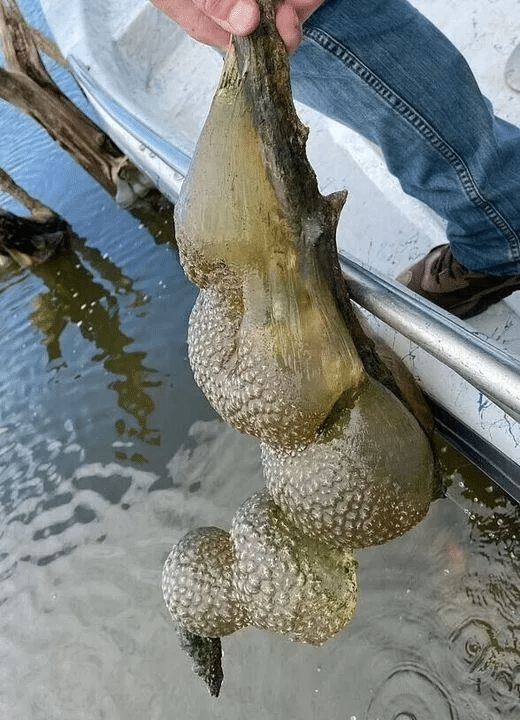
The jelly-like ball may look like one enormous organism, but it is actually a colony made up of many tiny animals.
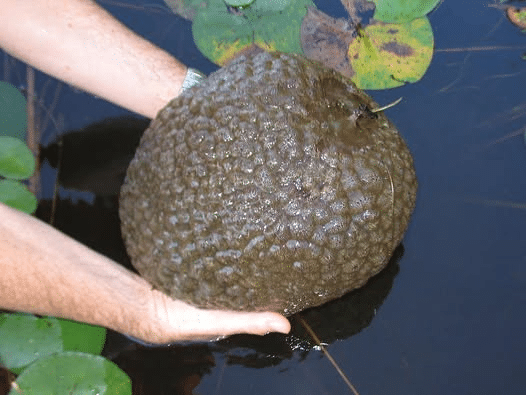
Each individual animal is called a zooid. Zooids live together and produce new members through budding, gradually building a much larger structure. Individual bryozoans can be only a few millimeters across, while the combined colony may become large enough to resemble a basketball or irregular sack beneath the water.
That distinction explains the object’s unusual appearance.
The visible mass is not filled with developing alien creatures. The patterns across its surface are groups of tiny filter-feeding animals living together inside a shared gelatinous structure.
Bryozoans are often called “moss animals,” although they are neither plants nor moss. They are aquatic invertebrates found in both marine and freshwater environments.
Why It Looks Like a Giant Jelly Ball
Freshwater bryozoan colonies can be soft, slippery, translucent, brown, greenish, or amber-colored. Their texture and shape vary according to species, age, and environmental conditions.
Pectinatella magnifica produces particularly noticeable gelatinous colonies. These masses commonly attach themselves to submerged tree branches, docks, rocks, vegetation, and other solid surfaces in calm freshwater. Some colonies remain attached, while portions may eventually become loose and float.
From a distance, the colony can resemble frog eggs, a brain, a jellyfish, or an organ from an unidentified animal.
That resemblance is why photos repeatedly go viral. Most people are familiar with fish, turtles, and aquatic plants, but they may spend years visiting lakes without ever noticing a bryozoan colony.
When one suddenly appears beside a dock or boat, its unfamiliar shape can seem almost unnatural.
What the Tiny Animals Are Doing
Bryozoans are filter feeders.
Each zooid has a crown of delicate tentacles known as a lophophore. The animal extends these structures into the surrounding water and uses them to capture microscopic food particles.
The colony therefore spends much of its time quietly filtering the water.
Bryozoans consume microscopic organisms and suspended material, while fish, insects, and snails may feed on the bryozoans themselves. This places the colonies within the wider freshwater food web.
Oklahoma officials described them as beneficial parts of the aquatic environment because they filter particles from the water and provide food for other animals.
That does not mean a bryozoan colony can single-handedly purify an entire lake. It means the organisms participate in the natural filtration and nutrient processes occurring throughout the ecosystem.
Are Bryozoans a Sign of Clean Water?
Wildlife agencies have described visible freshwater bryozoan colonies as being associated with relatively good water conditions. Oklahoma officials said the colonies observed at McGee Creek Reservoir were indicators of good environmental quality and clear water. Missouri conservation information similarly notes that their presence usually suggests good water quality.
However, the discovery of one colony should not replace formal water testing.
Water quality depends on many factors, including bacteria, chemical contamination, harmful algal blooms, temperature, oxygen levels, and runoff. A lake can contain bryozoans while still having temporary advisories or localized problems unrelated to them.
Swimmers and boaters should continue following official lake notices rather than assuming the water is safe solely because a bryozoan is present.
They Have Been on Earth for an Extraordinary Length of Time
Bryozoans are not a newly evolved organism.
Their fossil history reaches hundreds of millions of years into Earth’s past, long before humans—and before dinosaurs appeared. Ancient bryozoan fossils are common in some types of limestone, although the large gelatinous freshwater colonies seen today do not necessarily resemble all their fossil relatives.
This ancient history makes the “alien” comparison somewhat ironic.
The organisms may look unfamiliar to modern lake visitors, but their broader biological group has existed on Earth for an extraordinarily long time. What appears strange and new is actually part of an ancient lineage.
How the Colonies Survive Winter and Drought
Many freshwater bryozoan colonies grow during warmer seasons and die back when conditions deteriorate.
Before disappearing, they produce durable structures called statoblasts. These function somewhat like survival capsules or seeds, although they are not plant seeds. When conditions become favorable again, a statoblast can develop and begin a new colony.
Statoblasts can also help bryozoans disperse.
They may move through connected waterways or travel with animals, plants, boats, and other objects moving between water bodies. The U.S. Fish and Wildlife Service notes that Pectinatella magnifica may be transported by waterfowl, introduced fish, or aquatic vegetation.
This life cycle explains why colonies may seem to appear suddenly.
They were not created overnight by an unknown event. Favorable temperatures and water conditions simply allowed many small zooids to multiply until the colony became visible.
Should You Touch One?
Oklahoma officials said the colonies pose no danger to people or wildlife. They do not contain baby snakes, alien embryos, or eggs waiting to hatch.
Even so, leaving them where they are is the best approach.
Wildlife colonies should not be pulled apart merely for photographs or social media videos. Missouri conservation officials have encouraged lake visitors not to damage bryozoans because they are normal components of freshwater ecosystems.
People should also avoid handling unfamiliar aquatic material when they cannot confidently identify it. Lakes may contain sharp fishing equipment, decaying animals, harmful algae, contaminated debris, or other hazards that do not resemble bryozoans.
A clear photograph taken without disturbing the colony can be shared with a local wildlife agency, park office, or university extension service when identification is uncertain.
Are They Found Only in Oklahoma?
Bryozoans are not unique to McGee Creek Reservoir or to Oklahoma.
Freshwater species occur in lakes, ponds, wetlands, and some streams across broad geographic areas. The Missouri Department of Conservation describes them as widespread and common, although many colonies are overlooked because they remain small or hidden beneath the water.
Pectinatella magnifica is native to parts of North America but has also appeared outside its original range. Whether a species is considered native or introduced depends on the location, so lake users should rely on regional wildlife authorities for local information.
The Oklahoma colonies highlighted in the viral posts were described by state officials as native and harmless.
Why Officials Spoke Out
Headlines claiming that officials “issued a warning” can make the discovery sound dangerous.
In reality, Oklahoma wildlife officials were warning people not to panic.
The colonies were expected to become more noticeable as conditions supported their growth. Officials explained their identity before frightened residents began destroying them or spreading rumors about contamination and invasive monsters.
The distinction matters.
There was no announcement that people needed to evacuate the lake, avoid swimming because of bryozoans, or prepare for something to hatch.
The message was educational: these unusual formations are living animal colonies, they belong in the freshwater ecosystem, and their appearance is not a reason for alarm.
The Truth Behind the “Alien Egg Pod”
The strange object was not an egg pod.
It was not a newly discovered monster.
And it was not evidence of pollution or an extraterrestrial invasion.
It was a colony of thousands of tiny aquatic invertebrates living together, filtering microscopic food from the surrounding water and participating in an ecosystem that most visitors rarely see.
Its appearance may still make swimmers uncomfortable. A large, slippery mass hanging from an underwater branch is difficult to ignore, especially when someone encounters it unexpectedly.
But the object is more remarkable than frightening.
Bryozoans show that even familiar lakes contain forms of life that can remain unnoticed for years. Beneath an ordinary surface exists a complex community of microscopic animals, seasonal colonies, predators, prey, and survival structures older in evolutionary history than anything humans have built.
The next time an “alien pod” appears beneath a dock, there is no need to panic.
Leave it undisturbed, take a photograph, and appreciate one of the freshwater world’s strangest natural residents.