Mason Cole had been raised under one unusual rule: never use wealth to make people fear him.
His father, Jonathan Cole, was a billionaire businessman whose investments stretched across real estate, technology, and private finance. Yet Mason was not allowed to arrive at school in a chauffeured luxury car, wear flashy designer clothing, or use the family name to gain special treatment.
“If someone respects you only after learning who your father is,” Jonathan once told him, “then they never respected you in the first place.”
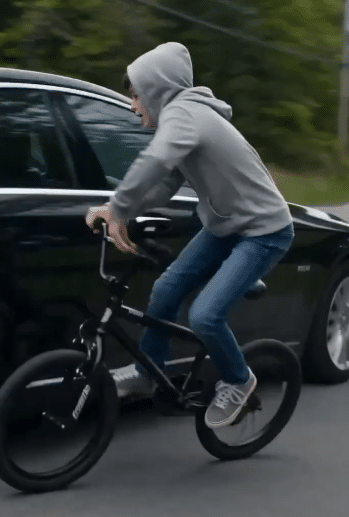
That was why Mason looked like any ordinary 15-year-old riding down Willow Road on a quiet Saturday morning.
He wore a faded gray hoodie, ordinary jeans, and simple sneakers. His black bicycle was reliable but hardly impressive. Nothing about him suggested that he lived behind guarded gates or that his father controlled one of the region’s largest investment groups.
Mason preferred it that way.
He loved Willow Road because his late mother, Evelyn, had loved it first. When Mason was young, she often brought him there in the spring to see the flowering dogwood trees beside an old stone church.
She called it “the last honest road in Fairview.”
But lately, the road had become the center of a bitter redevelopment dispute.
A Quiet Neighborhood Under Pressure
Willow Road was lined with aging houses, large trees, hand-painted mailboxes, and lawns that sloped gently toward the pavement.
Many of the residents had lived there for decades.
Developers saw something different.
They wanted to widen the road, purchase the surrounding properties, and transform the neighborhood into a commercial corridor. Elderly homeowners began receiving offers that seemed generous until attorneys examined the fine print.
Some residents were warned that their properties might soon be condemned. Others were told that selling immediately was their only way to avoid financial loss.
Jonathan had quietly begun investigating the development proposal.
Ownership records, political donations, shell companies, and questionable inspection notices repeatedly led back to one executive: Victor Kane of Northbridge Urban Renewal.
Mason knew Victor’s name, but his father had not told him the full story.
That changed on the morning a polished black sedan appeared behind Mason’s bicycle.
The Driver Did Not Pass
Mason was riding near the old church when he heard the engine.
The sedan approached quickly on the narrow two-lane road. Mason moved toward the shoulder to give the driver space.
But the car did not pass normally.
Its horn blasted.
Then it swerved toward him.
Mason pulled sharply on the handlebars. His front tire left the pavement, and the bicycle twisted beneath him.
He struck the roadside hard.
Pain shot through his hands, elbow, hip, and knee as the bike slid into the grass.
The sedan stopped several yards ahead.
Its window lowered.
A man in a perfectly tailored black suit leaned toward the opening and looked back at Mason without concern.
“Stay off the road, kid,” he said.
Mason recognized him immediately.
It was Victor Kane.
“You nearly killed me!” Mason shouted as he pushed himself upright.
Victor laughed.
“You fell off a bicycle. Don’t turn it into a legal drama.”
Mason looked at the sedan’s position and then at the empty road. There had been plenty of room to pass.
“You swerved at me.”
Victor stepped partly out of the car, revealing polished shoes and an expensive watch.
“This road is dangerous,” he replied. “That’s why it needs redevelopment.”
“People Like You Need to Move”
Victor looked at Mason’s worn hoodie and inexpensive bicycle and apparently decided the boy posed no threat.
He began lecturing Mason about progress, commercial development, and the responsibilities of “important people.”
When Mason accused him of deliberately forcing him off the road, Victor’s expression hardened.
“This road is full of obstacles,” he said. “People like you need to learn when to move.”
Mason looked past him at the old homes hidden behind the trees.
In that moment, he understood what Victor meant.
He did not see families.
He saw obstacles.
Mason reached into his pocket and removed his phone.
Victor smirked.
“What are you doing? Calling your daddy?”
Mason tapped the contact pinned at the top of the screen.
His father answered immediately.
“Dad,” Mason said, struggling to steady his voice. “I need help. I’m on Willow Road.”
Jonathan’s tone changed.
“Are you hurt?”
“No serious injury. Black sedan. The driver is Victor Kane.”
There was a brief silence.
“Stay where you are,” Jonathan said.
Four Black SUVs Arrived
Victor had heard his name.
For the first time, his confidence appeared to weaken.
But when he studied Mason again, he saw only an injured teenager beside a cheap bicycle.
He pulled a business card from his pocket and tossed it toward the road.
“Tell your parents to contact my assistant if they want compensation for the bike.”
“You’re not leaving,” Mason said.
Victor took a step toward him.
“You have no idea how badly this could end for your family.”
Before Mason could respond, an engine sounded from the north.
A black SUV rounded the bend.
Another arrived from behind Victor’s sedan.
Then two more approached from the opposite direction.
The four vehicles surrounded the black car without touching it.
Their doors opened, and several professionally dressed security officers stepped onto the road.
The man leading them was Daniel Cross, head of security for the Cole family.
Daniel approached calmly.
“Step away from the vehicle, Mr. Kane.”
Victor tried to recover his authority.
“Who authorized this?”
“I did,” Daniel replied.
Victor pointed toward Mason and claimed the boy had caused the accident by riding carelessly.
Daniel looked at Mason’s scraped hands, the damaged bicycle, and the position of Victor’s vehicle.
Then he explained that distress calls made from Cole family phones automatically preserved emergency audio. The security vehicles were also recording the scene.
Victor went still.
“Who is this kid?” he asked.
Daniel’s expression did not change.
“The chairman’s son.”
Victor’s Apology Came Too Late
The meaning of those words struck Victor immediately.
Mason was Jonathan Cole’s only son.
More importantly, Cole Meridian Group was scheduled to decide whether to finance Northbridge’s redevelopment project.
Victor’s face lost its color.
A fifth vehicle arrived several minutes later.
Jonathan stepped out wearing a white shirt with the sleeves rolled to his elbows. He ignored Victor and walked directly to Mason.
“Look at me,” he said, gently checking his son’s face and injuries. “Are you all right?”
Mason nodded.
Jonathan’s voice softened.
“You called. You did exactly what you were supposed to do.”
Victor stepped forward.
“Mr. Cole, this is a misunderstanding. I had no idea he was your son.”
Jonathan turned toward him.
“That is exactly the problem.”
Victor blinked.
“You are not sorry that you forced a child off the road,” Jonathan continued. “You are sorry that the child belonged to me.”
Daniel displayed footage from one of the arriving vehicles. The recording showed Victor’s sedan cutting toward Mason, the bicycle leaving the pavement, and the boy falling.
Victor could no longer dismiss the incident as an accident.
But Jonathan was not finished.
The Incident Reopened an Old Wound
Jonathan removed a faded photograph from his coat.
It showed Mason’s mother, Evelyn, standing beside a Willow Road mailbox years earlier.
Before marrying Jonathan, she had grown up in the neighborhood. Her father had worked for the county, and her mother had been a school librarian.
Sixteen years earlier, Evelyn had discovered that companies connected to Northbridge were pressuring vulnerable homeowners to sell properties below their true market value.
She collected suspicious letters, inspection notices, property records, and details about shell buyers.
Then she submitted the evidence to a county attorney.
The complaint disappeared.
Shortly afterward, Evelyn was nearly forced off Willow Road by a black sedan.
At the time, there was not enough proof to identify the driver.
But Jonathan had never stopped investigating.
The old vehicle had been registered to a company tied to Victor.
More recently, Victor’s former executive assistant, Laura Finch, had agreed to cooperate with investigators. She had preserved copies of payments, redevelopment documents, political donation records, and instructions targeting residents who lacked legal representation.
Victor argued that Laura had signed a confidentiality agreement.
Jonathan responded with one sentence.
“A confidentiality agreement does not protect criminal conduct.”
Police Arrived With More Than One Question
Sheriff’s deputies soon arrived.
Jonathan did not demand that they arrest Victor because of his wealth or influence. Instead, he provided the emergency recording, vehicle footage, witness statements, and documents connected to the larger investigation.
Victor tried to describe the incident as an unfortunate misunderstanding.
His language became polished and cautious. He used terms such as “accidental,” “mischaracterized,” and “unintentional.”
But the video told a different story.
As a deputy placed him in a patrol car, Victor looked at Mason.
“You have no idea what you started,” he said.
Mason stepped closer.
“No,” he replied. “You don’t.”
The Investigation Expanded
Within days, investigators began examining Northbridge Urban Renewal’s internal records.
The evidence led to county officials, staged safety complaints, questionable zoning decisions, and fake inspection notices.
Several homeowners had been pressured to sell their properties for far less than their market value. Some had been warned that refusing to cooperate could result in fines, condemnation, or forced displacement.
The Willow Road redevelopment vote was suspended.
Cole Meridian withdrew its potential investment.
Victor resigned from Northbridge, but the decision did not stop the criminal investigation.
He eventually faced allegations involving reckless endangerment, real estate fraud, intimidation, bribery, and conspiracy.
Investigators also reopened the old complaint filed by Evelyn.
Inside a county archive, they discovered a handwritten note from her.
It read: “If anything happens to me, look at Victor Kane.”
When Mason read the note in his father’s office, his hands began shaking.
“Why didn’t you tell me?” he asked.
Jonathan looked exhausted.
“Because I wanted you to have a childhood before you inherited our grief.”
Mason carefully folded the note.
“She tried to warn them.”
“Yes,” Jonathan said. “But no one listened.”
“Then we make them listen now.”
The Boy in the Gray Hoodie Took the Stand
Victor’s trial lasted nearly two weeks.
Prosecutors presented the traffic footage, company records, testimony from Laura Finch, and statements from Willow Road residents.
An elderly veteran described receiving fake condemnation notices.
A widowed mother testified that she had been told her home was structurally unsafe, even though no legitimate inspector had entered it.
A retired teacher explained how she had signed documents she did not fully understand because representatives warned that waiting would cost her everything.
Finally, Mason testified.
The defense attorney attempted to portray him as a privileged teenager seeking attention.
“Isn’t your life very different from the lives of Willow Road residents?” the attorney asked.
“Yes,” Mason replied.
The attorney smiled, believing the answer helped his case.
But Mason continued.
“That is why what happened to me matters.”
The courtroom became silent.
“When Victor Kane thought I was nobody, he treated me like nobody. He frightened me, mocked me, and threatened my family. He only became afraid after he learned my last name.”
Mason looked toward the jury.
“This case is not about me being important. It is about everyone he hurt because he believed they were not.”
Willow Road Was Finally Protected
Victor was convicted on the central charges against him. Two county officials were also held accountable, and Northbridge Urban Renewal was dissolved.
A restitution fund was established for affected homeowners.
Not every family recovered everything it had lost. Some people had already moved, spent their savings on legal fees, or sold homes filled with decades of memories.
But the remaining residents no longer felt as though they were waiting to be erased.
The county approved protections for Willow Road, and the old stone church was transformed into a community legal center.
A sign outside carried Mason’s mother’s name:
Evelyn Reed Cole Justice Center
The organization offered free legal assistance to families facing housing intimidation, wrongful displacement, and predatory real estate practices.
Jonathan provided the funding.
Laura Finch became the center’s records director.
Mason volunteered there on Saturdays.
He usually arrived on a bicycle.
“I Feel Like a Witness”
On the day Victor was sentenced, reporters gathered outside the courthouse.
One journalist asked Mason whether he considered himself a hero.
Mason thought about the residents who had suffered before anyone powerful paid attention. He remembered his mother’s note, his fall on the pavement, and Victor’s laughter when he believed Mason was an ordinary child.
“No,” Mason answered. “I feel like a witness.”
“A witness to what?” the reporter asked.
Mason looked beyond the cameras.
“To what happens when the people you tried to frighten finally get heard.”
Later that afternoon, Mason rode down Willow Road again.
When a vehicle approached from behind, it slowed, gave him space, and passed carefully.
Near the old church, Mason stopped beside the sign bearing his mother’s name.
Daniel Cross stood nearby, pretending he had not followed from a distance.
“Your father said 20 minutes,” Daniel reminded him.
“It has only been 19,” Mason replied.
Daniel looked at the road and then at the teenager who had helped expose a system built on fear.
“One more minute,” he said.
For years, Victor Kane believed Willow Road belonged to whoever possessed enough money to purchase, threaten, or destroy it.
He had been wrong.
Some roads belonged to the families who built their lives there.
Some belonged to memory.
And some belonged to the boy in the faded gray hoodie who finally made the powerful pull over.


