Sorting through a grandparent’s belongings can feel like opening a doorway into another era. Some objects are immediately recognizable: family photographs, handwritten recipes, old furniture, jewelry, or tools that were used around the house for decades.
Other discoveries are far more puzzling.
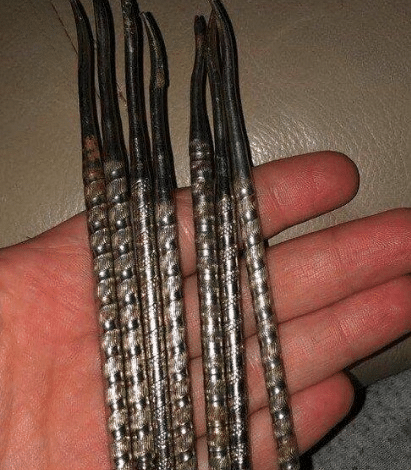
That is what happened when a man began going through several boxes left behind by his grandparents. Mixed among gardening equipment, household supplies, and old hand tools were a few unusual objects that no one in the family could identify.
Each one appeared to have a long wooden handle attached to a small rounded cage made from flexible metal wires. At first glance, they looked a little like cocktail stirrers, kitchen whisks, or perhaps tools used for arranging flowers.
But none of those explanations seemed quite right.
The wooden handles showed signs of frequent use, and the metal cages were scratched and slightly worn. Whatever these objects were, they had probably served a practical purpose for many years.
After comparing them with older household and agricultural tools, the most likely answer emerged: they were vintage nut gatherers, also called nut pickers or rolling nut collectors.
Without seeing the original objects, that identification cannot be guaranteed. However, the described combination of a long handle and flexible wire basket closely matches tools designed to collect fallen nuts from the ground.
What Is a Nut Gatherer?
A nut gatherer is a simple hand-operated tool used to pick up walnuts, pecans, chestnuts, acorns, and other small objects without requiring the user to bend down repeatedly.
Traditional versions typically include a wooden or metal handle connected to a round or oval wire basket. The wires are flexible enough to separate when rolled or pressed over a nut.
As the basket passes over the object, the wires spread slightly and allow it to enter. They then return to their original position, trapping the nut inside.
Once the basket is full, the user opens the wires or empties the contents into a bucket.
The design requires no electricity, motor, battery, or complicated mechanism. It relies entirely on movement and the natural spring tension of the wire.
That simplicity is one reason the tool remained useful for generations.
Why Families Once Needed Specialized Tools Like This
Today, most consumers buy nuts already shelled, cleaned, weighed, and packaged at a grocery store. Because of that convenience, many people never think about how much work goes into collecting them.
In earlier generations, particularly in rural communities, families often harvested food directly from their property. A walnut, chestnut, hazelnut, or pecan tree could provide a valuable seasonal food supply.
Gathering those nuts by hand was slow and physically demanding.
A person might spend hours bending, squatting, and reaching toward the ground. The task became especially uncomfortable for older adults or anyone with back, hip, or knee problems.
A rolling nut gatherer solved much of that problem. The user could remain upright while moving across the yard or orchard, collecting far more nuts with less strain.
For families that depended on homegrown food, a tool like this was not a novelty. It was a practical part of household life.
The Design Reflects an Era of Practical Engineering
Many older tools were created to perform one narrow job extremely well.
They did not include digital controls or disposable parts. Instead, manufacturers relied on durable materials and straightforward mechanical principles.
Vintage nut gatherers often featured:
- Solid wooden handles
- Springy metal wires
- Lightweight construction
- Replaceable or repairable components
- Few moving parts that could break
Because of that sturdy construction, many examples remain usable decades after they were made.
The worn handle on an inherited tool may reveal where the owner’s hand rested year after year. Scratches on the wire basket may come from repeated contact with soil, stones, roots, and tree debris.
Those details transform the object from an ordinary tool into a physical record of someone’s daily life.
Why They May Look Like Cocktail Tools
Someone unfamiliar with agricultural equipment could easily mistake a small nut picker for a kitchen utensil or drink accessory.
The wire basket resembles the shape of a whisk, strainer, or novelty cocktail stirrer. Smaller handheld versions may be particularly confusing because they lack the long pole seen on modern rolling collectors.
Some antique designs were also used for retrieving nuts from bowls, removing food from hot liquids, or reaching into narrow spaces. As a result, not every wire-cage tool has exactly the same purpose.
The size provides an important clue.
A long-handled model with a basket wide enough to roll across the ground was likely intended for outdoor harvesting. A short handheld model may have been used at a table, in a kitchen, or for another specialized task.
Marks, labels, patent numbers, or a manufacturer’s name can help confirm the identification.
How to Examine an Unfamiliar Antique Tool
Before cleaning, repairing, or discarding an inherited object, inspect it carefully.
Look for stamped words on the metal, engraved letters on the handle, or numbers that could correspond to a patent. These markings may be faint, so examine the object under strong light.
Measure the overall length and the width of the wire basket. Consider whether the cage rotates freely, compresses when pressed, or opens at a particular point.
The wear pattern can also provide clues. Dirt and scratches near the outer wires suggest ground use, while food residue or discoloration may indicate a kitchen application.
Photographs from several angles can be shared with antique-tool collectors, agricultural museums, local historical societies, or online identification communities. Including measurements and close-up images of markings usually produces better answers than showing only one distant picture.
Avoid aggressive polishing until the object has been identified. Removing patina, paint, labels, or surface markings can reduce both its historical interest and possible collector value.
Are Antique Nut Gatherers Valuable?
Most old household tools are more valuable as family keepsakes than as expensive collectibles.
The market value of a nut gatherer depends on its age, condition, manufacturer, rarity, and whether it has an unusual patented design. A common example in worn condition may sell for a modest amount, while a rare branded model could attract more interest from collectors.
But financial value is only one way to view the discovery.
An inexpensive tool may have been used by a grandparent every autumn for decades. It may have helped gather food for holiday recipes, preserves, baked goods, or extra household income.
That history cannot be measured only by an online sale price.
Before selling or donating inherited objects, families may wish to record where they were found and any stories older relatives remember about them. Even a short written note can preserve context that would otherwise disappear.
Modern Versions Still Exist
Although the antique form may look unfamiliar, the basic invention has not vanished.
Modern rolling nut collectors are still used by gardeners, orchard owners, landscapers, and homeowners. Some are designed for larger walnuts and fruit, while others collect pecans, acorns, golf balls, pine cones, or even small debris.
Newer models may include metal poles, adjustable handles, unloading brackets, or baskets made for specific object sizes.
The continued use of the design proves how effective the original idea was. A tool created generations ago still performs the same task with very little modification.
More Than an Old Piece of Metal
Once the objects were recognized as likely nut gatherers, their worn appearance began to tell a different story.
Perhaps the grandparents had nut trees on their property. Perhaps they gathered walnuts or pecans every year and stored them for winter. Maybe the tools were used by several family members during seasonal harvests.
What initially seemed like a collection of strange wire gadgets became a connection to work, tradition, and self-reliance.
That is often the most rewarding part of identifying an old object.
The answer does more than explain how it functioned. It reveals something about the people who kept it.
The Bottom Line
Based on the description, the mysterious wooden-handled tools with flexible wire cages were most likely antique nut gatherers or nut pickers.
They were designed to collect fallen nuts while reducing the need to bend down repeatedly. Their simple wire mechanism allowed nuts to enter the basket and remain trapped until emptied.
The precise identification would still require a clear photograph, measurements, and any visible markings. Similar wire tools were produced for several household and agricultural uses.
Whatever their exact model, they appear to represent a style of practical engineering that earlier generations relied upon every day.
Sometimes an unfamiliar object inherited from a grandparent is not merely clutter from the past.
It is evidence of how that person worked, lived, and solved ordinary problems long before modern convenience changed the routine.


