Observant passengers may notice flight attendants sitting in an unusually rigid position during takeoff and landing. They are secured in fold-down jumpseats, their backs are upright, their feet are planted firmly on the floor, and their hands may appear to be tucked beneath their thighs.
It can look uncomfortable or even slightly strange. Some travelers assume the crew members are cold, nervous, or simply resting their hands.
The real explanation is connected to aviation safety.
Placing the hands beneath the thighs is one version of a protective seated position used by some airlines. It helps keep the arms close to the body and limits uncontrolled movement if the aircraft experiences a sudden stop, impact, or severe jolt.
However, the viral claim that cabin crew always sit on their hands is not completely accurate. The required position varies according to the airline, aircraft, direction of the jumpseat, and type of restraint system installed.
It Is a Form of Protective Bracing
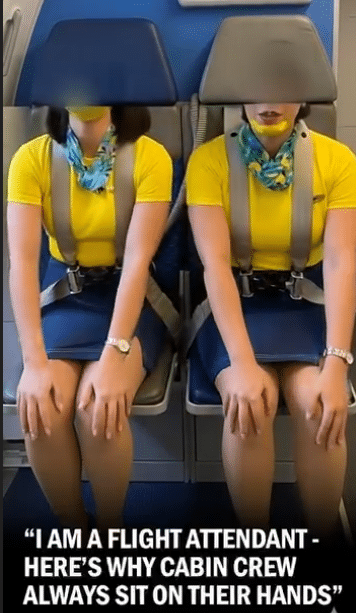
Cabin crew members do not sit in ordinary passenger seats during takeoff and landing. They normally occupy designated jumpseats equipped with lap belts and shoulder harnesses.
These seats are often located beside emergency exits because flight attendants must be positioned where they can respond quickly if an evacuation becomes necessary. Current U.S. regulations require flight attendants to be distributed near floor-level exits during takeoff and landing to support the most effective possible evacuation. Their assigned seats must also have appropriate restraints, which are secured during these phases of flight.
The protective position is designed to keep the crew member’s body supported and controlled.
Some airlines instruct crew members to sit upright with their backs and heads firmly against the jumpseat, place their feet flat on the floor, keep their knees positioned appropriately, and tuck their hands under their thighs with their palms facing upward.
Containing the hands in this way may reduce the possibility of the arms moving uncontrollably during sudden deceleration. It can also discourage someone from instinctively reaching for a nearby object or grabbing the restraint harness.
The broader goal of bracing is to limit uncontrolled movement, commonly described as flailing, and reduce the risk of secondary injuries during an impact. FAA brace-position guidance specifically considers the position of the arms, legs, head, and torso because each can affect how the body responds to sudden forces.
Not Every Airline Uses the Same Hand Position
The “sitting on their hands” explanation has become popular on social media, but it should not be treated as a universal aviation rule.
FAA guidance for flight attendants describes several positions based on the direction of the jumpseat and the type of shoulder harness. For a forward-facing jumpseat, the agency advises sitting upright, lowering the chin toward the chest, placing the hands in the lap, and keeping the feet flat on the floor with the knees bent at approximately 90 degrees.
For an aft-facing jumpseat, the recommended position includes sitting upright with the head against the headrest, the hands in the lap, and the feet firmly on the floor.
Older FAA guidance also allows flight attendants’ hands to remain in the lap or hold the sides of the seat, while warning against gripping the restraint system.
That means passengers may see several variations:
- Hands tucked beneath the thighs
- Hands resting flat in the lap
- Hands holding approved parts of the seat
- Chin lowered on a forward-facing jumpseat
- Head pressed against the headrest on an aft-facing seat
The correct version is the one included in that airline’s approved training and operating procedures.
Why the Direction of the Jumpseat Matters
Aircraft forces do not affect every seated person in exactly the same way. The direction a seat faces influences which part of the body is supported during sudden deceleration.
A flight attendant sitting in a forward-facing jumpseat may be instructed to lower the chin toward the chest. This position helps control the head while the shoulder harness restrains the upper body.
A crew member in an aft-facing jumpseat can usually place the head directly against the headrest. During forward deceleration, the seat back supports more of the occupant’s body.
The FAA therefore states that a flight attendant’s appropriate brace position depends on both the seat’s orientation and its restraint system. The belts should be worn tightly and positioned correctly so they can restrain the pelvis and upper torso effectively.
The posture is not chosen because one position looks more professional than another. It is based on how the seat, harness, and human body interact under force.
Why Flight Attendants Use Jumpseats
Jumpseats are compact because cabin space is limited, but they are not merely folding chairs installed for convenience.
A required flight-attendant seat must meet aviation safety standards and include a restraint system designed for the occupant’s pelvis, chest, and shoulders. The harness typically uses two shoulder straps connected to a single release point so the crew member can remain secured and still exit the seat quickly when necessary.
The locations of these seats also support the crew’s emergency duties. Flight attendants are not on board primarily to serve drinks or meals. Their central responsibility is passenger safety, including responding to smoke, fire, decompression, medical events, rejected takeoffs, emergency landings, and evacuations.
During takeoff and landing, they must be secured yet positioned to move quickly once the aircraft stops and circumstances permit.
Does the Position Mean the Crew Expects an Emergency?
No. Seeing cabin crew sitting rigidly with their hands tucked away does not mean something is wrong with the aircraft.
It is a routine precaution performed during normal operations. In the same way that passengers fasten their seat belts and place their seat backs upright, flight attendants secure themselves according to established procedures.
A smooth flight does not eliminate the need for preparation. Safety procedures are designed to be followed consistently rather than introduced only when danger becomes obvious.
The posture allows crew members to be physically prepared without alarming passengers. It also reduces the need to change position suddenly if an unexpected event occurs during takeoff or landing.
Should Passengers Sit on Their Hands Too?
Passengers should not automatically copy the cabin crew’s position.
Passenger seats and jumpseats are different. Most economy-class seats have a lap belt but no shoulder harness, while flight-attendant jumpseats generally include upper-body restraints. Seat spacing, seat orientation, and nearby structures also influence the safest passenger brace position.
FAA guidance for forward-facing passenger seats may instruct travelers to bend forward, position their heads appropriately, and place their hands near their lower legs rather than against the seat in front. The recommended posture can change depending on available space and the type of seat.
The safest approach is to study the aircraft-specific safety card and follow the crew’s instructions. During an emergency, flight attendants may use brief commands such as “brace,” “heads down,” or “stay down.” Those instructions should be followed immediately.
Do not assume that a posture seen in an online video is suitable for every passenger or aircraft.
Why This Small Detail Matters
The hand position is easy to overlook, but it reveals how carefully routine aviation procedures are designed.
Cabin crew training addresses more than opening doors and demonstrating seat belts. Flight attendants learn how to use jumpseat restraints, protect themselves during an impact, issue emergency commands, operate exits, assess hazards, and direct passengers away from danger.
Keeping the hands contained is only one part of that larger safety system.
The next time you see a flight attendant sitting upright with their hands beneath their thighs, there is no reason to worry. They are not hiding something, performing a superstition, or signaling that the flight is in danger.
They are following a protective procedure intended to keep them secured, reduce unnecessary body movement, and leave them physically capable of assisting passengers after an emergency.
And depending on the airline and aircraft, the crew member beside another exit may be using a slightly different—but equally deliberate—position.


