Most of us use the same household objects for years without examining how they were designed. We open bottles, measure furniture, clip our nails, cook dinner, and drive our cars without giving much thought to the tiny holes, arrows, grooves, and slots built into the tools around us.
Yet many of those small details are not decorative. They often make an item easier to carry, store, manufacture, or use.
One familiar example recently sparked a lively discussion online: the small circular hole found at the end of many nail clippers. Some people admitted they had never noticed it. Others had seen it countless times but assumed it served no real purpose.
The explanation is simpler than many of the dramatic theories shared online.
Why Nail Clippers Have a Small Hole
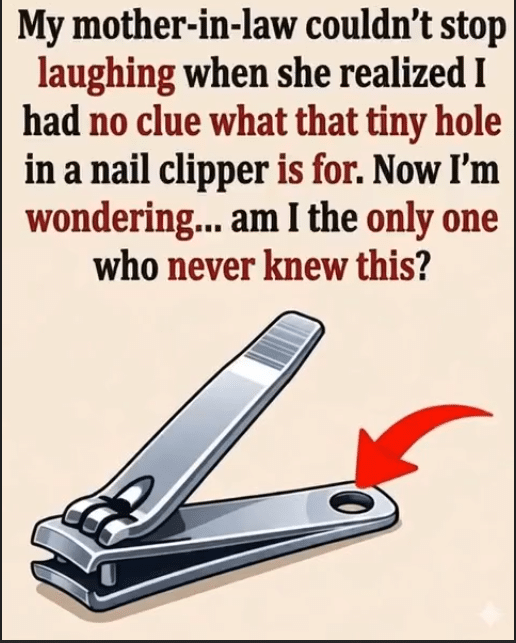
On many nail clippers, the hole near the back can be used as an attachment point. A small chain, key ring, cord, or lanyard can be passed through it, making the clipper easier to store or carry.
This can be particularly useful while traveling. Nail clippers are small enough to disappear inside a toiletry bag, bathroom drawer, or suitcase pocket. Attaching one to a key ring or hanging loop helps keep it visible and prevents it from being misplaced.
Some compact grooming kits even include a tiny chain already connected through the hole.
The opening may also be useful during manufacturing or product handling. Depending on how a particular clipper is produced, holes and cutouts can help machinery hold, align, hang, or move metal components during assembly and finishing.
However, not every manufacturer uses exactly the same process. It is more accurate to say the hole can serve practical attachment and production purposes than to claim every nail clipper was created according to one universal design plan.
What the Hole Does Not Do
Whenever a small household feature becomes popular online, creative explanations quickly appear.
Some people claim the hole catches nail clippings. It does not. Since it is located at the back of the tool, it cannot stop clippings from flying away from the cutting blades.
Others describe it as a thumb grip. While someone could hold the clipper in many different ways, the hole is generally too far from the lever to provide meaningful pressure during normal use.
It has also been described as a tool for bending wire or repairing jewelry. People may certainly repurpose it, but nail clippers are not designed as precision jewelry tools. Using them for jobs involving hard wire could damage the clipper or cause an injury.
The simplest explanation remains the most practical: it offers a convenient place to attach or hang the tool.
And nail clippers are not the only everyday items hiding useful design details.
The Moving Hook on a Measuring Tape
Look closely at the metal hook on the end of a retractable measuring tape. You may notice that it moves slightly.
Many people assume the hook has become loose, but the movement is intentional. It helps compensate for the thickness of the hook when taking different kinds of measurements.
When the hook catches around the outside edge of an object, it pulls outward. When the tape is pressed against an inside surface, the hook slides inward. That small movement helps keep both types of measurements more consistent.
Some measuring-tape hooks also include a slot that can fit over the head of a nail or screw. This allows one person to secure the end of the tape before measuring a longer distance.
Certain models have a slightly serrated lower edge as well. That edge may be used to make a temporary scratch mark on wood or drywall when a pencil is unavailable. It should be used carefully, however, because the metal tip can damage finished surfaces.
The Arrow Beside Your Car’s Fuel Gauge
One of the most useful hidden features appears directly in front of many drivers.
Next to the fuel-pump symbol on the dashboard, there is often a small triangular arrow. The arrow points toward the side of the vehicle where the fuel door is located.
An arrow pointing left generally means the fuel door is on the driver’s side. An arrow pointing right indicates that it is on the passenger side.
This feature is especially convenient when driving a rental car, borrowing someone else’s vehicle, or switching between family cars. Instead of leaning out the window or guessing at the gas station, drivers can simply check the instrument panel.
It is a tiny feature, but it prevents an awkward and surprisingly common mistake.
The Hole in a Pot or Pan Handle
Many pots and pans have a hole at the end of the handle. Its most obvious purpose is storage. The cookware can be hung from a wall rack, ceiling fixture, or kitchen hook.
Some people also use the opening as a temporary holder for the handle of a wooden spoon or spatula. Depending on the shape of the cookware and utensil, this can position the spoon above the pan and allow drips to fall back into the food rather than onto the countertop.
This method does not work with every pot, and it can leave the handle warm or messy. A proper spoon rest is often more stable. Still, the trick can be useful when the opening and utensil fit securely.
The detail shows how a simple storage feature can sometimes have a second practical use.
The Disc Inside a Plastic Bottle Cap
When you remove the cap from some soda or water bottles, you may notice a thin plastic or rubber-like liner inside it.
That small disc helps form a tight seal between the cap and bottle opening. In carbonated drinks, the seal helps prevent gas from escaping too quickly. It can also reduce leakage and protect the contents from outside contamination.
Without a proper seal, a carbonated drink could lose its fizz faster, and liquids might leak when the bottle is transported or stored on its side.
It may look like an insignificant piece of plastic, but it performs an important packaging function.
The Tiny Pocket on a Pair of Jeans
The small pocket inside the front pocket of many jeans was not originally designed for coins, wireless earbuds, or decorative purposes.
It is commonly associated with the watch pocket found on early jeans. Workers could use it to protect a pocket watch while keeping the item within easy reach.
Pocket watches are no longer part of most people’s daily routines, but the tiny pocket has remained. Today, people use it for coins, keys, guitar picks, small tools, or anything else that fits.
The feature survived because it became part of the familiar appearance and identity of denim jeans.
The Hole in a Spaghetti Spoon
Many pasta-serving spoons have a circular opening in the middle. The hole allows water to drain while pasta is lifted from a pot.
It is also sometimes promoted as a rough guide for measuring one portion of dry spaghetti. A bundle that fits through the opening may represent an approximate serving.
However, spoon sizes vary, and people have different nutritional needs and appetites. The opening should not be treated as an exact measuring instrument. A kitchen scale or package instructions will provide a more consistent portion.
Still, it is another example of a feature that may offer more than one use.
Why These Details Matter
Thoughtful design does not always announce itself. Often, the best features are the ones people use instinctively without realizing how much planning went into them.
A tiny hole can make a tool easier to carry. A moving hook can improve a measurement. A small dashboard arrow can save time at a gas station. A bottle-cap liner can keep a drink sealed and fresh.
These details can also help consumers use products more efficiently and avoid unnecessary purchases. Understanding the tools already available at home can support better organization, reduce waste, and make routine household maintenance easier. Those small savings may seem minor, but practical habits often contribute to smarter personal finance and home management over time.
The next time you pick up a familiar object, take a closer look.
Examine the seams, openings, tabs, arrows, and grooves. Some may be part of the manufacturing process, while others may improve storage, safety, or everyday use.
Not every viral explanation is accurate, and not every design has one universal purpose. But many ordinary objects contain clever features hiding in plain sight.
Sometimes, the smallest detail reveals the most interesting story.


