What began as a standard live report quickly turned into a shocking moment seen around the world.
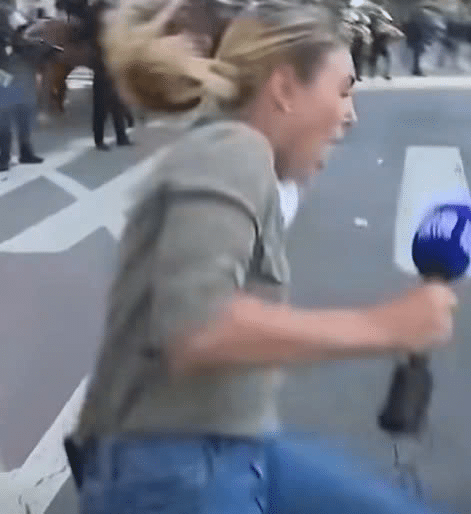
Lauren Tomasi, a correspondent for 9News Australia, was covering escalating immigration protests in downtown Los Angeles when she suddenly became part of the story herself—after being struck by a rubber bullet during a live broadcast.
The incident, captured on camera, has since sparked widespread concern about journalist safety and the risks of reporting in volatile environments.
Tensions Escalate in Los Angeles
The protests erupted in response to renewed immigration enforcement policies linked to Donald Trump, drawing thousands of demonstrators into the streets.
What started as peaceful gatherings quickly intensified over the weekend. Major roads were blocked, confrontations with law enforcement increased, and the situation grew increasingly unpredictable.
Authorities responded with a significant show of force, including riot police and the deployment of approximately 2,000 National Guard troops—an action that drew criticism from Gavin Newsom.
The Moment Everything Changed
During her live segment, Lauren Tomasi stood just meters away from a line of police officers, calmly describing the rapidly evolving situation.
Then, without warning, an officer behind her fired a rubber bullet.
The projectile struck her in the leg.
Tomasi cried out in pain, instinctively grabbing her leg as the camera quickly shifted and her crew moved to safety. A voice off-camera shouted in disbelief, calling out the fact that a reporter had been hit.
Despite the shock, Tomasi quickly reassured her team.
“I’m okay,” she repeated, even as the situation remained chaotic.
Global Reaction and Political Response
The footage spread rapidly across social media, drawing attention from journalists, press freedom organizations, and political leaders worldwide.
Australia’s Prime Minister, Anthony Albanese, described the incident as “horrific” after speaking directly with Tomasi.
He emphasized that journalists must be able to perform their duties without being targeted, especially when clearly identifiable as members of the media.
“There was no ambiguity,” he stated, noting that Tomasi was visibly reporting with a microphone and camera crew.
The Reality of Reporting in Conflict Zones
At the time of the incident, Tomasi was not wearing protective gear—something not uncommon for journalists covering fast-moving events where mobility and immediacy are critical.
Moments before the shooting, she had already been navigating a tense environment filled with:
- Flash-bang explosions
- Shouting protesters
- Police commands
- Physical interference from individuals in the crowd
This highlights a growing reality in modern journalism: even in democratic societies, covering protests can carry significant physical risk.
The Broader Issue: Press Safety Under Pressure
Nonlethal weapons like rubber bullets are designed for crowd control—but they are not harmless. When used at close range, they can cause serious injury.
Incidents like this raise important questions:
- Are journalists being adequately protected during protests?
- Are law enforcement protocols being followed when media are present?
- How can accountability be ensured in chaotic situations?
Press freedom advocates argue that protecting journalists is essential to maintaining transparency, especially during moments of public unrest.
Aftermath and Ongoing Investigation
Following the incident, Tomasi confirmed she was physically okay, though shaken.
Local authorities reported multiple arrests connected to the protests, though no immediate comment was made regarding the shooting of the journalist.
The situation remains part of a larger conversation about the balance between law enforcement, public safety, and the role of the media in documenting events as they unfold.
Final Thoughts
What happened to Lauren Tomasi is a stark reminder of the risks journalists face every day.
In just seconds, a live report turned into a global headline.
And in that moment, one truth became clear:
Telling the story can sometimes mean becoming part of it.


