Some lives seem to hold more than one century inside them.
The woman in these photographs was born before talking pictures had fully transformed Hollywood. She worked on two of the most celebrated movies released in 1939, danced on the grand soundstages of Metro-Goldwyn-Mayer, and witnessed the studio system during its most glamorous years.
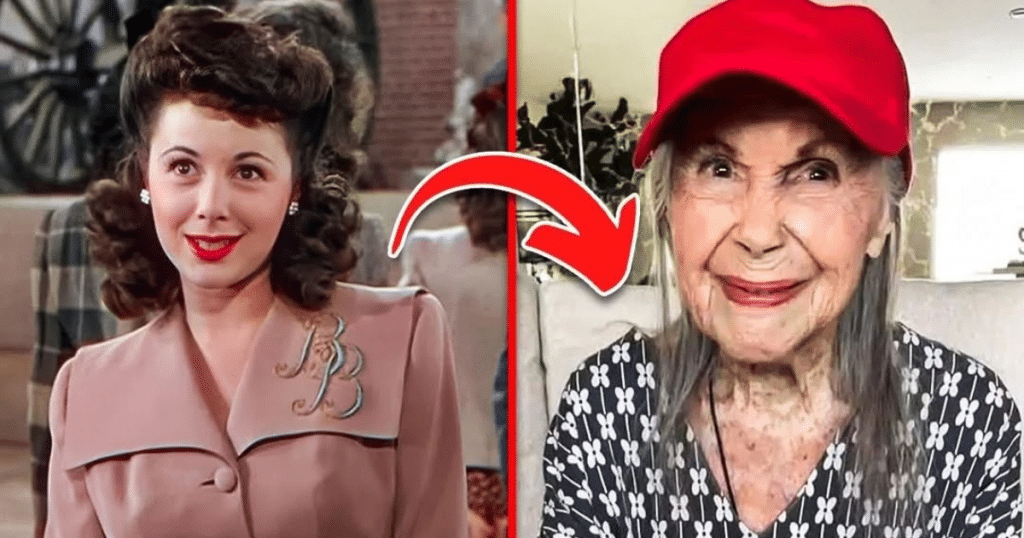
Then, just as she was building a life beyond the movie business, she survived a devastating plane crash that nearly ended her ability to walk—much less dance.
The remarkable woman is Caren Marsh Doll, the actress, dancer, and longtime instructor best remembered as one of Judy Garland’s stand-ins during the making of The Wizard of Oz.
Born on April 6, 1919, she celebrated her 107th birthday in 2026. Her extraordinary journey has made her one of the last living connections to the working world of Hollywood’s Golden Age.
A Childhood Close to the Movie Capital
Caren Marsh Doll was born Aileen Betty Morris in Los Angeles, at a time when Hollywood was still developing into the motion-picture capital of the world.
Movies were rapidly evolving. Silent pictures had made stars out of expressive performers who communicated without spoken dialogue, but sound was beginning to change everything. By the time Caren reached adulthood, studios were producing lavish musicals, romantic dramas, westerns, and colorful fantasies for audiences across America.
She graduated from Hollywood High School in 1937 and hoped to enter the entertainment business. Her parents reportedly wanted her to continue her education, but Caren was determined to see whether she could find professional work.
Video: Remember Caren Marsh-Doll? This Is What She Looks Like Now
Her first opportunity came through dance.
An often-repeated story from her early career tells how she auditioned for the musical Rosalie but was initially rejected. Rather than quietly accepting the decision, she changed her clothes, returned, and auditioned again in the hope that the casting team would not recognize her.
The second attempt worked.
That combination of persistence and good humor would appear repeatedly throughout her life.
The Unseen Work That Made Movie Magic Possible
Modern audiences often think of a stand-in as someone who performs dangerous stunts or replaces an actor in a finished scene.
On a major studio production, however, stand-ins also performed essential work away from the camera.
While the star rested, changed costumes, rehearsed elsewhere, or prepared for the next scene, a person of similar height and build would take the star’s position on the set. Camera crews used that stand-in to arrange framing, focus, shadows, and lighting.
It could require long hours of patiently repeating movements while technicians adjusted heavy equipment.
Caren’s size and appearance made her a suitable match for Judy Garland. MGM hired her to assist during the production of The Wizard of Oz, the Technicolor fantasy that would eventually become one of the most beloved films in American history.
Video: Caren Marsh Doll – A Life Through Time
Caren later remembered walking along the Yellow Brick Road repeatedly while the crew prepared cameras and lighting. Audiences did not see most of that work, but it helped create the polished images that appeared on screen.
A stand-in was expected to remember positions, movements, and timing. Small changes could affect the appearance of an entire scene.
There were no digital tools to correct every lighting problem afterward. Much of the visual magic had to be carefully arranged before the film moved through the camera.
For viewers accustomed to computer-generated environments, it can be difficult to imagine how physical the old studio system was.
Artists painted enormous backgrounds.
Carpenters built roads, houses, forests, and palaces inside soundstages.
Costume departments created clothing by hand.
Technicians moved lights that could generate tremendous heat.
And people like Caren stood patiently in place while every detail was prepared.
Helping Create an American Classic
When The Wizard of Oz opened in 1939, it did not immediately become the permanent cultural institution we know today.
Its reputation grew over time, particularly after television brought the film into American homes. For decades, its annual broadcasts became a family tradition.
Parents checked the television schedule.
Children gathered in front of the family set.
The opening scenes appeared in sepia tones, and then Dorothy stepped into the brilliant colors of Oz.
For millions of Americans, that transition remains one of the most magical moments in movie history.
Caren was part of the large, hardworking team behind that experience. Although her contribution took place primarily outside the finished frame, she helped the crew prepare scenes involving one of cinema’s most recognizable characters.
She later served as Garland’s stand-in again on Ziegfeld Girl, the 1941 MGM musical starring Garland, Lana Turner, and Hedy Lamarr.
A Second 1939 Landmark
The same year that she worked on The Wizard of Oz, Caren also appeared as an uncredited background performer in Gone with the Wind.
The two films could hardly have been more different.
One carried viewers into a fantasy world filled with witches, talking companions, and a road made of yellow bricks. The other presented a sweeping romantic drama against the turbulent setting of the American Civil War and Reconstruction.
Yet both became enduring symbols of the old studio system.
Caren’s connection to the films offers a glimpse into the working life of a young performer during that era. Actors, dancers, and extras frequently moved from one production to another, sometimes performing only briefly before reporting to a different soundstage.
They might never see their names in the credits.
Their families might have difficulty spotting them in the finished film.
But their work helped fill ballrooms, streets, railway stations, restaurants, and elaborate crowd scenes with life.
Hollywood history usually remembers the leading stars. Caren’s story honors the thousands of less-famous professionals whose dedication made those stars—and their cinematic worlds—look convincing.
Building a Career Through Dance and Film
Caren continued working through the 1940s, most often as a dancer or in smaller screen roles.
Her film career included appearances connected to productions such as That Night in Rio, Seven Sweethearts, Best Foot Forward, Night and Day, Wild Harvest, and Adventures of Don Juan. She also received more substantial parts in films including Secrets of a Sorority Girl and the western Navajo Kid.
This was an era when dancing could open the door to many different forms of entertainment.
A skilled performer might work in a movie musical, appear onstage, participate in a nightclub production, or teach students between engagements. Dancers needed stamina, discipline, and the ability to learn choreography quickly.
Caren specialized in modern dance and tap, forms that demanded both precise technique and an instinctive feeling for rhythm.
The work was not always glamorous.
Studio dancers endured repeated rehearsals and long filming days. A number might be performed many times so cameras could capture it from different angles. Costumes that looked beautiful on screen could be uncomfortable beneath powerful studio lights.
Yet for a young woman who loved movement, the soundstage offered opportunities that would have seemed unimaginable only a generation earlier.
The Flight That Changed Everything
On July 12, 1949, Caren boarded Standard Air Lines Flight 897R.
The aircraft was traveling toward Southern California when it crashed near Chatsworth during its approach to the Burbank area. There were 48 passengers and crew members aboard, and 35 lost their lives.
Caren was among those who escaped the wreckage.
The injuries she suffered were severe.
She was hospitalized for weeks, and doctors considered amputating her left foot. For a professional dancer, the possibility carried an additional emotional weight. Her career and one of her deepest personal joys depended upon the freedom to move.
Caren later recalled that surviving the crash—and coming so close to losing her foot—changed the way she understood life.
A doctor warned her that she might never dance again.
She refused to let that prediction become the end of her story.
Through careful rehabilitation and determined exercise, she gradually recovered. The process required patience rather than the instant transformation often shown in movies.
There was pain.
There were uncertain days.
There were small movements that had to be repeated until strength returned.
Eventually, she danced again.
Turning Dance Into a Gift for Others
After her recovery, Caren’s relationship with dance gradually entered a new chapter.
She became an instructor in the 1950s and continued sharing movement with students for decades. The woman who had once danced beneath studio lights discovered that teaching could be just as meaningful as performing.
Years later, she volunteered at the Stroke Activity Center in Palm Springs, helping participants engage with music and movement.
A 1999 Los Angeles Times profile described her teaching country-western and ballroom dance. Later photographs showed her assisting people through dance therapy, turning the skill doctors feared she had lost into a source of encouragement for others.
There is something beautifully circular about that part of her story.
Dance helped Caren enter Hollywood.
Dance gave her a reason to fight through rehabilitation.
And dance eventually allowed her to bring joy and confidence to people facing physical challenges of their own.
A Connection to an Era That Is Fading From Living Memory
Hollywood’s Golden Age is now preserved largely through films, photographs, costumes, scripts, and recorded interviews.
The sprawling studio lots have changed.
Many of the old movie palaces have disappeared or found new purposes.
The performers whose faces once filled giant screens have gradually passed into history.
Caren Marsh Doll occupies a rare place because she can remember the working environment behind those images.
She knew what it felt like to report to MGM while the studio was producing films on an enormous scale. She saw the sets before they became famous. She watched crews solve practical problems without digital technology.
Most importantly, she understood that a classic movie was never created by one star alone.
Every scene depended upon teams of people whose names might never appear in large letters.
That perspective has made her a cherished guest at classic-film gatherings and celebrations related to The Wizard of Oz. Fans are not simply meeting someone connected to Judy Garland. They are meeting a witness to an entire way of making movies.