There was a time when Sean Connery seemed almost indestructible.
On movie screens, he moved through elegant casinos, dangerous hideouts, and distant cities with the assurance of a man who was always one step ahead. His tailored suits remained immaculate, his voice carried unmistakable authority, and even the most threatening situation appeared unable to disturb his composure.
That is why these photographs from New York feel so deeply human.
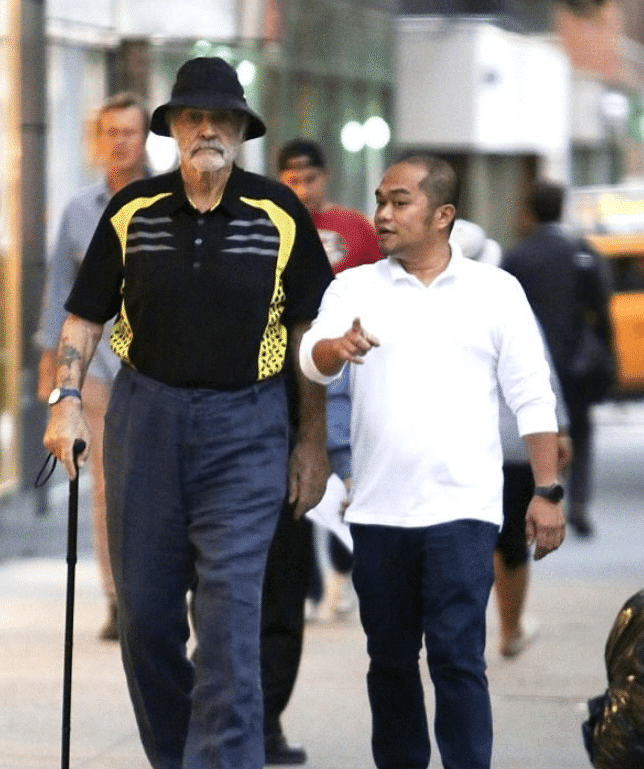
Taken in September 2017, the images show the retired actor walking through Manhattan with a cane and receiving assistance from a companion. Connery was 87 years old and had reportedly experienced discomfort after a recent fall, although a representative said that he was otherwise doing well.
There was no tuxedo, sports car, or cinematic entrance.
He wore a comfortable black polo shirt decorated with yellow and gray details, loose trousers, and a dark sun hat. The clothing was practical, the pace was measured, and the surroundings were those of an ordinary New York afternoon.
Yet the face beneath the brim remained instantly recognizable.
An Ordinary Moment With an Extraordinary Screen Legend
Photographs of older stars are often framed in unnecessarily dramatic language.
Natural changes associated with age are treated as shocking, while a cane or helping hand becomes the subject of speculation. A more respectful interpretation of these images is also the most obvious one: Connery was an elderly man continuing to move through the world on his own terms.
His gait may have been slower than audiences remembered, but the personality that had filled movie theaters for decades had not simply disappeared.
He still carried himself with quiet determination.
Video: Last Photos – Last Memories of Sean Connery
For longtime fans, the photographs created an emotional contrast between memory and time. Many remembered him first as the poised secret agent entering a casino in Dr. No, calmly introducing himself with a line that would become part of film history.
Now he was navigating a crowded sidewalk rather than an enemy headquarters.
That difference did not diminish his legacy. It made the man behind it easier to understand.
The Moment James Bond Entered the Movies
Connery became the first actor to portray James Bond in the official film series when Dr. No arrived in theaters in 1962.
The performance established many qualities that audiences would forever associate with Agent 007: controlled confidence, physical presence, dry humor, and an underlying sense of danger. Connery subsequently appeared in six productions made by the official Bond filmmakers, beginning with Dr. No and concluding with Diamonds Are Forever. He later returned to the character in the independently produced Never Say Never Again.
For Americans who discovered Bond during the 1960s, these films represented a new kind of adventure.
They offered exotic locations, memorable villains, ingenious gadgets, glamorous costumes, and opening sequences that immediately announced that ordinary rules did not apply.
The movies also arrived during an era when the weekly trip to the theater was still a major event. Audiences bought tickets at the window, found their seats beneath heavy curtains, and watched Connery appear on a screen far larger than anything available at home.
He did not merely play James Bond.
For many viewers, he became the standard by which every later interpretation would be judged.
Escaping the Shadow of 007
Video: Sean Connery young
The role that made Connery internationally famous could easily have limited the remainder of his career.
Instead, he gradually demonstrated that his screen presence could work in historical dramas, mysteries, adventures, thrillers, and character-driven stories far removed from the Bond formula.
He appeared in films including Marnie, The Man Who Would Be King, The Name of the Rose, Indiana Jones and the Last Crusade, The Hunt for Red October, The Rock, and Finding Forrester.
These later roles allowed audiences to see different qualities in him.
The youthful confidence remained, but it was joined by experience, humor, weariness, and paternal warmth. He could portray a commanding military officer in one film, an eccentric adventurer in another, and a guarded mentor whose hardest struggle was learning to trust again.
His transformation from action hero to respected character actor reached a major milestone with The Untouchables. Connery’s performance as veteran police officer Jim Malone earned him the Academy Award for Best Supporting Actor at the 1988 ceremony.
The victory confirmed what his admirers had long believed: his career was much larger than a single famous role.
The Strength of a Distinctive Presence
Connery possessed qualities that could not be manufactured by costume or dialogue alone.
His voice was immediately recognizable. His physical bearing communicated authority before he spoke. Even when playing supporting roles, he often seemed to shift the balance of a scene simply by entering it.
That presence came partly from an unusual life before Hollywood fame.
Born in Edinburgh in 1930, he grew up far from the comfortable world associated with international movie stars. His path toward acting was not carefully designed by a studio or arranged through an entertainment family.
Perhaps that background helped explain the independence he displayed throughout his career.
Connery was willing to leave Bond when he felt the character had become too restrictive. He chose unexpected projects, accepted the passage from leading man to older supporting actor, and eventually stepped away from film rather than remaining visible simply for the sake of attention.
In 1998, BAFTA honored him with its Fellowship, the organization’s highest distinction for an exceptional contribution to film, television, or games.
A Standing Ovation in New York
The Manhattan photographs appeared during the same period as one of Connery’s last widely reported public outings.
In August 2017, he attended the U.S. Open in Queens to watch Roger Federer play Frances Tiafoe. When tournament organizers recognized him, the familiar James Bond theme was played inside the stadium.
The audience responded with a standing ovation.
Connery smiled as the music filled the arena—a fitting tribute to an actor whose association with those notes had endured for more than half a century.
The scene offered an affectionate reminder of the place he continued to hold in popular culture.
Generations had changed. New actors had inherited the Bond role, filmmaking technology had advanced, and the world surrounding movie stardom had been transformed by cable television, the internet, and social media.
Still, a few seconds of music were enough for thousands of people to recognize the man and rise to their feet.
Growing Older Beyond the Cameras
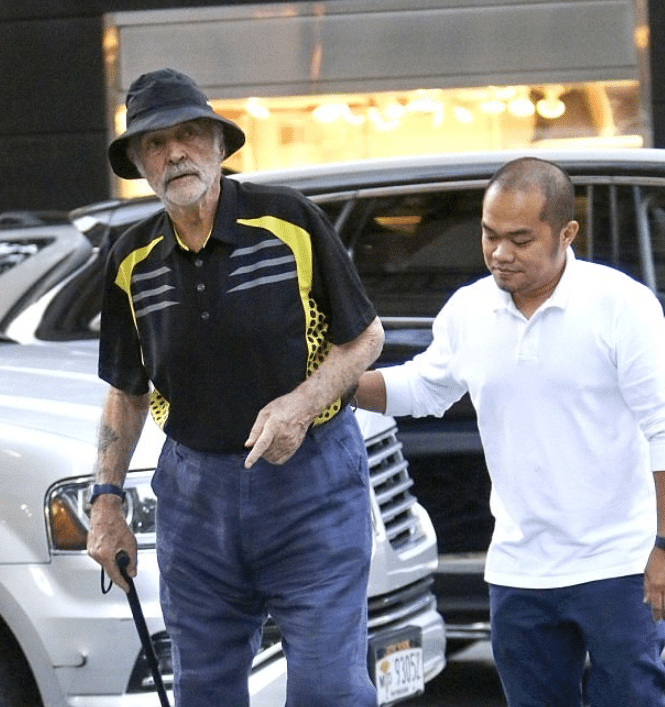
Connery had largely withdrawn from acting and formal public life by the time the New York photographs were taken.
That privacy made every later appearance seem significant, but it also created space for careless speculation. A photograph could be interpreted as evidence of illness even when no confirmed medical information was available.
The images deserve a gentler reading.
A cane is a practical aid, not a measure of someone’s dignity. Assistance from another person does not erase independence, accomplishment, or strength. Growing older changes how a person moves, but it does not cancel the life already lived.
Older readers may understand this better than anyone.
They know that the person reflected in a recent photograph carries every earlier version within them—the young worker, the new parent, the confident professional, the traveler, the friend, and the person who once entered a room without needing support.
Connery walking carefully through Manhattan was still the actor who had transformed a fictional spy into a worldwide cultural figure.
He was simply living in a later chapter.
His Final Years in the Bahamas
Connery spent much of his retirement in the Bahamas with his wife, Micheline Roquebrune.
He died peacefully in his sleep at his home on October 31, 2020. His family announced that he was 90 and had been unwell for some time. The official James Bond organization honored him as the actor whose style, grace, and magnetism first brought Ian Fleming’s character fully to life on the screen.
Tributes naturally returned to Bond, but they also celebrated the remarkable range of his later career.
He had been an adventurer, detective, soldier, king, submarine commander, professor, policeman, and mentor. He had won an Oscar, received the BAFTA Fellowship, and been knighted in 2000.
Behind all those honors was something more difficult to measure: the affection of audiences who had followed him across several decades.
Remembering the Man, Not Only the Image
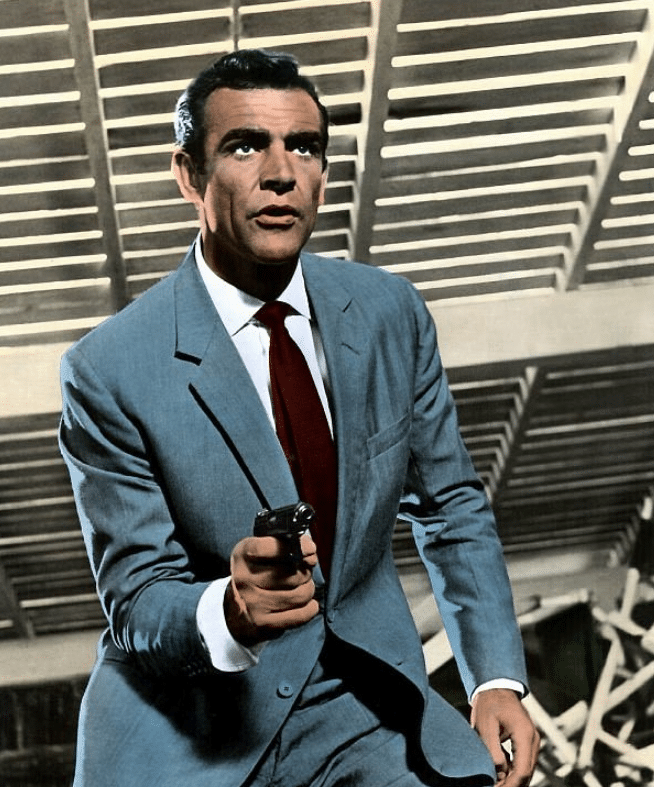
Looking back at the New York photographs today, it would be easy to focus only on how different Connery appeared from his younger self.
But that would miss their real meaning.
The polished secret agent preserved on film was a performance created by a gifted actor. The older man beneath the Manhattan sun hat was the person who had carried that performance—and many others—through an extraordinary lifetime.
Time had changed his appearance and slowed his steps.
It had not altered what his work meant to audiences.
For those who first saw him when theater marquees glowed above busy American streets, Sean Connery remains connected to an unforgettable period in movie history. His films recall Saturday matinees, television premieres, newspaper advertisements, and evenings when a new Bond adventure could make the world seem larger and more mysterious.
The rare photographs do not show the disappearance of a legend.
They show something more honest: a legendary performer growing older, accepting help when needed, and continuing forward with the same quiet resolve that audiences had recognized all along.