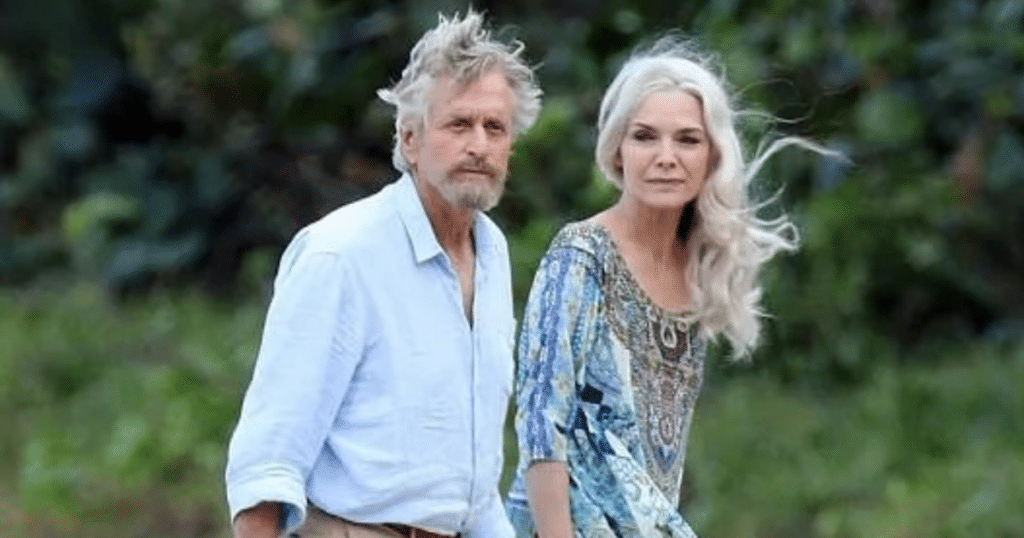
At first glance, the photographs seem to capture a distinguished couple taking a peaceful walk beside the sea.
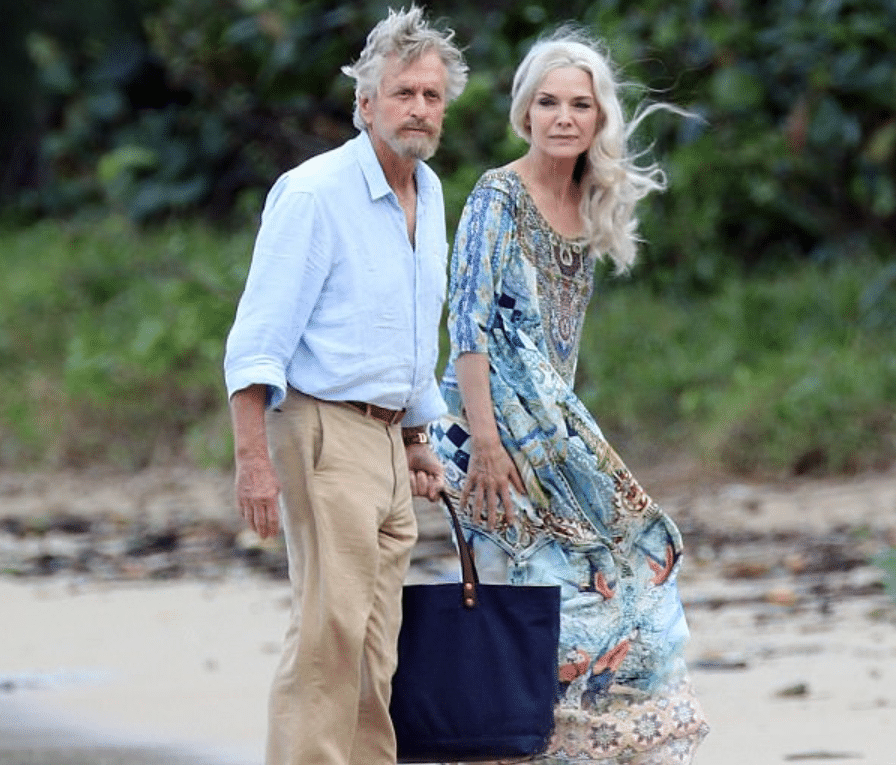
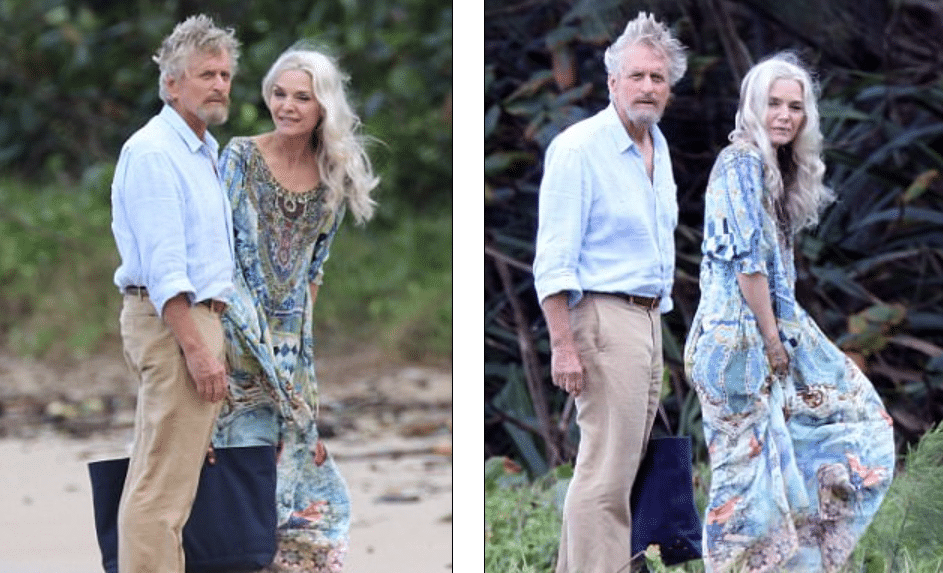
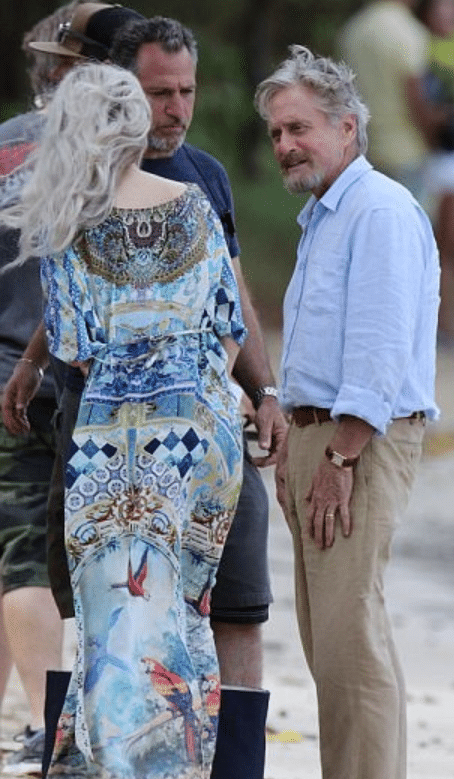
Michael Douglas wears a pale blue shirt with the sleeves casually rolled above his wrists. His beige trousers and windblown gray hair give him the appearance of a man enjoying an uncomplicated afternoon away from the city.
Michelle Pfeiffer walks beside him in a flowing blue patterned dress. Her long silver-white hair moves in the coastal breeze, while the fabric catches the wind with almost cinematic precision.
The surroundings appear natural and unhurried.
There is sand beneath their feet, tropical greenery beyond the shoreline and a large tote bag carried between scenes.
Yet this was not a private vacation.
The photographs were taken in November 2017 while Douglas and Pfeiffer were filming the closing moments of Marvel Studios’ Ant-Man and the Wasp at Kahana Bay on the Hawaiian island of Oahu. The production completed principal photography that same day.
A Movie Set Disguised as a Quiet Beach
The original article presents the photographs as though they were captured during a mysterious 2026 encounter.
The reality is more interesting.
Douglas and Pfeiffer were portraying Dr. Hank Pym and Janet van Dyne, a fictional married couple whose love story stretches across decades, scientific discoveries and the strange hidden world known as the Quantum Realm.
The beach sequence appears near the conclusion of Ant-Man and the Wasp. After Janet is rescued from the Quantum Realm, she and Hank begin rebuilding the life that was interrupted when she disappeared many years earlier.
Video: Ant-Man And The Wasp – Final Scene
Their peaceful coastal home represents a new beginning.
Only a brief portion of the Hawaiian footage appears in the finished movie, but the production brought a crew to Oahu to create that small moment of calm following the film’s elaborate action and visual effects. Local film coverage identified the location as Kahana Bay and noted that the house seen in the movie was created digitally.
The candid photographs therefore capture something between fiction and reality.
Douglas and Pfeiffer are dressed as their characters, but they are standing among crew members, equipment and the ordinary interruptions of a working film set.
They are not Hank and Janet entirely.
They are not simply Michael and Michelle either.
They occupy the fascinating space where experienced performers turn a few pages of screenplay into a world audiences can believe.
When Movie Locations Still Felt Like Secrets
Older film fans may remember when discovering where a movie had been made required patience.
A viewer might recognize a familiar street or landscape, but location information was not always immediately available. Details appeared later in newspaper features, entertainment magazines or books devoted to filmmaking.
Sometimes local residents knew more than the wider public.
They had seen trucks arrive, temporary signs appear and crews quietly transform a familiar park, beach or downtown block.
Marvel productions operate on a much larger scale, but secrecy still surrounds them.
Costumes can reveal plot details. A photograph of two actors together may confirm a character’s return, and even a small location can provide clues about how a story ends.
The Hawaiian shoot attracted attention because Michelle Pfeiffer’s role was central to the mystery of the film.
Her character had been absent for decades within the story.
Seeing her beside Michael Douglas on a peaceful beach strongly suggested that Hank’s rescue mission had succeeded.
Two Stars From Different Hollywood Traditions
Douglas and Pfeiffer belong to overlapping generations, but their paths to fame were very different.
Michael entered the entertainment world carrying one of Hollywood’s most recognizable family names.
His father, Kirk Douglas, had become a defining star of postwar American cinema through films including Champion, The Bad and the Beautiful, Lust for Life, Paths of Glory and Spartacus.
A famous parent can create opportunities, but it also creates constant comparison.
Michael had to demonstrate that he possessed an identity beyond being Kirk Douglas’s son.
Michelle entered Hollywood without that inherited film legacy.
She moved from beauty-pageant appearances and early television assignments into movies, gradually overcoming roles that did not initially reveal the full extent of her talent.
By the late 1980s, she had become one of the most acclaimed actresses of her generation.
Their careers eventually intersected in a superhero film—an unlikely meeting point for two performers whose most famous roles came from very different corners of American cinema.
Michael Douglas Before He Became a Movie Star
Many viewers first came to know Michael Douglas through television.
He starred with Karl Malden in The Streets of San Francisco, the police drama that aired during the 1970s.
The program belonged to an era when network crime dramas often used real city streets rather than anonymous studio environments. San Francisco’s hills, waterfront, neighborhoods and distinctive architecture became nearly as important as the weekly investigations.
Douglas played Inspector Steve Keller, the younger partner to Malden’s experienced Detective Lieutenant Mike Stone.
The series gave him regular exposure, but Michael was already developing another important part of his career behind the camera.
He helped produce One Flew Over the Cuckoo’s Nest, the 1975 adaptation of Ken Kesey’s novel. The film won the Academy Award for Best Picture, with Michael Douglas and Saul Zaentz receiving the honor as producers.
That achievement arrived before Michael became one of Hollywood’s leading movie actors.
It established him as someone interested not only in performing but also in finding and developing ambitious stories.
The Era of Romancing the Stone
Michael’s movie-star chapter expanded dramatically during the 1980s.
In Romancing the Stone, he played Jack Colton, a rough-edged adventurer who becomes entangled with Kathleen Turner’s sheltered romance novelist in Colombia.
The film combined adventure, comedy and romance in a style that made it ideal for the decade.
It offered dangerous landscapes, hidden treasure, villains, humor and two stars whose arguments carried as much energy as the action sequences.
Michael also served as a producer on the film.
For viewers who remember seeing it in theaters, Romancing the Stone may recall the particular excitement of 1980s adventure movies.
There were newspaper advertisements listing showtimes, lines at the box office and trailers that revealed just enough to create anticipation without explaining the entire story.
Home video later gave the movie another life.
Families rented it on VHS, watched it during weekends and returned the tape to the neighborhood store before late fees were added.
The Character Who Defined an Era of Ambition
In 1987, Michael appeared as Gordon Gekko in Oliver Stone’s Wall Street.
The character was wealthy, charming, ruthless and completely convinced that the pursuit of profit justified nearly any decision.
Michael’s performance captured the polished confidence associated with the decade’s financial culture while allowing the audience to sense the danger beneath it.
Gekko became one of cinema’s most recognizable representations of corporate greed.
The Academy awarded Michael the Oscar for Best Actor, and he also received the Golden Globe for the role.
The performance changed the way audiences saw him.
He was no longer only the adventurous romantic lead or the son of a famous actor.
He could command the screen as a morally troubling figure whose intelligence and confidence made him compelling even when his actions became impossible to defend.
A Career Willing to Enter Uncomfortable Territory
Michael continued selecting characters who were complicated, flawed or difficult to categorize.
Fatal Attraction became one of the most discussed thrillers of the late 1980s.
Basic Instinct combined mystery, sexuality and danger in a way that generated enormous public debate.
Falling Down presented an increasingly unstable man moving through Los Angeles while convinced that the world had mistreated him.
Later projects such as The American President, Wonder Boys, Traffic, Behind the Candelabra and The Kominsky Method revealed different shades of authority, humor, insecurity and age.
His career did not depend on appearing heroic.
Often, his greatest strength came from allowing audiences to feel uncertain about the man they were watching.
Michelle Pfeiffer’s Unlikely Road to Acclaim
Michelle Pfeiffer’s rise was less direct.
Early roles brought visibility but did not immediately establish her as a major dramatic actress.
Grease 2 placed her at the center of a musical sequel that received a mixed response on release, although it later developed a devoted following.
Then came Scarface.
As Elvira Hancock, Pfeiffer appeared elegant, emotionally distant and increasingly trapped inside the violent world created by Al Pacino’s Tony Montana.
The role demanded more than beauty.
Elvira had to appear both protected by wealth and profoundly endangered by it.
The film became a major part of popular culture, but Michelle’s most acclaimed period was still ahead.
The Extraordinary Run of the Late 1980s
During the second half of the 1980s, Michelle demonstrated an unusual ability to transform from one film to the next.
She appeared in The Witches of Eastwick, Married to the Mob, Tequila Sunrise and Dangerous Liaisons.
In Jonathan Demme’s Married to the Mob, she played a gangster’s widow trying to escape the world around her. The performance combined comedy, vulnerability and a carefully constructed New York accent.
In Dangerous Liaisons, she became Madame de Tourvel, a deeply principled woman drawn into an elaborate game of manipulation.
The Academy nominated Michelle for Best Supporting Actress for the film.
The following year brought an even more celebrated performance.
The Fabulous Baker Boys and a Moment of Movie Magic
In The Fabulous Baker Boys, Michelle played Susie Diamond, a former escort who becomes the singer for two struggling piano-playing brothers portrayed by Jeff and Beau Bridges.
Her performance balanced confidence with weariness.
Susie understands how people respond to her appearance, but she is also intelligent enough to recognize the limitations of the situation around her.
The scene in which she performs on top of a piano became one of the most memorable movie images of its era.
Yet the full performance was far richer than that single glamorous sequence.
Michelle received an Academy Award nomination for Best Actress and won the Golden Globe for her work in the film.
For moviegoers who encountered her during that period, she appeared capable of almost anything.
She could be funny, mysterious, romantic, wounded or quietly formidable without losing the sense of an inner life unfolding behind her expression.
Catwoman Became a Cultural Landmark
In 1992, Michelle appeared as Selina Kyle and Catwoman in Tim Burton’s Batman Returns.
Her transformation begins with a shy, overlooked office worker and develops into one of the most visually striking figures in modern superhero cinema.
The black costume became iconic, but the performance succeeded because Michelle gave Selina emotional depth.
The character is wounded, angry, funny, unpredictable and painfully aware of how little respect she received before becoming Catwoman.
For many viewers, her interpretation remains the definitive screen version of the character.
The performance also makes her later entry into the Marvel universe especially meaningful.
Decades before playing Janet van Dyne, Michelle had already helped demonstrate that a comic-book character could possess psychological complexity, adult sadness and theatrical power.
Three Academy Award Nominations Across Five Years
Michelle’s work during this period brought three Academy Award nominations in a remarkably short span.
She was recognized for Dangerous Liaisons, The Fabulous Baker Boys and Love Field.
In Love Field, she played Lurene Hallett, a Dallas housewife deeply affected by the assassination of President John F. Kennedy.
The story placed a seemingly ordinary woman against a moment of national grief and social division.
The performance required emotional openness rather than the controlled glamour associated with some of Michelle’s earlier roles.
Together, the three nominations demonstrated the range beneath her movie-star image.
Stepping Back When Family Life Required It
By the late 1990s and early 2000s, Michelle began working less frequently.
Hollywood often describes any absence by an actress as a disappearance, as though constant visibility were the only measure of a meaningful life.
Michelle’s priorities had changed.
She was raising her children and became more selective about projects, particularly when work required long periods away from home.
The reduced schedule did not mean that her ability had vanished.
It meant that professional ambition was no longer the only responsibility shaping her decisions.
Many older readers may recognize that choice.
Careers do not always proceed in a straight line. A parent may decline an opportunity because the timing is wrong. Someone may step away from a profession, return later and discover that experience has added qualities youth could not provide.
Michelle eventually returned to more regular screen work with a series of acclaimed and highly visible roles.
The Return of a Familiar Screen Presence
The year 2017 became especially important in Michelle’s career.
She appeared in Darren Aronofsky’s mother!, Kenneth Branagh’s Murder on the Orient Express and HBO’s The Wizard of Lies.
Her portrayal of Ruth Madoff in The Wizard of Lies earned an Emmy nomination for Outstanding Supporting Actress in a Limited Series or Movie.
The roles reminded audiences that her presence had not weakened during the quieter years.
If anything, age had added new emotional dimensions.
She could now bring a lifetime of private history into a pause, a guarded expression or a line delivered without unnecessary emphasis.
That same year, Marvel announced that she would join Ant-Man and the Wasp as Janet van Dyne.
Why Janet van Dyne Mattered
Within Marvel mythology, Janet van Dyne is not simply the wife of Hank Pym.
She is the original Wasp, a scientist and hero whose sacrifice shaped the lives of her husband and daughter.
In the movie’s backstory, Janet disappears into the Quantum Realm while preventing a disaster.
Hank spends decades believing she may still be alive.
Their daughter, Hope, grows up carrying the emotional absence of a mother she barely had the chance to know.
When Janet finally returns, the reunion must communicate years of loss without requiring a lengthy explanation.
Casting Michelle gave the character immediate emotional weight.
Audiences already understood her as a performer capable of expressing strength and vulnerability at the same time.
Michael Douglas brought a similar history to Hank.
The fictional couple’s long separation became more believable because the actors carried decades of screen experience into the reunion.
Two Careers Finally Sharing the Same Frame
By 2017, Michael and Michelle had each worked with many of Hollywood’s most celebrated actors and filmmakers.
Their careers had moved through thrillers, romances, comedies, period dramas, crime stories and awards-season productions.
Yet Ant-Man and the Wasp marked their first major screen partnership.
The meeting felt overdue.
They belonged to the same broad era of Hollywood stardom—the period when a performer could open a movie largely through name recognition and when a carefully photographed magazine cover still carried enormous cultural power.
Their screen styles were also complementary.
Michael often projects authority, intensity and impatience.
Michelle can convey calmness while suggesting that she understands far more than she has chosen to reveal.
As Hank and Janet, those differences help create the feeling of two strong individuals reconnecting after an extraordinary separation.
The Hawaiian Scene Was About Coming Home
The clothing visible in the set photographs was carefully designed to communicate peace.
Michael’s pale shirt and neutral trousers are far removed from Hank Pym’s laboratory clothing or superhero technology.
Michelle’s flowing dress contains ocean colors, birds and decorative patterns that appear almost to merge with the tropical setting.
Her silver hair reflects the decades Janet spent away from Earth.
The scene does not attempt to restore the characters to the young people they were before she disappeared.
They return to one another as older adults.
That detail gives the ending unusual emotional resonance for a superhero film.
The story acknowledges that lost time cannot be recovered.
Hank and Janet can begin again, but they cannot become the people they were 30 years earlier.
Their reunion matters precisely because both have changed.
Age as Part of the Story, Not Something to Hide
Hollywood has often struggled to imagine older people as romantic figures.
Young couples are allowed desire, adventure and dramatic reunions.
Older characters are frequently reduced to parents, grandparents or sources of advice.
Hank and Janet challenge that limitation.
Their relationship provides one of the emotional foundations of the film. Hank risks everything to bring his wife home, and Janet returns with experiences and abilities that make her essential to the family’s future.
The Hawaiian scene allows them a moment that is both romantic and mature.
They are not pretending to be young.
Their gray hair and weathered faces are part of what makes the image meaningful.
The actors did not need to conceal time for the scene to work.
Time was the reason it worked.
The Crew Just Beyond the Frame
One photograph reveals members of the production crew standing near the actors.
The illusion of a secluded beach immediately becomes a workplace.
A crew member watches the scene. Equipment remains nearby, and the actors appear to be waiting for another instruction or camera setup.
This image offers a useful reminder of how movies are created.
A peaceful two-minute sequence may require transportation, location permissions, costume preparation, hair and makeup, safety planning, camera crews, sound work, digital effects and hours of waiting for the correct light.
The finished scene appears effortless because hundreds of practical decisions remain invisible.
Older studio films created the same illusion through different technology.
A tropical coast might have been recreated on a soundstage with painted backgrounds, artificial plants and carefully controlled water.
Modern productions can travel to a real Hawaiian beach and later add an entire home digitally.
The methods evolve.
The desire to make the audience forget the machinery remains the same.
From Practical Sets to the Quantum Realm
The contrast between the Hawaiian beach and the Quantum Realm reflects the unusual visual world of Ant-Man and the Wasp.
Much of the film depends on objects and people changing size.
Cars shrink, buildings become portable and everyday spaces turn into enormous landscapes when viewed from a miniature scale.
The rescue of Janet requires advanced effects, imagined science and elaborate action.
Yet the emotional destination is remarkably simple.
A man wants his wife back.
A daughter wants the mother she lost.
The family wants another chance to be together.
That human center allows the visual effects to matter.
Without it, the shrinking technology and fictional dimensions would become only spectacle.
Why Marvel Chose Established Stars
The Marvel Cinematic Universe often pairs younger leading performers with actors whose careers connect the films to earlier periods of American cinema.
Michael brought the authority of Wall Street, Fatal Attraction and decades of filmmaking.
Michelle carried memories of Scarface, The Fabulous Baker Boys, Batman Returns and her celebrated dramatic work.
Their presence gave the Ant-Man family a sense of history.
Hank and Janet did not feel as though their lives began when the first movie opened.
They seemed to have known one another through decades of scientific work, arguments, family decisions and shared danger.
The audience did not need to see every year.
The actors’ faces carried the missing time.
A Film Partnership That Continued
Michelle and Michael returned as Janet and Hank in Avengers: Endgame and later played larger roles in Ant-Man and the Wasp: Quantumania.
The third Ant-Man film brought Hank, Janet, Hope, Scott and Cassie into the Quantum Realm together, placing the older couple directly inside the adventure rather than leaving them at its emotional edges.
Marvel’s official materials list both actors among the returning central cast members.
The continuation allowed Janet to become more than the person everyone had once tried to rescue.
She possessed knowledge, relationships and secrets created during her years in the Quantum Realm.
Hank also evolved from an isolated inventor into a member of a larger, complicated family.
The Difference Between a Set Photograph and a Paparazzi Story
Calling the 2017 images a rare paparazzi encounter changes their meaning.
It suggests that two stars were unexpectedly discovered together during private time.
They were not.
They were photographed while working on a film whose cast and production had already been announced.
Recognizing that context does not make the images less appealing.
It makes them more valuable.
We are seeing two accomplished actors near the completion of a demanding production.
Their costumes, hair and surroundings offer a glimpse of how a short movie scene looked before editing, music and visual effects transformed it.
The photograph is not revealing a secret relationship.
It is revealing the craftsmanship behind an illusion.
Why the Images Still Invite a Second Look
Even after the context is understood, the photographs remain striking.
Michael and Michelle look as though they belong in the landscape.
His white and gray hair is lifted by the wind. Her long silver waves and patterned dress create an image that seems both contemporary and connected to an older style of cinematic glamour.
They do not resemble action heroes in the conventional sense.
That is part of their appeal.
Heroism in later life may look different.
It may be quieter, more thoughtful and less interested in proving physical invincibility.
Hank and Janet survive not because they remain unchanged, but because experience has taught them how to adapt.
The Red Carpet After the Beach
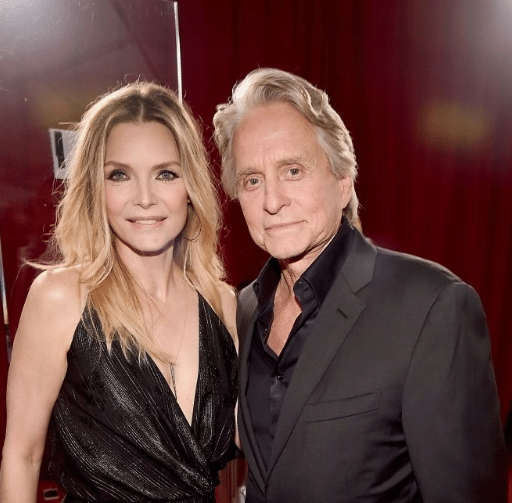
The final photograph shows Michelle and Michael at the Hollywood premiere of Ant-Man and the Wasp in June 2018.
The tropical costumes are gone.
Michelle wears a sleek black gown, while Michael appears in a dark suit with an open-collar shirt.
Once again, they stand side by side—but now the film is finished, the visual effects are complete and audiences are about to see the result.
The premiere was held in Hollywood on June 25, 2018, shortly before the movie’s American release on July 6.
The contrast between the two settings tells a complete production story.
On the Hawaiian beach, they are actors surrounded by wind, sand and crew members.
At the premiere, they are movie stars presenting a polished finished work.
Both images are authentic.
They simply belong to different stages of the process.
Stars Who Learned How to Grow Older on Screen
Michael Douglas and Michelle Pfeiffer became famous in an industry that placed enormous value on youth.
Both managed to continue working without pretending that time had stopped.
Michael gradually shifted from ambitious businessmen and dangerous leading men toward fathers, mentors, aging performers and authority figures whose confidence often hides private uncertainty.
Michelle moved from glamorous heroines and romantic leads into mothers, queens, complicated widows and women whose experience gives them greater power rather than less.
Those transitions are not automatic.
Hollywood has often struggled to write substantial later-life roles, particularly for women.
A performer must be selective, patient and willing to allow the public image to change.
Michelle’s three Academy Award nominations and Michael’s two Oscar-winning achievements belong to earlier decades, but neither career became only a museum of past success.
They continued entering new genres and reaching audiences who may not have been born when their most famous films opened.
Cinema Allows Different Generations to Meet
A child who first encountered Michael as Hank Pym may later discover Gordon Gekko, Jack Colton or President Andrew Shepherd.
A young Marvel viewer who knew Michelle as Janet van Dyne may eventually watch Selina Kyle, Susie Diamond or Madame de Tourvel.
That is one of cinema’s quiet gifts.
Performances do not disappear when the premiere ends.
They wait.
A film made decades ago can become new again whenever another viewer presses play.
For older audiences, the process works in reverse.
Seeing familiar stars inside a modern superhero film connects the present to memories of neighborhood theaters, rental stores, movie soundtracks and entertainment magazines.
The younger actors introduce a new world.
The established stars bring history with them.
A More Meaningful Kind of Transformation
The original article describes Michelle as “unrecognizable” because of the long white hair and flowing costume.
But she was not being photographed after some mysterious personal transformation.
She was playing a character.
Hair, makeup and costume departments had created Janet van Dyne’s appearance to reflect the decades she had spent in another dimension.
Even outside a film set, looking different from a photograph taken 30 years earlier should not be treated as a scandal.
Change is the natural evidence of a life continuing.
Michelle’s face carries the years between Scarface and Ant-Man and the Wasp.
Michael’s carries the distance between The Streets of San Francisco, Wall Street and Hank Pym.
Those years are not defects to be hidden.
They are the reason the actors can bring such history to the characters.
The Quiet Power of the Final Scene
After the action ends and Janet returns, the beach offers the family something the Quantum Realm never could: ordinary time.
There will be breakfasts, conversations, disagreements, projects and afternoons without a crisis to solve.
The scene suggests that ordinary life is not the absence of adventure.
It is the reward for surviving it.
That idea may resonate especially strongly with older viewers.
After enough years, the moments that once seemed unremarkable can become the ones most deeply missed.
A walk near the water.
A familiar person beside you.
A home waiting beyond the trees.
What the 2017 Photographs Truly Preserve
The pictures do not show a new 2026 celebrity sighting.
They do not document a private romance or an unexplained Hawaiian vacation.
They preserve the final day of principal photography on a 2018 movie.
They show two major performers creating a gentle reunion between fictional partners who had spent decades apart.
More broadly, they capture the meeting of two remarkable Hollywood careers.
Michael Douglas brought the confidence of an Oscar-winning actor and producer whose work helped define several eras of American film.
Michelle Pfeiffer brought the emotional precision of an actress whose beauty never prevented her from becoming one of her generation’s most respected performers.
Together, they made a few quiet minutes beside the sea feel as important as any shrinking laboratory or journey into another dimension.
Two Icons, One Hawaiian Shore
The wind was real.
The sand was real.
The house later seen behind them was not.
That mixture of reality and illusion is the essence of filmmaking.
Michael Douglas and Michelle Pfeiffer stood on Kahana Bay dressed as two people who had finally found their way back to each other.
Crew members waited nearby.
Cameras recorded the scene, and digital artists would later complete the world around them.
Years afterward, the photographs resurfaced without their proper date and context.
Yet the truth carries far more nostalgia than the misleading headline.
This was not an accidental encounter.
It was the day two enduring stars completed a story about time, separation and coming home.
For audiences who had followed them since the 1970s, 1980s or 1990s, seeing them together offered something special.
The roles were new.
The talent was familiar.
And on a quiet Hawaiian beach, two long Hollywood journeys finally shared the same frame.