Long before family photographs appeared instantly on social media, images of Hollywood stars often reached the public slowly.
A picture might first appear in a newspaper, remain tucked inside a magazine for decades, and later be rediscovered in an archive. By then, an ordinary arrival at an airport or hotel could feel like a valuable piece of American cultural history.
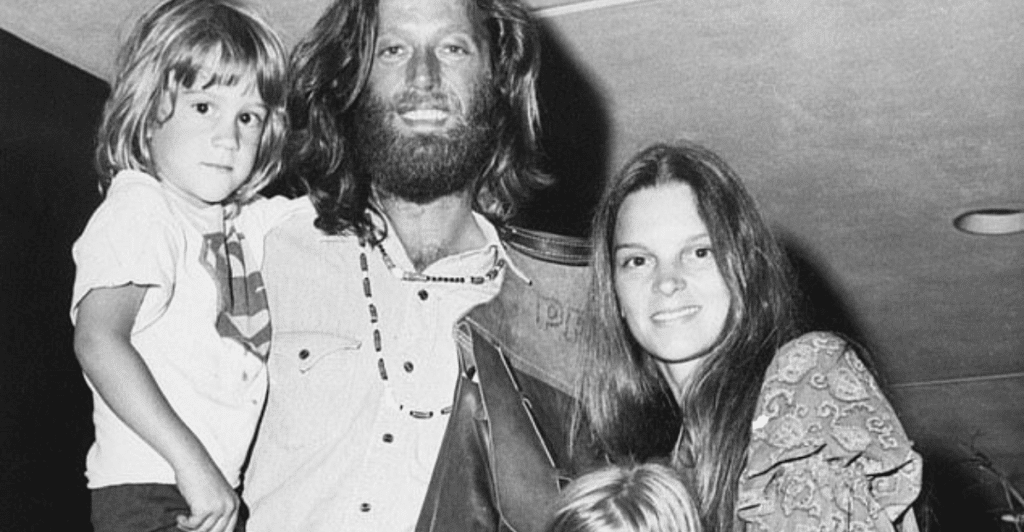
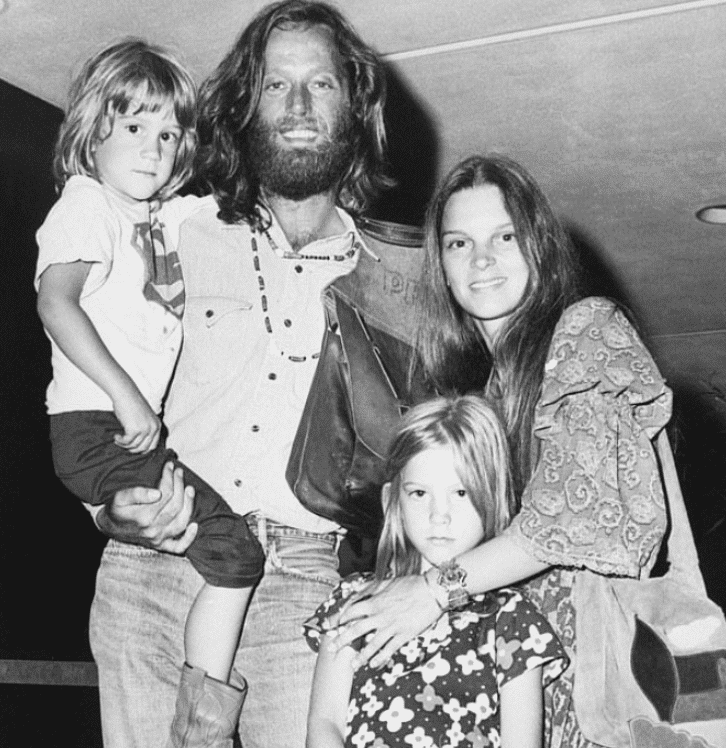
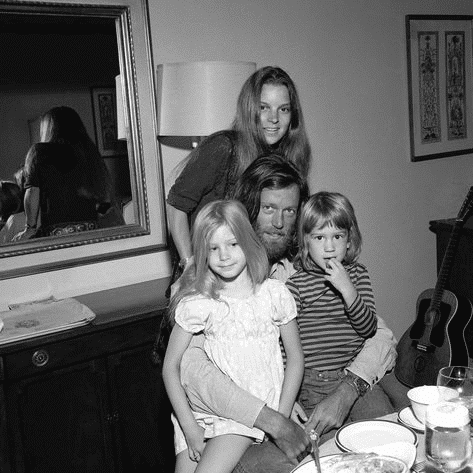
This black-and-white photograph of Peter Fonda, his wife Susan Brewer, and their children Bridget and Justin has that timeless quality.
The original Bettmann archival caption dates the photograph to August 5, 1971. Fonda had arrived in New York with his family to promote Universal Pictures’ The Hired Hand, his first feature film as a director. Seven-year-old Bridget stands in front of her parents, while five-year-old Justin rests comfortably in his father’s arm. The film was scheduled to premiere in New York on August 11.
Although newer descriptions sometimes present the picture as an unidentified hotel-room candid, the surviving archival caption provides a clearer story. This was a family arriving together during an important professional week in Peter Fonda’s life.
Do You Recognize the Bearded Young Actor?
With his long hair, beard, casual shirt, and faded jeans, Peter Fonda looks every bit the counterculture figure audiences remembered from the late 1960s.
Only two years earlier, he had become internationally famous through Easy Rider. Fonda starred as Wyatt, the reserved motorcycle rider sometimes called “Captain America,” and also helped create the film with Dennis Hopper and Terry Southern.
The screenplay earned Fonda, Hopper, and Southern an Academy Award nomination. More than half a century later, the movie remains closely associated with the freedom, uncertainty, music, and generational conflict of late-1960s America.
For older moviegoers, the photograph may bring back memories of a time when films were discovered in crowded theaters rather than through streaming menus.
There were no online trailers available at every hour. Viewers found showtimes in the newspaper, stood beneath a glowing marquee, and often knew very little about a movie before the lights went down.
A film such as Easy Rider did more than entertain. It became part of a larger national conversation.
A Family Portrait Taken at a Creative Crossroads
The timing of the photograph makes it especially meaningful.
After the cultural success of Easy Rider, Fonda could have continued making variations on the rebellious motorcycle persona that had transformed his career. Instead, he chose a much quieter project for his directorial debut.
The Hired Hand was a reflective Western starring Fonda, Warren Oates, and Verna Bloom. Rather than focusing on heroic gunfights and clearly defined villains, the story followed a wandering man who returns to the wife and home he had abandoned years earlier.
The production allowed Fonda to move behind the camera while continuing to act. It was the first of three feature films he would direct.
That professional context gives the family photograph greater depth.
Fonda was no longer simply the young actor who had become a symbol of rebellion. He was attempting to establish himself as a filmmaker with a quieter and more personal creative voice.
Beside him stood the people who knew him outside the public image.
Susan, Bridget, and Justin Shared the Journey
Peter Fonda married Susan Brewer in 1961. Their daughter Bridget was born in 1964, followed by their son Justin in 1966. The couple later separated, but this 1971 photograph preserves a moment when the four were traveling together as a young family.
Susan stands close to Bridget, resting one hand protectively across her daughter’s shoulder. Justin appears secure in his father’s arm, dressed in a small pair of boots that immediately recalls the children’s fashions of the period.
Nothing about the family’s clothing looks designed for a formal Hollywood portrait.
Peter’s jeans and open-necked shirt appear comfortably worn. Susan’s patterned blouse has the unmistakable style of the early 1970s. Bridget looks serious, perhaps uncertain about the photographer, while Justin gazes calmly toward the camera.
Those small details make the picture feel less like publicity and more like something that might have been found in an ordinary family album.
Before Every Family Moment Was Shared Online
In 1971, most American families took photographs sparingly.
Film was limited, flash cubes had to be replaced, and no one could immediately check whether everyone had kept their eyes open. A roll might remain inside the camera until a birthday, vacation, and holiday had all been recorded.
Once developed, the pictures arrived in a paper envelope.
Some were placed carefully into albums with adhesive corners. Others remained loose in kitchen drawers or shoeboxes, their dates eventually forgotten. A handwritten note on the back might become the only record of where the picture had been taken.
Celebrity photographs followed a similar rhythm.
Readers could not open a phone and see how an actor had spent the morning. Public figures appeared through finished movies, magazine interviews, press photographs, and occasional television appearances.
That distance made a family image feel unusually personal.
The Little Girl Would Become a Hollywood Star
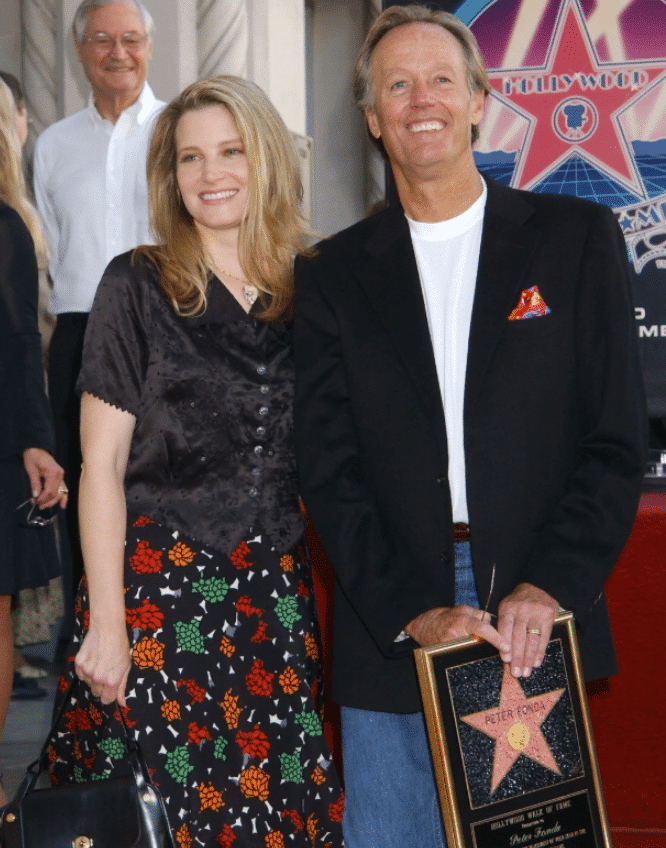
The seven-year-old standing in front of Peter and Susan was Bridget Fonda, who would later build a successful film career of her own.
Bridget became one of the familiar faces of 1990s cinema, appearing in films including The Godfather Part III, Single White Female, Singles, Point of No Return, It Could Happen to You, Jackie Brown, and A Simple Plan. She stepped away from acting after her final screen work in 2002.
Her later success continued a remarkable family tradition.
Bridget’s grandfather was Henry Fonda, one of the defining American actors of Hollywood’s classical period. Her aunt is Jane Fonda, whose career has included film, television, fitness, writing, and political activism. Peter forged his own identity through counterculture cinema, while Bridget became closely associated with the thrillers, romantic dramas, and independent films of the 1990s.
Yet none of that future is visible in the young girl’s expression.
She is not posing as the next member of a famous acting dynasty. She is simply a child standing close to her mother during a family trip.
Peter Fonda Was More Than Captain America
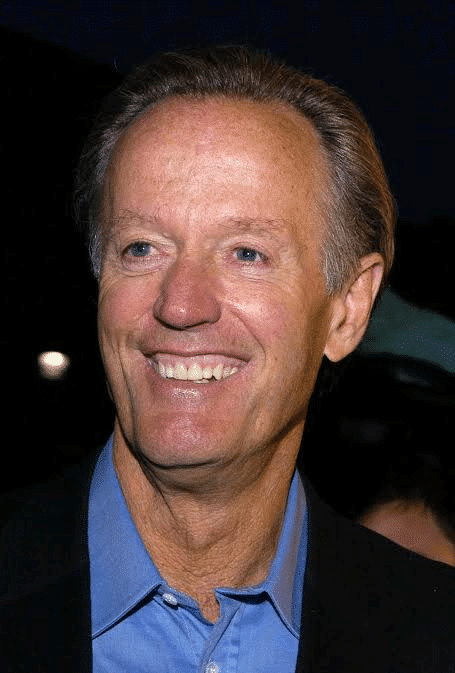
The success of Easy Rider was so enormous that it sometimes overshadowed the rest of Peter Fonda’s career.
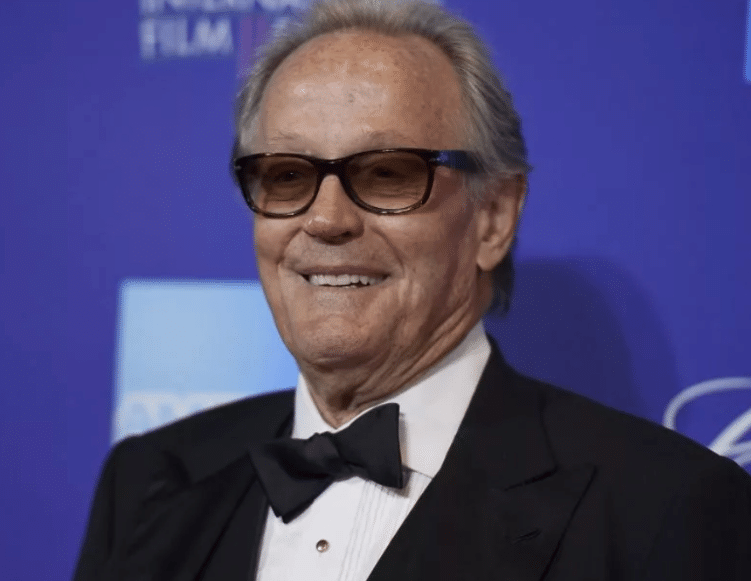
He continued acting for decades, appearing in productions ranging from independent dramas to Westerns and television movies. In 1997, he delivered one of his most acclaimed performances as a quiet beekeeper attempting to hold his troubled family together in Ulee’s Gold.
The role earned him a Golden Globe for Best Actor in a Motion Picture Drama and an Academy Award nomination for Best Actor.
The restrained performance surprised viewers who knew him primarily as the motorcycle rider from Easy Rider.
It also revealed a connection between the different stages of his career. The young rebel of the 1960s had grown into an actor capable of portraying responsibility, patience, regret, and the difficult work of holding a family together.
Seen from that perspective, the 1971 photograph feels almost prophetic.
Peter was promoting a film about a man returning home while standing beside his own wife and children. Decades later, one of his finest roles would again center on a reserved father attempting to protect his family.
When Movie Promotion Moved at a Slower Pace
Promoting a film in 1971 required travel, scheduled interviews, press screenings, newspaper features, and carefully arranged photographs.
Actors could not communicate directly with millions of followers from a hotel room. Studios depended on local newspapers, radio hosts, television interviewers, and entertainment reporters to introduce a project to the public.
Peter Fonda’s family accompanied him to New York as he prepared audiences for The Hired Hand. The preserved caption tells us why they were there, but the photograph captures something a press release could not.
Justin’s weight rests naturally against his father. Susan and Bridget stand closely together. Peter looks toward the camera with the relaxed smile of someone briefly surrounded by familiar people during a demanding professional trip.
The promotional tour has long since ended. The interviews have largely disappeared. The family photograph remains.
A Different Side of the Rebel
Peter Fonda’s public image was built around independence.
In Easy Rider, he traveled the highway on a motorcycle, carrying the hopes and contradictions of a generation searching for freedom. Magazine photographs often emphasized his long hair, unconventional clothing, and distance from the traditional Hollywood represented by his father.
The 1971 family photograph tells another story.
The famous rider is standing still. One arm supports his young son. His wife and daughter are beside him. Instead of the wide American highway, the setting is an arrival area during a family trip to New York.
Freedom and responsibility are not always opposites. A person can resist convention while still valuing family, creative purpose, and the comfort of familiar relationships.
That tension shaped much of Fonda’s most memorable work.
The Quiet Meaning Behind a Famous Family Picture
At first, the image may attract attention because of the recognizable beard or the famous last name.
Its lasting appeal comes from something simpler.
Almost every family owns a photograph in which the people pictured stand at the beginning of changes they cannot yet imagine. A child will grow up. A marriage will enter a new chapter. A career will rise, pause, or move in an unexpected direction.
Years later, viewers study the photograph with knowledge the subjects did not possess.
Peter Fonda’s 1971 family portrait captures one of those moments. Hollywood history surrounds it, but the emotional center remains wonderfully ordinary: a father holding his son, a mother standing beside her daughter, and four people briefly together during a busy summer trip.
For audiences who remember the rumble of Easy Rider, the neighborhood movie theater, and family albums filled with carefully saved prints, the photograph offers more than nostalgia.
It reminds us that behind even the most recognizable Hollywood legend was a family life measured in the same fleeting moments as our own.