Some movie stars were created by perfect lighting, carefully tailored clothes and publicity departments determined to present an ideal image.
Jean-Paul Belmondo seemed to become famous by ignoring nearly every traditional rule.
His nose carried the marks of his early boxing years. His smile was uneven, his manner was casual and his face did not resemble the polished leading men who dominated studio films during the 1950s.
None of that prevented audiences from watching him.
In fact, those qualities became essential to his appeal.
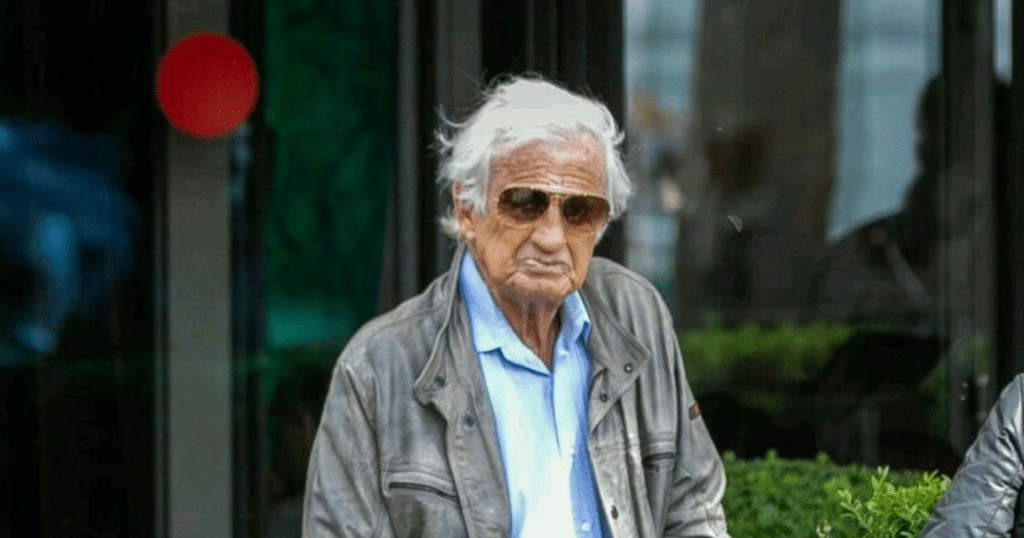
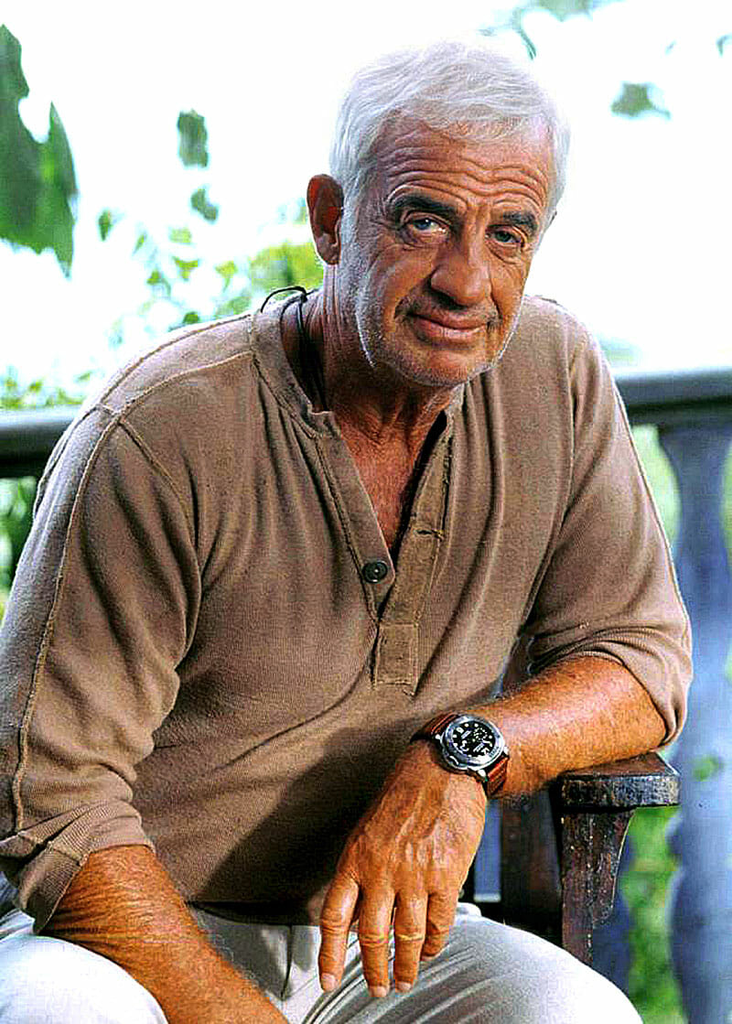
A collection of archival photographs shows Belmondo much later in life, wearing sunglasses, an open blue shirt and a weathered leather jacket. He appears far removed from a formal premiere or carefully arranged studio portrait.
The supplied source identifies the man as Jean-Paul Belmondo but does not provide a confirmed date or location for the candid images. They should therefore be understood as historical photographs rather than documentation of a recent public sighting.
A Face That Refused to Follow Hollywood’s Rules
For older American moviegoers, the photographs may recall an era when foreign films felt like discoveries.

They arrived at independent theaters, college film societies and late-night television programs. Viewers might hear about a French actor through a newspaper review or see his face on a poster outside a small theater several towns away.
Belmondo became one of the unmistakable faces of that world.
He was born in Neuilly-sur-Seine, near Paris, on April 9, 1933. His father, Paul Belmondo, was an established sculptor, so creativity was already part of the household in which the future actor grew up. Jean-Paul was also deeply interested in sports, particularly boxing, before pursuing formal dramatic training at the Paris Conservatory.
His boxing background contributed to the face audiences would later remember.
It was not conventionally perfect, but it was expressive. A slight movement of his mouth could suggest amusement, defiance or complete indifference. His relaxed posture made it appear that he had wandered into the scene rather than spent hours preparing for it.
Film-industry expectations initially worked against him. The Élysée’s official remembrance noted that teachers had once questioned whether his appearance would allow him to become a believable romantic actor. His later career provided a memorable answer to those doubts.
The Role That Changed Everything
Belmondo’s international breakthrough arrived with Jean-Luc Godard’s Breathless.
Released in Paris in March 1960, the film paired him with American actress Jean Seberg. Belmondo portrayed Michel Poiccard, a reckless young criminal fascinated by Humphrey Bogart and determined to move through life according to his own uncertain rules.
The film helped define the French New Wave, a movement that rejected many conventions of traditional filmmaking. Its unusual editing, informal street photography and unpredictable rhythm made it feel radically different from polished studio productions.
Belmondo was central to that feeling.
The British Film Institute describes Breathless as the film that transformed him into an overnight sensation and one of the leading French stars of the postwar period. His humor, physical energy and casual insolence gave the character a sense of spontaneity that audiences had rarely seen from a movie hero.
For American viewers accustomed to carefully structured dramas, Breathless could feel like opening a window onto another kind of cinema.
The characters walked through real Paris streets. Conversations seemed to begin and end unexpectedly. The camera followed people instead of forcing them into traditional compositions.
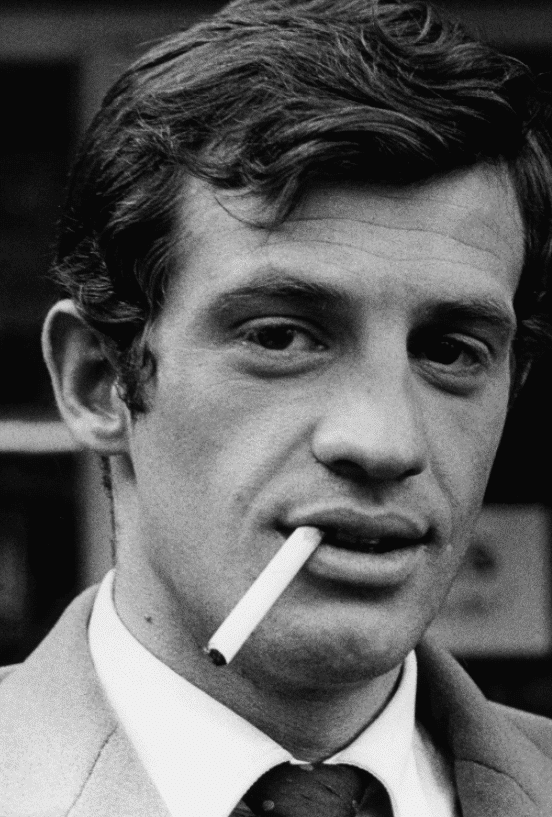
At the center of it all was Belmondo, cigarette resting against his lips and confidence apparently requiring no explanation.
The image influenced generations of young actors, photographers and filmmakers. Yet what appeared effortless on the screen was supported by theatrical training, athletic discipline and an instinctive awareness of the camera.
He Was Never Only an Art-House Actor
Belmondo could easily have remained permanently associated with experimental films.
After Breathless, he continued working with important New Wave directors and appeared in Godard’s A Woman Is a Woman and Pierrot le Fou. He also worked with François Truffaut in Mississippi Mermaid and Alain Resnais in Stavisky.
Yet he did not want to belong to only one corner of the film world.
Belmondo moved comfortably into crime stories, comedies, romantic adventures and large-scale action pictures. His work with director Jean-Pierre Melville included Léon Morin, Priest, Le Doulos and Magnet of Doom, three dramatically different roles that demonstrated his range.
Films such as That Man from Rio, Borsalino, The Magnificent One, The Professional and Ace of Aces helped turn him into one of France’s most reliable box-office attractions.
The Festival de Cannes later praised this unusual balance, observing that Belmondo had successfully united the art-house cinema of celebrated directors with the accessible entertainment of mainstream French filmmakers.
That combination made him exceptional.
Serious film enthusiasts could admire his performances for Godard, Melville, Truffaut and Resnais. Families looking for an entertaining weekend movie could enjoy his comedies and adventures.
Belmondo never appeared embarrassed by popular success. He understood that a movie could be artistically adventurous, broadly entertaining or sometimes both.
The Archival Images Show a Quieter Version of “Bébel”
In one of the candid photographs, an older Belmondo walks with the assistance of a cane. His silver hair is unstyled, his shirt collar is open and his leather jacket looks comfortably worn.
The image has little in common with the dramatic scenes that built his legend.
There are no speeding cars, helicopters or elaborate chase sequences. He is not standing beside a glamorous co-star or facing an applauding festival audience.
He is simply walking through an ordinary public setting.
Such images can be especially moving because they place time beside memory.
Viewers may remember the young Belmondo running through Paris, swinging above streets or escaping another impossible situation. The archival photograph shows the same person after decades of experiences had become visible in his face.
It does not diminish the earlier image.
Instead, it completes it.
Growing older is not the disappearance of the person someone once was. The young boxer, rebellious screen idol, action star and experienced stage actor all remained part of the man photographed in later life.
Older readers may recognize that feeling from their own family albums.
A recent photograph of a parent or grandparent can seem completely different from a picture taken 50 years earlier. Yet a familiar expression, tilt of the head or mischievous smile quietly connects the two.
An Action Star Who Preferred to Do the Work Himself
Belmondo’s physical confidence was not merely a performance.
Throughout the height of his action career, he became famous for carrying out many of his own stunts. French audiences watched him leap between vehicles, climb across buildings and place himself in situations that would usually require a professional double.
The BFI notes that his admirers celebrated the spectacular stunts he largely performed himself. These sequences became a major part of the “Bébel” screen identity: athletic, fearless, humorous and apparently impossible to defeat.
His earlier boxing experience gave him coordination, endurance and the ability to sell physical movement convincingly. Unlike action scenes assembled entirely through rapid editing, Belmondo’s sequences frequently allowed viewers to see that the star himself was involved.
That realism created excitement.
Audiences were not merely watching a fictional character in danger. They understood that the actor had accepted genuine physical challenges to make the sequence believable.
Modern safety standards and filmmaking technology have changed the way such scenes are produced. Digital effects can now create environments that would have been impossible or unacceptably dangerous during Belmondo’s era.
Yet his work retains a particular energy because viewers can sense the physical effort behind it.
A Star Who Did Not Need Hollywood
Many European performers who achieved international recognition eventually moved to the United States.
Belmondo took a different path.
Hollywood showed interest, but he recognized that American studios might limit him to supporting characters defined mainly by nationality. In France, he could remain the leading man, choose varied projects and move between serious cinema and popular entertainment.
The decision helped preserve the distinctiveness of his career.
He did not need to become a French version of an American star. His appeal came from being unmistakably himself.
For American film enthusiasts, that independence made him more intriguing. Watching Belmondo was not like watching a familiar Hollywood actor placed in a European setting. His rhythm, humor and physical confidence belonged to another cinematic tradition.
In the decades before streaming libraries made international films instantly accessible, discovering that tradition required effort.
Viewers searched television schedules, borrowed subtitled videotapes or attended retrospective screenings. The experience of finding a Belmondo film could therefore become part of the memory surrounding it.
Returning to the Stage
Although cinema made Belmondo famous around the world, theater remained an important part of his artistic identity.
As his box-office dominance began to change during the late 1980s, he returned more actively to live performance. In 1991, he acquired the Théâtre des Variétés in Paris and appeared in successful stage productions.
The return demonstrated that his talent did not depend solely on film editing, stunts or a carefully positioned camera.
Stage acting requires a different kind of presence. The performer must hold the audience’s attention in real time, maintain the rhythm of a full production and repeat the experience night after night.
Belmondo had begun with theatrical training, and his later stage work allowed him to reconnect with those foundations.
For longtime admirers, seeing him perform live also carried decades of cinematic memory into the theater. The audience was watching the character onstage while remembering the many other men Belmondo had portrayed.
A Difficult Chapter and a Nation’s Affection
Belmondo experienced a serious stroke in 2001.
His recovery became a matter of public concern throughout France. The response demonstrated that he was no longer regarded only as a successful actor. He had become part of the country’s shared cultural life.
The BFI noted that France followed his recovery with encouragement and that his popularity endured while television reruns continued introducing his films to new viewers.
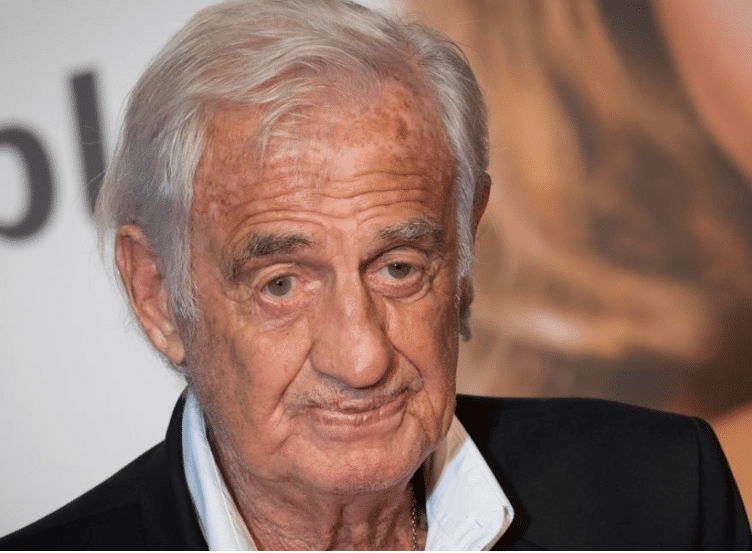
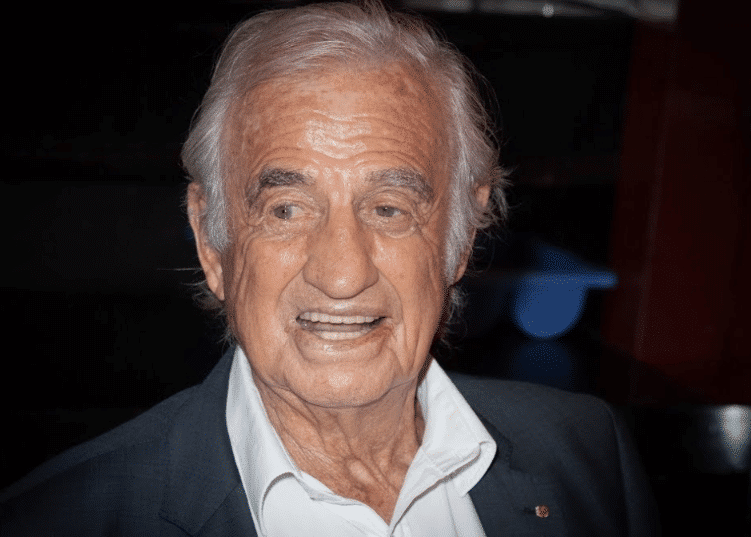
The later portraits show an older and physically changed man, but the familiar expression remains.
There is still humor in the eyes. There is still a suggestion that he understands the attention surrounding him but refuses to behave too formally because of it.
That continuity helps explain the affection contained in his nickname, “Bébel.”
A nickname of that kind cannot be manufactured easily. It develops when audiences feel that a public figure belongs not only to the screen but also to their personal memories.
Belmondo’s films had accompanied first dates, family outings, childhood afternoons and late-night television viewings. When viewers saw him again as an older man, they were also remembering earlier versions of themselves.
France’s Farewell to a National Favorite
Jean-Paul Belmondo died in Paris on September 6, 2021. He was 88 years old. The French presidency described him as a national treasure whose warmth, laughter and popular appeal had made him one of the country’s most cherished actors.
France later held a national tribute in his honor, reflecting the extraordinary place he occupied in the country’s cultural imagination.
His death ended a remarkable life, but it did not end his presence.
Belmondo still appears young whenever Breathless begins again. He continues running through adventures whenever an old action film returns to television. His laughter, gestures and physical daring remain preserved exactly as audiences first encountered them.
That is one of cinema’s quiet miracles.
Time changes the audience, the theater and the world outside. The performer within the frame remains ready to begin again.