Act I
The entire kitchen stopped moving when the homeless boy touched the plate.
For years, Gustave Dumont had believed one thing above all else:
Nobody knew his food better than he did.
His restaurant was not just a place to eat.
It was an institution.
Located in the heart of Paris, Gustave’s restaurant had become a symbol of French culinary excellence. Critics praised him. Celebrities requested private tables. Wealthy travelers planned entire trips around one dinner in his dining room.
Every dish carried his name.
Every detail had to be perfect.
And no dish represented his pride more than his famous ratatouille.
It was the recipe that helped build his reputation.
A simple dish made from vegetables, herbs, and patience.
But in Gustave’s hands, it became something extraordinary.
That evening, as always, the kitchen was filled with controlled chaos.
Knives moved quickly.
Orders were called out.
Waiters rushed between the dining room and kitchen.
And in the center of everything stood Gustave, carefully preparing his masterpiece.
He arranged every slice of zucchini, eggplant, and tomato with absolute precision.
He measured spices by instinct.
He adjusted the final touches with the confidence of someone who had spent decades mastering his craft.
When he finally stepped back, he smiled.
“Perfect.”
The dish was ready.
A few minutes later, it would be served to guests who had paid hundreds of euros for the experience.
Gustave walked away briefly to check another station.
Just one minute.
That was all it took.
When he returned, something was wrong.
Very wrong.
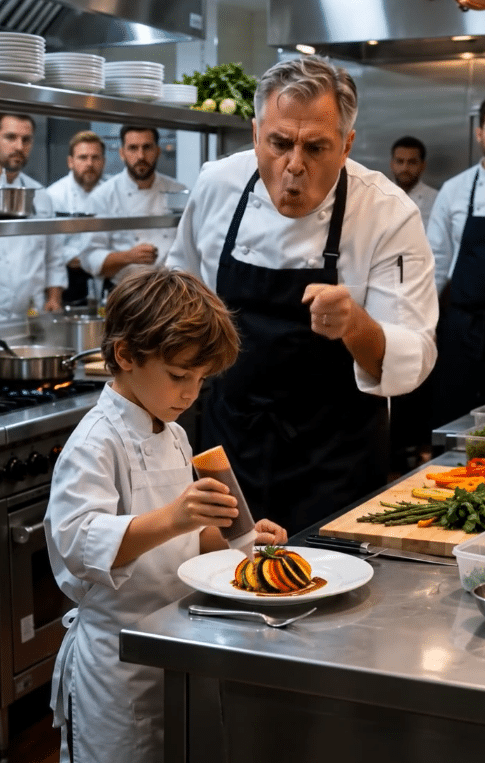
Standing beside his famous ratatouille was a boy.
A young boy wearing dirty, oversized clothes.
His shoes were worn out.
His hair was messy.
He looked like someone who had spent a long time surviving on the streets.
And he was holding a small bottle.
A bottle filled with dark liquid.
Before Gustave could understand what was happening, the boy tilted it over the dish.
A sauce.
His sauce.
The chef’s face changed instantly.
“Hey!”
The entire kitchen froze.
“What are you doing?!”
The boy did not jump.
He did not apologize.
He simply continued.
Carefully.
Calmly.
As if he belonged there.
Gustave rushed forward and grabbed the bottle from his hand.
“Who let this boy into my kitchen?”
Nobody answered.
The cooks looked confused.
The waiters looked nervous.
Nobody knew where he had come from.
The chef turned back to the boy.
“Who are you?”
The boy looked directly at him.
“I’m not just a child, Chef.”
A pause.
“I’m a cook too.”
For a second, nobody spoke.
Then laughter filled the kitchen.
Several employees covered their mouths.
Even Gustave smiled.
A homeless boy had just walked into a Michelin-star kitchen and claimed he was a chef.
It sounded ridiculous.
“Boy,” Gustave said coldly, “do you understand where you are?”
The boy stayed silent.
“This is not a street corner. This is my kitchen.”
He pointed toward the ruined dish.
“You just destroyed a dish that took me years to perfect.”
The boy shook his head.
“No, Chef.”
“I improved it.”
The laughter stopped.
Because the boy said it with complete confidence.
And somehow…
That confidence bothered Gustave more than the interruption itself.
Act II
Gustave had spent his entire life protecting his reputation.
He grew up believing that cooking was not just about food.
It was discipline.
Respect.
Tradition.
Every young chef who entered his kitchen learned quickly that Gustave had no patience for arrogance.
But what bothered him about the boy was not arrogance.
It was certainty.
The child genuinely believed he had done something right.
“Where are your parents?” Gustave asked.
The boy looked down for a moment.
“I don’t have any.”
The kitchen became quieter.
“I live on the streets.”
Some of the employees stopped smiling.
The boy continued.
“But I know food.”
Gustave crossed his arms.
“From where?”
The boy looked around the kitchen.
“At first, from leftovers.”
Nobody laughed this time.
“When restaurants threw away food, I learned what people wasted.”
His voice remained calm.
“Then I learned what ingredients were supposed to taste like.”
The cooks listened.
The boy explained that he spent years watching chefs from outside restaurant windows.
He memorized techniques.
He studied combinations.
He learned by observing.
Because he could not afford culinary school.
He could not afford expensive ingredients.
So he learned from whatever he could find.
Gustave almost dismissed him.
Almost.
Until the boy pointed toward the ratatouille.
“You made the same mistake every time.”
The chef’s eyes narrowed.
“Excuse me?”
The boy walked closer to the dish.
“You made it beautiful.”
He looked at the vegetables.
“But you forgot something.”
The room became silent.
“What?”
The boy looked at Gustave.
“You forgot the person eating it.”
That sentence hit differently.
Because nobody spoke to Gustave that way.
Not critics.
Not employees.
Not even other famous chefs.
The boy continued.
“Your ratatouille is perfect. But perfect is not always memorable.”
Gustave wanted to argue.
But the boy reached for a spoon.
He tasted the dish.
Then he added something small.
Not a large amount.
Not something dramatic.
Just a careful adjustment.
A few drops.
A tiny change.
Then he looked at Gustave.
“Now taste it.”
The chef almost refused.
Almost.
But something about the boy’s confidence made him curious.
He took the spoon.
He tasted the ratatouille.
And his expression changed.
Not dramatically.
Not immediately.
But enough.
The kitchen noticed.
Because everyone knew Gustave’s face.
They knew when he was angry.
They knew when he was disappointed.
They knew when he was impressed.
And right now…
He was surprised.
Act III
For several seconds, Gustave said nothing.
The entire kitchen waited.
The cooks.
The waiters.
The assistants.
Everyone wanted to know what the famous chef would say.
Finally, Gustave placed the spoon down.
“What did you add?”
The boy shrugged.
“Something your dish was missing.”
“That’s not an answer.”
The boy looked at him.
“Memory.”
The chef frowned.
The boy explained.
A great dish was not only about technique.
It was about emotion.
About making someone remember something.
The boy had noticed that Gustave’s ratatouille was flawless but distant.
Every ingredient was controlled.
Every flavor was measured.
But there was no warmth.
So the boy adjusted it using a simple technique he had learned from watching an elderly woman who once shared food with him on the street.
A small change.
A different balance.
Something that reminded people of home.
The kitchen remained silent.
Because suddenly, nobody was looking at a homeless child.
They were looking at someone who understood food in a way many trained chefs never did.
Gustave studied him carefully.
“Who taught you?”
The boy hesitated.
Then he answered.
“Many people.”
He explained that when he lived on the streets, different strangers helped him survive.
An old baker taught him how to work with dough.
A retired cook showed him how to respect ingredients.
A woman who owned a small café taught him that food was meant to bring people together.
He remembered everything.
Because every lesson mattered.
Gustave looked at the boy differently now.
But there was still one question.
“How did you even get inside this kitchen?”
The boy looked away.
And the answer surprised everyone.
He had not entered to steal food.
He had not entered to cause trouble.
He came because he saw the restaurant throwing away vegetables that were still good.
He wanted to show them that wasted food could become something meaningful.
And then Gustave noticed something.
The bottle the boy carried.
The sauce.
It was not random.
It was made from ingredients that would normally have been thrown away.
The boy had created something from nothing.
Just like he had done with his own life.
And for the first time in years, Gustave felt something unfamiliar.
Humility.
Act IV
The story could have ended there.
Gustave could have called security.
He could have sent the boy away.
He could have pretended nothing happened.
But he didn’t.
Instead, he asked one question.
“What is your name?”
The boy looked surprised.
“Leo.”
Gustave nodded.
“Leo, if you believe you are a cook…”
He looked toward the kitchen.
“Then prove it.”
The employees exchanged confused looks.
The famous chef was giving a homeless boy a chance?
It seemed impossible.
Gustave placed a challenge in front of him.
Create a dish.
No instructions.
No help.
Just ingredients.
Leo looked at the vegetables on the counter.
And he began.
At first, some employees still doubted him.
They expected a disaster.
But slowly, the atmosphere changed.
The boy moved with confidence.
Not the confidence of someone showing off.
The confidence of someone who understood every ingredient in front of him.
He did not rush.
He did not copy Gustave.
He created something completely different.
When the dish was finished, Gustave tasted it.
Then he did something nobody expected.
He walked out into the dining room.
He placed the dish in front of a table of important guests.
The guests had no idea who had prepared it.
They only knew they were trying a new creation.
Minutes later, the reactions began.
Surprise.
Confusion.
Emotion.
One guest closed his eyes and smiled.
“It reminds me of my grandmother’s cooking.”
Another said:
“I don’t know why, but this feels like a memory.”
Gustave stood quietly.
Because he understood.
The boy had done what he himself had forgotten how to do.
He had created a feeling.
But there was still one final secret about Leo that Gustave had not discovered.
A secret that would completely change the way he saw the boy.
Act V
Several days later, Gustave learned the truth.
Leo had not always lived on the streets.
Years earlier, his mother had worked in a small family restaurant.
She was not famous.
She had no awards.
No wealthy customers.
But she loved cooking.
She taught Leo the one lesson that stayed with him.
“Food is not about making people impressed.”
“It is about making people feel cared for.”
After she passed away, Leo lost everything.
But he kept her recipes.
He kept her lessons.
And he kept cooking.
Even when he had almost nothing.
When Gustave heard this, he understood something.
The boy had not entered his kitchen to challenge him.
He entered because he believed food mattered.
Something Gustave himself had almost forgotten.
The famous chef offered Leo a place in his kitchen.
Not as a charity.
Not as a favor.
As a student.
Because Gustave knew talent when he saw it.
Years later, people would still talk about the day a homeless boy walked into one of Paris’s greatest restaurants.
But the most surprising part was not that Leo changed Gustave’s famous recipe.
It was that he changed Gustave.
The chef who believed perfection was everything learned that perfection without heart meant nothing.
And the boy who had nothing taught a room full of professionals the most important lesson in cooking:
A great dish does not come from expensive ingredients.
It comes from knowing why you are making it.
Because sometimes, the person everyone thinks has nothing to offer…
is the person carrying the lesson everyone else forgot.