Act I
The room went silent before anyone understood why.
Except there was no room.
There was only the gray Oregon sky, the violent wind, the hiss of the retreating ocean, and my eleven-year-old Golden Retriever standing between a screaming child and the water as if he were guarding the gates of hell.
Buster had never bared his teeth at a living soul.
Not once.
He was the kind of dog who let toddlers pull at his ears and watched butterflies land on his nose without moving. Arthritis had slowed him to a stiff-legged shuffle, and most mornings, the greatest challenge he faced was climbing the three wooden steps to our porch.
But that morning at Cannon Beach, something inside him changed.
One second, he was sniffing a strip of kelp.
The next, the leash tore through my hand.
“Buster!”
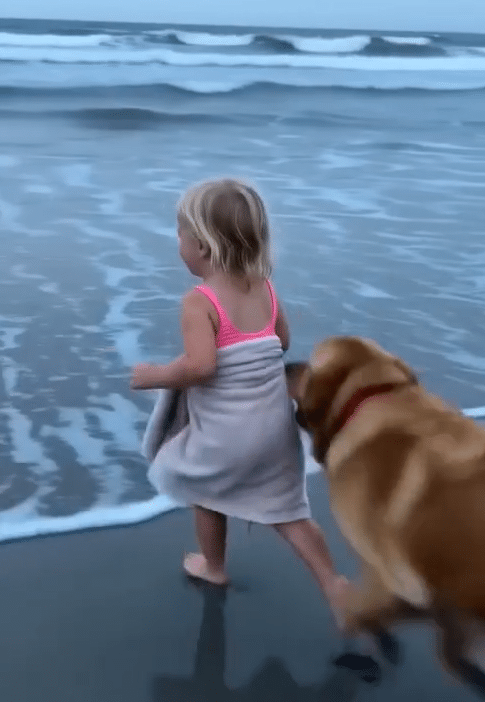
He sprinted toward the shoreline with a speed I had not seen in years. His paws struck the sand hard, his body low, his attention locked on a little girl in a bright pink swimsuit splashing in the shallow foam.
She was laughing.
Her mother was several yards away, bent over a tote bag.
By the time anyone realized what was happening, Buster had already reached her.
He slammed his eighty-pound body into the child and knocked her backward onto the wet sand.
Her scream tore across the beach.
Buster planted himself over her, barking wildly, his front paws braced on either side of her body. To everyone watching, it looked monstrous.
A large dog towering over a terrified little girl.
Her mother came running.
“Get away from her!”
I reached Buster and grabbed his collar with both hands. I pulled until my shoulders burned.
He would not move.
He was not looking at the girl.
He was not looking at me.
He was staring at the water.
The child’s mother dragged her daughter away and wrapped both arms around her. The little girl was crying so hard she could barely breathe.
A lifeguard rushed over, whistle still clenched between his teeth.
“Control your animal,” he shouted. “Now.”
“I’m trying.”
“Your dog attacked a child.”
“He’s never done anything like this.”
The words sounded useless the moment they left my mouth.
A crowd had begun to form.
Their faces carried the same expression: fear sharpened into judgment.
Someone said Buster should be put down.
Someone else asked why he was not muzzled.
The lifeguard reached for his radio.
My hands began to shake.
Buster had been with me through divorce, grief, and the death of my father. He had slept beside my bed when I was too broken to leave it. He had rested his head on my knees during the darkest years of my life without ever asking for anything in return.
Now one terrible moment was about to erase all of that.
“Please,” I said. “He’s old. He’s gentle. Something is wrong.”
“I don’t care what he usually is,” the lifeguard snapped. “I care what he just did.”
Then I felt Buster trembling against my leg.
Not snarling.
Not straining toward the child.
Trembling.
His eyes were wide and fixed on the patch of shoreline where the little girl had been standing. A low whine escaped his throat.
He pressed his body against my knees and tried to push me backward.
Away from the water.
“Look at him,” I whispered.
The lifeguard ignored me.
“Look at him!”
Something in my voice made everyone stop.
The mother tightened her grip around her daughter.
The crowd turned.
Buster pawed frantically at the sand, then looked toward the water again.
The tide drew back with a long, whispering hiss.
For one second, the shoreline looked perfectly normal.
Then the sand collapsed.
And something dark appeared underneath.
Act II
The first crack opened like a mouth.
It began as a narrow line in the wet sand, no wider than a finger. Then it spread outward in both directions, tracing an uneven circle around the exact place where the little girl had been standing.
The ground sank.
Not gradually.
All at once.
A section of sand nearly six feet across dropped downward with a deep, muffled groan.
The crowd screamed and staggered back.
Cold seawater rushed into the opening.
The smooth beach vanished, revealing a hollow cavity beneath it.
The little girl’s mother stared at the hole, her face drained of color.
Her daughter had been standing directly over it.
Had Buster knocked her down two seconds later, she would not have fallen onto solid sand.
She would have gone through.
The lifeguard lowered his radio.
For the first time, he had no words.
Buster barked again, but now everyone heard it differently.
It was not rage.
It was warning.
The lifeguard ordered the crowd back and called for emergency assistance. Another guard ran over carrying a rescue board and a coil of rope.
“What is that?” someone asked.
No one answered.
The hole continued widening as each retreating wave pulled more sand from beneath the surface. The edges crumbled inward, exposing splintered wood, twisted rope, and something that looked like rusted metal.
I kept one hand on Buster’s collar, though he was no longer trying to run.
He sat beside me, shaking.
The little girl’s sobbing had softened. She stared at him from her mother’s arms.
“Did he know?” her mother whispered.
I looked down at Buster.
“I think he heard it.”
But that was only part of the truth.
Buster had always been sensitive to things I could not detect. He knew when storms were coming long before the sky changed. He refused to walk across loose boards. Once, years earlier, he woke me in the middle of the night because a kitchen outlet had begun to smolder behind the wall.
Still, this was different.
He had not simply sensed danger.
He had recognized something.
The lifeguards secured the area while a fire rescue unit made its way down the beach. One of the guards crouched near the edge and shone a flashlight into the cavity.
“There’s a structure under here,” he said.
“What kind of structure?”
“Old timber framing. Maybe part of a drainage system.”
He leaned farther.
Then he stopped.
“What?”
He did not answer immediately.
“There’s a chain.”
The beach had changed within minutes.
The small gathering became a restricted scene. Police arrived. Rescue crews drove stakes into the sand and ran bright tape around the area.
The little girl’s mother remained close, still clutching her daughter.
Her name was Emily.
The girl’s name was Sophie.
When Sophie finally stopped crying, she pointed at Buster.
“Is he mad at me?”
The question broke something inside me.
I crouched beside her, though her mother watched carefully.
“No,” I said. “He was scared for you.”
Sophie looked toward the collapsed sand.
Then back at Buster.
“He pushed me.”
“Yes.”
“Because I was on the hole?”
“I think so.”
Her mother closed her eyes.
The horror of what nearly happened was beginning to settle into her body. She pulled Sophie closer and buried her face in the child’s wet hair.
“I thought he was attacking her,” she whispered.
“So did I.”
The words carried more shame than relief.
A police officer asked for my information. He took my name, my address, and Buster’s vaccination history. His tone was calmer than the lifeguard’s had been, but I knew the report had already begun.
An animal control officer was on the way.
Even after the hole appeared, the situation was not automatically over.
Buster had still knocked down a child.
There would still be questions.
There would still be forms.
But the crowd had gone quiet.
No one was asking for him to be put down anymore.
Near the collapsed area, rescue workers began lifting debris from the cavity.
They removed a blackened plank.
Then a length of rope.
Then a corroded iron ring attached to a section of timber.
One of the firefighters studied it.
“This isn’t drainage infrastructure,” he said.
The police officer turned toward him.
“What is it?”
The firefighter wiped sand from the metal.
“It looks like part of an old boat.”
The words should have explained everything.
Instead, they made Buster start whining again.
Because beneath the timbers, deeper inside the hollow, the flashlight had caught something else.
Something pale.
Something that looked like a child’s hand.
Act III
The beach erupted into motion.
The firefighters ordered everyone farther back. Sophie’s mother covered her daughter’s eyes. Police widened the perimeter as rescue crews pulled on gloves and began clearing sand by hand.
I could not move.
Buster stood rigid beside me.
The pale shape beneath the wreckage was not moving.
For several unbearable minutes, no one spoke loudly enough for us to hear. The wind carried fragments of conversation.
Human remains.
Possible skeletal material.
Old burial.
Preserve the scene.
A detective arrived less than half an hour later.
By then, the pale hand had been identified as bone.
Not recent.
Not a child who had fallen there that morning.
Someone who had been hidden beneath the sand for years.
The collapsed cavity was part of a wrecked fishing vessel buried below the beach. Storm patterns had shifted the shoreline over time, covering what remained of the boat beneath layers of compacted sand.
The retreating tide had hollowed out the space beneath the surface.
Sophie had been running across a natural ceiling only inches thick.
But the bones changed the story.
They found a small rib cage.
A rusted buckle.
A silver chain tangled around one of the wooden beams.
Then they found a metal identification tag.
The detective cleaned it carefully.
The name stamped into the surface was barely readable.
But I recognized it.
My breath stopped.
The last name belonged to my father.
For a moment, the world narrowed to the tag in the detective’s gloved hand.
I heard the waves.
I heard Sophie crying again.
I heard the low sound Buster made beside me.
But everything felt very far away.
“Where did you get this dog?” the detective asked.
I stared at him.
“What?”
“Your dog. How long have you had him?”
“Eleven years.”
“And where did he come from?”
“A rescue shelter in Tillamook.”
The detective looked back toward the remains.
“Did your father ever own a boat?”
The question landed like a blow.
“Yes.”
My father, Daniel Mercer, had been a commercial fisherman.
He had disappeared nineteen years earlier.
Everyone believed he had gone overboard during a storm.
His boat, the Maribel, was never recovered.
Neither was his body.
There had been a Coast Guard search, an insurance investigation, and months of newspaper coverage. My mother spent years waiting for a phone call that never came.
But there was another person on that boat.
My younger brother, Owen.
He was twelve.
My father had taken him out for what was supposed to be a short morning trip before the weather turned. Their disappearance destroyed my family.
My mother never recovered from it.
She died eight years later with Owen’s school photograph still inside her wallet.
The detective’s voice softened.
“What was the name of your father’s vessel?”
I looked toward the broken timbers emerging from the sand.
“The Maribel.”
The wreckage under the beach became an active recovery site.
The corroded identification tag had belonged to Owen.
They found a second set of remains deeper in the hull.
An adult male.
My father.
I sank onto the sand.
Buster lowered himself beside me with difficulty, his old hips trembling. He placed his head across my lap.
I held him and cried into his fur while strangers uncovered the grave my family had been searching for nearly two decades.
But the mystery only deepened.
The Maribel had not sunk offshore.
It had washed into a narrow inlet and become buried beneath a massive dune collapse during the storm. Old coastal maps showed that the beach had once curved inward at that point before erosion reshaped the coastline.
My father and brother had been trapped inside the wreck.
Yet one question remained.
How had Buster known?
The answer came two days later.
The rescue shelter checked its archived intake files.
Buster had been found as a puppy nineteen years ago.
Not eleven.
His age had been estimated incorrectly when I adopted him.
He was older than anyone realized.
The file contained a faded photograph.
A Golden Retriever puppy with a dark patch near one ear.
Around his neck was a blue collar with a brass tag.
The name on it was not Buster.
It was Sunny.
My brother’s dog.
I stared at the photograph until my vision blurred.
Owen had begged for that puppy.
He took Sunny everywhere.
The morning my father and brother disappeared, neighbors remembered seeing the dog on the dock.
But the Coast Guard report never mentioned him.
Everyone assumed Sunny had drowned too.
He had not.
He must have escaped the wreck.
Somehow, the puppy made it back to shore. He was found injured nearly six miles away and taken to a shelter under the wrong intake date.
Years later, I walked into that same shelter and adopted an aging Golden Retriever because something in his eyes felt familiar.
Buster was not simply my dog.
He had belonged to my brother.
And when he reached that stretch of beach, after all those years, he had smelled the buried wreck.
He had remembered.
But the police had not yet discovered the final secret inside the Maribel.
And it would change how my family understood that night forever.
Act IV
Inside a rusted storage compartment beneath the collapsed cabin floor, investigators found a waterproof case.
Its seal had held.
Inside were navigation charts, receipts, a small cassette recorder, and a bundle of documents wrapped in plastic.
One of the documents was a letter from my father.
It was addressed to my mother.
The ink had bled around the edges, but most of the words remained readable.
My father had not gone out that morning for a simple fishing trip.
He had been gathering evidence.
For months, he had suspected that the company leasing space at the local marina was illegally dumping industrial waste offshore. Dead fish had washed up near the inlet. Several fishermen had developed unexplained skin burns after handling damaged nets.
My father had photographed barrels being loaded at night.
He recorded boat registration numbers.
He kept copies of invoices.
He had planned to give the evidence to a federal investigator.
But someone found out.
The cassette contained a final recording.
The quality was poor, filled with wind and static, but the voices were clear enough.
My father was arguing with another man on the dock.
The man threatened him.
He told my father to forget what he had seen.
My father refused.
Then came the sound of Owen calling for Sunny.
The recording ended minutes later.
Investigators discovered signs that the Maribel’s fuel line had been cut before it left the marina. The storm had not caused the disaster alone.
My father had lost engine power in dangerous water.
He tried to steer toward the inlet, but the vessel was driven into submerged rock. The hull broke apart near shore.
The wreck became trapped beneath falling sand and timber.
He and Owen had almost made it back.
That was the detail that haunted me most.
The boat had not disappeared in deep water.
They had died beneath a beach where families later flew kites and built sandcastles.
The person recorded threatening my father was identified as Martin Vale, the former owner of the marina.
Vale was now seventy-three, wealthy, and respected.
He had served on charitable boards. He donated to coastal preservation groups. He appeared in local magazines as a model businessman.
When police questioned him, he denied everything.
He called the recording unclear.
He said the documents had been misinterpreted.
Then investigators found my father’s photographs.
One showed Vale beside the barrels.
Another showed him paying a crewman.
A third captured the registration number of a disposal vessel later linked to illegal dumping.
The case became national news.
Reporters gathered outside the police station.
The same people who had once demanded Buster be destroyed now called him a hero.
But Buster did not understand any of that.
He slept for most of the day.
The run across the beach had aggravated his arthritis badly. The veterinarian found swelling in both hips and a strained ligament in one front leg.
“He pushed beyond what his body could handle,” she told me.
I looked through the examination-room window at him lying on a blanket.
“He knew she was in danger.”
The veterinarian nodded.
“And he decided it mattered more than the pain.”
Sophie and her mother came to visit him.
Emily stood in the doorway holding a small paper bag.
For a moment, neither of us knew what to say.
Then she started crying.
“I called him vicious,” she whispered. “I said he should be taken away.”
“You were scared.”
“I was wrong.”
She knelt beside Buster and placed the bag on the floor. Inside was a new leather collar.
A small silver plate had been fastened to it.
BUSTER
SUNNY
HERO
Sophie wrapped her arms around his neck.
“Thank you for pushing me,” she said.
Buster lifted his head and licked her cheek.
The photograph appeared in newspapers across the country.
But the investigation was still not finished.
During the recovery, detectives found one more object inside the wreck.
It was a sealed envelope tucked inside Owen’s jacket.
And my name was written on it.
Act V
Owen had been twelve years old when he died.
The letter inside the envelope had been folded four times.
The handwriting was uneven and rushed.
He had written it before leaving the house that morning.
Dear Claire,
Dad says I can come with him if I promise not to complain about the cold. I know you’re still mad because I broke your headphones, but I fixed them with tape. They look bad, but they work.
Sunny keeps following me because he thinks every boat ride is for him.
When we get back, I’ll let you have the last piece of Mom’s pie.
Don’t tell her I said that.
Your annoying brother,
Owen
I read the letter at my kitchen table with Buster sleeping at my feet.
For nineteen years, I had carried guilt over the last conversation I had with my brother.
We had argued over those headphones.
I told him I wished he would disappear.
Then he did.
I knew I had not caused the accident, but grief does not care about logic. It finds one careless sentence and builds a prison around it.
Owen’s letter opened the door.
He had not left believing I hated him.
He had expected to come home.
He had saved me pie.
That small, ordinary promise broke me more completely than any funeral could have.
Martin Vale was arrested three weeks later.
He was charged in connection with the sabotage, illegal dumping, obstruction, and the deaths of my father and brother. Several former employees agreed to testify after investigators reopened old financial records.
The truth had waited under the sand for nineteen years.
It was exposed because an aging dog refused to ignore what everyone else could not see.
My father and Owen were finally buried beside my mother.
At the funeral, Sophie stood beside me holding Buster’s leash.
He wore the collar she had given him.
The ceremony was small.
The sky was clear.
When the wind moved through the cemetery, Buster lifted his head as if listening for someone.
I placed Owen’s old brass dog tag beneath the flowers on his grave.
“You found him,” I whispered.
Buster leaned against my leg.
He died four months later.
There was no dramatic final moment.
No storm.
No miracle.
He fell asleep in his favorite place beside the fireplace, his head resting on my foot.
His body had simply grown tired.
I buried him near my family.
His marker carried both names.
BUSTER “SUNNY” MERCER
HE REMEMBERED
People still ask me whether I believe dogs understand the past.
I do not know.
I cannot explain how memory lives inside an animal, or how one smell can survive nearly two decades, or why Buster recognized danger before any human saw it.
I only know what happened.
An old dog with failing joints ran through pain to knock a little girl away from a hidden grave.
Everyone thought he had become dangerous.
Everyone thought his gentleness had finally failed.
But Buster had not changed.
He had been the same dog all along.
Loyal to a child he had lost.
Loyal to the family that unknowingly found him again.
And gentle enough to risk being hated for doing the one thing he had been trying to do since the day the Maribel vanished.
Bring someone safely home.