Act I
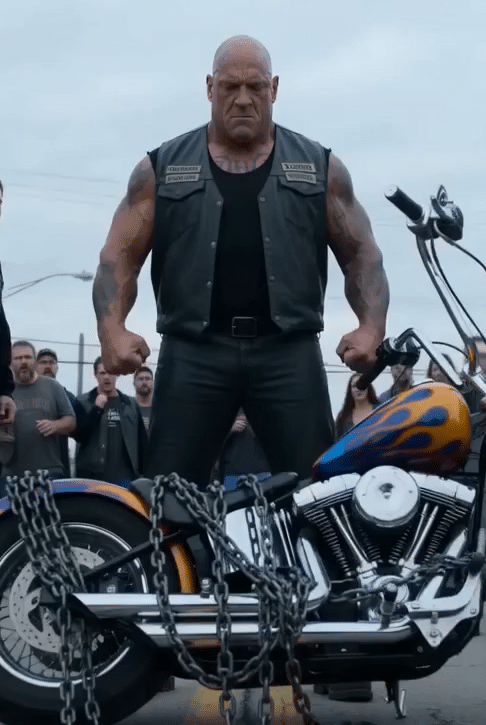
I stared at the heavy iron chains wrapped around my motorcycle, the metal links scraping against the asphalt like a death rattle.
Three local punks stood over the bike with baseball bats, laughing as one of them spat across the leather seat I had spent ten years imagining while rotting inside a maximum-security cell.
Every muscle in my thirty-nine-year-old body screamed to tear them apart.
To remind them why the name Axle used to make men cross the street.
But I did not move.
I stood outside Marlow’s Diner on a crowded Friday afternoon in Ohio, my fists hanging at my sides while strangers gathered along the sidewalk to watch a giant man covered in faded prison tattoos do absolutely nothing.
The punks thought they smelled fear.
It was not mine.
It belonged to everyone waiting for the fuse to reach the powder.
The tallest of the three was Brody Kane, a twenty-two-year-old dropout with a neck tattoo, a borrowed truck, and the confidence of a man who had never met consequences he could not outrun.
He stepped closer and blew cigarette smoke into my face.
My fists tightened until the old scars across my knuckles turned white.
I could have dropped him in two seconds.
I knew exactly how.
The body does not forget violence just because the mind has sworn it off.
Brody tapped his aluminum bat against my front tire.
The sharp metallic sound went through me.
“What’s the matter, jailbird?” he asked. “Lose your spine in the slammer?”
His friends laughed.
“Or did you forget how to fight without your little gang?”
I kept my eyes on the cracked pavement.
Fifteen months.
That was how long I had been out.
Fifteen months of parole meetings, drug tests, night shifts, anger counseling, and swallowing every insult the town had saved for me during the decade I was gone.
I had washed dishes.
Changed tires.
Unloaded produce trucks before sunrise.
I had lived in a one-room apartment above a shuttered hardware store because nobody else wanted my name on a lease.
Every day, I told myself the same thing.
The monster was dead.
Brody wanted proof that it was still alive.
He lifted the bat higher and aimed it toward the custom fuel tank I had painted by hand.
Black enamel.
Silver flames.
A tiny blue star near the gas cap.
The star had been added by a six-year-old boy named Toby Bell.
Toby lived next door to the garage where I worked. He came by after school with scraped knees and endless questions, asking what every tool did and whether motorcycles could outrun storms.
He never asked why I had been in prison.
He only asked whether he could help.
I was watching him now.
He stood in the crowd beside his mother, his eyes wide with confusion and horror.
He had seen me fix broken engines.
Carry groceries for Mrs. Pike.
Pull a stray dog from beneath a drainage pipe.
In his mind, I was not Axle Mercer, convicted felon.
I was the man who let him sort washers into coffee cans and taught him never to touch a hot exhaust pipe.
Brody raised the bat.
That was when Toby broke free.
His mother grabbed for him, but he slipped through her hands and ran across the pavement.
His tiny sneakers slapped against the sidewalk as he charged directly between my boots and Brody’s bat.
A gasp moved through the crowd.
Toby did not look at the thugs.
He looked up at me.
Tears ran through the dirt on his cheeks.
“Stop it!” he screamed.
His voice cracked so sharply that every person on the sidewalk fell silent.
He threw both arms around my leather vest and pressed his face against my chest.
“You promised me, Axle,” he sobbed. “You promised you were good now.”
My throat closed.
“Don’t look at them,” he begged. “Please don’t look at them.”
Brody lowered the bat slightly.
For the first time, uncertainty crossed his face.
I placed one hand over the back of Toby’s head.
“I’m not going to hurt anybody,” I said.
Brody laughed again, but it sounded weaker.
“Look at this,” he said. “Big bad Axle needs a kid to protect him.”
Toby pulled away from my chest and turned.
“He doesn’t need me to protect him,” he shouted. “He’s protecting you.”
The crowd went still.
Brody’s jaw tightened.
He stepped forward.
Then a woman’s voice cut through the air from behind us.
“That’s enough, Brody.”
I knew that voice.
I had heard it once through a courtroom door ten years earlier, begging a judge to bury me alive.
I turned slowly.
Sheriff Dana Bell stood at the edge of the crowd.
Toby’s mother.
And the widow of the man I had gone to prison for killing.
That was when everyone realized this was never just about a motorcycle.
Act II
Ten years earlier, I had been known as Aaron Mercer.
Almost nobody called me that anymore.
Back then, I rode with a club called the Iron Saints.
We were not saints.
We moved stolen parts, ran illegal races, collected debts, and frightened people who had never done anything worse than owe the wrong man money.
I was twenty-eight and angry at the world.
Angry at my father for leaving.
Angry at my mother for dying.
Angry at every man who had ever looked at me and seen exactly what I was afraid I might become.
Violence gave me a reputation.
The reputation gave me power.
For a while, power felt close enough to respect.
Then one winter night, everything ended behind an abandoned mill outside town.
A man named Michael Bell was found dead beside his patrol car.
He had been a deputy sheriff.
He had also been Toby’s father.
Witnesses placed my motorcycle near the mill.
My fingerprints were found on Michael’s jacket.
His blood was on my shirt.
And the gun recovered from the river had once belonged to a member of the Iron Saints.
I was arrested before sunrise.
The case became the biggest story the county had seen in years.
Former gang enforcer murders decorated deputy.
That was the headline everyone wanted.
I gave it to them.
At trial, I said almost nothing.
When the prosecutor called me a remorseless animal, I did not react.
When Michael’s pregnant widow stood in court and said I had stolen her child’s father, I stared straight ahead.
When the judge sentenced me to twenty-five years, I nodded once.
I served ten before the sentence was reduced for cooperation in an unrelated federal case.
The town saw that as another injustice.
A killer coming home early.
They did not know what happened at the mill.
They did not know that Michael Bell had not been chasing me that night.
He had called me there.
For months, Michael had been investigating a network of stolen firearms moving through the county.
The Iron Saints were involved, but they were not running it.
The real operation belonged to powerful people.
Business owners.
A councilman.
Two sheriff’s deputies.
And one man who would later become the most respected figure in town.
Michael knew I wanted out of the club.
He offered me a deal.
Evidence in exchange for protection.
I was supposed to hand him a ledger listing shipments, buyers, and payoffs.
But someone found out.
When I reached the mill, Michael was already bleeding.
A man in a dark coat stood over him.
I saw the man’s face.
He saw mine.
Then he aimed a gun at me.
Michael tackled him.
The shot went off.
Michael fell.
I attacked the shooter, but he escaped through the loading bay.
By the time I reached Michael, there was blood everywhere.
He grabbed my jacket and forced a small brass key into my hand.
“Keep Dana safe,” he whispered.
Then he died.
The police arrived three minutes later.
The deputy leading the arrest was part of the operation.
He told me Dana Bell would be dead before morning if I said a word.
So I confessed to being at the scene.
I refused to identify anyone.
And I let the town believe the easiest story.
At first, I told myself I was protecting Michael’s widow.
Then the years passed.
The men involved gained money and influence.
Dana raised Toby alone.
And my silence became its own kind of cowardice.
When I was released, I moved back because the key Michael gave me was still hidden where only I could reach it.
Inside the frame of my old motorcycle.
The bike had sat for ten years in a storage unit under my mother’s name.
I rebuilt it slowly.
Every bolt.
Every cable.
Every scar across the tank.
The brass key remained sealed beneath the seat.
I did not know what it opened.
But I knew Michael had died to give it to me.
Brody did not know that when he chained the motorcycle.
He only knew humiliating the town’s most hated man would make him look powerful.
But Sheriff Dana Bell knew something was wrong the moment she saw my face.
Not rage.
Fear.
I was not afraid of Brody.
I was afraid he would damage the one piece of evidence that might finally explain why her husband died.
Dana stepped between Toby and the baseball bat.
“Put it down,” she ordered.
Brody smiled.
“Relax, Sheriff. We’re just having fun.”
“You chained private property and threatened a man with a weapon.”
“He’s a murderer.”
Dana’s eyes moved toward me.
For ten years, that word had lived between us.
Murderer.
She had used it in interviews.
At community meetings.
Once, outside the prison after a parole hearing.
But that afternoon, something changed.
She looked at my motorcycle.
Then at the chain.
Then at the blue star Toby had painted near the tank.
“What is inside that bike?” she asked quietly.
My stomach turned.
Brody heard her.
Before I could answer, he swung the bat.
The aluminum barrel smashed into the side panel.
Metal cracked.
The seat shifted.
And a small brass key fell onto the pavement.
Dana stared at it.
Her face lost all color.
Because she recognized it.
It belonged to a deposit box her dead husband had opened three days before his murder.
Act III
The crowd vanished within minutes.
Dana ordered Brody and his friends against the diner wall while another deputy called for backup.
Toby stood beside his mother, still gripping my vest.
No one laughed anymore.
Dana crouched and picked up the key using a handkerchief.
Her fingers trembled.
“Where did you get this?”
“Michael gave it to me.”
She stood so quickly that Toby flinched.
“Do not say his name.”
“He gave it to me at the mill.”
“You expect me to believe that?”
“No.”
My voice came out rough.
“I stopped expecting that years ago.”
Dana’s eyes burned.
“You had this the entire time?”
“Yes.”
“Why?”
“Because the men who killed him threatened you.”
Her expression hardened.
“You killed him.”
“No.”
It was the first time I had ever said those words to her.
Not in court.
Not at a parole hearing.
Not through an attorney.
Dana stared at me as if the ground had shifted beneath her boots.
Behind us, Brody swore loudly.
One of the deputies pushed him back against the wall.
Dana lowered her voice.
“Who did?”
I looked toward the street.
A black SUV had slowed near the intersection.
Tinted windows.
County plates.
The vehicle paused for two seconds, then drove on.
“We should not talk here,” I said.
Dana saw the SUV.
Something in her face changed.
She took Toby by the hand and led us through the diner’s rear entrance.
The owner locked the door behind us.
In the small office beside the kitchen, I told her everything.
The gun-running operation.
The corrupt deputies.
The ledger.
The threat.
Michael’s last words.
Dana listened without interrupting.
Her face remained controlled until I told her the name of the man in the dark coat.
Judge Everett Kane.
Brody’s father.
Before becoming a judge, Everett Kane had been the county prosecutor who built the case against me.
He had stood twelve feet away in court and asked the jury to see me as an animal.
He knew exactly who killed Michael Bell.
Because he had pulled the trigger.
Dana sat down slowly.
“No.”
“He was at the mill.”
“No.”
“He ran the operation.”
“You are lying.”
“He prosecuted me to close the case.”
She slapped me.
The sound filled the office.
Toby began to cry.
Dana froze.
I did not move.
I had been struck by larger men.
Beaten by guards.
Stabbed once in a prison laundry room.
But the look on Dana’s face hurt more than any of it.
She was not angry because she believed I was lying.
She was angry because part of her already knew I was telling the truth.
Judge Kane had supported her after Michael’s death.
He helped secure benefits.
Attended memorials.
Spoke at Toby’s school.
Every year, he placed flowers at Michael’s grave.
Monsters rarely survive by looking like monsters.
They survive by standing close to grief and calling themselves comfort.
Dana opened an old records database on the diner owner’s computer.
The brass key bore a number.
Box 317.
The box had been rented at a private bank in Columbus.
The account holder was Michael Bell.
The access record showed no entry since two days before his death.
Dana called the bank and identified herself.
The manager confirmed that the box still existed but required either a court order or documentation naming the lawful beneficiary.
Dana was Michael’s surviving spouse.
She had the documents.
We drove to Columbus that evening in an unmarked cruiser.
Toby stayed with Dana’s sister.
Neither of us spoke much.
Halfway there, Dana asked the question I had dreaded.
“Why did you come back?”
“To open the box.”
“You could have mailed me the key.”
“I tried.”
She looked over.
“What?”
“I sent three letters from prison.”
“I never received them.”
I nodded.
“I know.”
One letter had been returned.
The other two disappeared.
After my release, I discovered they had been routed through the county prosecutor’s office under a victim-contact restriction signed by Everett Kane.
He had intercepted them.
Dana gripped the steering wheel harder.
At the bank, the manager led us into a private room.
The brass key opened Box 317.
Inside were four items.
A flash drive.
A handwritten ledger.
A photograph.
And a sealed envelope addressed to Dana.
She opened the letter first.
Michael’s handwriting covered three pages.
Dana read in silence.
Then her shoulders began to shake.
The letter explained everything.
Michael had been working with federal investigators.
He had identified Everett Kane as the head of the operation.
Two deputies and three local businessmen were named.
The ledger documented shipments, dates, and payments.
The photograph showed Kane beside crates of weapons in the abandoned mill.
The flash drive contained recorded conversations.
But the final paragraph broke Dana.
Michael wrote that Aaron Mercer had agreed to testify.
He wrote that I was taking an enormous risk.
He wrote that if anything happened to him, Dana should trust me.
For ten years, she had hated the only man her husband had asked her to believe.
Dana covered her mouth.
“I sent you to prison.”
“No,” I said. “Kane did.”
“You let me stand in court and condemn you.”
“I thought it kept you alive.”
She looked up, tears running freely now.
“And did it?”
I thought about ten years in a concrete cell.
Ten years of birthdays, funerals, and sunlight seen through wired glass.
“No,” I said. “It only kept the truth buried.”
Then the bank manager entered the room.
His face was tense.
“There are federal agents in the lobby,” he said. “And a man outside claiming he has a warrant for your arrest.”
Dana looked through the glass.
Judge Everett Kane stood beside two county deputies.
His son’s baseball bat had cracked open more than a motorcycle panel.
It had cracked open a decade-old conspiracy.
And Kane had come to close it again.
Act IV
Dana did not panic.
She photographed every page in the box and sent the files to three separate contacts, including an FBI agent named in Michael’s letter.
Then she placed the flash drive in her pocket.
The ledger went beneath her vest.
The original letter stayed in her hand.
When we entered the lobby, Kane was waiting.
He was sixty-one now, silver-haired and perfectly composed.
To the public, he looked like a man built for trust.
He looked at me first.
“Aaron.”
No one called me that anymore.
“You should have stayed gone,” he said.
Dana stepped between us.
“What is the warrant for?”
Kane gave her a sympathetic smile.
“Obstruction. Evidence tampering. Possibly aiding a fugitive.”
“I am the sheriff.”
“Not for long.”
The deputies behind him moved forward.
Dana recognized both men from Michael’s ledger.
Her hand went toward her sidearm.
Kane’s smile disappeared.
“Careful.”
The bank lobby fell silent.
Customers backed away.
A security guard stood frozen near the door.
Then the elevator opened.
Four federal agents stepped out.
Kane’s face changed.
Only for an instant.
But it was enough.
The lead agent, a woman named Special Agent Lila Grant, held up her credentials.
“Judge Kane, step away from Sheriff Bell.”
Kane laughed.
“You have no jurisdiction to interfere with a county warrant.”
“We have jurisdiction over interstate weapons trafficking, conspiracy, obstruction of justice, witness intimidation, and the murder of a cooperating law enforcement officer.”
The two deputies beside him looked toward the exit.
Agents blocked the doors.
Kane turned to Dana.
“You are making a mistake.”
Dana held up Michael’s letter.
“No. I made the mistake ten years ago.”
Kane’s expression became cold.
“He killed your husband.”
Dana looked at me.
For a moment, I saw the grief of a young widow standing in court.
Then I saw something stronger replace it.
“No,” she said. “You did.”
Kane lunged for the letter.
I moved before I could think.
I caught his wrist and drove him against the marble wall.
Every violent instinct in my body came alive at once.
I could feel the old Axle beneath my skin.
The man who solved problems with bone and fear.
Kane twisted beneath my arm.
“You are exactly what they said you were,” he whispered.
My grip tightened.
Then I heard Toby’s voice in my head.
You promised you were good now.
I released Kane and stepped back.
The federal agents took him down.
No punch.
No broken jaw.
No revenge.
Just handcuffs closing around the wrists of a man who had spent ten years believing the law belonged to him.
The investigation widened quickly.
The recordings on Michael’s flash drive matched the ledger.
Bank records confirmed payments.
One of Kane’s deputies agreed to cooperate within forty-eight hours.
Another businessman admitted helping move stolen weapons across state lines.
The original prosecutor’s file showed evidence had been suppressed, statements altered, and timelines changed to frame me.
My conviction was formally vacated six months later.
The courtroom was packed.
Reporters filled the back benches.
The same people who had called me a murderer now avoided my eyes.
The judge read the ruling slowly.
Aaron Mercer had been wrongfully convicted.
The state apologized.
The conviction was erased.
But there are things a court cannot return.
My mother died during my third year inside.
I attended the funeral in handcuffs.
My younger brother moved away and never came back.
My body aged under fluorescent lights.
I learned to sleep with one eye open.
No ruling could give me those years.
Outside the courthouse, reporters surrounded me.
One asked whether I planned to sue.
Another asked whether I hated Dana Bell for testifying against me.
I saw her standing near the courthouse steps with Toby beside her.
“No,” I said.
Dana looked up.
“I hate the men who built a lie and forced grieving people to live inside it.”
Then Brody Kane pushed through the crowd.
He looked smaller without the bat.
His father had been denied bail.
His family name, once feared across the county, had become evidence.
Brody stopped in front of me.
“This is your fault.”
The crowd went quiet.
I looked at him.
He had chained my motorcycle because he wanted to humiliate a man he thought could not fight back.
Now his own world had collapsed.
He wanted me to carry that too.
“No,” I said. “Your father did this.”
Brody swung at me.
I stepped aside.
His fist cut through empty air.
Before he could try again, deputies restrained him.
I never touched him.
Toby watched the entire thing.
This time, there was no horror in his eyes.
Only understanding.
Strength was not what I had once believed it was.
Strength was not proving you could destroy someone.
It was knowing you could and choosing not to.
Act V
A year after Kane’s arrest, the old garage next to my apartment went up for sale.
The roof leaked.
The lifts barely worked.
Half the windows were cracked.
I bought it with part of the wrongful-conviction settlement.
People assumed I would open a motorcycle shop.
I did.
But not only that.
The front half became Mercer Motor Works.
The back became a training program for teenagers with criminal records, unstable homes, or nowhere useful to go after school.
I hired two mechanics.
A counselor.
And one retired prison teacher who had once told me that a man is not the worst thing he has done unless he decides to remain there.
We taught engine repair.
Welding.
Electrical work.
Basic accounting.
Most importantly, we taught the difference between reputation and identity.
Reputation is what people repeat.
Identity is what you choose when no one expects better from you.
Dana helped secure county funding for the program.
The first time she entered the garage, everyone stopped talking.
Some people still found it strange to see us in the same room.
The sheriff and the ex-con.
The widow and the man she once blamed.
Healing is uncomfortable to people who prefer simple villains.
Dana never apologized only once.
She apologized in a hundred small ways.
She brought records that helped clear my name.
She spoke publicly when others wanted the scandal buried.
She sat beside my mother’s grave and told a woman she had never met that her son had been innocent.
I never told her she owed me forgiveness.
She never asked me to pretend the past had not happened.
That was why we eventually became friends.
Toby remained part of my life.
He was seven when he rebuilt his first carburetor.
Eight when he learned to change brake pads.
Nine when I finally let him sit on the motorcycle without someone holding the handlebars.
The blue star he painted near the fuel tank remained exactly where he left it.
The dent from Brody’s bat stayed too.
I could have repaired it.
I chose not to.
Some scars are warnings.
Others are witnesses.
On the second anniversary of my exoneration, the town held a memorial for Michael Bell outside the sheriff’s office.
For years, a bronze plaque had described him as a deputy killed by a violent criminal.
The plaque was replaced.
The new one called him an investigator who died exposing corruption.
Beneath that was another line.
His courage survived through those who carried the truth.
Dana asked me to speak.
I almost refused.
Crowds still made my shoulders tighten.
Courthouses still made it hard to breathe.
But Toby stood beside the podium in a small blue jacket, staring up at me.
So I stepped forward.
I told the town Michael Bell had saved my life before I understood that was what he was doing.
He had believed I could become more than the Iron Saints.
He had trusted me with the truth.
I failed to reveal it quickly enough.
But I carried it.
Sometimes carrying the truth is not bravery.
Sometimes it is only survival.
Bravery begins when you finally put it down where everyone can see it.
After the ceremony, Dana handed Toby a small wooden box.
Inside was Michael’s old deputy badge.
Toby stared at it.
Then he looked at me.
“Was my dad scared?”
The question cut through every defense I had.
I crouched so we were eye level.
“Yes,” I said.
He swallowed.
“Did he run?”
“No.”
Toby held the badge tightly.
“Were you scared?”
I thought of the mill.
The trial.
Prison.
Brody’s bat.
All the moments fear had stood close enough to breathe against my neck.
“Yes.”
“Did you run?”
I looked at Dana.
Her eyes filled.
“Not far enough,” I said. “But I came back.”
Toby nodded as if that answer was enough.
Maybe it was.
That evening, I rode the motorcycle home through the edge of town.
The chains were gone.
The tank still carried the blue star.
The engine sounded clean and strong beneath me.
At a red light, I caught my reflection in a dark storefront window.
Leather vest.
Prison tattoos.
Gray beginning at my beard.
For years, the man looking back had been Axle.
The fighter.
The convict.
The monster everyone expected.
But that was never the whole truth.
My name was Aaron Mercer.
I had been violent.
I had been afraid.
I had made terrible choices.
I had also protected a widow who hated me, carried a dead man’s secret, and lost ten years because powerful men knew the town would believe the worst about someone like me.
Brody thought refusing to fight made me weak.
He was wrong.
Prison had taught me how to hurt people.
A six-year-old boy taught me when not to.
And in the end, that was the choice that finally set me free.