Act I
The room went silent before anyone understood why I could no longer breathe.
One second, I was sitting beside my husband at his birthday dinner, forcing a smile through another evening with his mother. The next, heat spread beneath my tongue, my lips went numb, and my throat began closing so quickly that I could not even say James’s name.
He saw it anyway.
James knocked his chair backward, grabbed the EpiPen from my bag, tore off the cap, and drove it into my thigh with one hand while calling 911 with the other.
Around us, glasses tipped over. Someone screamed for a manager. A waiter froze in the middle of the dining room, still holding a tray.
And across the table, Linda covered her mouth with both hands.
“Oh my God,” she gasped. “What happened?”
Even then, even while my body fought for air, something in her voice felt wrong.
It was too polished.
Too ready.
James lowered me to the floor and kept one hand behind my head as the emergency dispatcher spoke through his phone.
“Stay with me,” he said. “Look at me. Don’t close your eyes.”
I tried.
My vision blurred around the edges. The ceiling lights stretched into white streaks. My chest burned as though an iron band had been pulled around it.
Linda hovered nearby, crying loudly enough for everyone to hear.
“The kitchen must have made a mistake,” she kept saying. “I told them. I told them she had an allergy.”
The manager rushed over and looked at my plate.
His face changed.
“No,” he said. “Her order was handled separately.”
Linda stared at him.
“What does that mean?”
“It means the kitchen followed the allergy protocol.”
The paramedics arrived before she could say anything else.
They placed an oxygen mask over my face, started another medication, and lifted me onto the stretcher. James climbed into the ambulance without asking permission.
As the doors closed, I saw Linda standing beneath the restaurant lights, one hand pressed to her chest.
She looked horrified.
But she did not look surprised.
At the hospital, the doctor confirmed what James and I already feared.
I had not suffered from minor cross-contamination.
I had ingested concentrated shellfish extract.
A deliberate amount.
A dose strong enough to kill me if James had hesitated.
Linda arrived in the hallway twenty minutes later, crying so hard that two relatives had to support her.
She kept saying the same thing.
“It was the restaurant. It had to be the restaurant.”
Then the restaurant manager stepped out of the elevator carrying a sealed evidence container.
And he was not alone.
A police officer walked beside him.
The manager looked at James first, then at me through the open hospital-room door.
“We kept the plate,” he said. “And we checked the cameras.”
Linda stopped crying.
That was when I knew the truth was about to become much worse.
Act II
I had warned Linda about my allergy so many times that I could hear myself saying the words in my sleep.
My throat closes.
I carry an EpiPen.
Cross-contamination can put me in the emergency room.
It was not a preference. It was not a diet. It was not one of those things I could ignore to keep the peace.
James understood that from the beginning.
On our third date, he asked the waiter three separate questions about the soup because the menu mentioned seafood stock in another dish. When I apologized for being difficult, he looked genuinely confused.
“You’re trying not to die,” he said. “That doesn’t sound difficult.”
That was one of the reasons I fell in love with him.
Linda reacted differently.
The first time James explained my allergy, she rolled her eyes.
“People your age collect diagnoses,” she said. “Allergies, anxiety, gluten, trauma. Everyone needs something.”
I thought she was joking.
She was not.
At our first dinner in her home, I showed her my medical bracelet. I explained that shellfish extract could be hidden in sauces, broths, seasoning blends, and even cooking oil.
She waved away my prescription papers as if I had brought her a coupon.
“Doctors will diagnose anything if they can bill for it.”
James immediately told her that my allergy had been confirmed by a specialist.
Linda smiled at me.
Not warmly.
“You poor thing,” she said. “You’ve been frightened into thinking food is dangerous.”
The little tests began soon after.
At first, they were small enough to deny.
She served a dipping sauce and insisted it contained only soy, vinegar, and garlic. After I ate two bites, she leaned forward with an amused smile.
“Maybe there was a little shrimp paste in there,” she said. “How do you feel?”
I remember the exact sensation.
A faint itch deep in my throat.
A pulse of heat behind my ears.
The room suddenly too bright.
I took antihistamines and sat very still while James demanded to know what she had done.
Linda laughed.
“She’s fine. See? This is exactly what I mean.”
Another time, she stirred a spoon through my soup before James walked into the kitchen and caught her.
“What are you doing?” he asked.
“Seasoning it.”
“With what?”
She held up a jar without a label.
James took the bowl away and poured it into the sink.
Linda burst into tears.
She accused him of humiliating her in her own home. She said I had turned him against his family. She told relatives that I rejected her cooking because I wanted control.
Eventually, we stopped eating at her house.
That only made her angrier.
At family gatherings, she would sigh when restaurants were chosen around my safety. She would announce that “some people” expected everyone else to rearrange their lives.
I learned to stay quiet.
There is a particular kind of exhaustion that comes from defending your right to remain alive to someone who treats it like a personal insult.
James tried to protect me, but Linda knew how to make every boundary look cruel.
If he confronted her, she cried.
If I left early, she told people I hated the family.
If we brought our own food, she called it disrespectful.
By the time James’s birthday came around, I had begun questioning myself.
Not the allergy.
Never that.
But whether I had made things worse by refusing to pretend her behavior was harmless.
The birthday dinner was held at a restaurant James and I had used before. The manager knew me. The kitchen had a strict allergy procedure. The waiter repeated every note back to me.
It should have been safe.
Linda insisted on ordering for the table because she “knew the menu best.”
When my pasta arrived, I asked again.
“No shellfish?” I said.
The waiter nodded.
“Separate utensils. Separate pan. No seafood stock.”
I looked at James. He squeezed my hand beneath the table.
For one brief moment, I relaxed.
Then Linda raised her glass.
“To family,” she said.
The word sounded almost like a threat.
And hidden inside her purse was the proof that none of this had ever been about food.
Act III
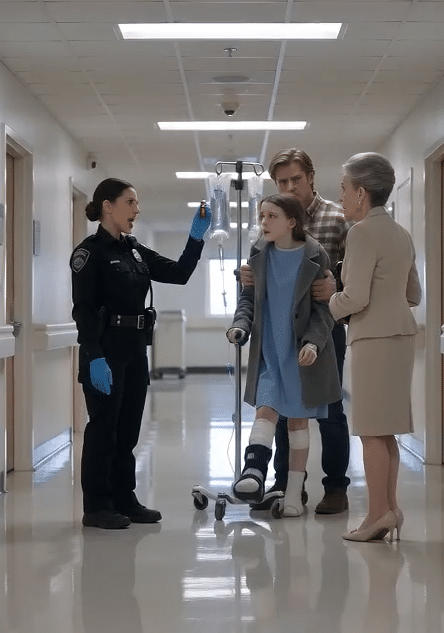
Officer Lorraine Boyd had a calm voice.
That frightened me more than shouting would have.
She asked the restaurant manager to explain what he had seen.
He placed the sealed container on a small table in the hospital corridor. Inside was my plate, still holding the pasta I had not finished.
“My staff knew they served the dish clean,” he said. “The chef checked the station immediately. No shellfish ingredients were used.”
Linda folded her arms.
“So someone in the kitchen made a mistake and covered it up.”
The manager looked directly at her.
“We have cameras.”
The footage showed our table from an angle above the bar.
James and I had left for less than three minutes. He had taken me to meet an old college friend near the entrance.
Linda stayed behind.
On the screen, she waited until the waiter walked away. Then she looked over both shoulders, opened her purse, and removed a small bottle.
She poured liquid into my pasta.
Not a drop.
Not an accidental splash.
A slow, deliberate stream.
Then she stirred it with my fork, wiped the bottle with a napkin, and returned it to her purse.
No one spoke when the video ended.
James stared at the frozen image of his mother’s hand over my plate.
“Why?” he asked.
Linda shook her head so quickly that her earrings trembled.
“That isn’t what happened.”
“We just watched it happen,” he said.
“It was fish sauce. Just flavoring.”
The doctor stepped into the hallway.
“Concentrated shellfish extract is not harmless flavoring to someone with her condition.”
Linda turned toward him.
“I didn’t know it was concentrated.”
The officer looked at her.
“You brought the bottle with you?”
Linda’s mouth opened.
No words came out.
Officer Boyd held out one gloved hand.
“Open your purse.”
For the first time that night, Linda’s crying stopped completely.
She clutched the bag against her body.
“I don’t see why that’s necessary.”
“It is now part of a criminal investigation.”
James looked at his mother as though he had never seen her before.
“Give it to her.”
Linda’s eyes filled again.
“James, please.”
“Give her the purse.”
Slowly, she handed it over.
Officer Boyd unzipped it while another officer photographed each item.
A wallet.
Lipstick.
Tissues.
Keys.
Then the officer removed a small amber bottle.
The label had been partly torn away, but enough remained to read the words.
Concentrated shellfish extract.
Linda immediately began talking.
“I only wanted her to understand that it wasn’t as bad as she claimed.”
James stepped backward as though she had struck him.
“You wanted to prove it?”
“She makes everyone afraid. Every dinner becomes about her. Every restaurant has to change everything. You stopped coming to my house.”
“You poisoned my wife.”
“I did not poison her.”
“You brought a bottle into a restaurant and poured it into her food.”
“I thought she would feel a little tingling. That’s all.”
My hands began shaking beneath the hospital blanket.
A little tingling.
That was what she called the feeling of my airway closing.
Officer Boyd placed the bottle into an evidence bag.
Then she asked a question that changed the investigation.
“Where did you buy this?”
Linda hesitated.
“I don’t remember.”
The officer turned the bottle around.
A pharmacy label had been removed, but adhesive marks remained.
The manager leaned closer.
“That doesn’t look like a grocery product.”
It was not.
The extract had come from a specialty medical supplier.
When police searched Linda’s phone later that night, they found more than an order confirmation.
They found searches.
“How much shellfish extract causes allergic reaction.”
“Can anaphylaxis look like panic attack.”
“How long does epinephrine delay symptoms.”
There were messages to one of James’s aunts as well.
Linda had written that she planned to “expose the performance” at the birthday dinner.
She had expected me to cough, panic, and reach for my EpiPen.
Then she intended to accuse me of exaggerating.
She had not expected my blood pressure to collapse.
She had not expected the restaurant to preserve the plate.
And she had not expected the camera above the bar.
But the worst discovery was still waiting inside her house.
Act IV
Linda was arrested before dawn.
She was charged with assault and the intentional contamination of food. The exact charges changed as investigators reviewed the medical evidence, but the meaning did not.
She had knowingly placed a life-threatening substance into my meal.
Her family reacted in the way families often do when the truth is too ugly to accept all at once.
Some were horrified.
Some blamed me.
One aunt called James and said Linda had made “a terrible mistake,” but sending her to jail would destroy the family.
James listened without interrupting.
Then he said, “She almost killed my wife. She destroyed it herself.”
He blocked the number.
For the next several days, I barely slept.
Every time I closed my eyes, I felt the heat under my tongue again. I heard chairs scraping. I saw Linda’s face across the table.
The physical reaction passed.
The fear did not.
I stopped trusting food I had not opened myself. Even sealed drinks made me nervous. When nurses brought trays into my hospital room, James checked every label twice.
He never once told me I was overreacting.
He sat beside me through the night, holding my hand whenever I woke.
“I should have cut her off sooner,” he said.
“This is not your fault.”
“I knew she was testing you.”
“You believed me.”
“I kept hoping she would stop.”
So had I.
That was the shame neither of us said aloud.
We had mistaken escalation for stubbornness.
We had mistaken cruelty for denial.
We had believed that because Linda was family, there had to be a line she would not cross.
The police found evidence that she had crossed it before.
During the search of her home, officers discovered a small notebook in a kitchen drawer. Most of it contained recipes, shopping lists, and family birthdays.
Near the back were pages with my name.
Dates.
Meals.
Symptoms.
“Redness after sauce.”
“Used antihistamine.”
“Claims throat itching.”
“No hospital.”
She had been recording my reactions.
Each test had been an experiment.
The spoon in the soup.
The shrimp paste in the dipping sauce.
A broth she had insisted was vegetable-based.
She had tracked what happened and treated my survival as evidence that I was lying.
The notebook turned earlier incidents into a pattern.
The prosecutor explained that it showed planning, knowledge, and intent. Linda could no longer claim she had made one impulsive mistake at a birthday dinner.
She had spent nearly two years testing the limits of my body.
James read copies of the pages in the prosecutor’s office.
He reached the final entry and stopped.
“Birthday. Stronger dose. Public setting. End this.”
His face went pale.
End this.
Two words.
That was how she had described the night I nearly died.
Linda’s attorney tried to frame her as a misguided mother desperate to repair a fractured family. He said she believed I suffered from anxiety rather than a severe allergy.
Then the prosecutor presented the medical-supplier receipt.
The product page contained warnings in bold print.
Dangerous for individuals with shellfish allergy.
May cause severe anaphylaxis.
Not for direct consumption.
Linda had clicked a box confirming that she understood the warning before completing the purchase.
Her defense began to collapse.
Still, she refused to apologize.
At a pretrial hearing, she looked directly at me for the first time since the hospital.
“You took my son,” she said.
The courtroom shifted.
James sat behind me.
I could feel his body go rigid.
Linda continued.
“Everything changed when you came into his life. He questioned me. He judged me. He stopped coming home.”
The judge interrupted her.
“Mrs. Harper, this is not the time for a personal statement.”
But the truth had already slipped out.
It had never been about whether my allergy was real.
That was only the excuse.
Linda had wanted to prove that I was manipulative because she needed James to believe I had stolen him.
She had turned my medical condition into a battlefield.
And she had been willing to risk my life to win him back.
Then James stood up.
His voice was quiet, but every person in the courtroom heard him.
“She did not take me from you.”
Linda looked at him.
“You lost me when you tried to kill her.”
That was the moment the power finally changed hands.
Act V
Linda accepted a plea deal three months later.
The evidence was overwhelming.
The footage.
The bottle.
The medical report.
The search history.
The notebook.
The restaurant staff.
She pleaded guilty to felony assault and food tampering. The judge ordered prison time, probation after release, mandatory psychological treatment, and a permanent protective order.
At sentencing, Linda’s attorney read a statement about remorse.
But when Linda was invited to speak, she still could not bring herself to say my name.
She apologized to James.
She apologized to the restaurant.
She apologized to the family for “the pain this situation had caused.”
Not once did she say she was sorry for what she had done to me.
The judge noticed.
“So far,” he said, “you have described the consequences to yourself. You have not described the terror experienced by the woman whose airway you intentionally endangered.”
Linda stared at the table.
The judge continued.
“You did not act from confusion. You acted from resentment, and you repeated the behavior over time. The victim survived because her husband responded quickly, not because your actions were harmless.”
When the sentence was announced, Linda began to cry.
This time, no one moved to comfort her.
James sat beside me with both hands clasped together.
He did not look at his mother as deputies led her away.
Outside the courthouse, reporters waited near the steps because the case had spread through local news. The restaurant had released a statement about allergy safety, and the prosecutor had used the case to warn that intentional allergen exposure was not a prank.
It was violence.
I did not speak to the cameras.
I had spent too long being forced to prove something that had always been true.
My body did not need public approval.
My medical records did not need family consensus.
My survival did not require Linda’s belief.
The restaurant manager met us privately a week later.
He apologized even though the restaurant had done nothing wrong. He showed us the changes they had made anyway: more cameras, stricter table monitoring during allergy orders, and a policy requiring staff to preserve food immediately after any suspected reaction.
Then he placed something on the table.
It was a new medical-alert card printed with my allergy information and emergency instructions.
“The staff made it for you,” he said.
I had not expected kindness to hurt.
But it did.
For so long, Linda had treated my condition like an accusation against her. The restaurant staff, strangers who owed me nothing, had treated it like a fact worth protecting.
James reached for my hand.
“We don’t ever have to eat here again,” he said.
I looked around the empty dining room.
The same lights.
The same polished tables.
The same corner where I had collapsed.
For a moment, I could almost feel the heat beneath my tongue.
Then the manager asked whether I wanted to see the kitchen.
He showed me the separate prep station, the labeled utensils, the allergy log, and the shelf where dangerous ingredients were stored away from everything else.
I stood there breathing slowly.
In.
Out.
No tightening.
No panic.
Just air.
Months later, James and I moved to another city.
Not because we were running away.
Because we had spent years organizing our lives around Linda’s reactions, her accusations, her tears, and her need to remain at the center of every decision.
For the first time, we chose something without asking how she would respond.
We found a small house with a narrow kitchen and a backyard filled with weeds. James planted herbs in cracked pots along the window. I replaced every old bottle in the pantry, even the safe ones.
Healing was not dramatic.
It happened in grocery-store aisles.
In therapy sessions.
In the first meal I ate without checking the door.
In the first family holiday where no one rolled their eyes when I asked about ingredients.
Sometimes, James still woke from dreams in which the EpiPen did not work.
Sometimes, I watched him watching me eat.
But the fear slowly loosened its grip.
One evening, nearly a year after the birthday dinner, he made pasta.
He set the plate in front of me, then placed the ingredient labels beside it without saying anything.
I checked them.
He waited.
Then I took a bite.
Nothing happened.
No heat.
No tingling.
No hands shaking beneath the table.
James let out a breath and smiled.
I smiled back.
Linda had tried to turn my allergy into proof that I was weak, dramatic, and dishonest.
Instead, she left behind evidence of exactly who she was.
The bottle in her purse had not exposed me.
It had exposed her.
And when the truth finally reached the table, no one could look away.