Act I
The morning was so still that even the birds seemed reluctant to disturb it.
Jonathan Keller sat alone on the deck of his pontoon boat, a steaming mug of coffee resting beside him as his fishing line disappeared into the mirror-like surface of Silvermere Lake. The quiet wasn’t accidental. It was the reason he’d bought the property.
After twenty years of corporate law, endless meetings, and cities that never slept, silence had become the one luxury money couldn’t usually buy.
Here, it finally had.
His neighbors barely knew him. Some assumed he worked remotely. Others guessed he had retired early. Jonathan never corrected them.
He wasn’t interested in neighborhood gossip.
He ignored the HOA newsletters.
Skipped every block party.
Declined every invitation.
The lake was enough.
Then one ordinary Tuesday, everything changed.
A crisp white envelope sat inside his mailbox, stamped with the bold blue logo of the Silvermere Residential Association.
The message was short.
REMOVE YOUR WATERCRAFT IMMEDIATELY.
Failure to comply would result in escalating fines, towing, and legal action.
Jonathan actually laughed.
Surely someone had made a mistake.
His dock had existed long before the subdivision.
His boat violated nothing.
He tossed the notice onto the kitchen counter and forgot about it.
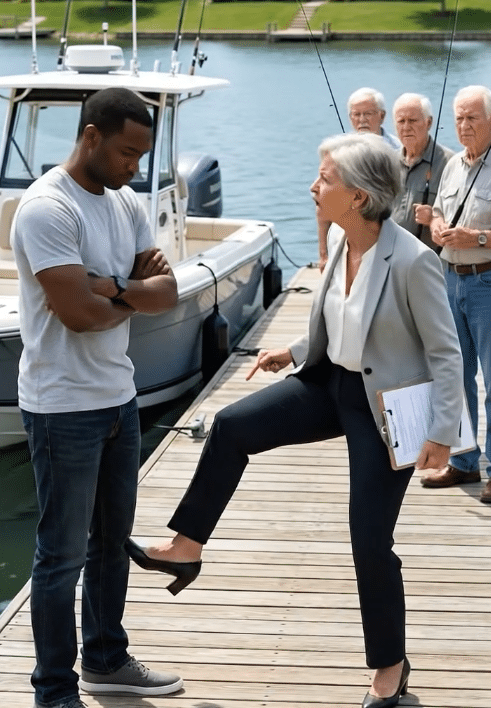
Until Karen Rowland knocked on his front door.
She stood perfectly upright, clipboard tucked beneath one arm, sunglasses balanced on carefully styled blonde hair.
She didn’t smile.
“Mr. Keller,” she announced. “I’m here regarding your boat.”
Jonathan opened the door wider.
“My boat?”
“It must be removed immediately.”
He blinked.
“Why?”
“It’s lowering neighborhood standards.”
Jonathan looked past her toward the lake.
The pontoon gleamed under the afternoon sun, polished only two days earlier.
“It’s parked at my dock.”
“Visible from multiple homes.”
“So is the lake.”
Karen’s lips tightened.
“The HOA has authority over aesthetic violations.”
Jonathan folded his arms.
“Authority over my dock?”
“Over everything residents can see.”
She scribbled another note.
“If it isn’t removed within forty-eight hours, we’ll have it towed.”
Jonathan simply nodded.
“Thank you for letting me know.”
He closed the door gently.
No argument.
No raised voice.
No anger.
Karen walked away wearing the satisfied smile of someone convinced she’d won.
She had no idea she’d just declared war with the only person in Silvermere who actually owned the water beneath her reflection.
She thought she controlled the neighborhood. She didn’t even know who controlled the lake.
Act II
Most people assumed Silvermere Lake belonged to the homeowners’ association.
It seemed obvious.
The walking paths circled it.
Residents fished from community piers.
Children kayaked there every summer.
The HOA newsletter proudly referred to it as “our beautiful private lake.”
There was only one problem.
Legally…
It wasn’t theirs.
Twenty-eight years earlier, when the subdivision was first developed, the construction company sold every house but quietly retained ownership of the lake itself.
The rights included everything.
The shoreline.
The docks.
Fishing licenses.
Boat access.
Water management.
Every inch.
Years later, after the developer dissolved, the forgotten asset was quietly auctioned.
No one from the HOA noticed.
Jonathan did.
Back then, he had been representing a client during a routine property acquisition when the title records revealed something astonishing.
The entire lake sat in legal limbo.
He bought it.
Not because he needed another investment.
Because he wanted peace.
The purchase had been recorded properly.
Taxes had been paid every year.
Every document was airtight.
He never advertised it because he never needed to.
Most neighbors treated him respectfully.
Until Karen became HOA president.
She had transformed minor rules into personal crusades.
Trash cans left out too long.
Mailbox colors.
Garden decorations.
Holiday lights.
Nothing escaped her attention.
Now she’d found a new target.
Jonathan.
Two mornings later he woke to loud metallic banging.
Outside, two towing contractors stood beside his dock.
Karen watched proudly from shore.
“There it is,” she called.
“Remove the vessel.”
One contractor hesitated.
“Ma’am…”
“This dock is on private property.”
Karen thrust a stack of papers toward him.
“The HOA has approved removal.”
Jonathan stepped onto his porch.
“Gentlemen.”
They turned.
“Before anyone touches that boat…”
He held up a leather folder.
“…you might want to see who actually owns the dock you’re standing beside.”
The older contractor frowned.
Jonathan handed him a certified property survey.
His expression changed almost immediately.
He looked back toward Karen.
“You told us the association owned this.”
Karen crossed her arms.
“They do.”
The contractor slowly shook his head.
“No, ma’am.”
He pointed toward Jonathan.
“He does.”
Karen laughed.
“No homeowner owns the lake.”
Jonathan quietly replied,
“I never said I was just a homeowner.”
For the first time, Karen’s confidence cracked.
Act III
The emergency HOA meeting filled the clubhouse beyond capacity.
Karen stood at the front, determined to prove Jonathan wrong.
She projected neighborhood maps onto a large screen.
Highlighted property boundaries.
Quoted bylaws.
Everything appeared airtight.
Until Jonathan arrived carrying a slim black briefcase.
He waited patiently until Karen finished speaking.
Then he approached the podium.
“May I?”
Reluctantly, she stepped aside.
Jonathan placed three documents beneath the overhead projector.
Certified deed.
County tax records.
State water-right registration.
The room grew silent.
He pointed to the legal description.
“This parcel includes Silvermere Lake in its entirety.”
Someone whispered,
“That’s impossible.”
Jonathan slid forward another document.
“The county assessor disagrees.”
An elderly resident slowly raised his hand.
“So…”
“…who owns the fishing docks?”
“I do.”
“The shoreline?”
“I do.”
“The boat ramps?”
“I do.”
“The water?”
Jonathan smiled politely.
“Legally speaking…”
“…yes.”
Karen interrupted.
“The HOA has always managed lake access.”
“You’ve maintained walking paths,” Jonathan corrected.
“Maintenance doesn’t create ownership.”
Another board member grabbed the documents.
After several minutes of reading, his face turned pale.
“They’re genuine.”
A wave of whispers swept through the room.
Karen’s expression hardened.
“This changes nothing.”
Jonathan looked directly at her.
“It changes everything.”
He removed one final envelope.
“I’ve spent the last week reviewing the association’s activities.”
He unfolded several invoices.
“For six years, the HOA has charged residents annual fishing fees.”
Heads turned.
Jonathan continued calmly.
“Those fees were collected without authorization.”
Silence.
“The association never possessed legal fishing rights.”
A resident stood.
“Wait…”
“We’ve been paying for permission…”
“…from people who didn’t own the lake?”
Jonathan nodded once.
“I’m afraid so.”
Karen suddenly looked much less certain.
The argument had stopped being about a boat. It had become something far more expensive.
Act IV
Within days, attorneys became involved.
The HOA’s legal counsel reviewed Jonathan’s documentation.
Their conclusion arrived in a seven-page letter.
The association possessed no authority over the lake.
No authority over boats.
No authority over docks.
No authority over fishing permits.
Every citation issued regarding the water was legally unenforceable.
The board held another emergency meeting.
This time Karen wasn’t smiling.
Residents demanded answers.
“Where did our fishing fees go?”
“Who approved this?”
“How many years have we been paying?”
Financial records revealed nearly a quarter-million dollars collected through unauthorized lake-related assessments.
Karen insisted everything had been done “for community benefit.”
No one believed her anymore.
Jonathan attended quietly.
When asked whether he intended to close the lake permanently, he paused.
He could.
Legally, every resident would lose access immediately.
The fishing club would disappear.
Summer kayak races would end.
Children would lose the place where they had learned to swim.
He remembered why he had bought the lake in the first place.
Not for power.
For peace.
“I have no interest in punishing families,” he finally said.
“But I won’t tolerate abuse.”
The room remained silent.
“So here’s my proposal.”
Every resident listened.
“The lake stays open.”
Relief spread instantly.
“But access will be managed through lawful agreements.”
Fishing would remain free.
Children’s activities would continue.
Community events could stay.
There would be one condition.
“No homeowner will ever again receive threats over property the HOA doesn’t own.”
Even Karen couldn’t argue.
She knew she’d lost.
Not because Jonathan had shouted louder.
Because he never needed to.
Truth had spoken for him.
Yet one final consequence still remained.
Act V
Three weeks later, Silvermere held its annual board election.
Karen didn’t even finish in second place.
Several longtime residents publicly apologized to Jonathan.
Others admitted they had assumed the rumors about him because he kept to himself.
One elderly fisherman shook Jonathan’s hand with tears in his eyes.
“I almost believed what they said about you.”
Jonathan smiled.
“Happens more often than you’d think.”
The new HOA board quickly repealed dozens of unnecessary rules.
They signed a formal access agreement with Jonathan that guaranteed residents continued use of the lake while recognizing his ownership.
For the first time in years, board meetings became peaceful.
The fishing club survived.
Children still launched tiny kayaks every summer.
Neighbors gathered by the water without wondering whether someone with a clipboard might interrupt.
As for Jonathan, very little changed.
Every morning he still walked down to his dock with fresh coffee.
He still cast a line into the same quiet water.
The difference was that no one questioned whether he belonged there.
One evening, months later, Karen drove slowly past his property.
Jonathan happened to be cleaning his boat.
She hesitated before rolling down the window.
“I was wrong.”
He looked at her.
She seemed smaller than before.
Less certain.
“I judged you before I knew anything about you.”
Jonathan nodded.
“I know.”
After a long silence, she added softly,
“I’m sorry.”
Jonathan didn’t celebrate.
He didn’t lecture her.
He simply replied,
“I hope the next person you meet gets the benefit of the doubt before they have to prove themselves.”
Karen lowered her eyes.
Then she drove away.
Jonathan returned to the dock, watching the sunset paint the lake in shades of gold and amber.
Ownership had never been the real victory.
Respect was.
Because the strongest kind of power isn’t reminding people what you own.
It’s showing them that dignity doesn’t need to raise its voice—and that the truth, no matter how deeply buried, eventually rises to the surface like calm water after the storm.