Act I
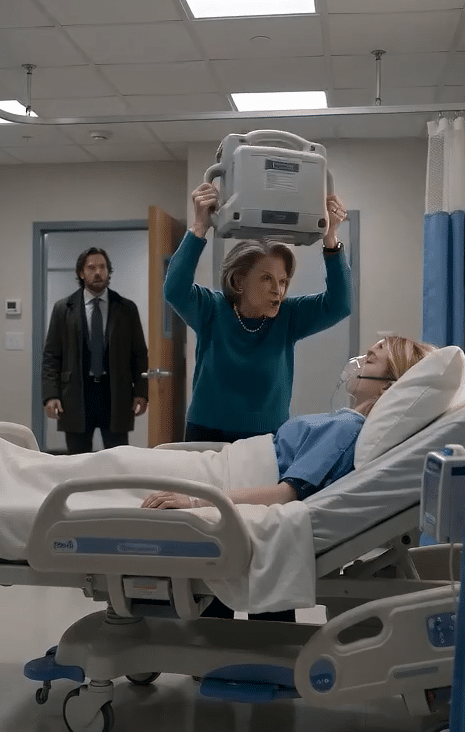
My mother raised the blood pressure monitor over her head for the second time.
“You will sign,” she said.
Her voice was low now. Almost calm.
That frightened me more than the shouting.
Blood ran warm behind my ear and soaked into the collar of my hospital gown. The dialysis machine beside me began beeping faster, each alarm cutting through the room like a warning no one in my family wanted to hear.
Connor stood frozen near the window.
My father, Richard, remained by the door, blocking the narrow pane of glass so no nurse passing in the hallway could see what was happening inside.
For years, I had told myself he was weak.
In that moment, I realized weakness had become a choice.
“Put it down,” I whispered.
My mother tightened her grip.
The loose blood pressure cuff swung beneath the machine.
“You think because you’re sick, you can punish this family?” she said. “You think you can hoard money while your brother’s future falls apart?”
“My future is falling apart.”
“You have insurance.”
“I have kidney failure.”
“You always make everything about you.”
Something inside me went still.
Not numb.
Clear.
My mother had spent my entire life teaching me that love was measured by what I surrendered. My time. My salary. My health. My silence.
Now she wanted the last thing I had managed to keep.
My money.
My escape.
My chance to survive without them.
She stepped closer.
Connor finally found his voice.
“Mom, maybe stop.”
She turned her head just enough to glare at him.
“Stay out of this.”
He did.
Of course he did.
My fingers shook beneath the blanket. The pain in my skull pulsed so hard that the ceiling lights blurred. I could taste metal.
On the tray table beside me sat my phone.
The screen was dark.
Earlier that morning, the transplant coordinator had helped me set up a hospital safety application after I mentioned that my family sometimes pressured me over money. She had been gentle about it, careful not to accuse anyone.
She had simply said, “You deserve to feel safe while you’re here.”
The app connected to a small camera mounted inside the room.
Not a hidden camera.
A hospital-issued patient monitoring device installed after I had fainted twice trying to walk to the bathroom alone. It recorded falls, medical emergencies, and unauthorized tampering with equipment.
My family had never noticed it.
They had been too busy looking at me.
Or rather, looking through me.
My mother lifted the monitor higher.
I slid one trembling hand across the sheet.
“Don’t,” my father warned.
He had seen me move.
His eyes dropped toward my phone.
For the first time that afternoon, fear entered his face.
My mother followed his gaze.
“What are you doing?”
I reached farther.
Pain tore through my arm where the IV tape pulled against my skin.
Connor moved toward the bed.
I slapped my palm against the phone screen.
It lit beneath my fingers.
My mother swung.
The monitor crashed into the metal bed rail instead of my head.
The impact rang through the room.
I pressed the red emergency icon.
One button.
That was all.
The lights above the door began flashing.
An alarm sounded at the nurses’ station.
And somewhere beyond the room, the recording automatically uploaded to hospital security.
My mother stared at the phone.
“What did you do?”
I looked at her through tears.
“The one thing you never thought I would.”
Footsteps thundered in the hallway.
Richard stepped away from the door.
Connor backed into the wall.
My mother dropped the monitor.
It hit the floor with a hollow crack.
The door burst open.
Two nurses rushed in, followed by a security officer and Dr. Patel, the nephrologist who had spent three weeks trying to keep me alive.
Everyone stopped.
They saw the blood.
They saw the broken equipment.
They saw my mother standing over my bed.
And for once, my family did not have time to invent a story before the truth entered the room.
But the recording would reveal something even worse than the attack.
Act II
The hospital removed my family within minutes.
My mother screamed that it was a misunderstanding.
My father insisted the machine had fallen.
Connor said he had been looking at his phone and had not seen anything.
No one believed them.
A nurse named Elena pressed gauze against my head while another checked my pupils. Dr. Patel ordered an emergency scan to make sure the blow had not caused bleeding inside my skull.
As security dragged my mother into the hallway, she twisted toward me.
“This is your fault!”
Those were the last words she said before the doors closed.
Not “I’m sorry.”
Not “Are you hurt?”
Not even “I didn’t mean to.”
This is your fault.
The sentence followed me into the CT scanner.
It followed me through the night.
It echoed through the dark private room after the police arrived, after photographs were taken, after the broken monitor was bagged as evidence, after a detective asked whether I wanted to press charges against my own mother.
My own mother.
Those three words had protected Evelyn Whitaker for thirty-two years.
She had used them like a title of ownership.
I am your mother.
Therefore, I may take.
I may insult.
I may demand.
I may hurt.
And you must forgive me before I even apologize.
Detective Lena Brooks sat beside my bed with a small recorder in her hand.
She was in her forties, with tired eyes and a voice that never once became impatient.
“Has she hit you before?” she asked.
I looked toward the window.
Chicago glowed below us, thousands of lights spread beneath the hospital tower.
“No,” I said.
Then I thought about it.
“She threw a plate at me when I was seventeen.”
The detective waited.
“She slapped me once when I refused to give Connor my car.”
Another pause.
“She pushed me into a cabinet after I asked why my college fund was gone.”
The words came slowly.
Not because I had forgotten.
Because I had never classified those things correctly.
In my family, violence was always renamed.
A plate became an accident.
A slap became discipline.
A shove became stress.
Financial control became responsibility.
Cruelty became concern.
And silence became loyalty.
Detective Brooks wrote everything down.
“What happened to your college fund?”
“My parents used it to pay Connor’s private school tuition.”
“Did they tell you?”
“Afterward.”
“How old were you?”
“Eighteen.”
She looked at me for a long moment.
Then she asked about the $250,000.
That story began five years earlier.
I had been twenty-seven and working as a senior financial analyst for a logistics firm near the Chicago River. I was good with numbers because numbers stayed where you put them.
People did not.
My salary rose quickly, and so did my family’s needs.
First, my father’s contracting business had a slow quarter.
Then the mortgage fell behind.
Then my mother needed dental surgery.
Then Connor lost another job.
Then there were credit cards, repairs, taxes, vacations disguised as emergencies, and emergencies created by vacations.
Every month, I transferred money into my parents’ account.
Every month, my mother thanked me by reminding me it was not enough.
“You don’t have children,” she would say. “What else do you need money for?”
So I began hiding part of my income.
At first, fifty dollars.
Then five hundred.
Then entire bonuses.
I opened an account at a bank my family did not use. I removed paper statements. I created a separate email address. I told no one.
The money became the only private thing in my life.
It was supposed to buy a condo.
Then it became a safety fund.
Then, after my kidneys began failing, it became survival.
I had ignored symptoms for months.
The headaches.
The swelling in my ankles.
The exhaustion.
The nausea.
I told myself I was overworked.
I told myself I could not take time off because my parents depended on me.
By the time I collapsed in the lobby of my office, my blood pressure was dangerously high and my kidney function had fallen to a fraction of what it should have been.
The doctors could not yet say exactly what had caused the damage.
Severe untreated hypertension was part of it.
So was a rare autoimmune condition that had likely been attacking my kidneys for years.
But stress had not helped.
Neither had neglect.
While I lay in the hospital waiting to learn whether I would qualify for a transplant, my mother somehow discovered the hidden account.
At first, I assumed she had found a statement.
The truth was worse.
Connor had logged into my laptop while visiting my apartment.
He knew my old password because my mother had once pressured me to share it with the family “for emergencies.”
He had searched my financial files, found the account, and told them everything.
They had not come to the hospital because they thought I was dying.
They had come because they knew exactly how much I had.
That realization hurt more than the stitches in my head.
Still, I did not yet know the deepest betrayal.
The next morning, Detective Brooks returned with a laptop.
“We reviewed the room footage,” she said.
I braced myself.
She pulled a chair close to the bed.
“There is something you need to see.”
The video began forty-three minutes before my family entered my room.
I expected an empty bed.
Instead, the footage showed Connor slipping through the door alone.
And what he did next changed the entire case.
Act III
Connor had arrived before my parents.
In the recording, he checked the hallway twice before entering.
I was asleep.
The dialysis machine hummed beside me. My Bible rested on the table. My phone was charging near the window.
Connor walked directly to my coat hanging inside the closet.
He searched the pockets.
Then he opened my purse.
He removed my wallet, photographed my driver’s license, copied my insurance card, and tried several times to unlock my phone using my thumb while I slept.
My stomach turned.
The footage continued.
When the phone did not open, he moved to the tray table and found a small notebook where I kept medical questions.
Inside the back cover, I had written a temporary banking verification code.
Connor photographed that too.
Then he stood beside my bed and called someone.
The room camera had captured audio.
“Yeah,” he whispered. “She’s barely conscious.”
A pause.
“No, Mom, I can’t transfer it without the full login.”
Another pause.
“I know Dad said the paperwork would be easier.”
He looked down at me.
“She might not make it anyway.”
Detective Brooks paused the recording.
I stared at Connor’s frozen face on the screen.
Something cold spread through my chest.
“Play it,” I said.
She did.
Connor walked toward the window.
“The investor doesn’t care where the money comes from,” he said. “He just needs proof of funds by Monday.”
Another pause.
Then he laughed softly.
“If she dies, it’s going to us eventually.”
I closed my eyes.
The room disappeared.
For years, Connor had treated me like an inconvenience.
He mocked my job, borrowed my car, forgot my birthday, and called me dramatic whenever I said no.
But hearing him discuss my death as a financial timeline was different.
That was not immaturity.
That was calculation.
Detective Brooks lowered the laptop screen.
“There’s more.”
I almost told her I could not take more.
But I had spent too long surviving half-truths.
“Show me.”
The recording jumped forward.
My parents entered the room.
Before waking me, all three stood near the foot of the bed.
My mother took out the folder.
My father asked, “Are you sure the power of attorney is enough?”
My mother answered, “Once she signs, we can move everything.”
Connor said, “What if the bank checks?”
“They won’t,” my father replied. “The notary already signed.”
Detective Brooks paused again.
“The documents were notarized before you signed them,” she said. “That is illegal.”
“Who was the notary?”
“We’re investigating.”
I already knew.
My mother’s younger sister, Denise, worked at a real estate office and held a notary commission.
She had always called my mother after family arguments.
She always seemed to know private details no one had told her.
“She helped them,” I whispered.
“That appears likely.”
The folder had not contained a simple transfer authorization.
It contained a durable financial power of attorney granting my mother control over every account, investment, property, benefit, and insurance payment in my name.
Another document named Connor as a beneficiary.
A third attempted to authorize the liquidation of my retirement account.
They had not come for $250,000.
They had come for everything.
My mother’s assault was no longer being treated as a spontaneous act of rage.
It was part of an attempted financial takeover.
By noon, police had searched my parents’ house.
They found copies of my tax returns, employment records, old medical documents, and bank statements hidden inside a locked filing cabinet in my mother’s office.
They also found a life insurance policy.
A $500,000 policy.
On me.
My mother had taken it out years earlier through a small insurance agency where she briefly worked.
She was the primary beneficiary.
Connor was the secondary.
The signature on the application looked like mine.
It was not.
Detective Brooks showed me a photograph of it.
My name had been copied carefully, but the “M” was wrong.
Too round.
Too slow.
My signature had always been sharp because I wrote quickly.
My mother had forged it.
The policy was still active.
She had been paying the premiums from the same joint account I used to cover my parents’ mortgage.
I had unknowingly funded a policy that paid them if I died.
For the first time since the attack, I vomited.
Elena helped me clean up.
She did not ask questions.
She simply stayed.
That night, my father called the hospital twelve times.
The calls were blocked.
My mother left a voicemail through an unknown number.
Her voice was soft and trembling.
“Maya, baby, this has gone too far. Families make mistakes. You know how stressed I’ve been. Connor’s opportunity has put pressure on all of us. Call the police and tell them you were confused because of your medication.”
Then her voice changed.
“If you let them ruin this family, you will never forgive yourself.”
I listened to the message twice.
The old part of me wanted to believe the first half.
The daughter she had trained wanted to rush in and repair everything.
Then I remembered the life insurance policy.
I remembered Connor saying, “She might not make it anyway.”
I remembered my father blocking the door.
I forwarded the voicemail to Detective Brooks.
The next morning, my father arrived with a lawyer.
He wanted to make a deal.
But he had not come to protect me.
He had come to save himself.
Act IV
Richard Whitaker had spent his entire life avoiding consequences.
He avoided debt collectors by changing phone numbers.
He avoided angry clients by blaming subcontractors.
He avoided my mother’s cruelty by leaving the room.
He avoided responsibility by calling himself a peacemaker.
Now, with criminal charges building, he finally decided to speak.
His attorney arranged for Detective Brooks to interview him at the police station.
I was not present, but portions of his statement were later shared with my lawyer.
My father claimed my mother had planned everything.
The forged power of attorney.
The life insurance policy.
The attempt to seize my savings.
He said he had only gone along because Evelyn threatened to leave him and expose his own financial problems.
It was a coward’s confession.
But it was still a confession.
He admitted that my mother had known about my illness long before I collapsed.
Nearly a year earlier, a lab had mailed abnormal test results to my parents’ address because it remained listed as my emergency contact.
My mother opened the envelope.
She read that I needed urgent follow-up testing.
She never told me.
At the time, I was paying for Connor’s latest business idea.
According to my father, Evelyn feared I would stop sending money if I realized how sick I was.
So she hid the letter.
My kidney disease continued untreated.
The revelation broke something inside me that anger could not reach.
I had wondered whether earlier treatment might have slowed the damage.
Now I knew I had lost that chance because my mother did not want to lose access to my paycheck.
Dr. Patel was careful.
He told me no one could say with certainty that earlier treatment would have saved my kidneys.
But it might have changed the course.
It might have given me time.
That was enough.
My attorney, Sarah Klein, filed for emergency financial protection and a restraining order. The bank froze every suspicious transfer request. The insurance company opened a fraud investigation. My aunt Denise’s notary commission was suspended while prosecutors reviewed the documents.
Connor’s investor disappeared the moment police contacted him.
There had never been a serious investment.
The so-called luxury streetwear company was nearly $80,000 in debt.
Connor had spent money on branding, rented sports cars, influencer parties, and a warehouse lease he could not afford.
He had promised investors he already had family capital.
My savings were never going to build a business.
They were going to cover a lie.
My mother was charged with aggravated battery, attempted financial exploitation, forgery-related offenses, and tampering with medical equipment.
Connor faced charges tied to identity theft and conspiracy.
My father received lesser charges after cooperating, though his lawyer insisted he had acted under pressure.
When the news reached our extended family, the phone calls began.
Not to ask how I was.
To ask whether I could keep the situation private.
My aunt Denise cried that losing her notary license would destroy her career.
My grandmother said prison would “kill” my mother.
A cousin told me Connor was young and had made a mistake.
No one called what happened to me a mistake.
They called my response unforgiving.
For three days, guilt ate at me.
Then Elena brought me an envelope.
Inside was a printed still image from the hospital footage.
It showed my mother raising the monitor.
My father stood at the door.
Connor watched.
I was in the bed beneath them.
Three people against one sick woman.
On the back, Elena had written a single sentence.
You are allowed to believe what happened to you.
I placed the photograph beside my Bible.
The next hearing was held remotely because I was still too weak to leave the hospital.
My mother appeared on a screen wearing a gray jail uniform.
Without pearls and polished makeup, she looked smaller.
But not sorry.
Her attorney argued that stress had caused a temporary break in judgment.
He described her as a devoted mother overwhelmed by her daughter’s illness and her son’s financial crisis.
Then the prosecutor played the recording.
The entire courtroom watched Connor search my purse.
They heard my father discuss the pre-notarized documents.
They heard my mother say, “Once she signs, we can move everything.”
They watched her strike me.
They watched my father block the door.
They heard her demand that I sign while I bled.
My mother’s expression changed only once.
Not when the monitor hit my head.
Not when I screamed.
Not when the nurses rushed in.
Her face changed when the prosecutor displayed the bank records.
The money.
That was still the only thing that frightened her.
The judge denied her request for release.
Connor’s attorney tried to argue that he had been manipulated by our parents.
Then the prosecutor played his phone call.
“She might not make it anyway.”
Connor lowered his head.
For the first time in his life, no one rushed in to rescue him.
But the greatest reversal came two weeks later, when the transplant team entered my room with news I had stopped allowing myself to hope for.
Act V
They had found a donor.
Not a perfect match.
But a strong enough match to move forward.
A deceased donor kidney had become available from a woman in Wisconsin whose family had chosen organ donation after a sudden aneurysm.
Her name was Claire.
That was all I was permitted to know at first.
Claire had been forty-one.
She had two children.
Her final decision gave strangers a second chance.
Including me.
I cried before the coordinator finished speaking.
Not because I was afraid.
Because a woman I had never met had shown me more humanity in death than my own family had shown me while I was fighting to live.
The surgery lasted several hours.
When I woke, the first thing I felt was pain.
The second was warmth.
The third was relief.
The new kidney began working quickly.
Dr. Patel stood beside my bed and smiled.
“Your numbers are moving in the right direction.”
For months, numbers had terrified me.
Blood pressure.
Creatinine.
Account balances.
Insurance payouts.
Now, numbers meant life.
My recovery was not easy.
There were medications, tests, weakness, and long nights when I woke convinced I could still hear the monitor crashing against the rail.
But each day, I became stronger.
Sarah helped me restructure everything.
I changed banks.
Changed passwords.
Changed beneficiaries.
Sold the small apartment my family had access to and bought a one-bedroom condo near the lake under a trust they could not touch.
I stopped paying my parents’ mortgage.
The house in Oak Brook went into foreclosure four months later.
My father moved into a rented room outside Joliet.
He sent me a letter.
It was six pages long.
He apologized for being afraid.
He said he had loved me but did not know how to stand up to my mother.
I read the letter once.
Then I placed it in a drawer.
Love without protection had nearly killed me.
I no longer accepted intention as a substitute for action.
Connor pleaded guilty to reduced charges in exchange for testimony against our mother and aunt.
His business collapsed.
The designer clothes disappeared from his social media.
So did the rented cars.
At sentencing, he turned toward the camera and said he was sorry.
He looked younger than twenty-six.
For a moment, I remembered the little boy who used to crawl into my bed during thunderstorms.
Then I remembered the man who had tried to unlock my phone while I lay unconscious.
Both versions were real.
Forgiveness did not require access.
My mother never admitted what she had done.
Even after the video.
Even after the forged documents.
Even after the insurance company confirmed the fraudulent signature.
She insisted she had been trying to protect the family.
The prosecutor asked her one question during sentencing.
“Protect the family from whom?”
My mother looked toward the screen where I watched from my attorney’s office.
“From her,” she said.
The room went silent.
There it was.
The truth beneath everything.
To my mother, I had become dangerous the moment I stopped obeying.
The judge sentenced her to prison.
Not for being a bad mother.
Not for favoritism.
Not for manipulation.
For crimes.
That distinction mattered.
For years, my family had hidden behind private language.
Family issue.
Misunderstanding.
Stress.
Sacrifice.
But the law used clearer words.
Assault.
Fraud.
Forgery.
Conspiracy.
The day after sentencing, I returned to Lakefront Medical Center for a follow-up appointment.
My lab results were stable.
My scar was healing.
The room where the attack happened had been repaired, but the hospital had not reinstalled the same style of blood pressure monitor.
Elena met me near the elevators.
“You look different,” she said.
“Better?”
“Free.”
We stood by the window overlooking Chicago.
The river cut between the buildings. Traffic moved below. People crossed sidewalks carrying coffee, briefcases, groceries, flowers.
Ordinary life.
I had once believed ordinary life was something that happened to other people.
People whose mothers loved them without invoices.
People whose fathers protected them.
People whose brothers did not count their inheritance before the funeral.
But survival had taught me something.
A family is not sacred simply because it shares your blood.
Love is not proven by how much pain you tolerate.
And sometimes the bravest thing a daughter can do is stop asking cruel people to become kind.
I later wrote to Claire’s family through the transplant network.
I told them I carried their generosity every morning.
I told them I had returned to work part-time.
I told them I walked along the lake whenever the weather allowed.
I did not tell them every detail of what had happened.
Only that their decision had saved more than my body.
It had given me time to build a life that belonged to me.
The $250,000 remained in my account.
I used part of it for medical expenses, legal fees, and the condo.
Then I donated $25,000 to a hospital fund for patients facing financial abuse during serious illness.
The program provided secure devices, emergency legal consultations, and private financial counseling.
At the opening, Elena asked whether I wanted my name on the donor wall.
I said no.
I asked them to use one sentence instead.
They placed it on a small silver plaque near the entrance.
It read:
You are allowed to believe what happened to you.
Sometimes I still think about that Thursday afternoon.
My mother standing over me.
My father blocking the door.
Connor watching.
For years, they had trained me to believe I was powerless unless they approved of me.
They were wrong.
I did not defeat them by becoming cruel.
I did not scream louder.
I did not destroy their lives.
I pressed one button.
The camera had already captured the truth.
All I had to do was stop protecting the people who had never protected me.