Act I
“My daddy said he’d be back in half an hour.”
The little girl’s voice trembled through the 911 line, almost disappearing beneath the rain pounding the tin roofs of San Miguel.
“But it’s already been four days.”
Dispatcher Daniel Mendoza stopped typing.
Around him, the emergency center continued its usual rhythm—phones ringing, radios crackling, operators speaking in calm, practiced voices. But something about the child’s words made the entire room seem to narrow around him.
“What’s your name, sweetheart?”
“Sofía.”
“How old are you, Sofía?”
“Seven.”
Daniel looked at the location flashing on his screen.
The call was coming from a small rented house on the outskirts of Puebla, in a neighborhood where walls were thin, money was scarce, and rumors traveled faster than ambulances.
“Are you alone?”
There was a pause.
Then a small sniffle.
“Yes.”
Daniel leaned closer to his headset.
“Where is your father?”
“He went to buy my medicine and some food. He said he would come back before my cartoon finished.”
Sofía’s breathing sounded shallow.
“My tummy hurts,” she whispered. “And my head feels funny.”
Daniel felt cold spread through his chest.
“When did you last eat?”
“I don’t remember.”
“Is there food in the house?”
“There was soup. But it smelled bad.”
She hesitated.
“I drank water from the faucet. I gave some to Pancho too.”
“Who is Pancho?”
“My teddy bear.”
Daniel closed his eyes for half a second.
Then he signaled urgently to the nearest patrol unit.
“Sofía, listen to me. A police officer is coming to help you. Her name is Mariana Torres. Stay with me on the phone, all right?”
“Am I in trouble?”
“No, sweetheart.”
“Because Daddy said never to call unless it was a real emergency.”
“This is a real emergency.”
Twenty minutes later, Officer Mariana Torres arrived outside a narrow house with peeling yellow paint and a small image of the Virgin of Guadalupe taped beside the door.
The porch light was off.
Rain streamed down the cracked windows.
Mariana knocked gently.
“Sofía? My name is Mariana. I’m here to help you.”
The door opened less than an inch.
One frightened brown eye appeared in the gap.
“You’re not going to scold me?”
Mariana crouched until her face was level with the child’s.
“No one is going to scold you.”
The door slowly opened.
Mariana had spent eleven years in uniform. She had seen accidents, assaults, and homes abandoned after disasters.
Still, the sight of Sofía nearly broke her.
The little girl was barefoot, wearing an oversized gray T-shirt that reached her knees. Her lips were cracked. Her hair was tangled. Dark circles sat beneath her eyes.
She held a worn teddy bear by one arm.
The house was nearly empty.
In the kitchen, an unplugged refrigerator contained half a lime, a jar of mustard, and an expired carton of milk. A pot of spoiled soup sat on the stove.
On the table was a handwritten list.
Rice.
Chicken broth.
Electrolyte solution.
Sofía’s medicine.
Beneath it was a folded note.
Appointment with Dr. Ríos. Urgent.
Mariana picked it up.
Before she could unfold it, voices rose outside.
Neighbors had begun stepping into the rain.
Doña Carmen, who lived across the street, crossed her arms.
“I knew Carlos couldn’t raise that girl alone.”
Another man shook his head.
“Four days? He abandoned her.”
Someone was already filming through the doorway.
Mariana’s jaw tightened.
She turned toward Sofía.
The child swayed.
“Sofía?”
Her knees buckled.
Mariana caught her before she hit the floor.
The teddy bear slipped from her hand.
“Dispatch,” Mariana said into her radio. “Minor unconscious. Severe dehydration, possible diabetic episode.”
Then she looked again at the shopping list.
At the medicine written in careful block letters.
At the father’s jacket still hanging by the door.
At the keys missing from the hook.
“And listen carefully,” she added. “This does not look like abandonment.”
The ambulance sped away through the storm.
Behind it, neighbors uploaded their videos.
Father leaves sick daughter alone for four days.
Monster abandons child without food.
By midnight, Carlos Ramírez had become the most hated man in San Miguel.
No one knew where he was.
No one knew what had happened.
But the town had already decided he did not deserve to be found.
And by morning, the first piece of evidence would make him look even worse.
Act II
Carlos Ramírez was thirty-two years old.
He repaired motorcycles in a small garage behind a tire shop, usually working twelve-hour days for less money than many of his customers spent on a single dinner.
Sofía’s mother, Elena, had died two years earlier from complications after a heart condition.
Since then, Carlos had raised their daughter alone.
He packed her school lunch before sunrise. He learned to braid her hair from online videos. He slept beside her hospital bed whenever her blood sugar became unstable.
He was not perfect.
He was often late.
He forgot permission slips.
Sometimes Sofía wore mismatched socks because laundry had piled up and Carlos had fallen asleep in his work clothes.
But he never forgot her medicine.
That was why Mariana refused to accept the obvious explanation.
At the hospital, doctors stabilized Sofía after hours of treatment.
She had severe dehydration and dangerously low blood sugar. Another day alone, they said, and she might not have survived.
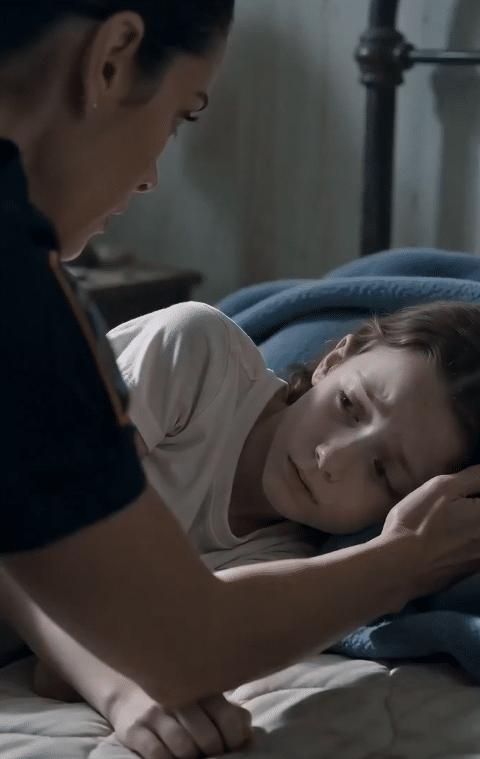
When Sofía finally opened her eyes, Mariana sat beside her.
“Do you remember anything else about the night your father left?”
Sofía stared at Pancho, now resting beside her pillow.
“He was worried.”
“About what?”
“My doctor called him.”
“Dr. Ríos?”
She nodded.
“Daddy said we needed money.”
Mariana leaned forward.
“What happened next?”
“He checked his wallet. Then he cried in the bathroom.”
Sofía lowered her voice.
“He thought I couldn’t hear.”
Mariana felt something twist inside her.
“Did he call anyone?”
“A man named Ernesto.”
The name produced the first real lead.
Ernesto Salgado owned the motorcycle garage where Carlos worked.
When police questioned him, he claimed Carlos had asked for an advance on his salary four days earlier.
“I told him no,” Ernesto said. “Business is bad.”
“Did he say why he needed it?”
Ernesto shrugged.
“The girl was sick again.”
“What happened after that?”
“He got angry.”
“Did he threaten you?”
“No. Carlos doesn’t threaten anyone.”
Ernesto hesitated.
“He just looked desperate.”
Police reviewed security footage from nearby streets.
At 6:12 p.m., Carlos appeared leaving his house in the rain.
At 6:19, he entered a pharmacy.
At 6:27, he left without medicine.
The pharmacist remembered him clearly.
“His card was declined,” she told officers. “He asked me to hold the prescription. Said he would find the money and come back.”
At 6:41, Carlos was recorded outside an ATM.
At 6:48, he made a phone call.
Then, at 7:03, a camera captured him entering a dark sedan.
He did not appear to be forced.
He opened the passenger door willingly.
The vehicle drove away.
By noon, that footage was leaked online.
The town’s anger exploded.
People claimed Carlos had left with a criminal friend.
Others said he had run away from debt.
One woman posted that she had always known he was irresponsible because Sofía sometimes arrived late to school.
No one mentioned that Carlos worked nights.
No one mentioned that he walked his daughter two miles to class when he could not afford bus fare.
The loudest voices belonged to people who had never once entered their home.
Then police identified the sedan.
It belonged to Vicente Márquez, a local businessman who owned several private lending offices.
His advertisements covered bus stops across Puebla.
FAST MONEY. NO QUESTIONS. SAME-DAY CASH.
But everyone in San Miguel knew there were always questions later.
And the price of answering them could be brutal.
Mariana went to one of Márquez’s offices.
The receptionist claimed Carlos had never been there.
Mariana placed a photograph on the desk.
“Security footage shows him getting into Mr. Márquez’s car.”
The receptionist’s eyes moved away.
“I don’t know anything about that.”
“Then let me speak to your boss.”
“He’s unavailable.”
Mariana noticed a paper shredder running behind the reception desk.
A young employee stood beside it, feeding documents into the machine.
She stepped forward.
“Stop.”
The receptionist blocked her.
“You need a warrant.”
Mariana looked through the glass wall.
On a desk near the shredder lay a file with Carlos Ramírez’s name written across the top.
By the time police returned with authorization, the file was gone.
But something else remained.
A carbon copy of a loan contract had fallen behind the desk.
Carlos had borrowed eighty thousand pesos.
Not for himself.
The purpose was written in his own hand.
Emergency pediatric treatment for Sofía Ramírez.
The contract had been signed three months earlier.
Carlos had already repaid nearly twice the amount he borrowed.
Yet according to Márquez’s records, he still owed everything.
Someone had been falsifying the payments.
And four days before Carlos disappeared, he had confronted them.
That should have made him a victim.
Instead, the next discovery made police wonder whether he had become something else.
Because in Carlos’s garage locker, they found a bloodstained shirt.
Act III
The shirt was wrapped in a plastic bag beneath Carlos’s workbench.
His name was written on the collar.
When the evidence technician unfolded it, a dark stain covered the front.
Ernesto went pale.
“I’ve never seen that before.”
Mariana studied him.
“You own the shop.”
“That doesn’t mean I know everything in every locker.”
The blood was rushed to the laboratory.
Meanwhile, officers searched Carlos’s financial records.
His bank account held the equivalent of less than forty dollars.
His rent was overdue.
His electricity had been disconnected twice that year.
Yet he had made weekly cash payments to Vicente Márquez for months.
Each payment was recorded in a small notebook hidden beneath Sofía’s mattress.
Carlos had written every amount, every date, and the name of every employee who received the money.
Beside several entries, he had added the same sentence.
They refuse to give me a receipt.
Mariana sat at the kitchen table, turning the pages carefully.
This was not the record of a man planning to disappear.
It was the record of a man preparing to prove something.
Inside the notebook’s back cover, she found a folded photograph.
Carlos stood beside Elena on their wedding day. Sofía, still a toddler, sat on his shoulders.
On the back, Elena had written:
Whatever happens, bring her home.
Mariana returned to the hospital.
Sofía was stronger now, though she still asked the same question every hour.
“Did you find Daddy?”
“Not yet.”
“He didn’t leave me.”
“I know.”
The girl looked at her with sudden intensity.
“No. You don’t understand.”
She pulled Pancho into her lap.
“My daddy promised.”
Mariana watched her squeeze the bear.
Something about its shape seemed uneven.
One side of Pancho’s belly was firmer than the other.
“Did your father ever fix Pancho?”
Sofía nodded.
“He opened him the night he left.”
Mariana’s pulse quickened.
“With what?”
“Scissors.”
“Did he put something inside?”
Sofía looked frightened.
“Daddy said if a bad man came to the house, I should give Pancho to the police.”
Mariana carefully opened the stitched seam along the bear’s back.
Inside the stuffing was a small memory card wrapped in tape.
The files on it changed the entire investigation.
Carlos had secretly recorded three conversations with employees of Márquez Lending.
In the first, a collector demanded payment Carlos had already made.
In the second, Carlos accused them of targeting families with sick children because desperation made them easy to control.
The third recording was different.
Vicente Márquez himself could be heard.
“You have two choices,” he told Carlos. “Keep paying, or work off the debt.”
“What kind of work?”
“You repair motorcycles. You know engines. You change serial numbers when we ask.”
“I won’t do that.”
“Then perhaps your daughter should learn what happens when a father cannot provide.”
Carlos’s voice became deadly quiet.
“Stay away from her.”
Márquez laughed.
“You should have thought of that before borrowing my money.”
The final file was a video.
It had been recorded inside the garage late at night.
Carlos faced Ernesto, his employer.
“You gave them my information,” Carlos said.
Ernesto avoided the camera.
“I introduced you to a lender. That’s all.”
“You knew what they were.”
“I knew you needed money.”
“You received a commission.”
Ernesto’s silence answered for him.
Then Carlos placed a stack of photocopies on the workbench.
They were lists of borrowers.
Single mothers.
Elderly pensioners.
Factory workers.
Parents of hospitalized children.
Hundreds of people had been charged illegal interest, threatened, or forced into criminal work.
Carlos had discovered the records while repairing a motorcycle belonging to one of Márquez’s collectors.
He had copied everything.
“Tomorrow I’m taking this to the police,” Carlos said.
Ernesto’s expression changed.
“You won’t make it through the night.”
The video ended there.
Within an hour, Ernesto was in custody.
Under questioning, he admitted that Márquez’s men had come to the garage.
But he denied knowing what happened afterward.
“They took Carlos,” he said. “I thought they were only going to scare him.”
“Where?”
“I don’t know.”
Mariana placed the bloodstained shirt photograph in front of him.
Ernesto began to sweat.
“That blood isn’t Carlos’s.”
The laboratory confirmed it minutes later.
The blood belonged to Ernesto.
A small cut on his arm matched the stain.
He had planted the shirt to make it appear that Carlos had attacked him before fleeing.
Now the story changed again.
Carlos was no longer a missing father who had abandoned his daughter.
He was a witness who had tried to expose a criminal network.
The police raided Márquez’s office, his home, and two warehouses.
They found forged contracts, stolen vehicle parts, and the original loan records Carlos had copied.
But they did not find Carlos.
Vicente Márquez had also disappeared.
Then, on the sixth day, a farmer outside the city reported seeing an abandoned sedan near an old quarry road.
Inside the trunk, police found Carlos’s pharmacy receipt.
Beside it lay a child’s medicine bottle.
Still unopened.
And twenty meters down the ravine, hidden beneath wet branches, they found footprints leading into the forest.
One set belonged to Carlos.
The others belonged to three men.
Only one set came back.
Act IV
The search lasted through the night.
Rain had turned the forest floor into mud. Search dogs struggled to hold the scent. Flashlights moved between trees while officers called Carlos’s name into the darkness.
At dawn, one of the dogs stopped beside a drainage tunnel beneath an abandoned railway line.
Mariana heard a faint sound.
Not a voice.
A scrape.
She crawled inside.
The tunnel smelled of wet stone and rust.
Thirty feet in, she found Carlos.
He was lying on his side behind a broken concrete barrier, his wrists bound with plastic ties. His face was bruised, and one ankle was swollen badly.
But he was alive.
Barely.
Mariana touched his shoulder.
“Carlos?”
His eyes opened.
The first word he spoke was not his own name.
“Sofía.”
“She’s alive.”
His body seemed to release a breath it had held for days.
“Hospital?”
“Yes.”
“Medicine?”
“She’s receiving treatment.”
Carlos closed his eyes.
A tear slid through the dirt on his cheek.
“I told her half an hour.”
Mariana swallowed.
“You tried to come back.”
“They took me from the car.”
“What happened to Márquez?”
Carlos looked deeper into the tunnel.
“He’s hurt.”
Officers found Vicente Márquez another hundred feet away with a broken leg and severe exposure.
During the kidnapping, one of his own men had turned on him after learning police were searching the lending offices. An argument began. The car crashed near the ravine.
Carlos escaped into the woods.
Márquez followed him, determined to recover the evidence.
Both men fell during the pursuit.
Carlos could have left him there.
Instead, he dragged Márquez into the tunnel before the night temperature dropped.
Then he used his own jacket to wrap the man’s injured leg.
The man who had threatened Sofía survived because Carlos refused to abandon him.
At the hospital, Carlos underwent surgery.
He had cracked ribs, severe dehydration, a dislocated ankle, and an infection from an untreated wound.
Doctors said he had survived through a combination of luck, rainwater, and stubbornness.
But Carlos did not ask about himself.
He asked when he could see his daughter.
That afternoon, a nurse pushed his wheelchair into Sofía’s room.
She was sitting up in bed, coloring.
For one second, neither of them moved.
Then Sofía dropped her crayons.
“Daddy?”
Carlos covered his mouth.
She jumped from the bed before the nurse could stop her.
Carlos opened his arms.
Sofía ran into them.
He winced from the pain but held her anyway.
“I’m sorry,” he whispered. “I’m so sorry.”
“You came back.”
“I tried.”
“You promised.”
“I know.”
Sofía touched the bruises on his face with both hands.
“Did the bad men hurt you?”
“Yes.”
“Did you cry?”
Carlos nodded.
“A lot.”
She leaned her forehead against his.
“I cried too.”
The room filled with silence.
Mariana stood by the door, unable to look away.
Daniel Mendoza, the dispatcher who had answered Sofía’s call, watched through a video connection from the emergency center.
Even the nurse turned toward the window to hide her tears.
Then Sofía lifted Pancho between them.
“He helped the police find you.”
Carlos smiled weakly.
“I knew he would.”
Outside the hospital, reporters waited.
The same people who had called Carlos a monster now described him as a hero.
Neighbors deleted their old posts.
Some pretended they had never believed the rumors.
Doña Carmen brought flowers and told anyone who would listen that she had always known Carlos loved his daughter.
Mariana watched the performance with quiet anger.
It was easy to praise a man after the truth made it safe.
It was harder to defend him when all anyone had was the evidence of his love.
The shopping list.
The prescription.
The unpaid bills.
The child who never once believed he had left willingly.
The case against Márquez grew quickly.
Investigators connected his lending operation to extortion, vehicle theft, fraud, kidnapping, and the financial exploitation of more than two hundred families.
Ernesto agreed to testify.
Several employees came forward.
Carlos’s recordings became the center of the prosecution.
But the discovery that left San Miguel in tears did not happen in court.
It happened three days later, when police returned Carlos’s belongings.
Inside his wallet was a small envelope.
On it, he had written:
For Sofía, in case I do not make it home.
Act V
Carlos had written the letter in the pharmacy parking lot.
He had known he was being followed.
He had known confronting Márquez might place him in danger.
But he also knew Sofía needed medicine he could not afford, and hundreds of other families were trapped in the same system.
So before entering the sedan, he wrote the only goodbye he could manage.
Mariana gave him the envelope unopened.
“This belongs to you,” she said.
Carlos stared at it for a long time.
Then he asked Sofía to sit beside him.
The hospital room was quiet.
Rain had finally stopped outside.
He unfolded the paper.
His handwriting was uneven.
My little moon,
If someone gives you this letter, it means I could not return when I promised. I need you to know that I did not leave because I wanted another life. You are my life.
Carlos paused.
His voice broke.
Sofía held his hand.
He continued.
I went out to find your medicine, but there are people who make money from parents when they are afraid. I tried to stop them because one day you will be old enough to understand that being poor is not the same as being weak, and needing help is not something to be ashamed of.
Your mother made me promise I would always bring you home. But the truth is, you are the home I was trying to return to.
Sofía began to cry.
Carlos could not read the final lines.
Mariana finished for him.
Do not believe anyone who says I forgot you. I have remembered you every minute since the day you were born.
Eat when you can. Take your medicine. Keep Pancho close. And when you look at the moon, know I am looking for the same one.
I love you beyond every road.
Daddy.
News of the letter spread through San Miguel.
This time, there were no cruel captions.
No accusations.
No strangers competing to condemn a man they had never tried to understand.
Instead, people stood outside the hospital holding candles.
Mechanics from across the city collected money to reopen Carlos’s garage under his own name.
Doctors offered to cover Sofía’s treatment.
A legal foundation began representing families victimized by Márquez Lending.
The supermarket near their home created a community account for parents who could not afford food or medicine.
Even Daniel Mendoza received a drawing from Sofía.
It showed a phone, a police car, a teddy bear, and three people holding hands beneath a yellow moon.
At the bottom she had written:
Thank you for believing me.
Carlos eventually testified from a wheelchair.
Vicente Márquez was convicted on multiple charges, along with several members of his organization. Restitution funds were created from seized assets.
But justice did not erase everything.
Carlos still woke from nightmares.
Sofía panicked whenever he left the house.
For months, he could not walk without a cane.
Healing came slowly.
It came in small things.
Carlos calling from the corner store even when he would be gone only ten minutes.
Sofía keeping a chair near the window until she saw him return.
Pancho sitting between them at dinner.
A full refrigerator humming in the kitchen.
One Sunday afternoon, nearly a year after the 911 call, the neighborhood gathered outside Carlos’s new garage.
A hand-painted sign hung above the entrance.
ELENA’S MOTOR REPAIR
Beneath it, in smaller letters:
No one turned away for lack of money.
Carlos stood beside Sofía as Mariana cut the ribbon.
The crowd applauded.
Doña Carmen cried openly.
But Carlos did not look toward the cameras.
He looked down at his daughter.
She wore clean red shoes and carried Pancho beneath one arm.
“Are you happy?” he asked.
Sofía thought carefully.
“Yes.”
Then her expression became serious.
“You’re not going anywhere after this, right?”
Carlos crouched despite the pain in his ankle.
“I’m going inside.”
“For how long?”
He smiled.
“Half an hour.”
Sofía narrowed her eyes.
Carlos laughed and pulled her close.
“Actually, you’d better come with me.”
She took his hand.
Together, they walked into the garage.
The town watched them disappear through the open doors.
Months earlier, many of those same people had looked at an empty house and invented the cruelest possible story.
They saw a hungry child and assumed her father had chosen himself over her.
They saw poverty and called it neglect.
They saw absence and called it abandonment.
But love is not always visible from the street.
Sometimes it is written on a shopping list.
Sometimes it is hidden inside a teddy bear.
Sometimes it is a father stepping into danger because medicine costs more than he has.
And sometimes it is a seven-year-old girl, alone in a dark house for four days, refusing to believe the one person who loved her most had simply walked away.
Sofía had been right from the beginning.
Her father had not abandoned her.
He had been fighting to come home.
And even when an entire town called him a monster, his little girl never stopped waiting by the door.