Act I
The room inside my patrol cruiser was warm enough to fog the windows.
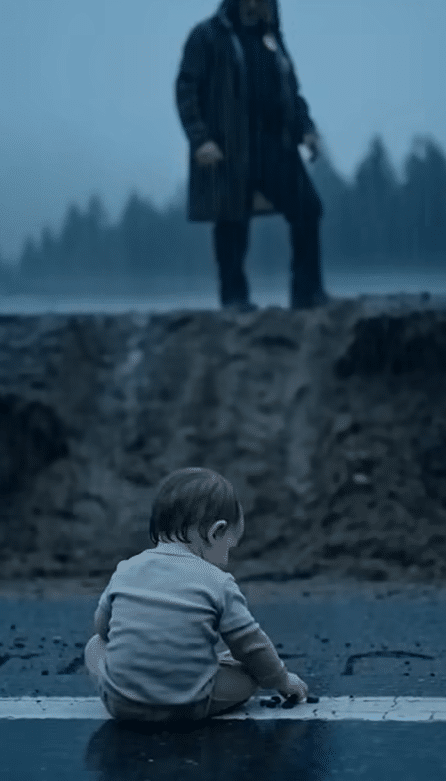
Outside, Interstate 5 had become a gray river of headlights, freezing rain, and roaring tires. Inside, a three-year-old boy sat wrapped in a silver emergency blanket, staring toward the trees as if something in the darkness had called his name.
“Dada sleep,” he whispered again.
I had been a Washington State Patrol trooper for twelve years. I had seen rollover crashes, drunken drivers, shattered windshields, and families receiving the worst news of their lives beneath flashing red and blue lights.
But nothing had ever made me feel as helpless as that little boy’s voice.
I left him secured in the back seat, radioed my position, and stepped into the rain with my flashlight raised.
The tire marks began near the shoulder.
They were deep and violent, cutting through the mud at an angle before disappearing over the embankment. Broken branches hung over the path. Wet leaves had been thrown in every direction. Whatever had gone down there had not rolled gently.
I moved closer to the edge.
The ditch dropped sharply into a wall of thorn bushes and dark pine. Rain hammered the hood of my cruiser behind me. Trucks screamed past, their headlights flashing through the branches like distant lightning.
Then my flashlight caught metal.
A crushed guardrail post.
A broken side mirror.
And twenty feet below, half-hidden beneath the brush, the roof of a dark SUV.
My stomach tightened.
“Dispatch, I’ve located a vehicle down the embankment,” I said into my shoulder radio. “Possible serious collision. Send fire, medical, and additional units. I have one child recovered from the roadway.”
The answer came back through static, but I was already climbing down.
Mud slid beneath my boots. Thorns tore at my uniform. Twice, I nearly lost my footing. The slope was so steep that the SUV could not be seen from the highway unless someone stood exactly where the boy had been sitting.
The vehicle had struck a tree nose-first.
The front end was folded inward. The windshield was fractured into a white spiderweb. One rear door hung open, bent almost completely backward.
That was how the boy had escaped.
I reached the driver’s side and aimed my flashlight through the shattered window.
A man was slumped over the steering wheel.
Blood darkened the side of his face, but there was no obvious movement. His left hand still gripped the wheel. His right arm hung uselessly beside the seat.
“Sir!” I shouted. “Washington State Patrol! Can you hear me?”
Nothing.
I checked for a pulse through the broken glass.
Weak.
But there.
“Dada sleep.”
The boy’s words echoed in my head.
I moved toward the passenger side, expecting to find another adult.
The seat was empty.
The airbag had deployed, but there was no blood on it. No purse. No coat. No phone.
Then my light passed over the back seat.
There was a child safety seat behind the passenger side.
Empty.
Beside it sat a pink backpack decorated with faded silver stars.
A second child.
I swept my beam across the ground outside the SUV.
There were footprints in the mud.
Not one set.
Two.
One belonged to a small child.
The other belonged to an adult.
They led away from the wreck and into the trees.
At first, I thought someone had gone searching for help.
Then I saw the driver’s wrists.
They were bound to the steering wheel with black plastic zip ties.
This was not an accident.
And somewhere beyond the trees, someone had taken another child.
Act II
The first ambulance arrived within twelve minutes.
It felt like an hour.
Firefighters cut the driver from the wreck while I remained near the boy, whose name we eventually learned was Noah Mercer. He could barely answer questions. He knew his first name, his father was “Eli,” and his sister was “Mia.”
Whenever we asked where Mia had gone, he pointed toward the forest.
“Bad man take her.”
That sentence changed the entire morning.
The driver, thirty-six-year-old Elijah Mercer, was transported with a fractured skull, broken ribs, and severe hypothermia. He regained consciousness briefly before the helicopter lifted off.
I leaned close as paramedics worked around him.
“Mr. Mercer, your son is safe,” I said. “We found Noah.”
His eyes moved beneath swollen lids.
“Mia,” he breathed.
“We’re looking for her. Who took her?”
His lips trembled.
“Not… stranger.”
Then he lost consciousness.
By noon, Interstate 5 was lined with patrol cars. Search teams entered the woods with dogs. A helicopter moved above the trees whenever the weather allowed it. Detectives photographed the SUV, the tire marks, and the zip ties around Elijah’s wrists.
What they found inside the vehicle made the situation even stranger.
Elijah’s wallet remained in the center console.
Two hundred dollars in cash had not been touched.
His phone was missing.
So was the SUV’s dash camera memory card.
The second car seat had been cut loose with a knife.
This was not a robbery.
Someone had wanted Mia.
Noah was examined at a nearby hospital. His body temperature was dangerously low, but he had no major injuries. A nurse found a scrape on his palm and dried mud beneath his fingernails, suggesting he had crawled up the embankment after escaping the SUV.
He had climbed through freezing brush, reached the highway, and sat down beside the white line.
He had not been trying to run away.
He had been waiting for someone to stop.
Elijah Mercer’s background looked ordinary at first.
He was a high school history teacher from Olympia. Divorced. No criminal record. No known enemies. He had full custody of Noah and eight-year-old Mia after their mother, Claire, disappeared eleven months earlier.
Not died.
Disappeared.
The case had received little attention outside the county. Claire Mercer had left her car at a bus station, withdrawn four hundred dollars, and vanished. Police initially suspected she had left voluntarily after a bitter custody dispute.
Elijah never believed it.
According to his sister, he spent months searching for Claire. He hired a private investigator, contacted shelters, checked hospitals, and distributed flyers long after police leads went cold.
Three weeks before the crash, he suddenly stopped talking about the investigation.
Then he withdrew both children from school.
He told the principal they were moving temporarily to stay with relatives.
They never arrived.
Detective Lena Ortiz, the lead investigator, came to the hospital that afternoon and placed a photograph in front of Noah.
It showed Claire Mercer standing beside Elijah and both children at a summer fair.
Noah touched his mother’s face.
“Mommy crying.”
Ortiz froze.
“When did you see Mommy crying?”
Noah pointed toward the window, toward the dark line of trees beyond the hospital parking lot.
“In house.”
“What house?”
“The red house.”
No one in the family knew of a red house.
Then Noah said something even more disturbing.
“Mia go back to Mommy.”
By sunset, the search dogs had followed the tracks nearly half a mile into the forest.
There, beneath a cedar tree, investigators found Mia’s pink glove.
Beside it was a fresh tire impression.
A second vehicle had been waiting beyond the crash site.
The abduction had been planned.
But the person behind it had made one mistake.
They had left behind a piece of paper inside the glove.
On it, written in Elijah Mercer’s handwriting, were six words:
Claire is alive. Do not trust Daniel.
Act III
Daniel Mercer was Elijah’s older brother.
He was also a deputy prosecutor for Thurston County.
When detectives first contacted him, Daniel appeared devastated. He arrived at the hospital in an expensive gray coat, embraced Noah, and demanded updates on the search.
He told investigators Elijah had become unstable after Claire disappeared.
“He was obsessed,” Daniel said. “He saw conspiracies everywhere.”
According to Daniel, Elijah had accused police officers, teachers, neighbors, and even members of his own family of hiding information about Claire.
“He loved his wife,” Daniel continued, lowering his voice. “But grief changed him.”
It was a convincing performance.
Too convincing.
Detective Ortiz did not show him the note.
Instead, she asked when he had last spoken to Elijah.
Daniel said three weeks earlier.
Phone records later proved he had called Elijah seven times the night before the crash.
Each call lasted less than a minute.
When confronted, Daniel claimed he had forgotten.
That was the first crack.
The second came from Elijah’s private investigator, a retired detective named Marcus Bell.
Bell had been hired nine months earlier. He told us Elijah’s suspicions had not been delusions.
Claire Mercer had not abandoned her family.
She had been hiding.
Two years before her disappearance, Claire worked as a financial administrator for a nonprofit youth foundation. Daniel Mercer served on its board.
The foundation raised millions for foster-care programs, emergency housing, and scholarships. Publicly, it was praised as one of the state’s most successful children’s charities.
Privately, Claire found false invoices, missing donations, and payments routed through shell companies.
The money trail led to Daniel.
Claire copied the records and threatened to report him.
Days later, she disappeared.
Elijah believed Daniel had frightened her into silence. He had no proof until Marcus Bell located a woman who had seen Claire after her disappearance.
She was working under another name at a roadside motel near the Canadian border.
Elijah went to meet her.
Claire told him she had been forced to choose.
Daniel threatened to destroy Elijah’s career, take the children through fabricated allegations, and make sure Claire was charged as an accomplice to the financial crimes. He showed her documents bearing her forged signature.
If she disappeared, he promised the family would remain safe.
Claire obeyed.
But she never stopped gathering evidence.
For months, she lived quietly, collecting bank records and contacting a federal investigator. She planned to return when the case was strong enough to protect her children.
Someone found out.
Three days before the crash, Claire called Elijah from a borrowed phone.
She told him Daniel knew where she was.
She had been moved to an abandoned property outside Centralia, a red farmhouse once owned by the Mercer family.
Elijah took the children and drove south before dawn. He did not contact police because Claire had warned him that Daniel had allies inside local government.
He was less than twenty miles from the farmhouse when a black pickup forced his SUV off the highway.
Noah later remembered loud voices after the crash.
One man dragged Elijah from the driver’s seat, bound him, then placed him back behind the wheel.
Another opened the rear door.
Mia screamed.
Noah hid beneath a blanket on the floor.
In the confusion, he crawled through the open door and into the brush.
The kidnappers did not notice him.
They took Mia because she had seen them.
By the time search teams discovered the farmhouse, night had fallen.
The building stood alone at the end of an overgrown logging road. Its red paint had faded almost to brown. Several windows were boarded. A generator hummed behind the barn.
Inside, investigators found a locked upstairs bedroom.
There were blankets on the floor.
Empty water bottles.
A woman’s hairbrush.
And a child’s silver bracelet engraved with the name Mia.
But Claire and Mia were gone.
On the wall, scratched into the peeling paint, someone had written a date.
November 18.
The next day.
Beneath it were three letters:
P.O.B.
Investigators believed it was a location.
I recognized it immediately.
Port of Bellingham.
Daniel was not hiding them anymore.
He was moving them out of the country.
And we had less than twelve hours to stop him.
Act IV
A statewide alert went out before midnight.
Daniel’s phone was turned off. His home was empty. His office computer had been wiped, but federal agents recovered fragments of deleted emails linked to a private vessel scheduled to leave Bellingham before sunrise.
The boat belonged to one of the shell companies Claire had uncovered.
The same company had received nearly two million dollars from the youth foundation.
At 3:40 a.m., officers located Daniel’s black pickup in a warehouse district near the marina.
Blood was found on the rear seat.
Not enough to suggest a fatal injury.
Enough to tell us someone had resisted.
I joined the search team at the port.
Rain swept sideways across the docks. The water beyond the breakwall was black and violent. Cargo lights cast long shadows over stacked containers and empty loading bays.
We moved through the warehouse in teams.
The first floor was empty.
The second contained office furniture, fuel drums, and shipping crates.
Then we heard a child crying.
It came from behind a steel door at the far end of the building.
“Mia!” a woman shouted from inside.
A gunshot cracked through the warehouse.
We took cover.
Daniel’s voice followed.
“Stay back!”
Detective Ortiz called out to him. “Daniel, the building is surrounded.”
“You don’t understand what she’s done.”
“We understand the stolen money. We understand the forged records. We understand the kidnapping.”
Silence.
Then Daniel laughed.
It was not the laugh of a frightened man.
It was the laugh of someone who still believed he was the smartest person in the room.
“You think this is about money?” he shouted. “Claire was going to ruin everything.”
Behind the door, Mia sobbed.
I moved along the side wall while Ortiz kept Daniel talking. Through a narrow window, I saw Claire sitting on the floor, one arm around Mia.
Her face was bruised, but she was conscious.
Daniel stood near the loading door with a handgun.
Beside him was a second man.
A sheriff’s detective named Paul Grady.
Grady had worked Claire’s missing-person case.
He was the reason every lead went nowhere.
He was also the man who had helped Daniel stage the highway crash.
The corruption went deeper than anyone had imagined.
Daniel had not merely stolen from the foundation. He and Grady had been diverting money from programs designed for vulnerable children. When Claire discovered it, Grady used his position to bury reports, intimidate witnesses, and monitor Elijah’s attempts to find her.
Now their entire operation was collapsing.
Ortiz demanded that they release Mia.
Daniel tightened his grip on the gun.
“Claire made a choice,” he said. “She should have stayed gone.”
Claire slowly raised her head.
“No,” she replied. “You made the choice.”
Daniel turned toward her.
That was the opening.
Mia reached into her coat and threw something across the floor.
A phone.
The screen was lit.
Recording.
Claire had managed to activate it while Daniel confessed.
For one second, everyone stared.
Then Grady lunged for the device.
I hit the side door with my shoulder and entered with two officers behind me.
“Drop the weapon!”
Daniel spun.
Grady ran.
The next few seconds happened in fragments.
Claire pulled Mia behind a crate.
Daniel raised his gun but hesitated.
An officer tackled Grady near the loading ramp.
I moved toward Daniel as Ortiz closed in from the opposite side.
He looked at the exits, then at the water beyond the open loading door.
There was nowhere left to go.
The gun slipped from his hand and hit the concrete.
The man who had spent years controlling everyone around him sank to his knees.
Not because he felt guilty.
Because he had finally lost.
And yet the most devastating truth was still waiting in the hospital.
Act V
Elijah woke two days later.
His first words were not about the crash.
They were not about Daniel.
They were not even about Claire.
“Where are my children?”
Noah was brought in first.
He ran across the hospital room in yellow socks and climbed carefully onto the bed. Elijah tried to sit up despite the bandages around his chest.
Noah touched his father’s face.
“Dada awake.”
Elijah broke.
He covered his eyes with one trembling hand and sobbed so hard that the heart monitor began to alarm.
Then the door opened again.
Mia entered holding Claire’s hand.
For a moment, Elijah stared as if he did not trust what he was seeing.
Claire looked older than she had in the family photographs. Her hair had been cut short. There was a healing bruise near her temple. Fear had carved new lines into her face.
But she was alive.
Mia let go of her mother and ran to the bed.
Claire stayed near the doorway.
Eleven months of fear stood between them.
Elijah reached out.
“You came back,” he whispered.
Claire shook her head as tears filled her eyes.
“I was always trying to.”
No apology could repair what had been stolen from them. No arrest could return the birthdays Claire missed, the nights Elijah searched alone, or the months their children believed their mother had chosen to leave.
Still, she crossed the room.
Elijah took her hand.
Noah climbed into her lap.
And for the first time since the nightmare began, all four members of the Mercer family were under the same roof.
Daniel Mercer and Paul Grady were charged with kidnapping, attempted murder, conspiracy, obstruction of justice, fraud, and multiple related offenses. Federal investigators later uncovered years of stolen charitable funds, falsified contracts, and threats against former employees.
Claire’s evidence dismantled the entire operation.
The youth foundation was placed under new leadership, and the recovered money was returned to the programs it had been meant to serve.
Elijah survived, though he spent months learning to walk without pain.
Claire entered protective custody during the trial.
Mia began therapy.
Noah stopped asking why his father had been sleeping in the trees.
As for me, I returned to patrol.
People often assume the worst part of police work is what you see after arriving too late.
Sometimes it is.
But sometimes the worst part is realizing how close you came to driving past.
A flash of yellow in the rain.
A shape that looked like trash.
A child sitting inches from traffic, too cold to cry, waiting for someone to understand what he could not explain.
I still drive that stretch of Interstate 5.
I still look toward the shoulder near the trees.
The grass has grown back over the tire marks. The broken branches are gone. There is nothing left to show where the SUV disappeared into the ravine.
But every November, when the rain turns the highway silver and the sky hangs low over Washington, I see him again.
A tiny boy in an oversized yellow coat.
Sitting alone beside the white line.
Waiting to save his family.