Act I
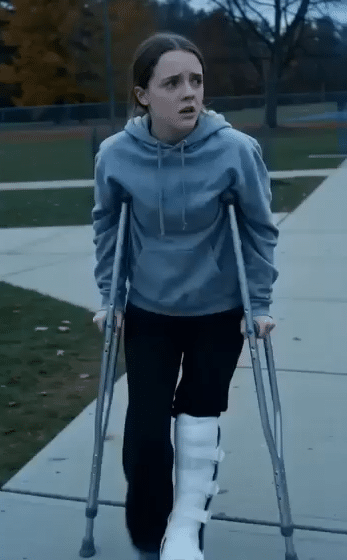
The first thing I saw was my daughter’s crutch skidding across the concrete.
The second was Lily hitting the ground.
She landed hard on her left side, one hand slapping against the pavement as her backpack twisted beneath her. A sharp cry escaped her before she could stop it.
Then came the laughter.
Three boys stood near the curb in Lincoln High varsity jackets, grinning as if they had just watched the funniest thing in the world. The tallest one—broad shoulders, expensive cleats, blond hair cut exactly the way local sports reporters liked—looked down at Lily with a smile that made something inside me go cold.
Caleb Turner.
Even I knew the name.
Star quarterback. Division I prospect. Son of the school board president. The kind of kid whose face appeared on banners outside the stadium and whose mistakes were always described as “poor judgment” instead of cruelty.
He spread his hands toward his friends.
“What?” he said loudly. “She was blocking the sidewalk.”
Lily tried to push herself upright, but the moment she moved her injured leg, her face collapsed in pain.
My hand froze on the Humvee door.
For half a second, the whole world went quiet.
No engines.
No students.
No wind scraping dead leaves across the parking lot.
Just my daughter on the ground and the boy standing over her like he owned the space around her.
I had imagined this reunion a hundred times during deployment.
I had pictured Lily seeing me from across the parking lot, her face lighting up before she awkwardly rushed toward me on her crutches. I imagined wrapping my arms around her and apologizing for every call I had missed, every surgery I had not been there for, every night she had stared at an empty doorway.
I had imagined tears.
I had not imagined this.
Caleb bent down and picked up Lily’s second crutch. For one stupid moment, I thought he was going to help her.
Instead, he held it out of reach.
“Come on, Miller,” he said. “You wanted everyone to treat you normally, right?”
His friends laughed again.
Several students had stopped to watch. A few held up phones.
No one moved.
Lily’s face burned red.
“Give it back,” she said.
Her voice was quiet, but I heard it from fifty yards away.
Caleb tilted his head.
“Stand up and get it.”
That was when I climbed out of the Humvee.
My boots struck the pavement with a heavy, wet thud.
Mud cracked off the soles.
Behind me, three diesel engines idled along the back fence, deep and steady, like distant thunder. The vehicles were coated in weeks of flood sludge. Brown water stains climbed halfway up the doors. Recovery chains, shovels, medical bags, and gear were strapped across the frames.
I started walking.
I was still wearing body armor.
My uniform was stained nearly black at the knees. My sleeves smelled of river water and fuel. There was dried blood on one cuff—not mine, and not from anything violent. It belonged to an old man we had pulled through a shattered attic window two nights earlier after he cut his arm on roofing metal.
Caleb did not notice me at first.
Lily did.
Her eyes lifted past him and found mine.
The humiliation vanished from her face.
For one breath, she looked six years old again.
“Dad?”
The word was barely audible.
But Tex heard it over the idling engines.
So did Sergeant Owens.
So did every soldier in those Humvees who had listened to me talk about Lily for six months.
Caleb turned.
His grin weakened when he saw me approaching, but it did not disappear.
Not yet.
I stopped a few feet away.
“Put the crutch down,” I said.
He looked at my uniform, then at the convoy.
A few students lowered their phones.
Caleb gave a short laugh, trying to keep control of the moment.
“This doesn’t concern you.”
Lily stared at him.
Then she looked at me.
“That’s my father.”
The parking lot changed.
It was subtle at first.
A whisper.
A shifting of feet.
A silence spreading through the crowd.
Caleb’s friends stopped smiling.
I stepped closer.
“Put it down.”
His jaw tightened. He was seventeen, surrounded by an audience, trapped inside the kind of pride that makes young men do reckless things because backing down feels worse than being wrong.
He tossed the crutch.
It clattered against the pavement beside Lily.
“There,” he said. “Happy?”
I did not answer.
I knelt beside my daughter.
Up close, I could see fresh scrapes across her palm. Her lower lip trembled, though she was fighting hard to keep it still. One of the straps around her medical boot had come loose.
“Did he hurt your leg?”
“I don’t know.”
Her voice cracked.
That nearly broke me.
I had spent three weeks carrying strangers through water deep enough to swallow houses. I had pulled children into rescue boats. I had watched families stand in parking lots with everything they owned stuffed into garbage bags.
I had remained calm through all of it.
But when Lily whispered those four words, my hands started shaking.
Then, behind me, twelve doors opened at once.
Act II
The sound was not dramatic.
It was worse.
Metal handles lifted.
Heavy doors swung outward.
Boots hit pavement.
One by one, the men and women of my unit stepped down from the Humvees.
They did not rush.
They did not shout.
They simply formed a loose line behind me, still covered in mud, exhaustion, and the quiet weight of everything they had seen.
Tex stood at the front.
Corporal Maria Alvarez was five-foot-four and looked like she had not slept since September. Her hair was tied under her patrol cap, and a bruise darkened one side of her jaw from when a rescue boat slammed into a flooded porch.
Beside her stood Sergeant Owens, who had carried two children through chest-deep water after their mother lost her grip on them.
Specialist Reed had spent fourteen hours directing traffic beside a collapsed bridge.
Private Donnelly had given his last dry pair of socks to an old woman at an emergency shelter.
They were not heroes in the movie sense.
They were tired people who had kept moving because somebody had to.
And now every one of them was looking at Lily.
Not Caleb.
Lily.
“You okay, kid?” Tex asked.
Lily nodded automatically, then winced.
Owens looked at me.
“Sarge?”
That one word carried a question.
Did I need help?
Did Lily need a medic?
Did we need witnesses?
I swallowed hard.
“Get the aid bag.”
Donnelly moved immediately.
That was when Principal Harold Vance came hurrying through the glass doors.
He was a narrow man in an expensive gray coat, his face already arranged into the tired expression of someone preparing to manage bad publicity.
“What is happening here?”
Nobody answered.
His eyes moved from the Humvees to my uniform, then to Caleb.
Recognition flickered.
So did calculation.
Caleb found his voice first.
“She fell.”
Lily looked at him in disbelief.
One of the boys beside him nodded quickly.
“Yeah. She slipped.”
I stood.
“She was shoved.”
Principal Vance looked at Lily, then at Caleb again.
“Are you certain?”
The question was aimed at me, but the doubt was meant for her.
Lily’s face changed.
It was a small thing, almost invisible.
She lowered her eyes.
That told me this was not the first time.
I turned toward her.
“How long?”
She said nothing.
“Lily.”
Her fingers tightened around the handle of her crutch.
“Since I came back.”
The words hit harder than the sight of her falling.
I looked at Principal Vance.
He avoided my eyes.
Caleb’s confidence returned.
“She’s exaggerating.”
Tex took one step forward.
Not threatening.
Just enough for Caleb to notice that muddy water still dripped from the hem of her trousers.
“What has he done?” I asked.
Lily shook her head.
“Dad, not here.”
That sentence was full of fear.
Not fear of me.
Fear of what would happen after I left.
I knew that kind of fear. I had seen it in evacuated families who refused to identify the landlord who had locked a safe exit. I had seen it in people who believed power always won because, so far, it always had.
I crouched beside her again.
“I’m here now.”
Her eyes filled.
“He takes my crutches,” she whispered. “He moves my chair in class. He tells people I caused the accident because I was texting.”
My chest tightened.
“Were you?”
“No.”
I already knew the answer.
Lily had been in the passenger seat.
Her friend Ava had been driving when another vehicle ran the light and struck them broadside.
At least that was what I had been told.
“Why would he say that?”
Lily looked toward Caleb.
Because everyone else did too.
Caleb’s face had gone pale.
Principal Vance stepped between us.
“This is not the appropriate place to discuss private student matters.”
That was the moment I realized he knew more than he was saying.
He was not surprised by the accusation.
He was afraid of it.
And the truth was about to come through the school doors holding a phone.
Act III
A girl with red hair pushed through the crowd.
She was thin, nervous, and breathing hard as if she had run from the far side of the building.
Her name was Ava Brooks.
I recognized her from the hospital video call two months earlier. She had sat beside Lily’s bed with a bandage across her forehead and guilt written all over her face.
“Mr. Miller,” she said.
Caleb turned sharply.
“Ava, don’t.”
She stopped.
For one second, she looked like she might obey him.
Then she looked at Lily on the ground.
Something in her broke.
“I recorded it.”
The parking lot went silent again.
Principal Vance stepped forward.
“Recorded what?”
Ava raised her phone.
“The accident.”
Caleb’s father had spent two months telling the town that Ava had caused the crash.
Richard Turner had gone on local radio and called it a tragedy involving “inexperienced teenage drivers.” His insurance company had accused Ava of speeding. Rumors spread through school that Lily had distracted her.
But Ava’s hands were shaking for another reason.
She opened a video.
The image was dark and tilted, filmed accidentally through the windshield because her phone had been mounted for directions. Rain streaked the glass. Lily’s voice could be heard faintly from the passenger seat.
Then headlights appeared from the left.
A black SUV shot through a red light.
The collision filled the screen.
Students gasped.
Ava paused the video just before impact.
The driver’s face was visible.
Caleb.
He had been driving his father’s SUV.
Not some unknown motorist.
Not a stranger who disappeared.
Caleb Turner had hit them.
My mind rejected it at first.
I stared at the frozen image, waiting for it to become someone else.
It did not.
Lily looked at me.
“He came to the hospital the next day.”
My throat tightened.
“He apologized?”
She shook her head.
“He told me nobody would believe us.”
Caleb stepped toward Ava.
“You said you deleted that.”
Tex moved between them.
She did not touch him.
She did not need to.
Ava’s voice shook.
“I told you that because your dad came to my house.”
Principal Vance closed his eyes.
There it was.
The secret behind his fear.
Richard Turner had not merely protected his son.
He had built a wall around him.
Ava explained in fragments.
Caleb had taken the SUV without permission after a party. He had been drinking. His father arrived at the hospital before the police finished their interviews. By morning, the vehicle had been reported stolen.
A family attorney contacted Ava’s parents.
Then came the pressure.
A scholarship recommendation for Ava’s older brother disappeared.
Her mother’s cleaning contract with the district was suddenly canceled.
Principal Vance called Ava into his office and warned her about making “unsupported accusations.”
Lily had tried to report the harassment after she returned to school.
Nothing happened.
Caleb became bolder.
He mocked her limp.
He kicked her crutch during lunch.
He told everyone she was lying because she wanted money.
And every time Lily complained, the school treated her as the problem.
I turned slowly toward Vance.
“You knew?”
He swallowed.
“I was advised that the matter was under legal review.”
“You knew.”
“I did not have verified evidence.”
Ava lifted the phone higher.
“You had this.”
His face drained.
She had emailed it to him three weeks ago.
He had never responded.
Caleb looked around at the students recording everything.
His power was slipping away, and he could feel it.
So he did what frightened people often do when the truth corners them.
He became crueler.
“You think anyone cares?” he snapped at Ava. “My dad owns half this town.”
Then another voice came from behind the crowd.
“No, he doesn’t.”
Richard Turner walked toward us in a dark overcoat.
He was broad, silver-haired, and polished enough to look calm even when he was not. Two men in suits followed him, one carrying a leather folder.
He had arrived fast.
Too fast.
Someone had called him the moment the Humvees entered the parking lot.
He looked at Caleb, then at the phones pointed toward them.
“What exactly has been said?”
I stood between him and Lily.
“Your son caused the crash.”
Richard barely looked at me.
“My attorney will address any defamatory statements.”
Ava held up the video.
His eyes flicked toward it.
Only once.
But it was enough.
He had seen it before.
Then Tex’s radio crackled.
“Sarge, state police just pulled in.”
Richard Turner’s calm finally disappeared.
And the man stepping out of the cruiser was carrying a file Richard thought had been buried forever.
Act IV
Trooper Daniel Hayes crossed the parking lot with a sealed evidence envelope under one arm.
I knew him.
Not personally.
But I knew the look on his face.
It was the look of a man who had spent too long being told to stop asking questions.
He nodded to me, then to Ava.
“Miss Brooks, do you still have the original recording?”
“Yes.”
“Good.”
Richard Turner stepped forward.
“Officer, I suggest you speak with counsel before turning a schoolyard misunderstanding into public theater.”
Hayes looked at him.
“This isn’t about the schoolyard.”
He opened the file.
The SUV had not been stolen.
Security footage from a gas station showed Caleb behind the wheel thirty minutes before the crash. A receipt from the same station showed alcohol purchased using Richard Turner’s credit card.
But the most damaging evidence came from the Turner family garage.
A mechanic had repaired front-end damage the morning after the collision.
He had kept photographs.
He had also kept the original broken grille.
Richard’s attorney had paid him cash and told him to destroy it.
He did not.
For two months, Hayes had been building a case quietly because every formal request he made somehow reached Richard Turner first.
Ava’s video completed it.
Principal Vance tried to step away.
Hayes stopped him.
“Stay here.”
The principal froze.
The leather folder in the attorney’s hand suddenly looked very heavy.
Caleb stared at his father.
“You said this was handled.”
Richard’s jaw tightened.
That single sentence destroyed whatever remained of their story.
Phones captured it.
Students heard it.
Teachers standing near the doors heard it.
So did the twelve soldiers behind me.
Richard grabbed his son by the arm.
“Do not say another word.”
Caleb pulled away.
“You told them Ava was driving!”
“Be quiet.”
“You said the video was gone!”
“Caleb.”
“You said nobody could touch us!”
The final sentence rang across the parking lot.
No one moved.
Richard looked around and realized his son had just confessed to the cover-up more clearly than any prosecutor could have hoped.
Caleb’s confidence collapsed.
For the first time, he looked seventeen.
Not powerful.
Not untouchable.
Just terrified.
Trooper Hayes moved toward him.
“Caleb Turner, I need you to place your hands where I can see them.”
Richard’s attorney protested.
Hayes ignored him.
No one cheered.
That mattered.
Lily did not smile when Caleb was placed in the back of the cruiser. Ava did not celebrate when Richard Turner was told to remain available for questioning.
Justice, when it finally arrives, is rarely as clean as people imagine.
It does not erase surgeries.
It does not return lost sleep.
It does not undo the moment a girl hits the pavement while strangers laugh.
But it changes who has to be afraid.
Principal Vance approached Lily.
“I am deeply sorry.”
She looked at him.
“You were sorry when I was alone too.”
He had no answer.
The school board later suspended him before the end of the day. Richard Turner resigned two days later. The district opened an investigation into deleted emails, altered incident reports, and pressure placed on staff.
But none of that was the moment I remembered most.
The moment I remembered was Lily trying to stand.
I reached for her.
She flinched.
Not from fear.
From pride.
“I can do it.”
She planted one crutch beneath her arm and pushed herself upright.
Her injured leg trembled.
Tex stood nearby with the medical bag.
Owens picked up her backpack.
Donnelly retrieved the crutch Caleb had thrown.
Nobody rushed her.
Nobody treated her like she was weak.
They simply waited.
Lily straightened.
Then she looked at the twelve exhausted soldiers surrounding her.
“Are these all your friends?”
Tex smiled.
“No, ma’am.”
She nodded toward me.
“We’re his backup.”
For the first time that day, Lily laughed.
Then she did something I had not expected.
She reached for my hand.
And I realized the hardest part was still ahead.
Act V
The doctors confirmed that Lily had not reinjured the bone.
She had bruising, a scraped palm, and pain that would keep her home for several days, but the surgery remained intact.
I sat beside her hospital bed that evening still wearing the same filthy uniform.
The mud had dried into pale cracks across my boots.
For hours, neither of us said much.
Her mother arrived furious, then relieved, then furious again. Ava’s family came later. Trooper Hayes took statements. Tex brought coffee that tasted like burned cardboard.
By midnight, the hallway was quiet.
Lily stared at the ceiling.
“You missed everything.”
There was no anger in her voice.
That made it worse.
“I know.”
“You missed the surgery.”
“I know.”
“You missed physical therapy.”
“I know.”
“You missed me calling you after Caleb cornered me in the stairwell.”
I looked at her.
“What?”
“I didn’t tell Mom everything.”
“Why not?”
“Because she already looked scared.”
I lowered my head.
For months, I had carried guilt like punishment. I had told myself I was serving people who needed me. I had told myself Lily understood.
But children can understand why you left and still be hurt that you were gone.
Both things can be true.
“I should have been here,” I said.
She turned toward me.
“You were saving people.”
“You needed saving too.”
Her eyes filled.
“So did they.”
I had no answer.
She reached toward my sleeve and touched the dried mud.
“Did you really come straight from the flood?”
“Yes.”
“You smell terrible.”
I laughed.
It came out broken.
Then she started crying.
Not quietly.
Not carefully.
She cried with the full force of two months of pain, fear, humiliation, and loneliness. I leaned over the bed and held her while she pressed her face into my filthy uniform.
“I’m sorry,” I whispered.
She gripped the back of my jacket.
“Just don’t disappear again.”
I could not promise that duty would never call.
I could not promise there would be no more storms, emergencies, or orders.
So I promised the one thing I could control.
“I won’t let silence take your place again.”
The investigation moved quickly after that.
Caleb was charged in connection with the crash, the false vehicle report, and witness intimidation. Because he was seventeen, some proceedings remained private, but the town learned enough.
Richard Turner faced charges tied to obstruction, evidence tampering, and coercion.
Principal Vance lost his position.
The school district restored Ava’s mother’s contract and created an outside reporting system for students after hundreds of parents demanded change.
Lily returned to school two weeks later.
She did not arrive alone.
Not because I wanted to intimidate anyone.
Not because the Guard staged a parade.
The convoy was gone by then. The Humvees had been washed. The uniforms were clean. The soldiers had returned to their families.
But Tex, Owens, Reed, and Donnelly came anyway.
Off duty.
In ordinary clothes.
They stood near the entrance holding handmade signs.
WELCOME BACK, LILY.
NO ONE WALKS ALONE.
Students filled the steps.
Some applauded.
Others simply moved aside.
Lily looked embarrassed for half a second.
Then she lifted her chin.
She crossed the courtyard on her crutches, moving slowly but steadily.
No one laughed.
At the doors, she stopped and looked back at me.
For six months, I had believed being her father meant standing between her and every danger.
I had been wrong.
Sometimes being a father meant teaching her that danger did not get the final word.
Sometimes it meant admitting you had failed.
Sometimes it meant showing up covered in mud, too late to prevent the fall, but not too late to help her rise.
Lily smiled.
Then she entered the school.
Behind her, the glass doors closed.
And for the first time since the flood began, I felt like I had finally come home.