Act I
The guests were still talking about the unusual wedding when the ambulance lights painted the mansion walls blue.
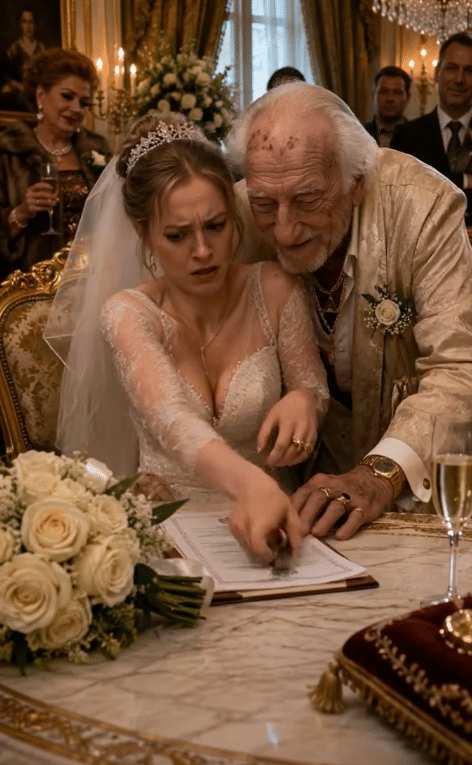
Only five days earlier, everyone had watched a beautiful young woman exchange vows with a man nearly fifty years older than her. They whispered behind polite smiles. Some called it love. Most called it calculation.
She ignored every stare.
As far as she was concerned, they simply didn’t understand opportunity.
Emily had grown up counting every dollar. Scholarships kept her in college, but they couldn’t erase the fear of poverty that had haunted her since childhood. When she overheard that Charles Ashford—a retired shipping magnate worth hundreds of millions—had no children, no siblings, and no known relatives, a dangerous idea quietly took root.
She convinced herself it wasn’t greed.
It was survival.
Charles was charming despite his age. He listened when she spoke. He remembered small details. He treated her with a kindness she had rarely experienced.
She smiled warmly.
She laughed at his stories.
She became exactly the woman he had always hoped to meet.
Within a month, Charles proposed.
She accepted without hesitation.
The ceremony was elegant, intimate, and surprisingly emotional. Charles looked genuinely happy.
Emily looked victorious.
As the guests toasted the couple, she was already imagining the mansion entirely hers.
She only had to be patient.
But fate had been making plans of its own.
Because five days after the wedding, Charles suddenly collapsed.
And everything Emily believed about her future began to fall apart.
She thought death would make her rich. Instead, it opened a door she never should have walked through.
Act II
Doctors moved quickly.
The diagnosis shocked everyone.
Charles had suffered a severe cerebral hemorrhage. Although surgeons managed to save his life, he remained unconscious.
The prognosis was uncertain.
Days became weeks.
The man Emily expected to outlive by only a short time was now suspended somewhere between life and death.
At first, she played the role of the devoted wife perfectly.
She sat beside his hospital bed.
She thanked nurses.
She cried whenever visitors appeared.
But the moment she was alone, her thoughts drifted elsewhere.
To bank accounts.
To property deeds.
To wills.
Eventually, curiosity became stronger than patience.
She began searching Charles’s private office.
Hidden inside an antique desk, she found a locked steel box.
After hours of searching, she discovered the key taped beneath a bookshelf.
Inside were legal documents.
Insurance papers.
Investment portfolios.
And one sealed envelope.
Across the front were six handwritten words.
Open only if I become incapable.
Emily’s hands trembled.
She broke the seal.
Inside was not a will.
It was a letter addressed directly to her.
“If you are reading this,” Charles had written, “then my greatest fear has probably come true.”
Emily’s heartbeat accelerated.
The next sentence made her blood run cold.
“I knew why you married me.”
But that wasn’t even the biggest secret waiting inside the envelope.
Act III
Emily read every word twice.
Charles confessed that from the beginning he had known she was interested in his fortune.
Not because someone warned him.
Because he had hired investigators before proposing.
The reports described her financial struggles, her conversations with classmates, even the afternoon she first asked questions about whether he had heirs.
He had known everything.
Yet he married her anyway.
Why?
The answer left her speechless.
“I spent decades building companies,” he wrote. “Money taught me to recognize lies. But loneliness taught me something even more painful.”
He admitted he had stopped caring whether people loved him for himself.
He simply wanted someone beside him before the end.
But there was another revelation.
One far greater.
Charles wasn’t actually alone.
Forty years earlier, he had fathered a son.
Believing the child had died shortly after birth, he spent decades mourning him.
Only recently had investigators uncovered evidence suggesting the boy had survived through an illegal adoption scheme.
For the last two years, Charles had quietly funded an international search.
If anything happened to him before they reunited, Emily was instructed to continue the search.
Attached was a folder.
Inside were photographs.
Old hospital records.
DNA reports.
Private investigators’ notes.
And a final handwritten sentence.
“If you truly wanted my fortune, earn it by giving my son his father back.”
Emily stared at the papers.
For the first time since meeting Charles, money wasn’t the only thing occupying her thoughts.
Guilt had finally found its way into the room.
She could destroy the evidence and inherit everything—or follow a path that might leave her with nothing.
Act IV
The temptation was overwhelming.
No one besides Charles knew about the missing son.
Destroying the documents would be easy.
No one would ever question her.
She held the folder over the fireplace.
For nearly a minute, she simply stood there.
Then she lowered her hands.
The next morning she contacted the investigators.
Months passed.
Emily traveled across cities, interviewed retired nurses, searched forgotten archives, and followed dozens of false leads.
Every answer uncovered another mystery.
Eventually one clue pointed toward a small coastal town.
There lived a middle-aged carpenter named Daniel.
He had never known he was adopted.
The DNA results arrived three weeks later.
A perfect match.
Charles’s son had finally been found.
Emily drove straight to the hospital.
Charles had unexpectedly regained consciousness only hours earlier.
Weak and barely able to speak, he watched as Daniel entered the room.
Neither man moved at first.
Years of loss, unanswered questions, and impossible hope filled the silence.
Then Charles whispered only one word.
“Son.”
Daniel crossed the room in tears.
The embrace lasted longer than anyone present could remember.
Emily quietly stepped outside.
She felt like an outsider watching a family she had nearly erased forever.
But the story still wasn’t over.
Act V
Several weeks later, Charles called his attorney.
Emily expected divorce papers.
Perhaps even criminal accusations.
Instead, Charles smiled gently.
“I already knew who you were when we married,” he said.
“But you’re not the same woman standing here today.”
He explained that wealth had revealed countless selfish people throughout his life.
Very few had chosen honesty when dishonesty would have been easier.
Emily had.
Because of her decision, a father and son had been reunited after four decades.
Charles amended his will.
The majority of his estate naturally went to Daniel and his family.
Emily did not become the sole heir she had once dreamed of becoming.
Instead, Charles established a charitable foundation in her name, dedicated to providing scholarships for students struggling with poverty—the very life she had once tried so desperately to escape.
She was also appointed to oversee the foundation.
Years later, people often asked how she had become connected to one of the country’s largest charitable organizations.
She never mentioned the fortune she almost stole.
She never admitted the lie that had begun everything.
She simply smiled and said that sometimes the greatest inheritance isn’t money.
It’s the chance to become someone better than the person you used to be.
The young woman entered the marriage believing wealth could buy happiness.
She left it understanding that redemption was worth far more than any mansion, any jewel, or any fortune that could ever be written into a will.