Act I
The entire business-class cabin fell silent the moment he spoke.
Some passengers looked away, pretending they hadn’t heard him. Others froze with the uncomfortable expression people wear when they witness something cruel but don’t know whether to intervene.
I wished I could disappear.
I had booked my ticket months earlier, carefully choosing the window seat for one simple reason: I wanted peace. It had been an exhausting few months at work, and this twelve-hour international flight was supposed to give me a chance to finish reviewing a proposal, answer a few emails, and maybe get a little sleep.
Everything had begun normally.
Flight attendants welcomed passengers with warm smiles. Carry-on bags disappeared into overhead bins. Someone laughed softly several rows behind me. The familiar hum of boarding filled the cabin.
Then he arrived.
He looked like someone who belonged on the cover of a business magazine. Tailored navy suit. Italian leather shoes polished to perfection. A silver watch that probably cost more than my first car. He carried himself with the confidence of a man accustomed to being obeyed.
He stopped beside my row.
His eyes landed on me.
His smile vanished instantly.
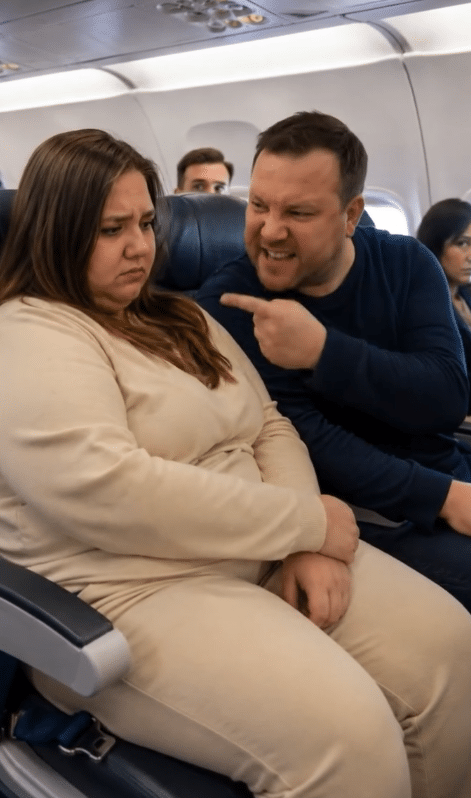
“What the hell is this?” he said loudly, making no effort to lower his voice. “I paid for business class, not to feel like I’m squeezed into a subway during rush hour.”
Several heads turned.
He looked directly at me with obvious disgust.
“I’m flying to an international conference,” he continued. “I need to prepare. How am I supposed to concentrate if I can’t even sit comfortably?”
The words hit harder than I expected.
I had spent years learning to ignore judgmental glances. I’d heard whispers before. I’d endured strangers making assumptions about my health, my discipline, my worth.
But this was different.
This wasn’t whispered.
It was performed.
As though humiliating me was part of the in-flight entertainment.
He sighed dramatically before lowering himself into the seat beside mine.
Then came the sentence I would never forget.
“Why do airlines even sell seats to people like her?”
Not overweight people.
Not passengers.
People like her.
As if I belonged to a completely different species.
I stared out the window, refusing to give him the satisfaction of seeing me cry.
What I didn’t know was that before this flight landed, every word he had spoken would return to him in a way he never imagined.
Act II
For the next several hours, the cabin settled into the quiet rhythm of long-haul travel.
Or at least everyone else’s did.
My seatmate made sure mine didn’t.
Every few minutes he shifted aggressively, letting his elbow dig into my arm.
Whenever a flight attendant passed, he sighed loudly, exaggerating how “cramped” he supposedly was.
At one point he even muttered, “This is unbelievable.”
I kept pretending to read.
Years earlier, I might have defended myself.
Now I knew something painful.
People determined to humiliate you rarely change their minds because of a clever comeback.
So I stayed silent.
Eventually the woman across the aisle leaned over.
“Are you alright?” she whispered.
I smiled politely.
“I’ll be okay.”
She gave me a sympathetic look before returning to her book.
Hours passed.
The man beside me buried himself in presentation slides.
From occasional phone notifications lighting his screen, I gathered he was some kind of executive preparing for a keynote speech.
He seemed obsessed with image.
Every chart had to be perfect.
Every sentence rehearsed.
Every number memorized.
Ironically, someone who cared so much about professional appearance had absolutely no concern for basic human decency.
When dinner service arrived, he refused dessert.
“Too much sugar,” he announced loudly.
Then he glanced at my tray.
“I guess not everyone worries about that.”
The flight attendant froze.
I quietly thanked her for the meal before she could apologize on his behalf.
She looked genuinely embarrassed.
Afterward she slipped me an extra bottle of water with a gentle smile.
It wasn’t much.
But kindness often feels enormous after cruelty.
Still, I wondered why his face looked strangely familiar.
I couldn’t place it.
Not yet.
The answer was waiting thousands of feet below us.
Act III
About two hours before landing, turbulence shook the aircraft.
Nothing serious.
Just enough to interrupt everyone’s concentration.
The captain announced we’d begin our descent soon.
My neighbor gathered his papers with growing confidence.
He practiced the opening lines of his speech under his breath.
“I am honored to lead the future…”
Lead the future.
Something clicked.
I had seen those exact words before.
Months ago.
On a proposal submitted to my department.
I slowly looked toward the folder resting beside his briefcase.
There it was.
The company logo.
Apex Dynamics.
My stomach tightened.
This wasn’t just another executive.
This was Richard Calloway.
The newly appointed CEO.
The keynote speaker for the Global Innovation Leadership Summit.
The very summit I was also attending.
Except I wasn’t attending as a guest.
I was chairing the committee responsible for selecting the recipient of the conference’s most prestigious partnership grant—a contract worth nearly fifty million dollars.
Only six people knew the committee members’ identities.
Our names had intentionally been kept confidential to prevent lobbying and favoritism.
Richard had no idea.
To him…
I was simply the overweight woman occupying the seat beside him.
He had spent ten hours showing me exactly who he was when no one important—at least in his mind—was watching.
The irony settled over me with remarkable calm.
I didn’t smile.
I didn’t gloat.
I simply closed my laptop.
The real test hadn’t even begun.
Act IV
The plane landed smoothly.
Passengers applauded softly.
Everyone stood to retrieve their bags.
Richard hurried into the aisle, eager to be among the first off the aircraft.
Then something unexpected happened.
The lead flight attendant approached me.
“Ms. Bennett,” she said warmly, “thank you again for flying with us. We’ve arranged for your conference transportation as requested.”
Richard froze.
He slowly turned around.
“You know each other?” he asked.
She smiled.
“Of course. Ms. Bennett travels with us several times every year.”
I thanked her and stepped into the jet bridge.
Moments later, a black sedan waited outside the terminal.
A conference coordinator hurried toward me.
“There you are!” she said. “Everyone’s already at the hotel preparing for tomorrow’s selection meeting.”
Richard happened to be walking only a few feet behind us.
Selection meeting?
His expression changed.
The coordinator continued talking.
“The finalists are incredibly nervous. After all, the committee chair has the deciding vote.”
Richard stopped walking.
Committee chair.
His eyes widened.
He looked at my conference badge for the first time.
Not at my body.
Not at my clothes.
At my name.
His face lost every trace of confidence.
“Wait…” he whispered.
He stared at me as though trying to rewrite the last twelve hours.
“You…”
I met his gaze calmly.
“Yes.”
He swallowed hard.
“I…I didn’t realize…”
“No,” I replied gently.
“You realized exactly what you wanted to.”
Silence stretched between us.
For the first time since boarding, he had nothing to say.
Act V
The conference began the following morning.
Richard delivered an impressive presentation.
Technically flawless.
Confident.
Polished.
The audience applauded enthusiastically.
Later that afternoon, our committee met privately.
We evaluated every finalist according to leadership, innovation, ethics, workplace culture, and long-term credibility.
Richard’s proposal scored exceptionally well in nearly every category.
Except one.
Character.
Not because I told anyone about the flight.
I never did.
Instead, during the ethics review, another committee member presented anonymous employee surveys gathered during due diligence.
A pattern emerged.
Bullying.
Public humiliation.
Disrespect toward subordinates.
A workplace built on fear instead of trust.
The stories sounded painfully familiar.
The committee reached its decision unanimously.
A different company received the partnership.
One known for investing in people rather than intimidating them.
That evening, as guests mingled during the closing reception, Richard approached me one last time.
He looked nothing like the arrogant man who had boarded the plane.
“I owe you an apology,” he said quietly.
“No excuses.”
“I judged you before I knew anything about you.”
I looked at him for a long moment.
“You didn’t need to know anything about me,” I answered.
“You only needed to remember I was human.”
He lowered his eyes.
“I’ll remember that.”
“I hope you do.”
Because life has a remarkable way of placing us beside strangers.
Sometimes for twelve hours.
Sometimes for only a few moments.
We never know who they are.
A future client.
A hiring manager.
A teacher.
A nurse.
A friend.
Or simply another person carrying battles we’ll never see.
Character isn’t revealed when we’re speaking to people who can benefit us.
It’s revealed when we believe they have nothing to offer.
Richard boarded that flight believing he was sitting next to someone beneath him.
He stepped off knowing the greatest distance between two people has never been measured by status, wealth, or appearance.
Only by compassion.
And that was a journey no first-class ticket could ever buy.