Act I
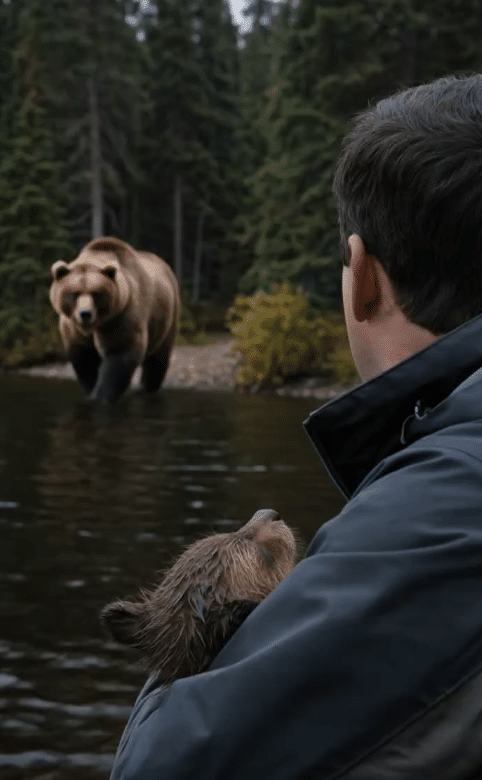
The bear cub looked dead when I pulled it from the river.
Its small body floated on its side near a bend where the current slowed beneath an overhanging bank. One paw moved weakly with the water, but the rest of it remained still.
At first, I thought it was swimming.
Then I saw its face.
Its eyes were closed.
Its mouth hung slightly open.
The fur around its head was dark and flattened against its skull.
“Probably drowned,” I whispered.
I should have called the wildlife authorities.
I should have stayed on the bank.
Instead, I stepped into the river.
The water was colder than I expected. It climbed above my knees and pushed hard against my legs as I reached for the cub.
Its body felt heavier than something that small should have.
I dragged it toward the shallows, slipped once on a submerged stone, and nearly went down with it.
By the time I reached the muddy bank, my jeans were soaked and my hands had gone numb.
I laid the cub on its side.
Nothing.
I touched its chest.
No movement.
I pressed gently beneath its ribs, then rolled it so its face pointed downward.
Water spilled from its mouth.
“Come on,” I muttered.
I pushed again.
Still nothing.
The forest around me had gone strangely quiet.
No birds.
No insects.
Only the river moving behind me.
I shook the cub carefully.
Its head rolled.
For one terrible second, I knew I had been too late.
Then something cracked in the trees.
Not a branch falling.
A heavy step.
I froze.
Another sound followed.
Closer.
Leaves shifted across the opposite side of the clearing.
Then she stepped out.
The mother bear was enormous.
Her coat was soaked along one side, as if she had already been in the water. Mud covered her front legs. One ear was torn.
She stared directly at me.
Then at the cub beneath my hands.
Every warning I had ever heard about bears entered my mind at once.
Do not run.
Do not scream.
Do not stand between a mother and her young.
I was already kneeling over her cub.
There was nowhere to move without appearing dangerous.
The bear lowered her head.
A deep sound rolled from her chest.
I lifted my hands slowly.
“I’m helping,” I whispered, though the words were meaningless to her.
She took one step forward.
Then another.
The ground seemed to shift beneath her weight.
I remained still.
The cub did not breathe.
The mother bear came within fifteen feet.
Then ten.
Her eyes never left my hands.
I expected the charge.
Instead, she stopped.
And behind her, through the trees, I saw something that made even less sense.
A length of orange plastic cord was wrapped around her back leg.
The other end disappeared into the brush.
She was not only watching me.
She was trapped.
The cord tightened when she tried to move closer.
She roared.
The sound hit my chest like a physical blow.
Then the cub coughed.
A small, wet sound.
The mother bear went silent.
I looked down.
The cub’s chest moved once.
Then again.
I rolled it carefully and cleared water from its mouth.
It coughed harder.
Its front paw twitched.
“Good,” I whispered. “That’s it.”
The cub opened its eyes.
At that exact moment, the orange cord pulled tight.
The mother bear lurched backward and crashed into the brush.
Something metallic snapped shut deeper in the trees.
And a man’s voice shouted from the ridge above us.
“Get away from it!”
I looked up.
Two men stood between the pines.
One held a rifle.
The other carried a coil of cable and a long metal hook.
Neither wore a wildlife uniform.
And when the man with the rifle aimed down toward me, I understood that the bear was not the most dangerous thing in the forest.
Act II
The rifleman wore a camouflage jacket and a black cap pulled low over his face.
His companion was older, with a red beard and mud covering both boots.
The orange cord attached to the mother bear ran past them toward a crude winch fixed between two trees.
Poachers.
The realization came so quickly it barely felt like thought.
The torn ear.
The trap.
The cub in the river.
They had been hunting the mother.
The cub must have fallen into the water while trying to follow her.
“Move away from the animal,” the rifleman said.
His voice was calm.
Too calm.
I stood slowly.
The cub tried to lift its head but collapsed against the mud.
The mother bear thrashed against the cord, snapping branches and tearing at the ground.
The bearded man glanced toward her.
“Line won’t hold much longer.”
The rifleman kept the weapon pointed at me.
“Then finish it.”
I looked at the bear.
Her rear leg had been caught in a steel cable snare. The more she fought, the tighter it cut.
“Why are you doing this?”
The rifleman laughed.
“Walk away.”
“You trapped her.”
“I said walk away.”
“And the cub?”
He looked down at it.
“That one’s worth more alive.”
My stomach tightened.
They were not simply hunting for meat.
They intended to sell the cub.
The mother bear roared again.
The rifleman raised the barrel toward her.
I moved without planning.
I stepped between him and the bear.
His expression changed.
“That is a bad idea.”
“Someone already called the authorities,” I lied.
The bearded man scanned the trees.
“No signal out here.”
“My phone sent the location before I went into the river.”
The lie sounded weak even to me.
The rifleman smiled.
“Then we should not waste time.”
He lowered the weapon.
Not because he believed me.
Because he had decided I was now part of the problem.
The cub moved beside my boot.
Its claws scraped weakly against the mud.
I could hear its breathing.
Shallow.
Fast.
The mother bear pulled again.
The orange cord groaned.
The bearded man stepped toward the winch.
“Shoot her.”
The rifleman turned slightly.
That gave me one chance.
I kicked mud toward his face.
He cursed and raised one hand.
I grabbed the cub.
Then I ran.
Not toward the trail.
Toward the river.
A shot exploded behind me.
Bark burst from a tree at shoulder height.
The cub cried out against my chest.
I slid down the bank and entered the water.
The current struck my legs.
I nearly fell.
Another shot hit the river several feet away.
The forest echoed.
I moved downstream, using the bank for cover.
The cub was alive now, but barely.
Its body shook from cold.
Behind me, the mother bear roared with such violence that the sound changed.
The orange line snapped.
The bearded man shouted.
Then came a scream.
I looked back once.
The mother bear had reached the ridge.
The rifleman fired.
The bullet struck dirt beside her.
He fired again.
She kept coming.
The two men ran.
One disappeared through the trees.
The other tripped near the winch and fell hard.
The bear reached him.
I expected blood.
Instead, she swiped the rifle away and stood over him while he covered his head.
Then she turned.
Not toward the fleeing man.
Toward me.
Toward the cub.
I was waist-deep in the river with her young pressed against my chest.
She descended the slope.
Every instinct told me to leave the cub and run.
But the current was stronger here, and the cub could not swim.
I reached a narrow gravel bar and laid it down.
The mother bear entered the water.
She came directly toward us.
Her wounded leg dragged slightly.
I stepped back.
She approached the cub.
Sniffed it.
Then nudged it with her nose.
The cub made a weak sound.
The mother looked at me.
For a moment, neither of us moved.
Then she lowered her head.
Not in submission.
Not in gratitude.
Simply recognition.
I had helped something that belonged to her.
That was all.
She picked the cub up gently by the loose skin behind its neck.
Then she turned toward the forest.
I thought the danger was over.
It was not.
The bearded poacher had survived.
And before the mother disappeared into the trees, he reached for the rifle she had knocked aside.
Act III
I saw the movement first.
His hand stretched across the mud.
His fingers closed around the rifle stock.
The mother bear was climbing the bank with the cub in her mouth.
She could not see him.
“Stop!”
The poacher looked at me.
Then raised the weapon.
I grabbed the nearest stone and threw it.
The rock struck his wrist.
The rifle fired into the air.
The mother bear spun.
The cub dropped onto the grass.
The poacher tried to aim again.
She charged.
This time, she did not stop.
The rifleman who had escaped reappeared near the trees and shouted to his partner.
“Run!”
The bearded man abandoned the weapon and scrambled backward.
The bear struck the ground beside him, close enough to tear his jacket.
He rolled down the slope.
Then both men fled into the forest.
The mother stood between them and the cub until their footsteps disappeared.
She returned to her young.
The cub tried to stand.
Its legs failed.
The mother nudged it twice.
Then looked toward the trees where the men had gone.
She could not carry the cub and defend herself if they returned.
I understood the problem.
I also understood how absurd it was that I was still there.
But leaving felt impossible.
The cub needed treatment.
The mother needed help with the cable cutting into her leg.
And armed men remained nearby.
I reached slowly for my phone.
No signal.
I had expected that.
The nearest ranger station was eight miles away.
My truck was parked two miles upriver.
The mother watched me.
I pointed toward the trail as though she could understand.
“I need help.”
She did not move.
The cub coughed again.
I removed my wet jacket and placed it on the ground near the cub.
The mother growled.
I stopped.
Then she lowered her head and sniffed the fabric.
I backed away.
She allowed the cub to lie against it.
That was as close to permission as I was going to receive.
I began climbing toward the ridge.
Halfway up, I found the rifle.
I unloaded it, removed the magazine, and threw the ammunition into the river.
The weapon itself I carried.
Not because I wanted it.
Because the poachers might return for it.
Their tracks led north.
Mine led south.
I reached my truck exhausted, soaked, and shaking.
The engine barely turned over in the cold.
I drove toward the ranger station while trying to call emergency services whenever the road rose above the trees.
A signal appeared after fifteen minutes.
I reported the poachers, the trapped bear, and the injured cub.
The dispatcher told me to stay away from the area.
I was already turning back.
Two wildlife officers met me near the trailhead.
One was a woman named Mara Collins. The other, Ben Torres, carried a tranquilizer rifle and medical pack.
I showed them the rifle.
Mara examined it.
The serial number had been filed away.
“This is not recreational hunting,” she said.
“I know.”
“Did you see a vehicle?”
“No.”
“Faces?”
“One clearly.”
She gave me a sharp look.
“You are lucky to be alive.”
I thought of the mother bear.
“So are they.”
We moved through the forest quietly.
When we reached the river bend, the mother and cub were gone.
Only my jacket remained.
Blood marked the grass.
Mara studied the tracks.
“The mother carried the cub uphill.”
“She was injured.”
“She is still moving.”
We followed.
The trail led toward an abandoned logging road.
Near sunset, we found the cub beneath a fallen tree.
Alone.
The mother was nowhere in sight.
Mara approached carefully.
The cub barely reacted.
Its breathing had worsened.
Ben sedated it lightly, wrapped it in a thermal blanket, and checked its lungs.
“Possible aspiration,” he said. “Maybe hypothermia.”
“Where is the mother?”
Mara pointed toward the road.
Blood drops continued beyond the trees.
Then we heard an engine.
A pickup truck approached through the darkness.
Its headlights were off.
It stopped fifty yards away.
Two doors opened.
The poachers had returned.
This time, they were not alone.
Four men stepped out.
And one of them wore the uniform of a wildlife officer.
Act IV
The uniformed man carried himself like someone accustomed to being obeyed.
He wore a department jacket, badge, and sidearm.
Mara recognized him.
“Deputy Warden Kell.”
Kell looked at the cub wrapped in Ben’s arms.
Then at the rifle I had brought from the river.
His expression did not change.
“I received a report of an illegal weapon,” he said.
Mara kept one hand near her radio.
“We found two armed suspects.”
“I’ll take over.”
“No.”
The word came quickly.
Kell’s eyes narrowed.
“This is my district.”
Mara glanced toward the men behind him.
They were not officers.
One was the bearded poacher.
His jacket was torn.
The rifleman stood beside him.
Kell followed her gaze.
“They are cooperating witnesses.”
The bearded man smiled.
I understood then.
The attacks had continued because someone inside the department protected them.
Kell stepped forward.
“Hand me the cub.”
Ben did not move.
“It requires emergency care.”
“I said hand it over.”
Mara raised her radio.
“Kell, I am requesting identification on all personnel present.”
The radio produced only static.
The same silence the poachers expected.
Kell had chosen the location because communications failed there.
He looked at me.
“You caused a serious problem today.”
“You trapped the bear.”
“I manage wildlife populations.”
“You sell them.”
His face hardened.
The rifleman moved toward me.
Kell stopped him with one hand.
“No mistakes.”
That phrase told us everything.
They had made mistakes before.
People had disappeared.
Evidence had been lost.
Animals had been sold.
The cub was valuable because young bears could be trafficked to private collectors, roadside zoos, and illegal training facilities.
The mother was useful dead.
Her claws, teeth, hide, and organs could all be sold.
The poachers had chosen the river area because few hikers came during winter.
They had not expected me.
Kell drew his weapon.
“Put the cub down.”
Mara slowly raised her hands.
“All right.”
She looked toward Ben.
He understood.
He lowered the cub near the fallen tree.
The animal made a faint cry.
It was a small sound.
But the forest answered.
A roar came from the dark.
Every man turned.
The mother bear emerged behind the pickup.
Blood covered her injured leg.
The cable still dragged from it.
She had not abandoned the cub.
She had circled around.
The poachers raised their weapons.
Mara shouted.
“No shooting!”
Kell fired first.
The bullet struck the truck.
The bear charged.
Chaos broke across the road.
One poacher ran.
Another climbed onto the hood.
The bearded man fired blindly toward the trees.
Ben pulled the cub behind the fallen log.
Mara knocked Kell’s arm aside before he could shoot again.
I tackled the rifleman.
We fell into the mud.
He struck my face.
I grabbed his jacket and rolled.
Behind us, the mother bear slammed into the side of the truck.
The vehicle rocked.
The man on the hood fell.
The bear moved toward the cub.
Not toward the fleeing men.
Toward her young.
Kell broke free from Mara.
He aimed at the mother’s back.
I saw him.
So did the bearded poacher.
But before either could fire, an engine roared from the opposite side of the road.
Two official wildlife vehicles entered the clearing with lights flashing.
Mara’s emergency beacon had transmitted our location despite the failed radio.
Kell turned.
That hesitation ended everything.
Officers surrounded the clearing.
Weapons were lowered.
Commands filled the air.
Kell tried to run into the trees.
He made it twenty feet before slipping on the dragging cable from the bear’s snare.
He fell hard.
Mara reached him first.
She pressed him into the mud and removed his badge.
The mother bear remained beside the cub.
No one approached.
Ben prepared the tranquilizer.
The shot struck her shoulder.
She roared once, staggered, then lay down beside her young.
The cub crawled against her chest.
Even sedated, she curled around it.
The officers cut the cable from her leg.
Then the arrests began.
But what they found in Kell’s pickup turned the rescue into one of the largest wildlife investigations the state had seen in years.
Act V
Inside the truck were forged permits, animal sedatives, cash, and a ledger.
The names filled twelve pages.
Buyers.
Poachers.
Private collectors.
A veterinarian who falsified health certificates.
Three officials who warned Kell about inspections.
The network reached across state lines.
Investigators later found hidden enclosures on an isolated property forty miles north.
Two wolves.
A cougar.
Several birds of prey.
And three bear cubs taken from different regions.
Some had been kept in cages too small for them to turn around.
The ledger connected Kell to at least nine illegal captures and four unexplained animal deaths.
He had used his position to redirect patrols, close investigations, and label poached animals as nuisance removals.
When witnesses reported unusual activity, he intimidated them.
When evidence appeared, it vanished.
The river trap had been part of a planned capture.
The poachers expected the mother to exhaust herself in the snare.
Then they would kill her and take the cub.
The water interrupted them.
The cub fled, fell from the bank, and nearly drowned.
My walk along the river changed the timing.
Nothing more.
But sometimes timing is enough.
The cub and mother were transported separately to a wildlife rehabilitation center.
The mother’s leg was badly injured, but the cable had not destroyed the bone.
The bullet had missed her.
The cub developed pneumonia from inhaling river water.
For four days, the staff did not know whether it would survive.
I visited once.
Not because I believed the bear would remember me.
Because I needed to see that pulling it from the water had mattered.
The cub lay inside a heated enclosure behind glass.
Its breathing was labored.
A tube delivered oxygen.
Mara stood beside me.
“You did everything wrong,” she said.
I looked at her.
“You entered deep water alone. Approached a wild animal. Interfered with armed criminals. Returned after being told to stay away.”
“That sounds bad when you list it like that.”
“It was reckless.”
“Would you have left it?”
She watched the cub.
“No.”
That was the only answer that mattered.
The mother recovered faster.
Once she could place weight on the injured leg, staff moved the cub into an adjacent enclosure.
A barrier separated them.
The mother spent hours pressed against it.
The cub answered with small cries.
After two weeks, the barrier was opened.
The mother crossed immediately.
She sniffed the cub from nose to tail.
Then lay down.
The cub climbed against her.
No drama.
No miracle.
Just recognition.
Kell and the others were charged with wildlife trafficking, conspiracy, illegal possession of firearms, obstruction, official misconduct, and several related offenses.
The bearded poacher accepted a plea deal and testified.
He claimed Kell told them the department would protect every operation.
The rifleman denied everything until investigators matched his boots to tracks near three other trapping sites.
The veterinarian lost his license.
Two officials resigned before they were arrested.
The case became public.
News stations called me a hero.
I hated it.
Heroes know what they are doing.
I was a man who saw something small floating in a river and could not leave it there.
That was all.
Months later, the rehabilitation center announced that the mother and cub were ready for release.
They selected a protected wilderness area far from roads and settlements.
I was invited to watch from a distance.
The transport crates opened at dawn.
The mother emerged first.
She sniffed the air.
Her injured leg carried a faint limp, but she moved strongly.
The cub followed.
It had grown.
Its fur was thick again.
For a moment, it stopped near the edge of the trees.
It looked in our direction.
People around me held their breath.
I knew better than to turn the moment into something sentimental.
The cub did not thank me.
The mother did not forgive humanity.
Wild animals owe us nothing.
Then the cub ran after her.
They disappeared into the forest.
Mara stood beside me.
“Do you ever think about what would have happened if you kept walking?”
“Yes.”
“What do you think?”
I watched the trees.
“I think the river would have carried it farther.”
She nodded.
We said nothing else.
A year later, I returned to the same bend.
The place looked ordinary.
Water sliding past rocks.
Branches moving over the bank.
No blood.
No traps.
No cardboard signs marking what had happened there.
I stood where I had pulled the cub ashore.
For a long time, I listened to the river.
The greatest shock had not been seeing the mother bear step from the trees.
It was not the rifle.
Not the corrupt officer.
Not even the discovery of the trafficking network.
It was realizing how much cruelty depends on people believing no one is watching.
The poachers chose an empty road.
A dead communication zone.
A winter morning when they expected the forest to hide everything.
They were almost right.
But a bear cub floated into view.
I reached into the water.
And one small act exposed a chain of people who had built their safety around silence.
The mother bear never needed me to save her.
She fought the cable.
Protected her cub.
Returned even after being wounded.
What she needed was one witness who refused to walk away.
That was the truth I carried home from the river.
Sometimes the thing that drags you into danger is not courage.
It is simply the moment you realize that if you do nothing, no one else may ever know what happened.