Act I
On the morning of our divorce hearing, my husband pushed his sick sister’s medical bag across the courtroom table and smiled.
“Take the burden,” Daniel Archer said. “You always liked charity work.”
His lawyer smiled too.
Brooke DeLuca, the woman Daniel had been hiding in hotel rooms for eight months, sat behind him in a cream coat with my anniversary necklace resting at her throat.
They believed I was walking away with nothing.
No house.
No company shares.
No fight over Daniel’s accounts.
No public scene over the affair.
Just Margaret.
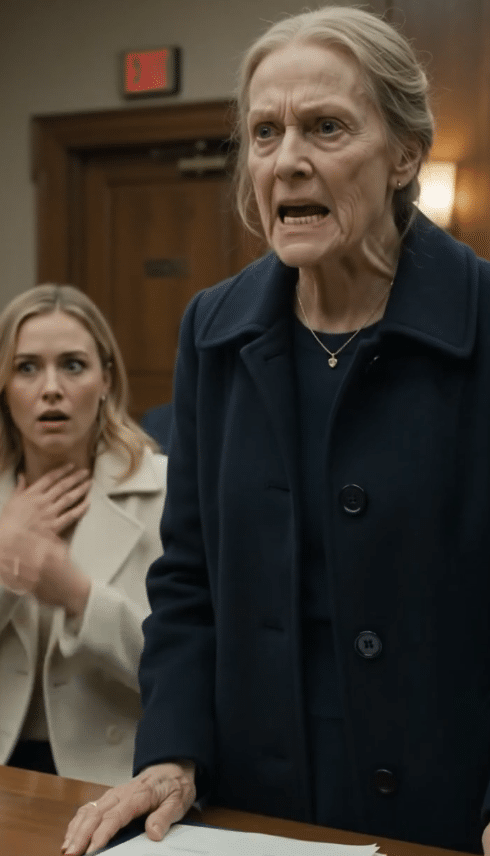
Daniel’s older sister sat beside me with one hand trembling around her cane and the other resting on a sealed blue folder.
Daniel never looked closely at that folder.
That was his first mistake.
The judge adjusted her glasses.
“Mrs. Archer, you understand that under this agreement, you are waiving claims to several substantial marital assets?”
Daniel leaned back in his chair.
“Claire understands. She’s always been emotional.”
The courtroom went quiet.
My cheeks burned, but I did not look at him.
I looked at Margaret.
Her face was pale from the difficult morning she had already endured just to reach that room. She had buttoned her navy coat incorrectly before we left, then cried in the car because her hands would not cooperate.
I fixed the buttons for her.
Daniel had not called once.
Six weeks earlier, he had stood in our kitchen holding sparkling water and explained the end of our marriage like a disappointing quarterly report.
He said we had grown apart.
He said no one was to blame.
He did not mention Brooke.
He did not mention hotel suite 914.
He did not mention the message he had sent her three weeks earlier.
Claire is useful, but exhausting.
I listened until he ran out of polished lies.
Then I folded my hands.
“I’ll sign,” I said. “I only want Margaret.”
He laughed.
Not a shocked laugh.
A relieved one.
“That’s it?”
I said nothing.
“You want my disabled sister?”
Margaret was standing in the hallway.
She heard every word.
That night, her cane tapped slowly against the floor outside my bedroom. She stood in the doorway for a long time before speaking.
“Claire, there’s something Daniel never told you.”
I waited.
Her eyes filled, but her voice remained steady.
“Not yet,” she whispered. “Let him think you’re leaving empty-handed.”
She glanced toward the staircase.
“Please. Just protect Jamie. And bring me to court.”
So I did.
I packed my daughter’s lunch.
Copied the affair emails.
Printed hotel receipts.
I made no threats.
I hired no dramatic attorney eager to destroy Daniel in public. I let him believe silence meant defeat.
By divorce day, he was glowing.
He wore the charcoal suit I had bought for his promotion dinner. Brooke wore my necklace. His lawyer slid documents toward me as though presenting a bill.
“Mrs. Archer agrees to vacate the family residence within thirty days,” he said. “Mr. Archer agrees not to contest her request to assume personal care responsibilities for Ms. Margaret Archer.”
Personal care responsibilities.
That was how they wrote a human being out of a family.
Margaret’s fingers tightened over the blue folder.
Daniel noticed.
His eyes moved toward it.
“What’s that?”
Margaret lowered her chin.
“Insurance papers.”
Brooke gave a small laugh.
“How touching.”
Jamie was not in the courtroom, and I was grateful.
She was at school with strawberry slices in her lunchbox, unaware that her father was trying to discard the only aunt who remembered every science fair, every birthday theme, and every fear she had never admitted to him.
The judge asked me one final time whether I understood what I was signing away.
Daniel’s lawyer tapped the settlement.
Daniel tapped his phone.
Brooke crossed her legs.
Everyone waited for me to break.
I picked up the pen.
Daniel leaned close enough that only Margaret and I could hear him.
“Enjoy the hospital bills,” he whispered. “You won’t last six months.”
Margaret stopped trembling.
Completely.
She placed the blue folder flat on the table.
The sound was small.
But Daniel went still.
For the first time all morning, his smile disappeared.
The judge looked up.
“Ms. Archer?”
Margaret removed a notarized page.
Then a bank letter.
Then a copy of a deed Daniel had sworn no longer existed.
Brooke’s hand rose to the necklace at her throat.
Margaret faced the judge.
“Before Claire signs anything, Your Honor, you need to know whose name is really on the company Daniel built his empire on.”
And in that instant, the divorce hearing became something else entirely.
Act II
Daniel liked to tell people he built Archer Medical Systems from nothing.
It was part of the mythology.
The poor boy with a brilliant mind.
The relentless entrepreneur who slept in his car, survived on vending-machine coffee, and turned a garage prototype into a company supplying rehabilitation equipment to hospitals across three states.
Investors loved the story.
Journalists repeated it.
Brooke had probably fallen in love with it.
The truth was less flattering.
Archer Medical Systems began with Margaret.
Before the tremors.
Before the cane.
Before the neurological disease slowly took control of her hands and legs.
Margaret Archer had been a biomedical engineer.
A gifted one.
At twenty-six, she designed a pressure-responsive support system for patients recovering from spinal injuries. The device adjusted automatically to movement and muscle fatigue, reducing skin damage and increasing mobility.
Daniel was still drifting between sales jobs.
Their father had recently died.
Their mother was already gone.
Margaret used the small inheritance to build a prototype.
She rented a workshop.
Filed early research notes.
Paid for Daniel to attend business courses after he promised he could help bring the device to market.
Then Margaret became ill.
At first, it was numbness.
Then tremors.
Then sudden weakness in her right leg.
Doctors struggled to diagnose her. While she underwent testing, Daniel stepped into the company.
He met suppliers.
Spoke to investors.
Signed contracts Margaret could no longer travel to negotiate.
She trusted him.
He was her younger brother.
By the time doctors identified a rare degenerative neurological condition, Daniel had placed himself at the center of everything.
The public began associating the invention with him.
Margaret did not fight it.
She believed they were still partners.
Then came the first major hospital contract.
Daniel told her investors would not support a visibly ill chief designer. He asked her to transfer certain business rights temporarily so the company could survive.
Margaret signed papers from a hospital bed.
She remembered a lawyer.
A notary.
Daniel holding her hand.
What she did not remember was transferring ownership of the original patents.
Because she never had.
Margaret spread the documents across the courtroom table.
The first was the original deed to the industrial property where Archer Medical Systems operated.
The land had belonged to their father.
It passed to Margaret alone under his will.
Daniel had told investors the property was company-owned.
It was not.
The second document was a patent assignment.
Daniel had submitted a copy years earlier claiming Margaret transferred the device rights to him.
The signature had been challenged in private arbitration.
A forensic examiner concluded it was forged.
The third document was the settlement from that arbitration.
Daniel had agreed that Margaret remained the beneficial owner of fifty-one percent of the original technology and any company valuation derived from it.
The agreement was sealed.
Daniel had never disclosed it to me.
Or to his investors.
Or, judging by her face, to Brooke.
The judge removed her glasses.
“Mr. Archer, is this agreement authentic?”
Daniel’s lawyer whispered urgently into his ear.
Daniel looked at Margaret.
“You said those papers were gone.”
His voice was barely audible.
Margaret met his eyes.
“You told me they were destroyed.”
Daniel’s lawyer stood.
“Your Honor, these documents are outside the scope of today’s domestic proceeding.”
Margaret lifted the bank letter.
“Not this one.”
The company’s primary line of credit had been secured using the disputed patent rights and Margaret’s industrial property.
Daniel had signed the loan documents personally.
He had certified that no other ownership claims existed.
That certification was false.
Worse, the bank had recently discovered irregular transfers from company accounts.
Money had been moved into private investment vehicles controlled by Daniel and an unnamed partner.
Brooke stopped touching the necklace.
The judge called a recess.
Daniel rose so quickly his chair struck the floor.
He leaned over the table.
“What did you do?”
Margaret’s hand began trembling again.
I stood between them.
“Sit down.”
Daniel laughed once.
It was no longer charming.
“You think this belongs to you now?”
“No,” I said. “I think it never belonged to you.”
His eyes moved toward the unsigned settlement in front of me.
For the first time, he understood why I had been willing to waive everything.
I had not been surrendering.
I had been waiting.
Then Margaret looked at me and said the part Daniel had never expected.
“The trust names Claire as successor.”
The courtroom seemed to tilt.
Daniel’s face emptied.
“What trust?”
Margaret opened the final section of the folder.
And the empire Daniel had spent fifteen years building his name around began to collapse page by page.
Act III
Margaret created the trust nine years earlier.
At the time, she still believed Daniel might eventually do the right thing.
She transferred her patent interests, the industrial property, and her residual company rights into the Archer Innovation Trust.
She named herself as primary beneficiary.
If she became incapacitated, control would pass to an independent trustee.
If she died, the assets would fund medical research and long-term care for patients with degenerative neurological conditions.
Daniel was not the successor trustee.
I was.
The paperwork had been updated four years earlier.
That was when Margaret began noticing things.
Invoices she did not recognize.
Royalty payments that arrived late.
Medical expenses Daniel claimed the company had covered but had quietly been charged against her personal trust distributions.
At first, she blamed clerical errors.
Then I started helping with her care.
I organized appointments.
Reviewed insurance denials.
Tracked medications.
I found that Margaret’s private nursing fund had been reduced by nearly half.
Daniel said treatment had become more expensive.
That was a lie.
The money had been redirected into a property development company.
One connected to Brooke DeLuca.
Brooke was not merely Daniel’s girlfriend.
She was his business partner.
Her firm purchased luxury apartments through shell companies. Daniel moved money from Archer Medical Systems into those companies, labeling the transfers as consulting fees and equipment-storage expenses.
Hotel suite 914 was not only where they conducted their affair.
It was where they met accountants.
I discovered that after copying the receipts.
Daniel had believed I was gathering evidence of infidelity.
I was gathering evidence of theft.
Margaret knew more than I did.
Three months before the divorce, she overheard Daniel speaking to Brooke in his home office.
He was planning to place Margaret in a state-funded facility.
Not a private neurological center.
A low-cost nursing home two counties away.
Once she was moved, he intended to petition for financial guardianship by claiming she could no longer manage her affairs.
Then he would gain access to the trust.
There was one obstacle.
Me.
I held Margaret’s medical proxy.
I attended every appointment.
I knew she remained mentally competent.
Daniel needed me gone before he could isolate her.
That was when the affair stopped being carelessness.
It became strategy.
He left messages where I would find them.
Allowed hotel receipts to remain in jacket pockets.
Started coming home smelling like Brooke’s perfume.
He wanted me angry.
He wanted a fast divorce.
He wanted me focused on betrayal instead of finances.
And when I asked for Margaret, he believed the last obstacle had removed itself willingly.
Daniel’s second mistake was confusing compassion with stupidity.
During the recess, his lawyer requested a private conference.
The judge refused.
The bank letter had already raised possible fraud. Court staff contacted the appropriate authorities.
Daniel paced near the windows.
Brooke stood several feet away from him.
The necklace still rested against her coat.
I recognized every diamond.
Daniel had given it to me on our tenth anniversary.
He claimed it was being cleaned.
Brooke caught me looking.
Her chin lifted.
“You abandoned the marriage,” she said.
I almost admired the confidence.
“Did he tell you that?”
“He said you stopped loving him years ago.”
Daniel looked away.
Brooke continued.
“He said you cared more about his sister than your husband.”
Margaret gave a tired laugh.
“That sounds like Daniel.”
Brooke’s face tightened.
Then Margaret looked at the necklace.
“You should have it appraised.”
Brooke touched it.
“Why?”
“Because the original was sold six months ago.”
The color left Brooke’s face.
Daniel had replaced my necklace with a high-quality imitation and given it to her.
The real piece had been sold to cover a margin call on one of their failed investments.
Brooke removed it slowly.
“You said this was hers.”
“It was,” Daniel snapped.
Margaret looked at her.
“He lies even when the truth would cost him less.”
Brooke turned toward Daniel.
“What else did you sell?”
He said nothing.
Her expression changed from humiliation to calculation.
She opened her handbag and removed a phone.
Daniel moved toward her.
“Do not.”
Brooke stepped back.
“You told me the company was clear.”
“It is.”
“You told me Margaret signed everything.”
“She did.”
“No,” Margaret said. “I didn’t.”
Brooke looked at the documents.
Then at Daniel.
Whatever affection existed between them disappeared beneath fear.
“I’m not going to prison for you.”
She walked toward the courtroom deputy.
Daniel grabbed her arm.
That was his third mistake.
The deputy intervened.
Brooke began shouting.
Not about the affair.
About offshore accounts.
Encrypted drives.
A storage unit registered in her assistant’s name.
By the time the judge returned, Daniel’s perfect divorce had become an active financial investigation.
But the most painful truth had nothing to do with the company.
It was waiting in a sealed envelope addressed to Jamie.
Act IV
Daniel was not arrested that morning.
Not immediately.
The court suspended the divorce proceeding and froze several disputed accounts. The judge also issued temporary orders preventing Daniel from selling or transferring company assets.
Margaret left with me.
Daniel left with two attorneys and no Brooke.
By evening, federal investigators had contacted the trust’s lawyer.
By the end of the week, Archer Medical Systems was under forensic audit.
Daniel called me twenty-seven times.
I answered once.
“You set this up,” he said.
“No.”
“You knew what Margaret had.”
“Yes.”
“And you let me walk into that courtroom.”
“You pushed her medical bag toward me like garbage.”
His breathing changed.
“She manipulated you.”
“Margaret protected herself.”
“That company is mine.”
“You marketed it. She created it.”
“I built it.”
“With her land. Her patent. Her money.”
He lowered his voice.
“What do you want?”
There it was.
The question men like Daniel ask when charm fails.
Not what happened.
Not who was hurt.
What will make this disappear?
“I want you to stop calling.”
“Claire.”
“I want Margaret’s care fund restored.”
“I can do that.”
“I want every stolen dollar traced.”
His tone hardened.
“You think you’re powerful because she handed you papers?”
“No.”
I looked across the room at Margaret sleeping in the recliner beneath a blanket.
“I think you’re frightened because she kept them.”
I ended the call.
The sealed envelope for Jamie remained in Margaret’s blue folder.
She asked me not to open it until my daughter came home from school on Friday.
Jamie was twelve.
Old enough to understand divorce.
Too young to understand why adults could spend years pretending love while planning exits.
When she arrived, she noticed Margaret’s cane beside the door.
“Aunt Marg is staying?”
“Yes.”
Her face brightened.
Then she saw my expression.
“What happened?”
We sat together at the dining table.
Margaret placed the envelope in front of her.
Jamie opened it carefully.
Inside was a handwritten letter and a photograph.
The picture showed Daniel at twenty-three, standing beside a hospital bed.
In the bed was a young woman holding a newborn baby.
Jamie looked at me.
“Who is that?”
I did not know.
Margaret did.
The woman’s name was Elena Ruiz.
She had worked with Margaret during the earliest days of the company.
Elena was a laboratory technician.
She and Daniel had been involved before I met him.
The baby was theirs.
A son named Lucas.
Daniel had signed a private paternity acknowledgment.
Then he walked away.
Elena raised Lucas alone.
When Archer Medical Systems became successful, she contacted Daniel for help. Not millions.
Medical insurance.
Lucas had been born with a cardiac condition requiring ongoing care.
Daniel refused.
Margaret discovered the situation and quietly created a sub-account in the trust for the child’s medical expenses.
For years, she paid for his treatment without revealing Daniel’s identity publicly.
“Why didn’t you tell me?” I asked.
Margaret’s eyes filled.
“Because Elena asked me not to. She was afraid Daniel would retaliate.”
“Why tell Jamie now?”
Margaret looked at my daughter.
“Because Lucas is her brother.”
Jamie stared at the photograph.
The room became very quiet.
“How old is he?”
“Seventeen.”
“Does Dad know him?”
Margaret looked down.
“He knows he exists.”
Jamie’s voice changed.
“He left him?”
No one answered.
She pushed back from the table and walked outside.
I found her sitting on the front steps.
The photograph rested in her lap.
“Did he leave us too?” she asked.
“No.”
“He cheated on you.”
“Yes.”
“He was going to send Aunt Margaret away.”
“Yes.”
“He ignored Lucas.”
“Yes.”
She looked at me.
“Then what part of him was real?”
I sat beside her.
“I don’t know.”
That was the only honest answer.
The following Monday, Elena called.
Federal investigators had contacted her because the trust payments to Lucas were part of the audit.
She had something else.
Years earlier, Daniel had pressured her to sign a confidentiality agreement. In exchange, he promised to cover Lucas’s medical care directly.
He never made the payments.
But the agreement included financial disclosures.
Those disclosures proved Daniel knew Margaret retained ownership interests long before he signed the bank certifications claiming otherwise.
They also showed he had hidden assets during our marriage.
Elena agreed to testify.
Not for money.
For Lucas.
Daniel’s lawyers responded by attacking her character.
They called her bitter.
Opportunistic.
Unstable.
The same language Daniel used for every woman who remembered facts he needed erased.
Then Brooke turned over the encrypted drive.
It contained spreadsheets, forged invoices, private messages, and recordings.
One recording captured Daniel discussing Margaret’s future.
“Once Claire is gone, we move Margaret before she understands what’s happening.”
Another voice asked, “What about the girl?”
Daniel answered without hesitation.
“Jamie goes with Claire. She’s attached to her mother.”
He spoke about his daughter as though deciding who should keep a chair.
That recording ended any hope I still had that Daniel’s cruelty was limited to panic.
He had planned to discard all of us.
The wife.
The sister.
The daughter.
The son he never claimed.
And he believed the company would remain standing after we disappeared.
He was wrong.
Because the trust held one clause no one had yet activated.
A morality provision.
If Daniel was found to have exploited Margaret’s incapacity or misused company funds, every licensing right he controlled would automatically revert to the trust.
Without those rights, Archer Medical Systems could not legally sell its flagship products.
The empire did not need to be taken from him.
It had never truly been his.
Act V
The company board removed Daniel three weeks later.
He arrived at headquarters with security guards and found his access card disabled.
Employees watched through glass walls as he argued in the lobby.
For fifteen years, he had walked through that building beneath a polished steel sign bearing his name.
ARCHER MEDICAL SYSTEMS.
He had never considered which Archer it honored.
The forensic audit uncovered more than eleven million dollars in improper transfers, concealed debt, false consulting contracts, and diverted trust payments.
Several executives cooperated.
Brooke cooperated first.
She returned the remaining company funds in her control and pleaded guilty to lesser financial charges.
Her cream coat appeared in every news photograph.
The imitation necklace did too.
Daniel was charged with fraud, embezzlement, forgery, and financial exploitation of a vulnerable adult.
The divorce resumed eight months later.
This time, he entered the courtroom without the charcoal suit.
His legal bills had consumed most of his accessible cash.
His face looked thinner.
His confidence did not.
Men like Daniel often mistake delay for rescue.
His lawyer argued that I had colluded with Margaret to destroy him.
The judge asked whether he denied the transfers.
He blamed accountants.
Whether he denied the affair.
He called it irrelevant.
Whether he planned to move Margaret into a low-cost facility.
He called it a practical decision.
Then the recording played.
Once Claire is gone, we move Margaret before she understands what’s happening.
Daniel stared straight ahead.
Margaret testified from a wheelchair.
Her illness had progressed during the investigation. Her voice was softer, but the courtroom leaned toward every word.
“My brother did not steal my company in one day,” she said. “He took it one signature, one lie, and one moment of silence at a time.”
Daniel finally looked at her.
Margaret continued.
“I kept forgiving him because I remembered the little boy he was. I forgot that adults are responsible for the people they choose to become.”
The judge granted the divorce.
I received primary custody of Jamie.
The court awarded me a fair share of marital assets, including funds Daniel had tried to conceal.
I did not receive the company.
Neither did Daniel.
Control remained with the trust.
As successor trustee, I was responsible for protecting Margaret’s interests, restoring stolen care funds, and appointing an independent board.
The company was renamed.
Not after me.
Not after Daniel.
The new sign read:
MARGARET ARCHER MOBILITY SYSTEMS.
The first time Margaret saw it, she cried.
Quietly.
She placed one trembling hand over her mouth and asked for a chair.
Employees gathered in the lobby, but no one applauded until she nodded.
Then the sound filled the building.
Lucas came to the ceremony with Elena.
Jamie stood near the door, twisting her fingers together.
She had exchanged messages with him for months but had never met him.
When he entered, she stared.
He had Daniel’s dark hair.
My daughter’s cautious smile.
For several seconds, neither knew what to say.
Then Jamie held out a small box.
Inside was half of a silver compass charm.
She wore the other half around her neck.
“I thought siblings are supposed to have something matching,” she said.
Lucas looked at Elena.
Then at Jamie.
“Are you sure?”
“No,” Jamie admitted. “But I want to try.”
He took it.
That was how their relationship began.
Not with instant closeness.
With permission.
Margaret moved into my new home after the divorce.
Not because she was a burden.
Because she was family.
We converted the downstairs study into a bedroom with wide doors, low shelves, and windows facing the garden.
Her condition worsened.
Some days she could walk with assistance.
Other days, holding a spoon exhausted her.
But she remained mentally sharp.
She reviewed research proposals.
Advised engineers.
And corrected anyone who spoke about her as though she were absent.
Daniel sent one letter from prison.
It was addressed to Margaret.
She asked me to read it first.
Three pages of explanations.
His pressure.
His fear of failure.
His belief that the company would collapse without him.
Near the end, he wrote that everything he did had been for the family.
Margaret laughed when I read that sentence.
Then she asked me to place the letter in the fireplace.
I did.
We watched it burn without ceremony.
She died two years later.
Jamie held one hand.
Lucas held the other.
Her final coherent sentence was not about Daniel.
It was about the company.
“Make it useful,” she whispered.
We did.
The trust expanded access to mobility devices for families who could not afford them. It funded treatment programs for patients with rare neurological diseases.
One grant supported a rehabilitation center in Elena’s city.
Another created scholarships for young biomedical engineers with disabilities.
On the anniversary of Margaret’s death, the company installed a small blue plaque beside the entrance.
It contained no list of accomplishments.
Only one sentence.
SHE BUILT WHAT OTHERS CLAIMED.
I kept the original blue folder.
The corners softened over time.
The deed, trust papers, and bank letter moved into secure legal storage, but the folder itself remained in my desk.
Whenever I touched it, I remembered the sound it made against the courtroom table.
Soft.
Almost insignificant.
Daniel had pushed Margaret’s medical bag toward me and called her a burden.
He believed he was handing me hospital bills, exhaustion, and obligation.
He did not understand that Margaret was the only person in that courtroom carrying something he could never manufacture.
The truth.
Daniel lost the house.
The company.
His freedom.
Brooke.
And eventually, the daughter who stopped answering his letters.
He blamed Margaret until the end.
But Margaret had not destroyed him.
She had simply opened a folder.
Everything that followed came from the life he had hidden inside it.