Act I
The cheap plastic snapback made a hollow clatter when it hit the concrete walkway forty feet below the stands.
The boy did not lean over the railing to watch it fall.
He simply stood there with both hands buried in the pockets of a jacket three sizes too big, his narrow shoulders locked in place.
I was forty yards away near the penalty box.
The stadium was almost empty. Folding seats slammed shut in distant sections. Groundskeepers rolled equipment onto the wet field. The scoreboard still glowed above the far goal.
Oakridge United 1.
Harbor City 2.
I had missed the save that decided it.
In the eighty-ninth minute, their striker had driven the ball low toward the left post. I got one hand to it, but not enough. The shot skipped off my glove and rolled across the line.
Twenty thousand people groaned.
Then they left.
Mud covered my knees. Rainwater ran down the back of my neck. I wanted nothing more than to reach the locker room, pull off my gloves, and disappear before the reporters found me.
Then a man’s voice cut through the damp air.
“Waste of my time.”
I stopped.
“You’re a waste of my money.”
The words cracked across the concrete.
I looked up toward Section 114.
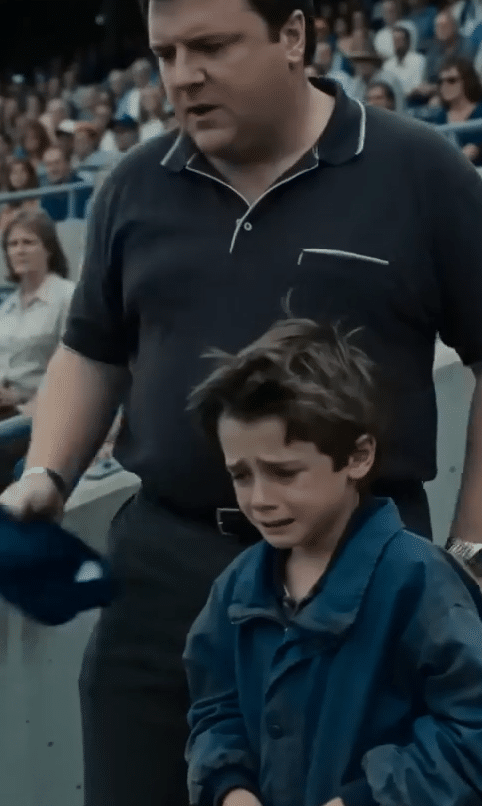
A heavyset man in an expensive leather jacket stood over a boy who could not have been older than nine. The man’s face was red with anger. The boy stared at the metal grating beneath his boots.
“Can’t even cheer right,” the man hissed. “You sit there like a lump. I should’ve left you at home.”
The child did not flinch.
That was what disturbed me.
He had the practiced stillness of someone who understood that any movement might make things worse.
I pulled the strap loose on my left glove.
The man grabbed the back of the boy’s hood and jerked him toward the stairs.
“Walk.”
As they turned, the boy looked over the railing.
Only for a second.
His eyes found the cheap blue team cap lying upside down in a puddle near the players’ tunnel. The logo had been printed slightly crooked, the kind of knockoff merchandise sold outside the stadium for five dollars.
Then he looked up.
Across the field, his eyes met mine.
There were no tears.
Only humiliation.
The kind no nine-year-old should know how to carry.
“Keep moving,” the man barked.
He shoved the boy again.
The child stumbled on the metal steps.
I looked down at the cap.
Then I began walking.
Not toward the locker room.
Toward the chain-link fence separating the field from the spectator exit.
I picked up the dripping hat.
The fabric was thin. One seam had already started to fray. A faint brown stain marked the front panel.
When I turned it over in my mud-covered hands, my stomach dropped.
Three words had been written beneath the brim in thick black marker.
PLEASE FIND DAD.
For a moment, I heard nothing.
Not the mowers.
Not the rain.
Not the distant voices from the tunnel.
I stared at the message until the letters blurred.
Then I noticed something else.
A phone number had been written beneath the words.
The first six digits had faded.
The last four had not.
They were the same last four digits as my private mobile number.
A number only family, teammates, and club officials possessed.
I looked toward the West Exit.
The man and the boy had disappeared into the concrete corridor.
I ran.
My boots slipped once on the wet walkway. I caught the fence and kept moving. A security guard near the tunnel shouted after me, but I did not stop.
I reached the exit concourse just as the man dragged the boy around the corner.
“Hey!”
My voice echoed through the stadium.
The man turned.
Up close, he looked older than I expected. Late forties. Expensive watch. Clean shoes. The careful polish of someone accustomed to being treated seriously.
The boy froze beside him.
I held up the cap.
“I think he dropped this.”
The man glanced at it.
“Throw it away.”
The boy’s eyes lifted.
He stared at the hat as if it were the only object in the world.
I walked closer.
“Is this yours?”
The man stepped between us.
“I said throw it away.”
I looked at him.
Then at the hand gripping the boy’s shoulder.
His fingers were digging through the oversized jacket.
“Let him answer.”
The man gave a short laugh.
“You football players think everyone wants an autograph.”
“I’m asking the child.”
“He’s my son.”
The boy’s face changed.
Not surprise.
Fear.
I lowered the hat.
“What’s your name?”
The man tightened his grip.
“We’re leaving.”
The boy’s mouth opened.
Nothing came out.
Then, so quietly I almost missed it, he whispered one word.
“Evan.”
The man pulled him toward the exit.
I stepped sideways, blocking the corridor.
“You wrote something inside the hat, Evan.”
The man’s eyes dropped to the brim.
For the first time, real panic crossed his face.
He lunged for it.
I pulled the cap back.
His hand closed around empty air.
“Give me that.”
“Why?”
“It belongs to me.”
“No,” I said. “It belongs to him.”
Two security guards appeared at the far end of the concourse.
The man immediately changed.
His posture softened. His voice became calm.
“This athlete is harassing my son.”
Evan’s head dropped.
One guard recognized me.
“Mr. Cole?”
My name is Nathan Cole.
For twelve years, I had been Oakridge United’s goalkeeper.
To most people, that was all I was.
They did not know I had spent the first seven years of my life in foster homes.
They did not know my father vanished before I learned to speak.
They did not know my mother had once written the same three words on the back of a photograph.
Please find Dad.
I looked at Evan again.
“Is this man your father?”
The man answered first.
“Of course I am.”
Evan remained silent.
I crouched until we were nearly eye level.
“Evan, look at me.”
His eyes rose slowly.
“Is he your father?”
The man’s voice hardened.
“Do not speak to him.”
That was when Evan whispered the sentence that changed everything.
“He says he bought me.”
The corridor went completely still.
And the man in the leather jacket started running.
Act II
He did not get far.
One of the security guards stepped into his path. The man swung his shoulder, shoved past, and dragged Evan with him.
The boy fell.
His knee struck the concrete.
I reached them before the second guard did.
I caught the man’s wrist and forced him to release the child. He turned, raised his fist, then stopped when he saw three cameras pointing toward us.
Stadium security had begun recording.
The transformation was immediate.
“I am his legal guardian,” he said. “This is a misunderstanding.”
Evan crawled backward.
He did not move toward the man.
He moved toward me.
That told the guards more than any document could.
Police arrived within minutes.
The man identified himself as Richard Vale, a financial adviser from Northbridge. He produced a driver’s license and a digital copy of a guardianship order.
The paperwork named the child as Evan Vale.
It looked official.
The officer asked Evan where he lived.
The boy stared at the floor.
Richard answered.
The officer asked what school Evan attended.
Richard answered again.
When the officer asked Evan his birthday, the child whispered, “I don’t know.”
Richard laughed nervously.
“He gets confused.”
I handed the cap to the officer.
He read the words beneath the brim.
Then he looked at me.
“Is that your number?”
“The last four digits are.”
Richard folded his arms.
“Coincidence.”
The officer asked Evan who had written the message.
“I did.”
His voice shook.
“When?”
“Today.”
“Why?”
Evan looked at Richard.
The man gave him a warning glance.
The boy’s mouth closed.
Police separated them.
Richard was taken into a private office. Evan sat in the stadium medical room while a social worker drove over.
I should have gone to the locker room.
The manager had sent three messages asking where I was. Reporters were waiting. The club’s communications director called twice.
I stayed.
Evan sat on the edge of the examination table with the wet cap in his lap.
Without Richard beside him, he looked even smaller.
A nurse cleaned the scrape on his knee.
When she asked permission to lift his sleeve, he panicked.
“No.”
She stopped.
I saw the fear in his face.
“Nothing happens unless you say yes,” I told him.
He looked at me as if the idea were unfamiliar.
The social worker arrived twenty minutes later. Her name was Julia Hart. She had sharp eyes, a calm voice, and the exhausted expression of someone who had seen too many children coached into silence.
She asked me to wait outside.
Evan grabbed my sleeve.
The movement surprised both of us.
“Can he stay?”
Julia looked at me.
I nodded.
So I sat in the corner while she asked questions.
At first, Evan answered with shrugs.
Then single words.
Then fragments.
Richard was not his father.
Richard told other people he was.
Evan lived in a house with locked bedroom windows.
He was homeschooled, though no one taught him most days.
He had been told his real father did not want him.
He had been told his mother was dead.
“Why did you write Nathan’s number in the hat?” Julia asked.
Evan looked at me.
“I saw it in the drawer.”
“What drawer?”
“Richard’s office.”
He described a locked desk filled with photographs, newspaper clippings, and old documents.
One picture showed me holding a baby.
I stopped breathing.
“I’ve never held a baby in a published photograph.”
Evan shook his head.
“It wasn’t from a newspaper.”
Julia leaned forward.
“What was written on it?”
The boy closed his eyes, trying to remember.
“Nathan and Noah.”
The room tilted.
Noah was my younger brother.
He had died when I was seven.
At least, that was what I had always been told.
Our mother, Sarah Cole, struggled with addiction and disappeared for months at a time. When authorities finally removed us, Noah and I were separated.
A social worker later told me he had died from pneumonia in another foster home.
There had been no funeral.
No grave I was allowed to visit.
Only a typed letter.
I kept his name private for decades.
No reporter knew it.
No teammate knew it.
No fan could have known.
“How old is Evan?” I asked.
Julia glanced at the paperwork.
“Nine.”
My mother had died ten years earlier.
The timeline made no sense.
Then Evan reached beneath his shirt and pulled out a thin chain.
A brass key hung from it.
Richard had told him never to remove it.
On one side, a number had been engraved.
The same section where I found him.
On the other side were two initials.
N.C.
My initials.
And beneath them, in smaller letters, was a name I had spent thirty years believing belonged to the dead.
Noah Cole.
The cheap hat had not fallen by accident.
Evan had dropped it exactly where he hoped I would find it.
Because someone had taught him who I was.
And that someone might have been the brother I thought I had buried as a child.
Act III
Richard Vale was released that evening.
The guardianship documents passed the first verification check. He had no active warrants. He claimed Evan’s story was the result of emotional disturbance and obsession with football.
Police could not return the child to him immediately, but they could not arrest him either.
Evan was placed in emergency care.
Richard left the stadium smiling.
Before he walked out, he looked at me through the glass wall of the security office.
He tapped two fingers against the brim of his own hat.
A warning.
The next morning, Julia called.
The guardianship order was real.
That was the problem.
It had been issued eight years earlier by a family court in another state. The original file was sealed. The judge had retired. The attorney who submitted the petition was dead.
Richard had not forged custody.
Someone had given it to him.
I asked my club for personal leave and began searching through my mother’s old belongings. Most had been packed away after her death.
In the bottom of a storage box, I found a photograph.
Two boys stood beside a rusted playground slide.
I was six.
Noah was four.
On the back, my mother had written:
Nathan always protects him.
Beneath the photograph was a folded hospital bracelet.
The name printed on it was not mine.
NOAH COLE.
The date of birth was twenty-eight years later than my brother’s.
I called Julia.
She arrived with a detective.
The bracelet had been issued ten years earlier at St. Matthew’s Women’s Hospital. Hospital records showed that Sarah Cole had been present at the birth of a boy.
She was listed as the emergency contact.
The mother’s name was blank.
The father’s name was listed as Noah Cole.
My brother had survived.
He had grown up under another identity, found our mother, and fathered a child.
Evan.
The hospital file contained one additional note.
The newborn had been transferred to private guardianship three weeks after birth because both parents were missing.
Richard Vale became the guardian.
Julia requested an emergency search warrant for his home.
By the time police arrived, the house was empty.
The office had been stripped.
Hard drives removed.
Files burned in a steel drum behind the garage.
But one thing remained.
A framed photograph had fallen behind a cabinet.
It showed Richard standing beside my mother and a man with my face.
Not similar.
Not vaguely related.
The same eyes.
The same jaw.
The same crooked line in the left eyebrow.
Noah.
He was alive when the picture was taken.
The date printed at the bottom was nine years earlier.
Evan had been an infant.
On the back, someone had written:
Vale keeps him until the debt is paid.
The investigation shifted immediately.
Richard was not merely an abusive guardian.
He was connected to a debt.
A debt involving my brother.
Detectives traced his finances.
Richard had spent years advising wealthy clients, athletes, and business owners. His public reputation was flawless.
Privately, he ran illegal loans through shell companies.
Borrowers who failed to pay lost homes, businesses, and sometimes custody of their children through manipulated court cases.
My mother had borrowed money from him.
So had Noah.
The amount was not large.
The interest was.
Noah had apparently spent years paying Richard for information about me. He wanted to reconnect, but my mother warned him that entering my life could expose both of us to the people she owed.
Then Noah discovered Richard had stolen money from one of my youth charity accounts.
He threatened to report him.
Three days later, Noah disappeared.
Richard took custody of Evan.
Not legally because the child needed protection.
Legally because Richard controlled the people filing the papers.
Evan was collateral.
I stared at the financial records until I could no longer see straight.
For nine years, Richard had raised my nephew inside a locked house while using my name to frighten him.
He showed Evan photographs of me.
Told him I was rich.
Told him I knew he existed.
Told him I had refused to help.
That was why the boy’s message read Please find Dad.
He was not asking me to find my own father.
He was asking me to find his.
Noah.
The detective believed Richard had killed him.
I did not.
Not yet.
Because inside the burned office, investigators found one unscorched receipt.
A monthly payment to a private medical facility called Grayhaven Recovery Center.
The patient’s identity had been hidden under a number.
The emergency contact was Richard Vale.
And the admission date was nine years earlier.
Noah had not disappeared.
He had been hidden.
Alive.
Less than sixty miles away.
Act IV
Grayhaven sat behind high stone walls in the countryside.
It called itself a neurological rehabilitation facility.
In reality, it housed wealthy patients whose families wanted privacy and vulnerable patients whose guardians wanted control.
Richard had placed Noah there under a false name.
The facility claimed he suffered permanent cognitive damage from a drug overdose.
No independent doctor had evaluated him in eight years.
When detectives entered his room, they found a man strapped to a hospital bed.
My brother was forty.
He looked sixty.
His hair had gone almost completely gray. His wrists were thin. His speech was slow from years of medication.
But when I walked in, his eyes found mine.
“Nate?”
I had not heard that name in his voice since childhood.
I sat beside him.
Neither of us spoke for a long time.
Then he lifted one trembling hand.
I took it.
“I looked for you,” he whispered.
“So did I.”
He shook his head.
“No. Mom stopped you.”
I felt the old wound open.
Our mother had told each of us the other was dead.
She believed separation kept us safe from Richard and the people surrounding him.
Instead, it made us easier to control.
Noah remembered everything.
He had borrowed money from Richard after Evan’s mother died during childbirth. Medical bills swallowed him. Richard offered help, then doubled the debt through fake fees.
When Noah discovered the stolen charity funds, he threatened to expose him.
Richard sent two men to his apartment.
They drugged him.
A corrupt physician signed the commitment papers.
Richard gained control over Noah’s finances and took Evan as guardian.
For years, Noah tried to contact me.
Letters vanished.
Calls were blocked.
When he resisted medication, staff restrained him.
One nurse secretly showed him sports broadcasts. That was how he learned where I played.
He began teaching Evan about me during supervised visits.
He showed the boy my jersey number.
My face.
My private phone number, which he had memorized from a letter our mother once carried.
Most importantly, he taught Evan a plan.
If Richard ever took him to a match, he was to write the message in his hat and drop it near the players’ tunnel.
“Why Section 114?” I asked.
Noah’s eyes filled.
“Our room number.”
I understood.
When we were children, the first foster home that kept us together placed us in Room 114.
It was the last place we had both felt safe.
Richard had eventually learned Noah was communicating with Evan.
He stopped the visits.
But Evan remembered the plan.
Nine months later, Richard took him to the stadium.
Not out of kindness.
He had arranged a meeting with one of his clients in a hospitality box.
Evan saw me on the field.
He wrote the message in the cap.
Then he waited until the stands emptied.
The forty-foot drop had been deliberate.
A child’s entire rescue plan depended on one goalkeeper noticing a five-dollar hat after losing a match.
Richard was arrested before sunset.
He was charged with kidnapping, unlawful imprisonment, fraud, abuse, and conspiracy. Grayhaven’s director and two doctors were arrested days later.
But Richard still believed he had one weapon left.
The night before the first custody hearing, a video appeared online.
It showed me confronting him in the stadium corridor.
The clip had been edited to remove Evan’s words.
It looked as though an angry professional athlete had attacked a father after losing a match.
Richard’s lawyers called me unstable.
Violent.
Unfit to care for Evan.
They argued the boy should remain in state custody while Noah recovered.
The video spread quickly.
Sponsors called.
The club suspended me pending review.
Reporters surrounded my house.
For the second time in my life, a powerful man tried to separate me from my family by controlling the story.
This time, I was not seven years old.
At the custody hearing, Richard entered in a dark suit with three attorneys.
He smiled at me across the courtroom.
Then the judge asked whether the child wished to speak.
Evan walked in holding the cheap blue cap.
He looked smaller than everyone else in the room.
But he did not look down.
Richard’s smile disappeared.
Evan placed the cap on the evidence table.
Then he turned it over.
Beneath the brim, below the message and the phone number, was another line none of us had noticed.
The ink had bled into the dark fabric.
Julia held it beneath a forensic light.
The hidden words appeared.
HE HURT NOAH AT GRAYHAVEN.
Evan had known exactly where his father was.
And Richard had spent nine years believing a frightened child could never prove it.
Act V
The hearing lasted six hours.
The judge watched the full stadium security footage.
Not the edited clip.
The complete recording showed Richard grabbing Evan, ignoring his questions, and running after the child said he had been bought.
Medical investigators testified about Noah’s condition.
Grayhaven staff records showed unnecessary sedatives, falsified diagnoses, and repeated denials of outside contact.
A former nurse described Richard’s visits.
“He never asked how Noah was feeling,” she said. “He asked whether Noah could still remember names.”
The judge revoked Richard’s guardianship immediately.
Evan was placed with me under temporary kinship care while Noah began rehabilitation.
The first night in my house, he refused to sleep in the bedroom.
He lay on the floor beside the front door with his jacket still on.
I did not tell him he was safe.
Children who have spent years in fear do not believe safety because an adult announces it.
I brought down a blanket.
Then I slept on the other side of the hallway.
In the morning, his hand was resting on the cheap cap.
Recovery came slowly.
Evan hid food beneath his mattress.
He asked permission before opening the refrigerator.
He flinched when doors closed too loudly.
At matches, he sat near exits.
Noah had to relearn how to walk steadily after years of medication and inactivity. Some days he remembered everything.
Other days, time folded.
He called Evan by the name of a childhood friend.
He asked where our mother was.
He woke believing he was still locked in Grayhaven.
But every Sunday, Evan visited.
At first, he sat across the room.
Then beside the bed.
Then one afternoon, he leaned against Noah’s shoulder.
Neither of them spoke.
They did not need to.
The criminal trial began seven months later.
Richard Vale was convicted on nearly every major charge.
Investigators uncovered twenty-three additional victims connected to his loan network. Families had lost homes through forged defaults. Elderly clients had lost savings. Three vulnerable adults had been placed in private facilities after challenging him.
My mother’s involvement was harder to accept.
She had borrowed from Richard.
Lied to both sons.
Helped arrange Noah’s first false identity.
She had also tried, years later, to expose him.
Police found an unsent letter in a safe-deposit box.
She wrote that fear had turned her into the kind of parent who confused secrecy with protection.
I read it once.
Then I locked it away.
Forgiveness was not a duty.
Neither was hatred.
Some truths simply had to be carried until they became lighter.
The club reinstated me after the full footage became public.
At my first match back, the stadium was sold out.
We won 3–0.
But the only moment I remember happened before kickoff.
Evan stood near the players’ tunnel wearing a new Oakridge United cap.
Not expensive.
Not signed.
Just blue.
This time, the logo was straight.
Noah stood beside him using a cane.
When I approached, my brother smiled.
“You still dive left too early.”
“You still talk too much.”
His laugh was weak.
But it was his.
Evan removed the new cap and handed it to me.
Under the brim, he had written three words.
DAD FOUND ME.
I looked at him.
Then at Noah.
“You want this back?”
Evan shook his head.
“It’s yours.”
I kept it in my locker for the rest of the season.
The original cap was preserved as evidence until Richard’s appeals ended. Afterward, the court returned it to Evan.
He placed it in a wooden box beside Noah’s hospital bracelet and the photograph of us at the playground.
One year after the stadium incident, Noah moved into an apartment two streets from my house.
He was not fully recovered.
Maybe he never would be.
But he made breakfast for Evan on Saturdays.
He attended school meetings.
He learned to answer difficult questions honestly.
The first time Evan called him Dad in public, Noah had to leave the room and cry in the hallway.
Richard had once told the boy that his father did not want him.
He had repeated it so often Evan began believing it.
Cruel people understand that the easiest way to control a child is not through locks.
It is through a story.
Make him believe he is unwanted.
Make him believe no one is searching.
Make him believe the person who hurts him is the only person who stayed.
But Richard had made one mistake.
He took Evan to the stadium.
He placed him forty feet above a concrete walkway.
And he forgot that a child raised in silence can still find a way to speak.
Sometimes it is a scream.
Sometimes it is a note.
Sometimes it is one cheap plastic snapback falling through the rain.
The hat made almost no sound when it hit the ground.
But it was loud enough to bring a family back from the dead.