Act I
Caleb Mercer dropped to one knee on the porch and opened his arms.
“Come here, buddy.”
For eleven months, he had carried that moment through deserts, cargo holds, sleepless barracks, and the long fluorescent corridors of military airports. He had imagined five-year-old Owen racing across the porch hard enough to knock him backward.
He had imagined laughter.
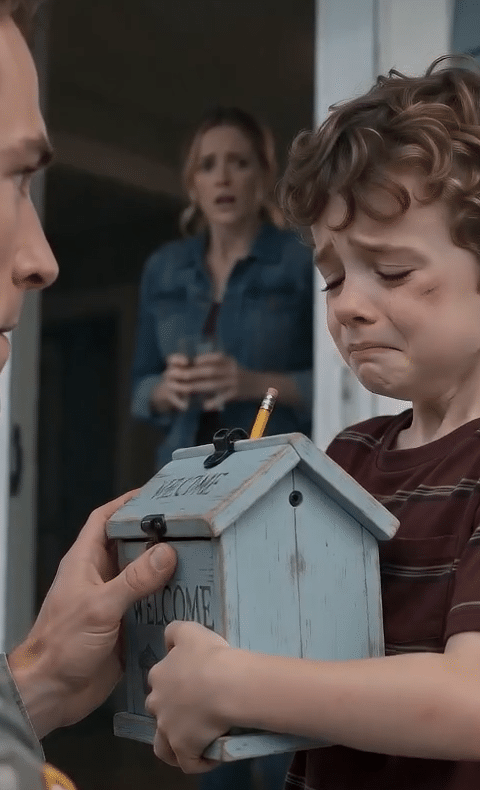
Instead, his son stood behind the glass storm door with a small blue box pressed against his chest.
The welcome banner Caleb’s sister had promised to hang was missing. There were no balloons, no neighbors filming his return, no paper flags taped crookedly to the railing.
Only the weathered doormat, the gray-blue porch boards, and an overcast sky flattening the afternoon into cold light.
Caleb kept smiling.
Sometimes children froze when emotions became too large. The family-readiness counselor had warned him about that. Eleven months was a fifth of Owen’s life.
Caleb had changed too.
He was thinner. Darker beneath the eyes. Still wearing digital camouflage because his duffel remained in the bed of his brother’s pickup.
“It’s me,” he said softly.
Owen looked down.
His small hands tightened around the box.
Caleb knew it immediately. He had built it with Owen the weekend before deployment, using leftover fence boards and paint from the porch. Owen had insisted it was for important things, though the only important things inside had been crayons, bottle caps, and a plastic dinosaur missing one leg.
WELCOME had been painted across the lid in uneven white letters.
A yellow pencil now protruded through a narrow gap in the warped wood.
The storm door opened.
Laura Vale stood in the dim hallway holding a glass of water. Her blonde-brown hair was tied into the same low ponytail she wore in nearly every photograph she had sent during his deployment.
She smiled too brightly.
“You made it.”
Caleb rose.
“Eventually.”
“The traffic?”
“Plane delay. Then traffic. Then Ben missed the exit.”
Behind him, his older brother unloaded a duffel from the pickup and pretended not to watch the doorway.
Laura laughed softly.
“That sounds like Ben.”
The ice in her glass tapped against the side.
Then Caleb looked at Owen again.
The boy’s face remained angled toward the blue box.
Faint red scratches crossed both cheeks. Beneath them, yellowing bruises clouded the skin near his left eye and along his jaw.
The smile left Caleb’s face.
He did not ask immediately.
He had spent years learning that the first version of an incident was often the version people had prepared. Surprise made witnesses careless. Anger made them defensive.
Fear shut children down.
He stepped inside without touching Owen.
The hallway smelled of lemon cleaner and old heat. The house had once smelled like coffee, dog hair, and lavender detergent.
Now the floors shone.
Shoes sat in a straight line against the wall. Mail had been stacked by size on the entry table. Even Owen’s red rain boots had been turned so the toes pointed in exactly the same direction.
Caleb removed his cap.
“Hey,” he said to Owen. “I like your box.”
Owen’s lower lip trembled.
Laura’s fingers tightened around the water glass.
Caleb noticed both.
“What happened to his face?”
Laura inhaled.
“He fell.”
“Where?”
“In the backyard.”
“When?”
“Two days ago.”
Owen stared at the floor.
Caleb crouched several feet away.
“Were you playing outside?”
The boy did not answer.
Caleb looked at the box instead of his face.
“Still keeping important things in there?”
A tiny nod.
“What’s important now?”
Owen’s fingers moved over the chipped edge.
Laura spoke from behind him.
“He hasn’t wanted anyone opening it.”
Caleb looked over his shoulder.
“I asked him.”
She swallowed.
“I know.”
The bruises were faint enough to be healing and dark enough that they had once been worse. One scratch curved downward from the boy’s ear. Another sat too straight across his cheek, as if made by an edge rather than a fall.
Caleb let his right hand close beside his leg.
His knuckles tightened.
Then he breathed once and opened it.
The movement was small.
Laura saw it.
Owen saw it too.
Caleb lowered himself onto the porch threshold, no longer towering over anyone. He rested one hand beside the box without pulling it away.
“Who hurt you?”
Owen’s face crumpled.
His crying made almost no sound. Tears gathered beneath his lashes and slipped over the bruises.
Then he looked toward Laura.
She lifted one hand to her mouth.
Caleb followed his son’s gaze.
Fear moved across Laura’s face, followed by something that tried to resemble concern.
“She told me not to tell,” Owen whispered.
The house seemed to hold its breath.
Caleb stood.
He did not move toward Laura. Instead, he stepped sideways and placed himself between her and his son.
“Ben.”
His brother appeared at the bottom of the porch steps.
“Yeah?”
“Take Owen to the truck.”
Laura’s eyes widened.
“Why?”
Caleb ignored her.
Ben looked from Owen to the bruises and understood enough. He came up the steps slowly, speaking to the boy in the same gentle voice he used with frightened horses.
“Want to show me what’s in your box?”
Owen hesitated.
Then he walked toward him.
Laura took one quick step forward.
The water glass slipped from her hand and shattered across the hardwood floor.
“Caleb, wait.”
He looked at the broken glass.
Then at her bare feet.
Then at the thin silver bracelet around her wrist.
He had mailed that bracelet from overseas three months earlier.
She had told him it never arrived.
And beneath it, almost hidden by the sleeve of her jacket, was a dark fingerprint-shaped bruise.
That was when Caleb realized his son might not be the only person in the house who was afraid.
And the truth was far worse than the bruises on Owen’s face.
Act II
Laura Vale was not Owen’s mother.
Owen’s mother, Emily, had died in a car accident when he was two years old. Caleb had spent the next eighteen months learning how to braid nothing, burn pancakes, answer impossible questions, and keep moving through grief when he wanted to collapse.
Laura had been Emily’s younger sister.
She stepped in slowly.
First with groceries.
Then daycare pickups.
Then weekends when Caleb had reserve training.
She knew Owen’s bedtime song because Emily had sung it to both of them as children. She knew which stuffed bear had to face the door and which cereal bowl Owen refused to use because it was “too green.”
By the time Caleb received deployment orders, Laura was the obvious person to care for him.
At least, that was what everyone believed.
The family court approved the temporary guardianship. Caleb transferred money into an account for expenses. His sister Rachel promised to visit every week.
For the first three months, everything looked normal.
Laura sent photographs of Owen at the park, Owen covered in pancake batter, Owen sleeping beside the dog. During video calls, he talked constantly.
He showed Caleb drawings.
He asked when he was coming home.
Then the calls became shorter.
Laura said the connection was bad.
Owen began appearing only briefly, usually already in pajamas. Sometimes he was asleep. Sometimes he was “at a friend’s house.” Once, Laura claimed he had dropped the tablet in the bathtub.
Caleb had felt uneasy.
But guilt was a strange thing during deployment. It made every doubt feel selfish.
He told himself Laura was tired. Owen was adjusting. Children changed quickly.
Standing in the silent hallway now, Caleb understood that his absence had not caused him to imagine danger.
It had made him easier to deceive.
Laura stepped carefully around the broken glass.
“You’re frightening him.”
“No,” Caleb said. “He was frightened before I arrived.”
“You don’t understand.”
“Then explain.”
Her eyes moved toward the window.
Ben had lifted Owen into the pickup. The boy still held the blue box against his chest.
Caleb lowered his voice.
“Did you hurt him?”
“No.”
“Did you see who did?”
Laura looked away.
That was answer enough.
Caleb reached into his pocket and took out his phone.
She reacted instantly.
“Who are you calling?”
“My sister.”
“Caleb, don’t.”
Rachel answered on the second ring.
Her voice was breathless.
“Are you there? Did he see you?”
“Why weren’t you here?”
Silence.
Caleb looked toward the door.
“Rachel?”
“I thought Laura told you.”
“Told me what?”
Another silence.
Then his sister began to cry.
“I’m sorry.”
Caleb felt something cold spread through his chest.
“What did you know?”
“Not enough. I swear. I saw a bruise on Owen’s arm in January. Laura said he fell at preschool. Then she stopped letting me visit without calling first.”
“And you accepted that?”
“No. I called social services.”
Caleb closed his eyes.
“What happened?”
“They did a home visit. Laura said Owen had behavioral problems because you were gone. She showed them a letter from a child therapist.”
“Which therapist?”
“I don’t know.”
Laura moved toward the stairs.
Caleb saw it and stepped into the hallway.
“Stay where I can see you.”
Her face hardened.
For the first time, the frightened expression disappeared.
“You come home wearing a uniform and suddenly you think you can give orders in my house?”
Caleb stared at her.
“My house?”
Laura froze.
The mortgage was in Caleb’s name.
So were the utilities.
So was the guardianship agreement that ended the moment he returned.
Yet she had called it her house.
Rachel was still talking through the phone.
“There’s more.”
Caleb’s grip tightened.
“What?”
“The school called me six weeks ago. Owen had started taking food from other children’s lunches. When they asked why, he said he wasn’t allowed to eat if he made mistakes.”
Laura’s face drained of color.
Caleb stopped breathing.
“He said what?”
“The school contacted Laura. She told them he was lying for attention.”
“Why didn’t anyone call me?”
“Because she had paperwork saying all contact had to go through her.”
“What paperwork?”
“I don’t know.”
Caleb looked toward the perfectly stacked mail.
He crossed the hallway and pulled open the entry-table drawer.
Inside were envelopes addressed to him.
Military family services.
The school district.
The bank.
Most had been opened.
Some had been resealed.
One carried a red stamp.
URGENT: CUSTODY REVIEW HEARING.
The date was three months earlier.
Caleb turned around.
Laura had disappeared.
A door slammed upstairs.
Then came the sound of wood scraping against wood.
She was not running from him.
She was trying to hide something.
Act III
Caleb took the stairs two at a time.
At the end of the hallway, the bedroom door was locked.
“Laura.”
No answer.
He heard a drawer close.
Then paper tearing.
Caleb stepped back and drove his shoulder into the door.
The frame split on the second impact.
Laura stood beside the bed with a metal cash box open in front of her. Papers covered the blanket.
In her hand was a disposable lighter.
“Put it down.”
She flicked the wheel.
Caleb crossed the room before the flame touched the paper. He caught her wrist, twisted only enough to make her release the lighter, and kicked it beneath the dresser.
Laura struck his chest with both hands.
“You ruined everything.”
He let her push him.
“What did you do?”
Her eyes filled with tears, but there was no softness in them.
“You left me with a child who screamed every night. A child who asked for you every morning. I gave up my job. My apartment. My life.”
“I paid every expense.”
“You paid bills. You didn’t live it.”
Caleb looked at the documents on the bed.
There were bank statements, court filings, medical forms, and printed emails bearing his name.
His signature appeared at the bottom of several pages.
It was not his signature.
Laura had filed for permanent guardianship.
She claimed Caleb had abandoned Owen and had become psychologically unstable during deployment. A forged letter supposedly written by a military psychiatrist described him as impulsive, violent, and unsuitable for custody.
Another document transferred temporary control of Caleb’s house to Laura.
A third requested access to his military life insurance.
He stared at the papers.
“This wasn’t about being overwhelmed.”
Laura’s face changed.
Only slightly.
But enough.
Caleb opened the metal cash box.
Inside were withdrawal receipts from Owen’s education account. Nearly forty thousand dollars had been removed over nine months.
There were also photographs.
Owen sitting on the bathroom floor.
Owen holding a handwritten sign that read I LIE.
Owen asleep in a laundry room beside a folded blanket.
The photographs were dated.
Organized.
Documented.
Caleb felt sick.
“Why would you keep these?”
Laura covered her face.
“He made me look cruel.”
“He is five.”
“You don’t know him when you’re gone.”
Caleb picked up one photograph.
A man’s reflection appeared in the bathroom mirror behind Owen.
Tall.
Broad-shouldered.
Wearing a red work jacket.
Caleb knew him.
Grant Vale.
Laura’s husband.
The man she had claimed to be separated from for nearly two years.
Grant had a history Caleb knew only in pieces. Bar fights. Gambling debts. A restraining order filed by a former girlfriend and later withdrawn.
Caleb had refused to let him near Owen.
Laura had agreed.
Apparently, she had lied.
“Where is Grant?”
She said nothing.
Caleb stepped closer.
“Where is he?”
“At work.”
“Where?”
“I don’t know.”
“You’re married to him.”
“We’re not together.”
“His jacket is in these photographs.”
Laura sat on the edge of the bed.
Her shoulders began shaking.
“He came back in December.”
“And?”
“He needed money.”
“So you gave him Owen’s.”
“He said he would repay it.”
Caleb looked again at the bruises beneath her bracelet.
“Did he do that to you?”
Laura did not answer.
He crouched several feet away.
The anger inside him remained, but it changed shape.
Fear could make people conceal terrible things.
It could also make them participate in them.
“Did Grant hurt Owen?”
Her tears fell faster.
“He gets angry.”
“That was not my question.”
“He said discipline was the only thing Owen understood.”
Caleb’s voice became almost inaudible.
“What did he do?”
Laura stared at the floor.
“He locked him in the laundry room.”
Caleb looked at the photograph.
“How long?”
“Sometimes an hour.”
“How long?”
“Once overnight.”
The room seemed to darken around him.
“The bruises?”
“He tried to climb out through the window.”
Caleb stood so quickly the bed frame struck the wall.
Laura flinched.
He forced his hands open.
“Where is Grant now?”
“I told you, I don’t know.”
Then a car door closed outside.
Laura’s head snapped toward the window.
Caleb saw terror cross her face.
Not guilt.
Terror.
A red pickup had pulled behind Ben’s truck, blocking the driveway.
Grant Vale stepped out.
He was carrying a tire iron.
And he was walking toward Owen.
Act IV
Caleb reached the porch as Grant crossed the yard.
Ben had already moved in front of the truck’s passenger door.
Owen was inside, curled around the blue box.
Grant raised the tire iron.
“Get out of my way.”
Ben did not move.
“You should leave.”
“This is family business.”
Caleb came down the steps.
Grant looked at his uniform and laughed.
“The hero finally came home.”
“Put it down.”
“Or what?”
Caleb stopped several yards away.
He knew exactly what Grant wanted.
A fight.
One violent mistake.
One witness recording a soldier attacking an unarmed civilian.
One more piece of evidence for Laura’s forged custody case.
Grant took another step toward the truck.
Caleb stayed still.
“Police are on the way.”
Grant smiled.
“No, they’re not.”
Ben glanced toward Caleb.
Grant continued.
“Laura called them last month. Told them the kid was causing trouble. Guess what happened? Nothing.”
He pointed the tire iron toward the house.
“She has guardianship. You don’t.”
“Not anymore.”
Grant’s smile faded.
Caleb lifted his phone.
The call to emergency services had remained connected since he entered the bedroom.
Everything Grant said had been recorded.
So had Laura’s confession.
Grant looked toward the road.
A siren sounded in the distance.
Then another.
His face changed.
He lunged toward the truck.
Ben intercepted him.
The tire iron swung once, clipping Ben’s shoulder and driving him against the hood.
Caleb moved.
Not with rage.
With training.
He caught Grant’s wrist, turned his arm, and forced him to the ground without throwing a single punch. The tire iron struck the gravel.
Grant cursed beneath him.
Caleb held him there until two patrol cars arrived.
When the officers pulled Grant to his feet, Owen finally opened the truck door.
“Dad?”
Caleb turned.
The boy stood on the running board with the blue box in both hands.
Caleb approached slowly.
“Yeah, buddy.”
Owen looked at Grant, then at Laura standing in the doorway.
“Am I in trouble?”
The question broke something in everyone who heard it.
Caleb crouched.
“No.”
“I took things.”
“What things?”
Owen opened the box.
Inside were folded pieces of paper, food wrappers, photographs, and a small voice recorder shaped like a blue plastic keychain.
The yellow pencil sticking through the lid was attached to a sheet of paper covered in uneven letters.
BAD DAYS.
Each entry had a date.
NO DINNER.
GRANT YELLED.
AUNT LAURA CRIED.
SLEPT IN ROOM WITH WASHER.
HIT FACE ON WINDOW.
The recorder contained more.
Owen had started using it after a teacher told his class that writing or recording feelings could help when words were hard.
His small voice filled the porch.
“Grant says Dad is not coming back.”
Then Laura’s voice.
“Do not tell anyone what happens here. If you tell, they will take you somewhere worse.”
Another recording.
Grant shouting.
A crash.
Owen crying.
Then one final file, dated two nights earlier.
Grant demanding that Laura sign a new insurance form.
Laura refusing.
Grant striking her.
Owen screaming and running into the room.
The sound of a struggle.
Then Grant’s voice, low and vicious.
“Your soldier father left because he didn’t want you.”
The recording ended.
Caleb stared at the blue box he had built from scraps before deployment.
He had told Owen to keep important things inside.
His son had turned it into an evidence locker.
The police took Laura and Grant away in separate cars.
Laura was not charged immediately.
The detective said her bruises, the recordings, and the financial documents complicated the case.
Caleb did not care whether she was viewed as a victim, an accomplice, or both.
That would be decided later.
All that mattered was Owen.
At the hospital, a pediatric specialist documented healing injuries across his back, arms, and face. None were life-threatening.
Every one of them mattered.
When the doctor asked Owen where he wanted to sleep that night, he looked at Caleb.
“Is Dad allowed to stay?”
Caleb sat beside him.
“I’m not going anywhere.”
Owen’s eyes narrowed, as if testing the promise.
“You said that before.”
The words hurt more than anything Grant could have done.
Caleb nodded.
“I know.”
He did not ask for forgiveness.
He only stayed.
But the final truth was still waiting inside the box.
Act V
The folded papers at the bottom were not written by Owen.
They were letters from Laura.
Some were addressed to Caleb.
None had been sent.
The earliest letter was dated two weeks after Grant returned.
Caleb read them alone in the hospital corridor while Owen slept.
I thought I could control him.
I thought if I gave him money, he would leave.
Then he saw the custody paperwork.
He realized your house, benefits, and insurance were worth more than anything I had.
Another letter came four weeks later.
I tried to call the number you left, but Grant took my phone.
He says he knows people at the unit and that any complaint will make you look unstable.
I do not know if he is lying.
The last letter had been written three days before Caleb returned.
I am going to take Owen and leave tonight.
If I fail, look inside the blue box.
He trusts it because you made it.
Caleb sat with the letter in both hands.
Laura had helped forge documents. She had taken money. She had lied to social workers and kept Owen in a dangerous house.
But she had also tried to create a path toward the truth.
Too late.
Too quietly.
Yet not completely.
The legal process lasted more than a year.
Grant Vale pleaded guilty to multiple charges after the recordings, photographs, and financial evidence made a trial almost impossible to win.
Investigators discovered he had used part of Owen’s education fund to pay gambling debts and had planned to increase Caleb’s life insurance before arranging what prosecutors described as a fraudulent accident claim.
Laura accepted a plea agreement for financial fraud, falsifying records, and child endangerment.
She testified against Grant.
At sentencing, she did not ask Caleb to forgive her.
She asked only that a letter be placed in Owen’s file for the day he was old enough to decide whether to read it.
Caleb agreed.
Not for Laura.
For Owen.
The school district faced an investigation after records showed staff had raised concerns but failed to contact anyone outside the false guardianship paperwork. Two administrators resigned.
Rachel carried her own guilt.
She had made one report and then trusted the system to continue without her.
For months, she apologized whenever Caleb looked tired.
One evening, he stopped her.
“You should have done more.”
She lowered her eyes.
“So should I.”
That was the hardest truth.
Distance had not made Caleb responsible for Grant’s violence. Deployment had not made him a bad father.
But love did not erase warning signs simply because they were painful to examine.
He had sensed Owen withdrawing during calls.
He had accepted explanations because the alternative terrified him.
After the hospital, Owen moved in with Caleb and Ben temporarily while the house was repaired.
For several weeks, he slept with the blue box beneath his bed.
He ate too quickly.
He hid crackers in his pillowcase.
He apologized whenever he spilled anything.
Caleb learned not to say, “You’re safe now,” because safety was not something a frightened child believed after hearing it once.
Instead, he showed him.
Dinner appeared every night, even after mistakes.
Doors stayed unlocked.
No one shouted when a glass broke.
Therapy happened on Thursdays. Pancakes happened on Sundays.
Sometimes Owen refused to speak.
Caleb stayed beside him anyway.
Three months after the homecoming, they returned to the porch together.
The weather had warmed. Fresh paint covered the boards. Rachel had finally hung the banner she had made almost a year earlier.
WELCOME HOME, DAD.
The letters were crooked.
Owen had helped.
Caleb sat on the step while his son placed the blue box between them.
“Can we fix it?” Owen asked.
The wood was split near one corner. The latch had rusted.
“We can.”
“Will it look new?”
Caleb examined it.
“Probably not.”
Owen considered that.
“Good.”
They sanded the rough edges together.
Caleb replaced the latch but left the chipped blue paint untouched. Owen removed the old papers and placed them in a folder his therapist kept locked away.
Then he added new things.
A photograph of Caleb asleep on the couch.
A movie ticket.
A red bottle cap.
The plastic dinosaur with one missing leg.
At the bottom, he placed a drawing of two figures standing beneath a gray sky.
One was small.
One wore green camouflage.
Their hands were almost touching.
Above them, in large uneven letters, Owen had written:
HE CAME BACK.
Caleb looked at the picture for a long time.
Then he opened his arms.
This time, Owen moved.
He stepped forward slowly at first.
Then faster.
His skinny arms closed around Caleb’s neck, and the force of him nearly knocked Caleb backward off the porch.
It was not the homecoming Caleb had imagined during those eleven months away.
There were no flags.
No cheering neighbors.
No perfect reunion beneath a bright sky.
There was only a repaired blue box, a crooked banner, and a little boy learning that the door would remain open.
Caleb held him tightly.
Not because the nightmare was forgotten.
Because it was over.
And because sometimes coming home was not the moment a soldier reached his front porch.
Sometimes it was the moment his child finally believed he would stay.