Act I
Nobody expected the courtroom to go silent.
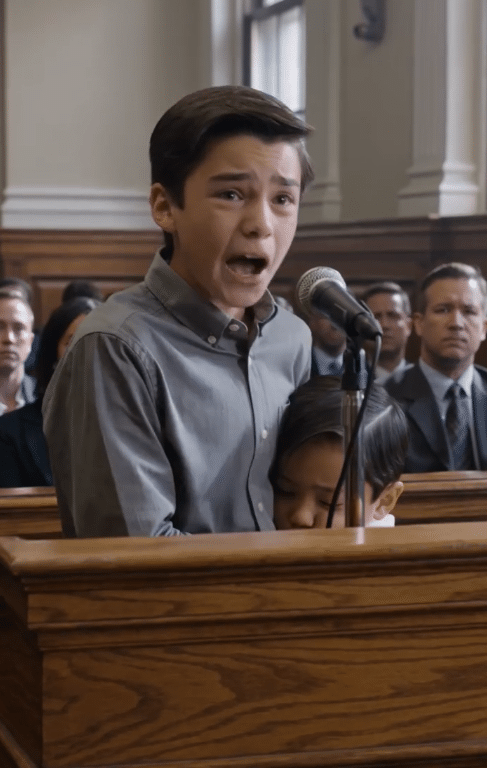
Not when the teenage boy took the witness stand.
Not when he carried his little brother in his arms because the child refused to let go.
Not even when the judge asked the question everyone had been avoiding.
“Where are your parents?”
The boy looked down.
His name was Noah Carter. He was seventeen years old, thin from too many missed meals, and wearing a borrowed dress shirt that hung loosely from his shoulders.
His little brother, Eli, was six.
Eli had not spoken since the night their mother died.
He communicated through nods, drawings, and the way he clung to Noah whenever strangers came too close.
Now, under the cold white lights of Family Courtroom Three, the child buried his face against Noah’s chest.
Noah tightened one arm around him.
“I don’t have parents,” he said.
His voice trembled only slightly.
Then he looked directly at the judge.
“But I can still take care of him.”
The younger child gripped Noah’s shirt immediately, as if the sentence itself had frightened him.
Judge Eleanor Whitmore lowered her eyes.
Across the room, the attorneys stopped writing.
The social worker at the state’s table stared at the floor.
Because now, everyone understood the same thing.
Noah had not become Eli’s guardian when their mother died.
He had become Eli’s parent long before that.
He had cooked the meals.
Signed school forms.
Stayed awake through fevers.
Walked three miles to buy medicine because they had no car.
He had learned which stories helped Eli sleep and which noises sent him hiding beneath the bed.
He knew how to cut crusts from sandwiches.
He knew how to make a six-year-old believe everything would be all right even when the electricity had been shut off.
But the law did not care how many nights Noah had stood between his brother and disaster.
The law saw a minor.
A child trying to raise another child.
The county wanted Eli placed with a foster family.
Noah would be sent to a transitional home until his eighteenth birthday.
Separate addresses.
Separate schools.
Separate lives.
The judge folded her hands.
“Mr. Carter, love is not the only requirement for guardianship.”
“I know.”
“You have no permanent housing.”
“I can get it.”
“No income sufficient to support a child.”
“I work.”
“You attend school full time.”
“I can work more.”
Noah’s court-appointed attorney touched his arm gently.
“Noah.”
He ignored her.
“I’ve been taking care of him for three years.”
The county attorney shifted in his chair.
Judge Whitmore spoke carefully.
“And during those three years, you were both living without consistent adult supervision.”
Noah’s jaw tightened.
“We survived.”
“That is not the same as stability.”
The words landed harder than anyone intended.
Eli lifted his head.
For the first time all morning, he looked at the judge.
Then he whispered one word.
“No.”
It was so soft that several people thought they had imagined it.
Noah froze.
Eli had not spoken in eight months.
The child turned toward the social workers waiting near the door.
“No go.”
Noah closed his eyes.
The courtroom seemed to shrink around them.
Judge Whitmore removed her glasses.
She had spent twenty-two years hearing custody cases. She had watched parents lie, relatives fight over money, and children used as weapons by adults who claimed to love them.
But she had never seen a child cling to another child as though the entire world existed inside his arms.
The judge looked toward the county.
“Is there truly no family available?”
The social worker stood.
“No verified relatives, Your Honor.”
Noah suddenly looked toward the gallery.
Someone had entered moments earlier and taken a seat in the back row.
A woman in a gray coat.
She had kept her head lowered.
Until now.
As the judge prepared to issue her ruling, the woman stood.
“No,” she said.
Every face turned toward her.
Her eyes were fixed on Noah.
“There is family.”
And the expression on Noah’s face made it clear he had seen her before.
Act II
Eight months earlier, Noah had been a high school junior with perfect attendance and a secret no teacher understood.
He was always tired.
He never stayed after school.
He never went on field trips.
When classmates invited him anywhere, he found excuses.
Work.
Homework.
A sick relative.
No one knew the truth.
His mother, Rachel Carter, had been sick for almost three years.
At first, it was only exhaustion.
Then headaches.
Then days when she could not climb the stairs without stopping halfway.
She lost her job at a dental office after missing too many shifts.
Medical bills arrived faster than she could open them.
The refrigerator emptied.
The rent fell behind.
Noah was fourteen when he started working nights at a grocery store under the table.
He told the manager he was sixteen.
By day, he attended school.
By evening, he stocked shelves.
By midnight, he returned home to help his mother bathe and prepare Eli’s lunch for the next morning.
Rachel tried to apologize.
Noah never let her.
“You took care of me,” he would say. “Now I take care of you.”
But Rachel’s illness was not the only thing she feared.
There was someone she refused to discuss.
A woman named Margaret.
Whenever Noah asked if they had other family, Rachel’s expression changed.
“We don’t.”
That was the answer.
Always.
No explanation.
No photographs.
No names.
Just silence.
Then, one rainy night, Rachel collapsed in the kitchen.
Noah found her on the floor beside a broken glass.
Eli stood in the hallway crying.
The ambulance arrived too late.
Rachel died before sunrise.
The official cause was an undiagnosed heart condition.
Noah did not remember much from the hospital.
Only fluorescent lights.
A nurse pressing forms into his hands.
Eli asking when their mother was coming home.
Noah could not tell him.
So he held his brother until the child fell asleep against him.
The county became involved almost immediately.
A social worker named Dana Ruiz visited the apartment two days later.
She found unpaid bills stacked beside the sink, little food in the cabinets, and an eviction notice taped to the door.
She also found Eli clean, fed, and dressed for school.
His backpack was packed.
His homework was finished.
His lunch contained a handwritten note from Noah.
You’re braver than you think.
Dana saw what the paperwork did not.
Noah was not careless.
He was overwhelmed.
She tried to help quietly.
She arranged emergency food assistance and delayed foster placement while searching for relatives.
But the records were almost empty.
Rachel had never listed an emergency contact.
Eli’s birth certificate named no father.
Noah’s father had died in a construction accident when Noah was a baby.
The only family name Dana found appeared on a sealed document from sixteen years earlier.
Margaret Hale.
No relationship listed.
When Dana asked Noah about her, he went pale.
“I don’t know her.”
But he did.
At least, he knew the name.
His mother had spoken it once during her final week.
Rachel had been half asleep, feverish, and confused.
She grabbed Noah’s wrist.
“Don’t let Margaret take him.”
Noah thought she meant Eli.
“Who is Margaret?”
Rachel’s eyes filled with fear.
“She’ll say she came to help.”
Then she fell asleep.
By morning, she denied saying anything at all.
After Rachel’s death, Noah found a locked metal box beneath her bed.
Inside were three hundred dollars, an old hospital bracelet, and a photograph torn down the middle.
One half showed Rachel at nineteen.
The other half was missing.
On the back, in faded handwriting, were the words:
Rachel and Margaret, summer before everything changed.
Noah hid the box.
He did not tell Dana.
For months, he kept Eli out of the foster system by doing everything expected of an adult.
He paid part of the rent.
He met teachers.
He learned to sign Rachel’s name convincingly enough to keep Eli enrolled.
He never spent money on himself.
When the heat was disconnected, he slept beside Eli beneath three coats and told him they were camping.
When food ran low, Noah claimed he had already eaten.
Eli believed him.
Children often believe the lies told to protect them.
The arrangement ended when Eli developed pneumonia.
At the hospital, a nurse discovered Rachel had been dead for months.
The county filed an emergency petition.
Noah begged Dana not to separate them.
She promised she would try.
But trying was not the same as winning.
By the time the case reached Judge Whitmore’s courtroom, one approved foster family had already agreed to take Eli.
Only Eli.
Noah was too old.
Too close to adulthood.
Too complicated.
The law called the solution practical.
Noah called it abandonment.
Then Margaret Hale stood in the courtroom and claimed she was family.
But she had not come to rescue Noah.
She had come because of the secret Rachel had taken to her grave.
Act III
Margaret approached the front of the courtroom slowly.
She looked to be in her early sixties, with silver hair pulled tightly at the nape of her neck and a face that seemed familiar in a way Noah could not place.
The bailiff stopped her.
“Ma’am, you cannot interrupt proceedings.”
“I understand.”
“State your name.”
“Margaret Hale.”
Dana Ruiz went still.
The county attorney looked down at his file.
Judge Whitmore studied the woman carefully.
“You claim to be related to the children?”
Margaret looked at Noah.
“Yes.”
“How?”
Her answer took too long.
“I’m their grandmother.”
A murmur spread through the gallery.
Noah’s grip tightened around Eli.
“No.”
Margaret flinched.
Judge Whitmore raised a hand.
“Mr. Carter, let her speak.”
“She’s lying.”
Margaret reached into her handbag and removed a yellowed envelope.
“I have proof.”
The judge ordered a brief recess.
Noah refused to leave the witness area until Dana promised Margaret would not come near Eli.
In a conference room beside the courtroom, the documents were examined.
There was a birth certificate for Rachel Carter.
Mother: Margaret Hale.
Father: Thomas Hale.
There were school records.
Hospital records.
Photographs.
Enough to establish that Margaret had not lied about one thing.
Rachel was her daughter.
But Noah did not feel relief.
He felt rage.
“You knew we existed.”
Margaret sat across the table.
Her hands shook.
“Yes.”
“You knew my mother was sick?”
“No.”
“You knew she had children?”
“Yes.”
“And you did nothing.”
Margaret looked down.
“I was told she did not want contact.”
“She was dying.”
“I didn’t know.”
“You could have found out.”
“I tried.”
Noah laughed bitterly.
“Not very hard.”
Margaret accepted the accusation without defending herself.
Judge Whitmore entered with both attorneys.
The envelope Margaret brought contained something more than family records.
A notarized letter written by Rachel eleven years earlier.
It was addressed to Margaret.
It had never been mailed.
Margaret claimed she received it only two weeks ago from a storage facility that was clearing unpaid property belonging to Rachel.
The judge opened it.
The letter was not long.
Mother,
I know you think I disappeared because of what happened to Anna.
I know you blame me.
Maybe you should.
But Noah is not responsible for any of it.
He deserves better than the way we grew up.
Do not come looking for us unless you are prepared to tell the truth.
All of it.
Rachel
Judge Whitmore looked up.
“Who is Anna?”
Margaret closed her eyes.
“My younger daughter.”
Noah stared at her.
“My mother had a sister?”
“Yes.”
“What happened to her?”
Margaret’s voice became barely audible.
“She died.”
The room changed.
This was no longer merely a custody case.
Dana leaned forward.
“How?”
Margaret looked at Noah.
The resemblance was unmistakable now.
The same eyes.
The same way they pressed their lips together when holding back emotion.
“Anna died in a car accident,” Margaret said. “Rachel was driving.”
Noah felt the floor shift beneath him.
“She was nineteen. Anna was fourteen. They had argued before leaving a party. Rachel had been drinking.”
“Was she charged?”
“No.”
“Why not?”
Margaret did not answer.
The judge did.
“Because the truth was concealed.”
Margaret nodded.
Her husband, Thomas, had been chief of police in their small town.
He altered the accident report.
He pressured a witness.
He made sure the blood test disappeared.
Publicly, Anna’s death was blamed on another driver who fled the scene.
Privately, Margaret blamed Rachel.
The family collapsed.
Thomas demanded silence.
Margaret obeyed.
Rachel left town months later and never returned.
Years passed.
Thomas died.
Margaret began writing letters, but Rachel sent every one back unopened.
Then, eleven years earlier, Rachel wrote the letter demanding the truth.
Margaret still did not confess.
She was afraid of disgrace.
Afraid Anna’s case would be reopened.
Afraid everyone would know the respected police chief had destroyed an innocent driver’s life to protect his daughter.
So she stayed silent.
And Rachel stayed gone.
Noah pushed back from the table.
“You let my mother believe she had no family because you were protecting a reputation?”
Margaret looked as if the words had physically struck her.
“Yes.”
“You could have helped her.”
“Yes.”
“You could have helped us.”
“Yes.”
Noah stood.
“Then leave.”
Margaret’s face crumpled.
“I’m not asking you to forgive me.”
“You’re asking the court to give you Eli.”
“No.”
Noah stopped.
Margaret looked toward the judge.
“I’m asking the court to investigate me.”
Silence returned.
She placed another folder on the table.
Inside were copies of Thomas Hale’s private records.
The original accident report.
The missing blood analysis.
A witness statement that had never been filed.
And a letter Thomas wrote before his death admitting what he had done.
Margaret had kept them hidden for seventeen years.
That morning, before entering the courtroom, she had delivered copies to the district attorney.
She had surrendered the secret that destroyed her family.
But that was not the only reason she had come.
“I do not deserve custody,” she said. “I know that.”
Noah stared at her.
“Then what do you want?”
“To make sure you are not punished for what the adults in this family did.”
She offered the court her home, her financial support, and any supervision required.
But she asked for one condition.
Noah and Eli would remain together.
The judge studied her.
“You understand the court may determine you are unsuitable.”
“Yes.”
“You may face criminal consequences for withholding evidence.”
“Yes.”
“You could lose everything.”
Margaret looked at Noah.
“I already did.”
But the hardest truth had not yet been spoken.
Because Rachel’s guilt was not what had kept her away.
Margaret’s betrayal had.
Act IV
The hearing resumed two hours later.
This time, Margaret sat at the witness stand.
Noah and Eli remained together at the defense table.
Judge Whitmore questioned her directly.
“Why now?”
Margaret took a breath.
“Because I saw a photograph in the newspaper.”
The previous week, a local reporter had published a brief article about Noah’s attempt to keep custody of Eli.
The photograph showed Noah leaving school with his brother asleep against his shoulder.
Margaret recognized Rachel instantly in the shape of his face.
She called the county.
Then the courthouse.
Then every attorney whose name appeared on the case.
No one returned her call before the hearing.
So she came in person.
The county attorney rose.
“Mrs. Hale, are you asking this court to believe you transformed overnight from an absent relative into a suitable guardian?”
“No.”
“Then why should the court trust you?”
“It shouldn’t.”
The answer unsettled him.
Margaret continued.
“Trust should not be given because I walked into a courtroom and cried. I abandoned my daughter emotionally long before she left physically. I stayed silent when my husband committed a crime. I let shame become more important than my child.”
She looked toward Noah.
“I have no right to ask for trust.”
“Then what are you asking for?”
“A chance to earn it under supervision.”
The county attorney turned to Judge Whitmore.
“The state’s concern remains unchanged. Mr. Carter is seventeen. He has no legal income sufficient for a dependent child. Mrs. Hale has no existing relationship with either boy and may be implicated in an active investigation.”
He was not wrong.
The approved foster family waited in a room down the hall.
They had a stable home.
Background checks.
Experience.
A bedroom prepared for Eli.
On paper, they were the safer choice.
Then Dana Ruiz requested permission to testify.
The judge allowed it.
Dana carried a thick file to the witness stand.
She described the apartment.
The unpaid utilities.
The dangerous lack of supervision.
Then she described everything else.
Noah’s grades had fallen only after he began working nights.
Before that, he had been in advanced classes.
Eli had missed no vaccinations.
His teachers described him as clean, gentle, and deeply attached to his brother.
There had been no neglect caused by indifference.
Only poverty.
Only exhaustion.
Only a child carrying responsibilities that should never have belonged to him.
Dana opened a folder of receipts.
Noah had saved every grocery bill.
Every pharmacy purchase.
Every rent payment.
He kept them because he believed the court might ask whether Eli had been worth the money.
“He should not qualify as a parent,” Dana said. “He should not have been placed in that position. But pretending he has not already fulfilled that role would be dishonest.”
The judge glanced at Noah.
“What arrangement do you recommend?”
Dana proposed temporary kinship placement in Margaret’s home, supervised by the county.
Noah would turn eighteen in six months.
During that time, he could complete school, obtain legal employment, attend parenting and financial-planning classes, and petition for guardianship after his birthday.
Margaret would provide housing.
The county would monitor the home.
Eli would remain with Noah.
It was not a clean solution.
Family court rarely offered clean solutions.
It offered the least damaging path available.
Judge Whitmore called Noah back to the stand.
“You understand that living in Mrs. Hale’s home would require rules.”
“Yes.”
“You would not be Eli’s legal guardian immediately.”
“I understand.”
“You would have to attend school.”
“Yes.”
“Reduce your work hours.”
Noah hesitated.
Margaret spoke from the gallery.
“You won’t need to pay rent.”
He looked at her sharply.
She lowered her eyes.
The judge continued.
“And you would need to allow professionals to help you.”
That was the hardest condition.
Noah had learned that help disappeared.
Help came with forms.
Help split families apart.
Help arrived after the worst had already happened.
He looked down at Eli.
The child traced one finger along a button on Noah’s shirt.
Noah realized something then.
He had spent years proving he could do everything alone.
But Eli did not need him to suffer alone.
He needed him to stay.
Noah nodded.
“I’ll do it.”
Judge Whitmore leaned back.
Before she could issue the order, Eli suddenly slipped from Noah’s arms.
He walked across the courtroom.
Every adult froze.
The child stopped in front of Margaret.
She did not reach for him.
She barely breathed.
Eli looked at her for several seconds.
Then he asked the first full question he had spoken since his mother’s death.
“Did you know my mom?”
Margaret covered her mouth.
“Yes.”
“Did she like pancakes?”
A sob escaped her.
“She burned them every time.”
Eli nodded solemnly.
“So does Noah.”
A few people laughed through tears.
Then Eli returned to his brother.
It was not forgiveness.
It was not acceptance.
But it was the first small bridge between two broken parts of the same family.
Judge Whitmore granted temporary placement.
Noah bowed his head.
For the first time that day, his shoulders dropped.
But staying together was only the beginning.
Living with the woman his mother had spent years running from would force Noah to uncover the final secret Rachel had never told him.
Act V
Margaret’s house was larger than any place Noah had ever lived.
It also felt empty.
The walls held no family photographs.
The guest rooms smelled unused.
The dining table could seat eight, but Margaret ate alone at one end.
On the first night, Noah locked his bedroom door.
Eli slept beside him.
Margaret did not object.
She left clean towels outside the room and a note explaining where the cereal was.
For weeks, they moved around each other carefully.
Margaret never asked Eli to call her Grandma.
She never entered Noah’s room without permission.
She gave him receipts for every item she bought for them because she understood he did not want to feel purchased.
Noah remained suspicious.
He attended school, counseling, and the court-ordered classes.
He worked weekends at a mechanic’s shop.
Every night, he checked Eli’s breathing before going to sleep.
Some habits did not disappear simply because the lights stayed on.
Then one afternoon, Margaret asked Noah to come into the attic.
She stood beside an old cedar chest.
“I should have given this to your mother.”
Inside were Rachel’s returned letters.
Dozens of them.
Most had never been opened.
But not by Rachel.
By Margaret.
She had written every birthday.
Every Christmas.
Every anniversary of Anna’s death.
She apologized in different ways, but never confessed publicly.
Never took action.
Never did the one thing Rachel had asked.
Tell the truth.
At the bottom of the chest was a small cassette tape.
Rachel had recorded it when Noah was a baby.
Her voice filled the attic.
She was laughing.
A baby cried in the background.
Then Rachel said, “Noah, one day I’m going to tell you about your aunt Anna. She was brave and loud and stole all my clothes. She would have loved you.”
Noah sat on the floor.
He had never heard his mother sound so young.
So unburdened.
Margaret sat several feet away.
“She blamed herself every day,” she whispered.
Noah stared at the tape player.
“Did you blame her?”
“Yes.”
“Do you still?”
Margaret’s answer came slowly.
“No. I blame the girl who made a terrible decision. I blame the father who taught us that shame mattered more than truth. And I blame the mother who let grief become cruelty.”
She did not ask Noah to comfort her.
That mattered.
Six months later, Noah returned to Family Courtroom Three.
This time, he wore a shirt that fit.
Eli sat beside him, drawing motorcycles with blue crayons.
The investigation into Thomas Hale’s cover-up had cleared the name of the driver falsely accused in Anna’s death.
The man had died years earlier, but his daughter attended the public hearing where the record was corrected.
Margaret apologized to her in person.
No apology could restore what had been taken.
But the truth no longer belonged to the people who hid it.
Judge Whitmore reviewed Noah’s petition.
He had turned eighteen.
He had graduated high school.
The mechanic’s shop had offered him a full-time apprenticeship.
Margaret had established a legal trust for both boys but placed an independent attorney in charge of it, removing her own control.
The county reports were positive.
Eli was speaking again.
Not constantly.
But enough.
He still slept with the hallway light on.
He still panicked when Noah left without explaining where he was going.
Healing did not arrive all at once.
It arrived in routines.
Breakfast.
School pickup.
Nightly stories.
Promises kept repeatedly enough to become believable.
Judge Whitmore looked at Noah.
“Why do you seek guardianship?”
Noah glanced at Eli.
“Because he’s my brother.”
“Is that the only reason?”
“No.”
He thought about cold apartments, unpaid bills, and nights when he had been terrified but smiled anyway.
Then he thought about Margaret learning to make pancakes without burning them.
About Dana answering late-night calls.
About teachers who helped him apply for scholarships.
About the mechanic who rearranged his shifts around court dates.
Noah finally understood that taking care of Eli did not mean being the only person allowed to help.
“I want him to know someone will always come back,” he said.
Judge Whitmore approved the petition.
The gavel fell softly.
Eli looked up.
“Does this mean we’re not leaving?”
Noah knelt beside him.
“It means we’re going home.”
Eli wrapped both arms around his neck.
Across the aisle, Margaret began to cry.
This time, Noah noticed.
He did not hug her.
Not yet.
He simply held out his hand.
Margaret took it.
A year earlier, Noah had entered that courtroom believing adulthood meant carrying every burden without breaking.
He had been wrong.
He had already learned how to feed a child, calm a nightmare, and survive loss.
What he had not learned was how to let others stand beside him.
The woman who rose from the back row did not save them.
She could not.
She had arrived far too late for that.
But she told the truth.
She surrendered the secret that had poisoned three generations.
And in doing so, she gave Noah something he had never been offered before.
Not rescue.
Not charity.
A choice.
He chose to remain Eli’s protector.
He chose to finish school.
He chose to accept help without surrendering his brother.
And slowly, carefully, he chose to let a broken family become something new.
That day in court, everyone believed they were watching a teenage boy beg for the right to become a parent.
The truth was far more painful.
Noah had already been one for years.
The judge did not give him that role.
The law did not create it.
Love had.
All the courtroom did was finally recognize the boy who had been holding his family together long before anyone thought to ask who was holding him.