Act I
The glass cracked before anyone heard the child scream.
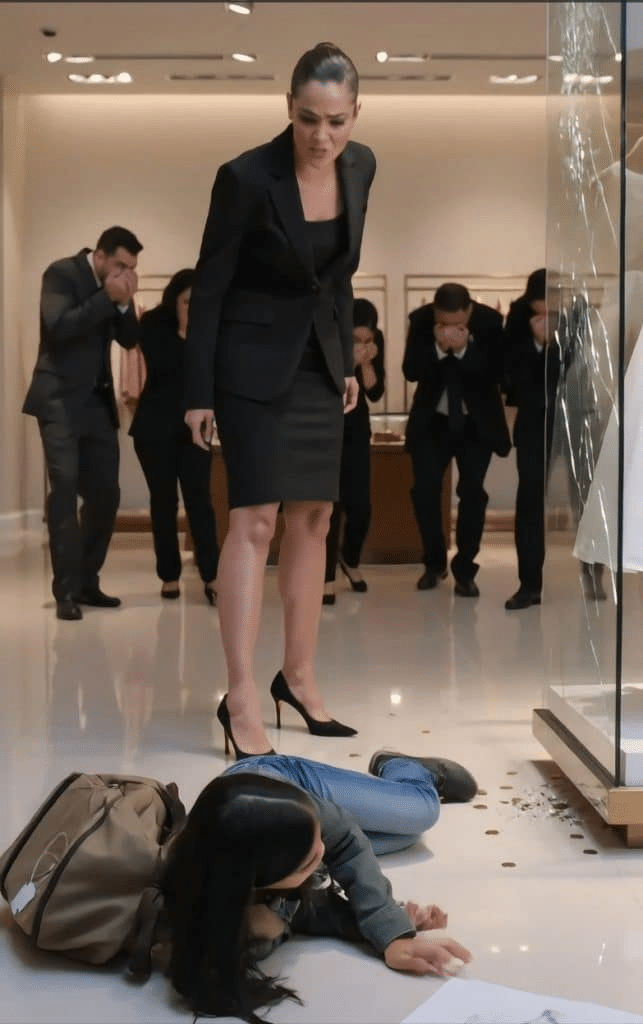
A high heel struck the ten-year-old girl between the shoulder blades and drove her forward.
Her head and shoulder collided with the display case.
Safety glass fractured in a web of white lines, then released a shower of tiny pieces near the base as the girl fell onto the glossy floor.
Her old backpack slid away.
Coins rolled beneath the clothing racks. Folded drawings scattered beside them, one stopping beneath the white dress she had been admiring through the glass.
The boutique went silent.
Wealthy shoppers froze beneath the warm display lights. Two employees stopped beside a rack of embroidered coats. A security guard near the mall entrance turned toward the sound but did not move.
The girl pressed one scraped palm against the floor.
A thin scratch marked her cheek. Her hands shook, and tears ran down her face as she struggled to understand why a stranger had attacked her.
Standing over her was Vanessa Crowe.
Thirty-five years old, dressed in a fitted black suit and sharp heels, Vanessa had spent six years selling children’s clothing that cost more than many families earned in a week.
She believed she could identify a valuable customer before they spoke.
She also believed she could identify everyone who was not one.
“Get away from that dress, trash.”
Her voice cut through the silence.
The girl flinched.
Vanessa pointed toward the shattered display.
“People like you can only stare through glass.”
Several shoppers looked horrified.
None challenged her.
Vanessa mistook their shock for agreement.
The child’s name was Lily Morgan.
She wore faded jeans, an old jacket, and sneakers cleaned so carefully that the worn edges looked almost deliberate.
She had entered the boutique alone ten minutes earlier.
Not through the staff corridor.
Not by slipping past security.
Through the main glass doors.
A sales assistant greeted her, but Vanessa immediately interrupted.
“Children must be accompanied.”
Lily explained that her mother was coming.
Vanessa looked at the old backpack and decided that was a lie.
Then Lily saw the white dress.
It stood inside the glass case beneath a soft spotlight.
Simple silk.
Small embroidered flowers.
A blue ribbon at the waist.
Lily stopped in front of it and touched the outside of the glass with two fingers.
That single gesture enraged Vanessa.
The display was reserved for the boutique’s anniversary collection. Wealthy clients had appointments to view the dress before it was released.
Vanessa saw Lily’s hand against the glass and imagined fingerprints.
She charged from behind.
She did not warn the child.
She did not ask her to step back.
She kicked her.
Now Lily lay beside the cracked case while her drawings and coins covered the floor.
Vanessa bent down and picked up one of the pages.
It showed a child’s version of the white dress.
The proportions were uneven, but the details were unmistakable.
The ribbon.
The flowers.
The high collar.
Vanessa tore the paper in half.
“You copied our design.”
Lily stared at the pieces.
“No.”
“Then why did you draw it?”
“Because I designed it.”
A few shoppers exchanged glances.
Vanessa laughed.
The sound was sharp and public.
“You?”
Lily reached toward another drawing.
Vanessa stepped on it.
“You think walking in here with a few crayons makes you a designer?”
“They’re mine.”
“Nothing in this store belongs to you.”
Lily looked toward the white dress.
For the first time, something stronger than fear appeared in her face.
“That does.”
Vanessa’s expression hardened.
She raised one hand toward security.
“Remove her.”
Before the guard could respond, an engine roared beyond the glass entrance.
A black luxury SUV accelerated through the boutique doors.
The glass panels shattered outward in a storm of safety glass as the vehicle rolled into the store and braked across the white floor.
Shoppers screamed and scattered.
The rear door opened.
A woman in a black suit stepped out with two bodyguards behind her.
She saw the cracked display.
Then the child on the floor.
Her face changed.
She crossed the boutique in seconds, knelt beside Lily, and lifted her carefully away from the broken glass.
Only after placing the girl behind the bodyguards did she turn toward Vanessa.
“That’s my daughter,” she said. “And this store belongs to our family.”
Vanessa’s face went pale.
“Your family…?”
And the woman who had treated Lily like an intruder was about to learn why the child’s drawings had been hidden from her.
Act II
The woman’s name was Claire Morgan.
She was the majority owner of Morgan & Vale, the luxury children’s brand operating the boutique and thirty-two others across the country.
Fashion magazines called Claire disciplined.
Competitors called her ruthless.
Employees who knew her well called her fair, though never to her face.
But Lily knew her as the mother who burned toast, forgot school spirit days, and answered business calls during bedtime stories.
Claire knelt beside her daughter.
“Look at me.”
Lily tried to stop crying.
“I’m okay.”
“No.”
Claire’s voice softened.
“You don’t have to say that.”
The mall’s medical staff entered and examined the scratch on Lily’s cheek, her shoulder, and the scraped palm.
Claire held her daughter’s hand throughout.
Only after the medic confirmed that Lily had no serious injury did Claire rise.
Vanessa remained near the shattered display.
Her posture had collapsed, but she was still searching for a way to control the story.
“Ms. Morgan, there has been a terrible misunderstanding.”
Claire looked toward the glass.
“My daughter is injured.”
“She damaged the display.”
A shopper spoke.
“She touched the outside.”
Vanessa turned toward her.
The woman did not look away.
Another shopper stepped forward.
“The saleswoman kicked her.”
The security guard lowered his eyes.
Claire noticed.
“You saw it?”
He nodded.
“Why didn’t you intervene?”
Vanessa answered for him.
“He reports to store management.”
Claire looked back at the guard.
“That was not my question.”
The man swallowed.
“Ms. Crowe has had staff dismissed before.”
The boutique went still.
Claire’s anger changed shape.
This was no longer only about what happened to Lily.
It was about how fear had become part of the store’s operating system.
She turned toward Vanessa.
“Did you kick my daughter?”
Vanessa’s mouth tightened.
“She was acting suspiciously.”
“She is ten.”
“She claimed the dress was hers.”
Claire glanced at the white dress.
Then she looked toward the torn drawing on the floor.
Lily had drawn that dress six months earlier.
It began as part of a school art assignment.
The teacher asked students to design clothing for someone they loved.
Lily drew a white dress for herself because her grandmother once promised to teach her how to sew one.
That grandmother, Evelyn Morgan, founded the company.
Evelyn began as a seamstress in a rented apartment. She made children’s clothes because she believed luxury did not need to make children look like small adults.
Her designs were soft.
Practical.
Built for movement.
Claire inherited the company when Evelyn became ill.
Lily inherited her grandmother’s eye.
She spent afternoons sketching in hospital waiting rooms while Claire handled meetings.
One day, Evelyn saw the white dress.
She asked Lily to explain every detail.
The blue ribbon represented the river near Evelyn’s childhood home.
The embroidered flowers were forget-me-nots.
The high collar came from an old photograph of Evelyn’s mother.
Evelyn asked the design team to develop it.
The anniversary dress became the final project she approved before her death.
At Lily’s request, her name was kept off the marketing materials.
She wanted to see whether people liked it without knowing who drew it.
Claire agreed.
The dress became the most anticipated piece in the new collection.
Vanessa had spent weeks presenting it to wealthy clients.
She never knew a child designed it.
She certainly never imagined that child would arrive wearing an old jacket.
Claire looked down at the scattered coins.
“Why did you bring money?”
Lily’s voice shook.
“I wanted to buy Grandma’s ribbon.”
The design team had created a small blue ribbon accessory to accompany the dress.
Lily saved coins from chores.
Claire could have given it to her.
That was not the point.
Lily wanted to purchase the first one herself.
She had come dressed simply because she wanted one normal visit to the store.
No announcement.
No bodyguards.
No employees pretending not to stare.
Claire had agreed to meet her there.
Traffic delayed her.
Lily arrived first.
And Vanessa revealed exactly how the boutique treated children when their parents did not look wealthy enough.
But the torn drawing was not the only secret on the floor.
Inside Lily’s backpack was a small notebook filled with staff names.
She had been visiting stores anonymously for months.
And Vanessa’s name appeared more than once.
Act III
The notebook belonged to Evelyn Morgan.
Before she died, she gave it to Lily with a strange request.
“Look at the stores when no one knows who you are.”
Lily did not understand at first.
Evelyn explained that brands become dangerous when they care more about being admired than being kind.
She had watched Morgan & Vale grow from one small shop into a luxury company.
She was proud.
She was also afraid.
Prices rose.
Customers changed.
Employees began judging families by clothing, accents, and spending.
Evelyn worried the company would forget why she created it.
Clothes were meant to protect children.
Not teach them which children mattered.
Lily began visiting stores with trusted adults nearby but out of sight.
Sometimes she wore her school uniform.
Sometimes an old coat.
She asked simple questions.
Could she look at a dress?
Could she sit while waiting?
Could she use the restroom?
Most employees treated her kindly.
Some did not.
Lily wrote down what happened.
Vanessa Crowe’s boutique appeared in the notebook four times.
A boy wearing a thrift-store jacket was followed by security.
A mother using discount vouchers was asked to wait outside while full-price customers entered.
A child with muddy shoes was told not to touch the furniture.
A cleaning worker’s daughter was removed from a fitting area during her mother’s break.
Claire had received complaints about the store.
Regional management dismissed them.
Vanessa’s sales numbers were among the highest in the company.
She attracted wealthy clients.
She protected inventory.
She maintained what executives called premium atmosphere.
No one asked what that atmosphere cost everyone else.
Lily planned to make one final visit before giving the notebook to her mother.
She chose the day the white dress arrived.
Vanessa’s attack provided an answer more brutal than anything Evelyn feared.
Claire opened the notebook.
Her face grew colder with every page.
Vanessa saw the names.
“That is not an official company record.”
“No,” Claire said. “It is more honest.”
“You cannot judge employees through secret tests conducted by a child.”
Claire looked at Lily’s scraped hand.
“I am judging you through security footage.”
Vanessa glanced toward the ceiling.
The boutique cameras covered the display area.
The store director rushed in from the mall office.
He had heard about the SUV.
He had not yet heard about the assault.
Claire ordered the video secured.
Vanessa stepped forward.
“I acted to protect company property.”
Lily looked toward the cracked display.
“You broke it.”
The child’s voice was quiet.
It still stopped the room.
Claire turned toward the director.
“How many complaints have been filed against her?”
He hesitated.
“Several.”
“How many?”
“Seventeen.”
Claire stared at him.
“And she remained employed?”
“Her client retention is exceptional.”
A bitter silence followed.
The explanation was not surprising.
That made it worse.
Vanessa was not protected despite her behavior.
She was protected because of it.
Her cruelty created exclusivity.
Exclusivity attracted clients who wanted to feel elevated above others.
The company profited.
Then called the result luxury.
Claire closed the notebook.
“Pull every complaint from this location.”
The director nodded.
“And suspend regional management.”
His face changed.
“Ms. Morgan, that could affect the anniversary launch.”
Claire looked toward her daughter.
“The launch is already affected.”
Vanessa made one final attempt.
“The child’s presence was unauthorized.”
Claire’s bodyguards exchanged a glance.
Claire did not.
“She is an owner.”
The sentence shocked the room.
Lily did not merely belong to the family.
Evelyn’s will had placed part of the company into a trust for her granddaughter.
Lily’s shares would fully activate when she turned twenty-one.
Until then, Claire managed them.
Legally, Lily already owned more of the boutique than every executive who ignored the complaints.
Vanessa’s lips parted.
“You let an owner enter dressed like that?”
Claire looked at her.
The question exposed everything.
“Dressed like what?”
Vanessa said nothing.
Claire stepped closer.
“You mean dressed like a child you believed could not punish you.”
The boutique doors filled with mall security and police.
But before they approached Vanessa, the store director received an urgent message.
A file had been discovered in regional management.
It contained instructions to target specific customers for removal.
The list included clothing descriptions, neighborhood names, and racial and financial assumptions disguised as fraud prevention.
Vanessa had helped write it.
Act IV
The document was titled Loss Prevention Profile Guide.
Its language sounded clinical.
Neutral colors.
Low-cost footwear.
Unaccompanied minors.
Worn bags.
Cash payments using coins or small bills.
Limited familiarity with brand terminology.
Each category assigned a risk score.
None actually proved theft.
Together, they created permission to suspect poverty.
Employees were instructed to remain visible near high-risk shoppers, discourage product handling, and request security assistance when necessary.
The guide was never approved by corporate legal.
Regional executives distributed it privately.
Vanessa contributed examples from her store.
One described a child with an old backpack lingering near a display.
The description matched Lily almost exactly.
Claire read the guide twice.
Her mother’s company had turned prejudice into procedure.
Not through a public policy.
Through a file executives assumed no one important would ever see.
The police reviewed the security footage.
Vanessa watched herself charge toward Lily.
The kick was clear.
So was the collision with the glass.
There was no theft.
No threat.
No warning.
Only violence against a child who touched a display case.
An officer approached.
Vanessa’s composure broke.
“This cannot happen in front of customers.”
Claire looked around the boutique.
“Why not?”
“It will destroy the brand.”
“No.”
Claire’s voice remained cold.
“What destroys a brand is training people to believe beauty belongs only to the wealthy.”
The officer asked Vanessa to turn around.
She looked toward the store director.
He stepped back.
She looked toward several clients who had requested her personally for years.
None defended her.
One woman removed a Morgan & Vale shopping bag from her arm and placed it on the counter.
“I don’t want this anymore.”
Another shopper followed.
Then another.
The store’s most profitable customers were not all cruel.
But they had benefited from an environment that made them feel more welcome by making others feel unwelcome.
Now they saw the price.
Vanessa’s hands were restrained.
Her face turned pale.
“That child ruined my career.”
Lily stood behind Claire.
The scratch on her cheek was small.
Her expression was not.
“You kicked me.”
Vanessa looked at her.
“You shouldn’t have been here alone.”
Claire stepped between them.
“Stop blaming her for surviving what you chose to do.”
Mall security prepared to escort Vanessa out.
She looked toward the white dress one final time.
“You said she designed that?”
Claire nodded.
“My daughter drew it.”
“And your family owns the store?”
“Yes.”
Vanessa’s lips trembled.
“Your family…?”
Lily held one of the torn drawings in her scraped hand.
Then she gave Vanessa the answer no title could soften.
“You were wrong before you knew.”
The officers led Vanessa through the shattered entrance.
Outside, shoppers gathered around the damaged storefront.
Inside, staff stood among broken glass and scattered drawings.
Claire looked at them.
Some were frightened.
Some ashamed.
Others appeared relieved.
A junior sales assistant raised her hand.
“I reported the profiling guide.”
The director looked at her.
“When?”
“Three months ago.”
“To whom?”
She named a regional executive.
The same executive had transferred her to fewer shifts.
Claire understood that firing Vanessa would not repair the system.
The company had rewarded sales, buried warnings, and treated fear as discipline.
Evelyn’s concern had been correct.
Morgan & Vale had begun forgetting children.
Claire canceled the anniversary launch.
Then she ordered every boutique closed.
Not permanently.
Long enough to decide whether they deserved to reopen.
Act V
The closure lasted three weeks.
Investors panicked.
Executives warned that customers would move to competitors.
Claire accepted the risk.
The independent investigation uncovered profiling practices in eleven stores.
Not every location used the written guide.
Many did not need one.
Managers communicated expectations through hiring, training, and quiet corrections.
Employees learned which families to greet warmly.
Which children to watch.
Which customers should never be allowed to feel comfortable enough to stay.
Regional leaders protected the behavior because targeted stores produced higher average sales.
The company had confused intimidation with prestige.
Claire dismissed four executives and removed six store managers.
The store director who kept Vanessa after seventeen complaints resigned.
The junior assistant who reported the profiling was reinstated with back pay and invited to join the new standards council.
Morgan & Vale rewrote its policies.
No child could be removed solely for being unaccompanied unless there was an immediate safety concern.
Security intervention required observable conduct, not clothing or payment method.
Complaints involving discrimination bypassed local management.
Sales bonuses no longer depended only on average customer spending.
Employees were evaluated on service consistency across all clients.
Claire also made a change the board hated.
She reduced prices on selected children’s essentials and created a repair program for worn clothing.
Luxury clients complained that accessibility weakened the brand.
Claire answered that dignity was not a limited edition.
Vanessa pleaded guilty to assaulting a minor and reckless endangerment.
She received probation, counseling, community service, and a restraining order protecting Lily.
The court also ordered restitution for medical expenses.
Claire donated the money to a youth art program.
Vanessa lost her career in luxury retail.
At first, she blamed everyone else.
The child.
The pressure.
The company.
The customers who expected exclusivity.
Her court-ordered community service placed her inside a donation center sorting children’s clothing.
One afternoon, a girl arrived with her father.
She held a worn coat with a broken zipper.
The father asked whether it could be exchanged.
Vanessa almost dismissed it.
Then she saw the child clutching the coat.
It had belonged to her older sister.
The girl did not want another one.
She wanted that one repaired.
Vanessa found a volunteer seamstress.
They fixed the zipper together.
The child smiled.
No sale was recorded.
No client profile improved.
No commission followed.
For the first time, Vanessa saw value without price.
Months later, Lily received a letter.
Vanessa admitted that she had spent years measuring people by whether they could afford the objects around them.
She wrote that she had looked at Lily’s jacket and backpack and decided the child had no right to beauty.
She did not ask for forgiveness.
Lily placed the letter inside Evelyn’s notebook.
She did not answer.
Not every lesson required access to the person who had been hurt.
The anniversary dress was never sold as originally planned.
Claire wanted to remove it from production.
Lily refused.
“It wasn’t the dress’s fault.”
Instead, the company released it in a limited collection supporting youth art education.
The label carried no family name.
Only one line from Evelyn:
Beauty should invite a child closer, not remind her to stay outside.
The dress sold out.
But Lily cared more about the drawings submitted by children to the art program.
Hundreds arrived.
Dresses with wings.
Coats shaped like clouds.
Shoes with secret pockets.
Clothing designed for wheelchairs, sensory needs, and children who hated buttons.
Lily reviewed every page.
She chose several designs for a new collection developed with the young artists.
Each child was credited.
Each was paid.
One year after the assault, Lily returned to the same boutique.
The glass entrance had been rebuilt.
The display case had been replaced.
She wore the old jacket again.
Claire noticed.
“You have newer clothes.”
“I like this one.”
“It has a tear.”
“Grandma fixed it.”
That ended the discussion.
Inside, a new sales associate greeted Lily.
“Good afternoon. Are you looking for anything?”
Lily pointed toward the display.
A boy in a faded sweatshirt stood near it, studying a blue coat.
“No.”
She watched.
The boy touched the glass.
No one shouted.
The sales associate opened the case.
“Would you like to see it?”
The boy looked toward his mother, who was checking a price tag with concern.
“Can we?”
The associate smiled.
“You can look.”
She removed the coat and let him feel the fabric.
Lily’s shoulders relaxed.
Claire stood beside her.
“Is that what you wanted?”
“It’s a start.”
Lily opened Evelyn’s notebook.
On the final page, she wrote:
Children were allowed to come closer.
Then she closed it.
Vanessa Crowe had looked at a worn jacket, faded jeans, scattered coins, and a child staring through glass.
She saw someone poor enough to humiliate.
She never saw the artist whose imagination created the dress inside the case.
She never saw the young owner whose family name could end her career.
But that was never the most important truth.
Lily deserved gentleness before anyone knew who her mother was.
She deserved safety before anyone learned who owned the store.
And she had every right to stand close to something beautiful without proving that she could afford it.