Act I
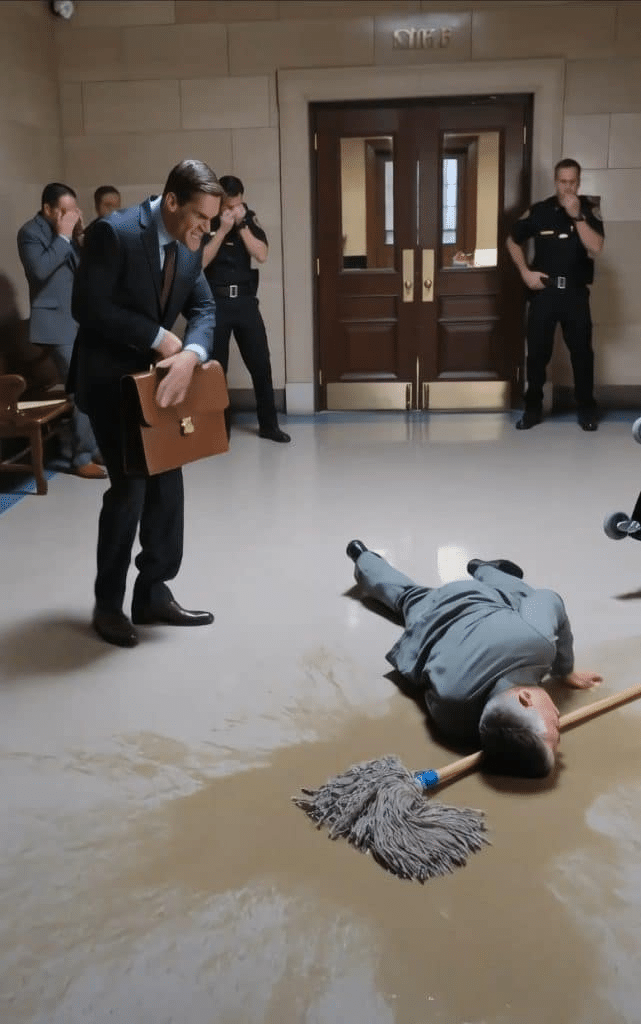
The lawyer’s shoe struck the old man in the stomach before anyone in the courthouse hallway could stop him.
Samuel Carter folded forward with a strangled gasp.
His mop slipped from his hand. The janitor cart tipped sideways, cleaning bottles scattered across the stone floor, and gray water poured from the bucket in a widening sheet.
Then Samuel fell.
His elbow struck first.
His shoulder followed.
The back of his head stopped inches from the courthouse wall as he curled around the pain in his stomach and fought to breathe.
The hallway went silent.
Lawyers paused outside courtroom doors. Police officers turned from the security station. Clerks, defendants, witnesses, and families waiting for hearings stared at the sixty-eight-year-old janitor lying beside the overturned cart.
Standing over him was Adrian Cole.
He was forty-five, expensively dressed, and minutes away from delivering the closing argument in the biggest case of his career.
His charcoal suit had been tailored in London. His leather briefcase cost more than Samuel earned in a month. His polished shoes remained perfectly clean despite the water spreading across the floor.
Adrian looked down at the old man with open disgust.
“Trash,” he said. “People like you clean the floor, not block lawyers.”
Samuel’s face tightened with pain.
He did not beg.
He did not apologize.
He reached toward the mop handle lying beside the wall.
Adrian kicked it farther away.
“You’ve already made enough of a mess.”
A woman seated on the public bench covered her mouth.
One of the police officers took a step forward, but Adrian lifted a hand.
“He came at me.”
Samuel looked up.
The lie seemed to hurt almost as much as the kick.
“I was moving the cart,” he said weakly.
“You rolled it directly into my path.”
“The floor was wet.”
“You should have cleaned it before people arrived.”
Samuel’s fingers curled against the stone.
It was just after eight in the morning. The courthouse had been open for less than fifteen minutes, and rainwater from hundreds of shoes had already turned the main hallway slick.
Samuel had placed warning signs near both entrances.
He was pulling the cart aside when Adrian rounded the corner at full speed, speaking angrily into his phone.
The lawyer’s briefcase clipped the bucket.
Water splashed across one polished shoe.
That was all.
Adrian looked at the stain as though Samuel had committed a crime.
He demanded the old man kneel and wipe it clean.
Samuel refused.
Quietly.
Respectfully.
But he refused.
“There are towels on the cart,” he said. “You can use one.”
The answer shocked Adrian.
Not because it was rude.
Because it suggested they were equals.
He grabbed Samuel by the front of his uniform.
Samuel pulled away.
Then came the kick.
Now the old man lay on the floor while courthouse employees watched a lawyer turn cruelty into confidence.
Adrian adjusted his cuff.
“I have an important hearing.”
Samuel drew a painful breath.
“So do the people whose floors I clean.”
Adrian’s expression hardened.
He stepped closer.
Behind him, the heavy courtroom doors opened.
A female judge emerged in her black robe, followed by a bailiff and two clerks. She was reviewing a file as she walked.
Then she saw the overturned cart.
She saw the old man on the floor.
The file slipped from her hand.
“Dad?”
The single word echoed through the hallway.
Adrian stopped breathing.
And every person who had remained silent suddenly understood whose father he had just kicked.
Act II
Judge Olivia Carter crossed the hallway in seconds.
She dropped beside Samuel without caring that the hem of her robe touched the dirty water.
“Dad, look at me.”
Samuel forced a small smile.
“You’re supposed to be in court.”
“You’re supposed to be standing.”
“I’ll get there.”
Olivia touched his shoulder carefully.
“Where does it hurt?”
“My pride.”
“Dad.”
“My stomach.”
The bailiff called for medical assistance.
Olivia looked at the scrape on Samuel’s elbow and the pain tightening his face. Then she reached for his fallen mop and pushed it away so no one would trip.
Only after checking that he could breathe normally did she look up at Adrian.
He had defended clients in her courtroom dozens of times.
He had donated to judicial education programs.
He had shaken her hand at bar association dinners and praised her commitment to public service.
Now he stood above her father with his expensive briefcase in one hand and panic spreading across his face.
“Your father?” he whispered.
Olivia rose.
Her expression no longer showed shock.
Only cold fury.
“Yes.”
Adrian’s mouth opened.
“Judge Carter, this is a misunderstanding.”
Samuel slowly sat upright with the bailiff’s help.
Olivia stepped between them.
“Did you touch him?”
“He pushed the cart into me.”
“Did you kick him?”
Adrian glanced toward the witnesses.
“It happened quickly.”
“That was not my question.”
The hallway became even quieter.
“Yes,” he admitted. “But I believed he was becoming aggressive.”
Samuel looked at him.
The old man’s silence was devastating.
Olivia turned toward the nearest security camera.
“Preserve the footage.”
Adrian’s confidence cracked.
“Your Honor, I think we should discuss this privately.”
“You assaulted a courthouse employee in a public hallway.”
“I did not know he was your father.”
Samuel’s eyes lowered.
Olivia stared at Adrian.
“That does not help you.”
The paramedics arrived and began examining Samuel.
As they worked, Olivia picked up his identification badge from the floor.
Samuel Carter.
Facilities Services.
Twenty-three years.
Most courthouse employees knew him.
Olivia had spent much of her career pretending not to.
Not because she was ashamed.
Because Samuel insisted.
When she became a prosecutor, he asked her never to mention their relationship at work. When she was appointed to the bench, he became even more determined.
“I don’t want anyone being kind to me because they’re afraid of you,” he said.
Samuel wanted people to treat him as they treated every other worker.
That was the point.
He had raised Olivia alone after her mother died from cancer. During the day, he repaired boilers and electrical systems in an old municipal building. At night, he cleaned offices.
He brought Olivia to the courthouse when childcare failed.
She did homework on public benches while he mopped the floors around her.
He taught her to read using discarded legal notices.
He brought home damaged law books that attorneys threw away.
The first time Olivia said she wanted to become a judge, she was eleven.
Samuel did not laugh.
He bought her a secondhand black robe from a costume shop and called her “Your Honor” for an entire week.
Years later, when she graduated from law school, he stood at the back of the auditorium in the only suit he owned.
When she became a judge, he refused to retire.
“This building gave you a future,” he told her. “I can help take care of it.”
Samuel cleaned the courthouse because the work mattered to him.
Adrian saw only the uniform.
But his cruelty was about to expose something much larger than one violent outburst.
Because Samuel had been quietly collecting evidence for months.
And some of it involved Adrian Cole.
Act III
The paramedics recommended taking Samuel to the hospital.
He refused at first.
Olivia did not argue.
She simply gave him the look she used when attorneys ignored direct orders.
Samuel sighed.
“Fine.”
Before they lifted him onto the stretcher, he reached toward the janitor cart.
“My folder.”
Olivia looked around.
“What folder?”
“Bottom shelf.”
The cart had fallen against the wall. Beneath scattered cleaning supplies was a blue binder secured with an elastic strap.
A courthouse clerk retrieved it.
Samuel held it against his chest.
Adrian’s face changed.
It was slight.
Most people missed it.
Olivia did not.
“You recognize this?” she asked.
“No.”
His answer came too quickly.
Samuel looked at his daughter.
“That’s why I was outside Courtroom Four.”
Adrian’s hearing was scheduled in Courtroom Four.
He represented a property developer accused of bribing city officials and falsifying inspection records. The trial had lasted six weeks.
Olivia was not presiding.
She had deliberately avoided the case because Samuel once worked in one of the municipal buildings involved.
But Samuel knew more than anyone realized.
During his night shifts, he had found legal documents abandoned in conference rooms.
Draft affidavits.
Internal emails.
Notes left in trash bins without being shredded.
At first, he assumed they were ordinary case papers.
Then he saw the same names repeated.
Adrian Cole.
A senior clerk.
A private investigator.
The documents suggested witnesses had been pressured to alter testimony. One courthouse employee had been paid to provide access to sealed scheduling records.
Samuel reported the matter to courthouse administration.
Nothing happened.
So he began keeping copies.
Not because he understood every legal implication.
Because he knew secrecy when he saw it.
That morning, he planned to deliver the binder to the courthouse ethics officer.
Adrian had seen him near Courtroom Four.
He saw the blue folder.
The kick had not been entirely about the water.
Olivia watched Adrian’s eyes move toward the binder.
“What is in it?”
Samuel looked at him.
“He knows.”
Adrian laughed, but there was no humor in it.
“This is becoming absurd.”
The ethics officer arrived from the second floor.
Samuel handed her the binder.
Adrian stepped forward.
“That material may be privileged.”
Olivia turned sharply.
“You said you did not know what it was.”
Adrian stopped.
The ethics officer opened the binder.
The first page contained a copy of an email from Adrian’s firm to the senior clerk.
Move the hearing to Judge Warren’s calendar. He understands the importance of discretion.
The second page showed a payment routed through a consulting company.
The third contained a draft statement from a witness with handwritten edits.
Remove reference to structural defects. Emphasize city delay.
The witness’s final testimony used those exact words.
Adrian looked around the hallway.
The witnesses to the assault were now witnesses to something else.
He lowered his voice.
“Those documents were obtained illegally.”
Samuel shook his head.
“They were in the trash.”
“Confidential trash.”
The ethics officer looked up.
“You appear very familiar with them.”
Adrian’s composure began to split.
He turned toward Olivia.
“This man has been stealing legal papers.”
“My father found evidence of misconduct.”
“Your father is a janitor.”
The sentence landed like a blow.
Not because Samuel was ashamed of the work.
Because Adrian still believed the job made his testimony less valuable.
Olivia took one step toward him.
“He is a courthouse employee reporting possible corruption.”
“He cleans toilets.”
“And you practice law.”
Her voice remained calm.
“Only one of you appears to have forgotten what duty means.”
Several attorneys lowered their eyes.
Adrian looked toward the police officers.
“This is professional retaliation. The judge is emotionally compromised.”
Olivia removed herself before he could finish.
“I will take no part in reviewing the evidence or your case.”
That was not mercy.
It was procedure.
The chief judge was summoned.
The district attorney’s public-integrity unit was contacted.
Courtroom Four was temporarily sealed.
Adrian’s client was escorted into a conference room.
The blue binder disappeared into official custody.
But before the hallway could clear, a young clerk stepped forward.
Her name was Rachel Kim.
Her hands were shaking.
“Mr. Carter isn’t the only one who has evidence.”
Adrian turned toward her.
Fear crossed his face.
Rachel had worked under the clerk named in the emails.
For nearly a year, she had watched files move without explanation.
She had seen sealed motions copied for private attorneys.
She had been ordered to change timestamps.
She kept records.
She stayed silent because Adrian threatened to destroy her legal career.
Now she looked at Samuel on the stretcher.
“He told me last week that fear only protects the person causing it.”
Samuel gave her a small nod.
Rachel handed her phone to the ethics officer.
It contained messages from Adrian.
And one of them revealed why he had been so desperate to enter Courtroom Four that morning.
A witness was about to change his testimony.
Adrian intended to stop him.
Act IV
The witness was a former building inspector named Robert Lane.
For weeks, Robert testified that the developer had followed city procedures.
That morning, he planned to admit the truth.
Inspection reports had been altered.
Unsafe buildings were approved.
Adrian knew.
He had helped prepare the false account.
Robert sent an email to the prosecutor before dawn.
He wanted protection.
Adrian learned of the message through the clerk he had been paying.
That was why he ran through the courthouse hallway.
That was why a spilled bucket enraged him.
Every second mattered.
Samuel’s cart blocked the fastest path to Courtroom Four.
To Adrian, the old janitor was not merely beneath him.
He was in the way.
Now the courtroom was sealed, the witness was in protective custody, and Adrian’s phone was being taken as evidence.
He reached for his briefcase.
A police officer stopped him.
“Leave it on the floor.”
“I am an officer of the court.”
The chief judge had arrived.
He was an older man named Henry Walsh, known for patience until patience became complicity.
He looked at Adrian.
“Then you should understand the order.”
Adrian’s jaw tightened.
“You cannot search privileged materials because of accusations from a custodian.”
Samuel was being wheeled toward the elevator.
He heard the word.
Custodian.
He lifted one hand.
The paramedic stopped.
Samuel looked directly at Adrian.
“I cleaned your office once.”
Adrian stared at him.
“You left coffee on the desk. Papers on the floor. You didn’t look at me when I entered.”
Samuel’s voice was weak but clear.
“That is why people tell the truth around workers like me. They think we are furniture.”
No one spoke.
Samuel continued.
“You never saw me. So you never imagined I could see you.”
The truth stripped away Adrian’s final layer of confidence.
Police took his phone.
His briefcase was sealed.
Rachel gave a formal statement.
The senior clerk was detained before noon.
The former inspector testified under guard.
By evening, the bribery case had transformed into a corruption investigation reaching through the courthouse, city government, and Adrian’s law firm.
The assault remained separate.
Its evidence was simpler.
The hallway camera showed Adrian rounding the corner.
It showed Samuel pulling the cart aside.
It showed the briefcase strike the bucket.
Then Adrian grabbing the older man.
The kick was unmistakable.
There was no threat.
No confusion.
Only anger directed at someone he believed could not matter.
Adrian watched the footage in a courthouse interview room.
His attorney sat beside him.
For the first time, he was not speaking as counsel.
He was the subject.
He insisted stress had impaired his judgment.
He claimed Samuel provoked him.
He argued the kick was defensive.
Every claim failed against the video.
When officers prepared to escort him downstairs, he saw Olivia standing at the far end of the hallway.
She was no longer wearing her robe.
She had recused herself from every proceeding connected to him.
She stood only as Samuel’s daughter.
Adrian looked at her.
“This will destroy me.”
Olivia’s expression did not change.
“You made choices.”
“I have a family.”
“So does he.”
“I didn’t know he was your father.”
Olivia stepped closer.
“That is the problem you still do not understand.”
Adrian glanced toward the elevator where Samuel had disappeared.
“Your father…?”
“Yes.”
Then Olivia said the sentence that followed him through every hearing that came after.
“But the law was supposed to protect him before you knew that.”
The officers led Adrian away.
Yet Olivia’s anger did not end with him.
She had seen police hesitate.
Lawyers look away.
Clerks remain silent.
The courthouse had witnessed an assault and waited for power to identify the victim before reacting.
That failure belonged to the institution.
And Olivia intended to confront it.
Act V
Samuel returned home the following afternoon.
The kick left a deep bruise across his abdomen and a painful scrape on his elbow, but no internal injuries.
Olivia stayed with him.
She made soup.
He complained that it had no salt.
She reminded him of his blood pressure.
He said judges were not supposed to interfere with private citizens’ seasoning.
For several hours, neither mentioned the hallway.
Then Samuel looked toward the framed photograph on the mantel.
It showed Olivia at her swearing-in ceremony.
He stood beside her in his janitor uniform.
She had asked him to wear a suit.
He refused.
“I wanted them to know who put you there,” he said at the time.
Now Olivia sat across from him.
“Why didn’t you tell me about the binder?”
“You would have worried.”
“You were collecting evidence against a corrupt lawyer.”
“I was picking up trash.”
“Dad.”
Samuel looked at her.
“You had to be able to say you did not know.”
She understood.
He had protected her from any accusation of using judicial authority.
Even while risking himself.
Olivia lowered her eyes.
“When he kicked you, everyone watched.”
“Yes.”
“A police officer was ten feet away.”
“Yes.”
“No one moved until I came out.”
Samuel said nothing.
That silence became her answer.
Within a month, the courthouse adopted a new workplace violence policy.
It applied equally to judges, attorneys, police, defendants, and members of the public.
No professional title delayed intervention.
Any assault against staff required immediate response and independent review.
Workers gained direct access to the courthouse ethics office without going through supervisors.
Security training changed too.
Officers were instructed that uniforms did not create levels of human worth.
A robe did not make someone more deserving of protection than coveralls.
A law degree did not excuse aggression.
A mop did not make a person invisible.
Olivia insisted that Samuel speak at the training.
He refused.
She asked again.
He refused more strongly.
Finally, she recorded one sentence from him and played it at every session.
“You do not learn who people are by looking at the work in their hands.”
Adrian was charged with assault, witness tampering, obstruction, bribery, and conspiracy.
His law license was suspended.
Several partners at his firm claimed they knew nothing about his conduct.
The investigation proved otherwise.
Two were indicted.
The firm collapsed within a year.
The former clerk pleaded guilty and cooperated.
The building developer was convicted after Robert Lane’s testimony and the recovered documents exposed years of falsified inspections.
Three unsafe properties were evacuated and repaired.
Lives were likely saved.
None of that made Samuel celebrate.
He did not enjoy seeing careers destroyed.
He enjoyed seeing records corrected.
“That’s what the courthouse is for,” he said. “Getting the record right.”
Adrian eventually pleaded guilty.
At sentencing, his attorney emphasized his education, charitable donations, and years of legal service.
Samuel attended from the back row.
When invited to speak, he approached slowly.
His elbow had healed, but he still moved carefully.
Adrian looked thinner.
The polished confidence was gone.
Samuel unfolded a single page.
“I have cleaned this courthouse for twenty-three years,” he said. “I have seen innocent people frightened and guilty people arrogant. I have seen judges kind and lawyers cruel. I have seen both switch places.”
He looked toward Adrian.
“You called me trash because you believed my job made me less than you.”
Adrian lowered his head.
Samuel continued.
“I do not want revenge. I want you to understand that the floor remembers everyone’s footprints. The difference is some people clean up after themselves, and some expect others to do it.”
The judge sentenced Adrian to prison, probation after release, and permanent disbarment.
Years later, people still remembered the corruption case.
Few remembered the spilled mop water.
Samuel did.
He returned to work three months after the assault.
Olivia objected.
He ignored her.
On his first morning back, courthouse employees gathered near the entrance.
They applauded.
Samuel looked embarrassed.
Then annoyed.
“Floor’s still dirty,” he said.
Everyone moved aside.
He righted the cart and began his shift.
But things were different.
Lawyers held doors for staff.
Clerks greeted custodians by name.
Security officers responded when voices rose.
Some changes came from policy.
Others came from shame.
Samuel accepted both.
One evening, long after the courtrooms emptied, Olivia found him polishing the stone outside Courtroom Four.
She had removed her robe and carried a stack of files.
“You’re working late.”
“So are you.”
She looked down at the floor.
The place where he had fallen was indistinguishable from the rest of the hallway.
“You ever think about retiring?”
“Every morning.”
“And?”
“I usually decide after lunch.”
She smiled.
Then she picked up a second mop.
Samuel stared at her.
“What are you doing?”
“Helping.”
“You’re a judge.”
“You’re my father.”
“That does not qualify you to mop.”
“Show me.”
He sighed and handed her the handle.
She moved it badly.
Water streaked across the stone.
Samuel took it back.
“You went to law school for nothing.”
Olivia laughed.
The sound echoed through the empty courthouse.
For a moment, neither was a judge nor a janitor.
They were simply a daughter and the man who raised her.
Adrian Cole had looked at Samuel’s uniform and believed he saw someone beneath him.
He saw gray hair.
A mop.
A tired worker blocking the path to an important courtroom.
He never saw the father who cleaned offices so his daughter could study law.
He never saw the man brave enough to collect evidence when attorneys remained silent.
And he never understood that the janitor he kicked to the courthouse floor had spent his entire life teaching a future judge what justice was supposed to look like.