Act I
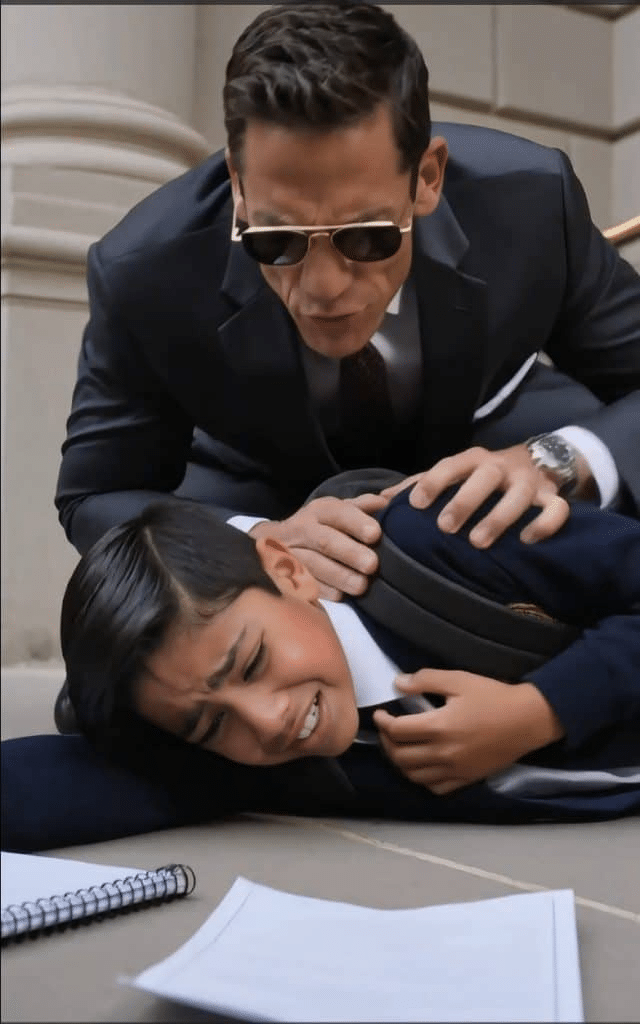
The scholarship letter left twelve-year-old Noah Carter’s hand before his body hit the stone.
A man in an expensive suit had ripped the paper from his fingers and slapped him so hard that he lost his balance at the top of the academy steps.
Noah stumbled backward.
His backpack slipped from one shoulder, his heel missed the edge, and he tumbled down three steps before landing chest-first on the lower stone platform.
The sound stopped the morning.
Not the traffic.
Not the engines of the luxury cars lined along the circular driveway.
The people.
Parents froze beside open car doors. Uniformed students turned toward the staircase. Drivers, guards, teachers, and office staff stared as Noah’s notebooks spilled from his backpack and slid across the gray stone.
His right knee struck first.
Then his palm.
A sharp scrape burned across his skin, and the impact knocked the breath from his lungs.
For several seconds, Noah could not move.
Standing above him was Richard Langford.
Forty-four years old, dressed in a tailored charcoal suit and dark sunglasses, Richard was the kind of man who expected doors to open before he reached them.
His son, Preston, stood several steps behind him in a perfectly pressed academy blazer.
Richard looked down at Noah with the disgust of someone who believed poverty was contagious.
“Trash,” he said. “People like you beg for schools like this.”
The words carried across the entrance of Ashbourne Academy.
Founded nearly a century earlier, Ashbourne was one of the most exclusive private schools in the country. Its stone towers appeared in university brochures. Its graduates became senators, judges, surgeons, and chief executives.
Tuition cost more than many families earned in a year.
Most children arrived in chauffeured cars.
Noah had arrived by city bus.
His school jacket was secondhand. One sleeve had been carefully repaired near the cuff, and his shoes were polished but worn at the edges.
The uniform technically matched Ashbourne’s dress code.
It simply did not look new enough for Richard.
Noah pushed one trembling hand against the stone and tried to sit up.
His cheek burned red where Richard had struck him. His lips trembled, but he refused to cry in front of the crowd.
He reached toward the scholarship letter lying halfway down the steps.
Richard moved first.
He placed his shoe on the page.
“You should leave before security removes you.”
Noah looked up at him.
“I’m supposed to be here.”
Richard gave a cold laugh.
“My son is supposed to be here.”
Preston lowered his eyes.
Noah swallowed through the pain.
“So am I.”
Richard bent down, close enough for Noah to smell the sharp cologne on his coat.
“Do you have any idea what kind of families attend this school?”
Noah did.
He had read every page of Ashbourne’s website.
He knew the school’s history, its academic record, its science program, and the names of the students who had won national mathematics competitions.
He knew because, for nearly a year, Ashbourne had existed in his mind like a distant country he might never be allowed to enter.
He had applied anyway.
His mother called it brave.
Noah called it practical.
Ashbourne had the best engineering laboratory in the state, and Noah had been building small machines since he was seven.
His first motor came from a broken fan.
His first circuit board came from a discarded television.
His first robotics project was held together with wire, tape, and pieces from an old kitchen timer.
Two months earlier, he had submitted that project with his scholarship application.
Then the letter arrived.
Full tuition.
Books.
Meals.
Transportation.
Everything covered.
Noah’s mother had read it three times at the kitchen table before she believed it.
That morning, she could not accompany him because she worked the early shift at a hospital laundry facility. She packed his lunch, straightened his tie, and kissed his forehead before he left.
“Walk in like you earned it,” she told him.
Now he sat bruised on the academy steps while a stranger told him he did not belong.
Richard pressed his shoe harder against the letter.
Behind him, the academy’s grand front doors suddenly opened.
The headmaster appeared first.
Beside him was Charles Whitmore, chairman of the Ashbourne board.
Both men saw Noah on the stone.
Then Charles saw the letter beneath Richard’s shoe.
His expression changed.
The two men rushed down the steps.
And Richard’s confidence began to disappear before anyone had explained why.
Act II
Charles Whitmore reached Noah first.
He was sixty-three, silver-haired, and usually so controlled that even angry board meetings failed to raise his voice.
That morning, he moved with open urgency.
He stepped around Richard, picked up the scholarship letter, and knelt beside the boy.
“Noah?”
Noah looked at him cautiously.
“Yes, sir.”
“Are you hurt?”
“My knee.”
The headmaster crouched on Noah’s other side and examined the scrape on his palm.
“We need the nurse.”
“I’m okay.”
“You fell down stone steps,” the headmaster said. “You are not required to be okay.”
The kindness in his voice almost broke the restraint Noah had held since the slap.
But Noah blinked hard and stayed silent.
Charles carefully unfolded the damaged letter.
The academy seal was visible at the top.
Beneath it were the signatures of the admissions director, the headmaster, and Charles himself.
He looked toward Richard.
“What happened here?”
Richard removed his sunglasses.
The contempt in his face shifted into caution.
“This boy attempted to enter without proper authorization.”
Charles looked down at the letter.
“He has authorization.”
Richard’s jaw tightened.
“He claimed to have a scholarship.”
“He does.”
A murmur moved through the parents gathered near the steps.
Richard glanced toward the crowd, then lowered his voice.
“Chairman Whitmore, surely this can be handled privately.”
Charles ignored him.
He turned back to Noah.
“Young Mr. Carter, your full scholarship was personally approved by the board.”
Richard’s face went pale.
“The board…?”
Noah looked at the letter in Charles’s hand.
It was creased now.
One corner had torn during the fall.
But it was still real.
The headmaster helped him stand.
Noah winced when he put weight on his knee, but he straightened his back.
Charles handed him the letter with both hands.
“We were waiting for you.”
Those words mattered more than Noah expected.
Not merely expecting.
Waiting.
The distinction settled something inside him.
Richard took one step backward.
His son remained behind him, staring at Noah’s scattered notebooks.
“Mr. Whitmore,” Richard began, “I believed he was trespassing.”
Charles looked at Noah’s uniform.
“He is wearing an Ashbourne blazer.”
“It’s worn.”
The answer came too quickly.
Richard seemed to realize it only after he spoke.
The headmaster’s expression hardened.
“And that made you believe he was dangerous?”
Richard adjusted his cuff.
“This entrance has had problems with people asking for money. I was protecting the students.”
Noah looked toward the guards.
Neither had approached him before the assault.
One guard now stepped forward.
“He showed me the letter at the gate.”
Charles turned.
“You verified it?”
“Yes, sir. His name was on the incoming student list.”
Richard looked at the guard.
“Then why didn’t you tell me?”
The question exposed the arrogance beneath his defense.
The guard had never been required to explain another student’s admission to him.
Richard simply assumed every adult near the entrance answered to him.
Charles rose.
“You struck a child after he had been cleared by security.”
Richard’s confidence cracked further.
“I did not know he had been cleared.”
“You did not ask.”
“I saw him reaching toward Preston.”
For the first time, Richard’s son spoke.
“He wasn’t.”
Everyone looked at him.
Preston’s face reddened.
“Noah dropped his letter,” he continued. “He was picking it up.”
Richard’s eyes narrowed.
“Get in the car.”
Preston did not move.
The silence between father and son drew the crowd’s attention.
Noah glanced away, embarrassed for him.
That small act of mercy would later matter.
But in that moment, Charles was studying Richard with a new kind of suspicion.
Because Richard Langford was not merely another wealthy parent.
He had donated nearly four million dollars to Ashbourne.
He chaired the academy’s development committee.
And for the past year, he had been demanding greater control over who received financial aid.
The assault on Noah was not random.
It was the physical expression of a campaign the board had only begun to uncover.
Charles folded his hands behind his back.
“Mr. Langford, do not leave.”
Richard stared at him.
“Excuse me?”
“The police are being called.”
The crowd shifted.
Richard’s mouth opened, but no sound came.
Then the headmaster noticed something written in the margin of Noah’s scholarship letter.
A reference number.
He recognized it immediately.
And when he turned toward Charles, the anger in his face deepened.
“Noah’s application was one of the files that disappeared.”
Act III
Three weeks earlier, six scholarship applications had vanished from Ashbourne’s admissions system.
The technical department blamed a database error.
The missing files were restored from a backup, and the board approved the students anyway.
At the time, no one could prove deliberate interference.
Noah’s was one of those six applications.
Charles looked at the reference number again.
Then he looked at Richard.
“You served on the admissions technology review.”
Richard’s expression became unreadable.
“As an adviser.”
“You had access to the scholarship portal.”
“So did several employees.”
The headmaster stepped closer.
“Only two board members had administrator access.”
Richard gave a dismissive shake of his head.
“This is absurd.”
Noah stood quietly beside Charles, holding his damaged letter.
He did not understand every detail.
But he understood the way adults’ voices changed when a secret entered the room.
Charles turned to the school’s security director.
“Preserve the entrance footage. Then contact our legal counsel and the admissions auditor.”
Richard laughed once.
It sounded forced.
“Over a technical problem?”
“Over an assault,” Charles said. “The technical problem is separate.”
A teacher gathered Noah’s notebooks from the steps.
One had opened to a page covered in hand-drawn machine designs.
The teacher paused.
“Did you draw these?”
Noah nodded.
Richard glanced at the notebook.
His face changed for the briefest moment.
Recognition.
Charles saw it.
“You know his work.”
Richard looked away.
Noah tightened his grip on the scholarship letter.
Months earlier, Ashbourne had hosted a regional youth engineering competition. Noah entered through his public school and won first place with a low-cost water filtration device built from recycled materials.
Richard had attended because Preston was also competing.
Preston’s team placed third.
During the awards ceremony, Richard approached one of the judges and argued that the competition should separate privately funded teams from “community entries.”
The judge refused.
A week later, Noah received an anonymous message warning him not to apply to Ashbourne.
He never told his mother.
He assumed it was a cruel joke from another student.
Now he looked at Richard and remembered the message.
People like you should know when a door is closed.
The wording was different.
The contempt was the same.
Noah reached into his backpack.
His phone screen had cracked during the fall, but it still worked.
He opened the message and handed it to Charles.
“I got this after the engineering contest.”
Charles read it.
The message had been sent from a temporary account, but the legal team could trace it.
Richard saw the screen.
“This proves nothing.”
Noah met his eyes.
“I didn’t say it was you.”
For the first time, Richard looked uncertain.
Preston stared at his father.
“Was it?”
Richard turned sharply.
“I told you to go to the car.”
“No.”
The single word shocked everyone.
Preston had spent his life obeying.
He attended the schools Richard chose, joined the teams Richard selected, and smiled for photographs beside donations he did not understand.
But he had also watched his father slap a boy down the stairs.
Something inside him had shifted.
“You knew Noah,” Preston said.
Richard’s face tightened.
“I knew his application.”
“How?”
No answer came.
The admissions auditor arrived twenty minutes later with the academy’s legal counsel. By then, Noah had been taken inside, examined by the nurse, and seated in the headmaster’s office with a cold pack against his cheek.
His mother was on her way.
Outside, morning drop-off had ended, but many parents remained.
The story was already spreading.
Press photographers had not been present, but phones had recorded everything.
Inside the office, the auditor opened the access logs.
Richard’s board account had entered the scholarship system eleven times during the week the files disappeared.
He claimed he was reviewing financial projections.
The logs showed otherwise.
He opened individual student applications.
Noah Carter.
Lena Brooks.
Samuel Ortiz.
Mei Park.
Aisha Reynolds.
Daniel King.
All six came from low-income families.
All six scored within the highest range of Ashbourne’s applicants.
All six files were later deleted.
Richard leaned back in his chair.
“This data can be misinterpreted.”
Charles looked at him.
“Then interpret it.”
Richard’s attorney had arrived by then.
He advised silence.
But Richard had spent too many years believing that wealth could turn any accusation into a negotiation.
He spoke.
“The scholarship program has expanded too quickly.”
The headmaster’s eyes narrowed.
“That was not your decision to make.”
“We are changing the culture of the academy.”
“By admitting qualified students?”
“By ignoring what families like mine have built.”
Noah sat across from him.
His cheek still red.
His knee bandaged.
His torn scholarship letter resting on the desk.
Richard glanced toward him.
“This school survives because of donors.”
Noah’s mother entered at that moment.
Her hospital uniform was visible beneath her coat.
She had run from the parking area, still wearing the white shoes from her laundry shift.
She crossed the room and wrapped both arms around her son.
“Are you hurt?”
“I’m okay, Mom.”
She looked at his face.
“No, you’re not.”
Then she saw Richard.
The room changed.
She did not know his name.
She did not know his wealth.
She saw only the man who had struck her child.
“What did you do to him?”
Richard’s attorney stood.
Charles raised a hand.
“No one will prevent her from speaking.”
Noah’s mother looked at the board members.
“My son earned that letter.”
Charles nodded.
“Yes, he did.”
Richard exhaled impatiently.
“This is exactly the emotional spectacle I was trying to avoid.”
The words ended whatever protection his status had left.
Noah’s mother stared at him.
“You hit a twelve-year-old child, and you are embarrassed by emotion?”
Richard said nothing.
Charles closed the admissions file.
“You will resign from the board today.”
Richard’s attorney objected.
Charles did not look at him.
“And before the day is over, we will determine whether your donations were ever tied to improper influence.”
Richard’s face hardened.
“You remove me, and I withdraw every dollar.”
Charles leaned forward.
“Then we will learn what this institution is actually worth.”
But Richard had one final weapon.
He claimed Ashbourne could not afford to lose him.
By noon, the board discovered he was wrong.
Act IV
Richard Langford’s donations were large.
They were also strategically exaggerated.
The academy’s finance office reviewed every commitment linked to his name. Several gifts announced publicly had never been fully paid.
Others were loans disguised as donations.
One construction project carried a clause giving Richard’s company preferred bidding rights.
He had not merely supported Ashbourne.
He had been building influence inside it.
The development committee records revealed more.
Richard had pushed for a policy limiting full scholarships to two students per year.
He described the existing program as a threat to “community alignment.”
When the board rejected the proposal, he began contacting donors privately.
Some supported him.
Most did not understand what he was truly asking.
Then the legal team traced the anonymous message sent to Noah.
The temporary account had been created from an internet address registered to Langford Capital’s executive office.
Richard’s attorney stopped speaking.
Preston sat apart from his father.
His face had gone pale.
“Why?” he asked.
Richard looked at him.
“This was for you.”
Preston shook his head.
“No.”
“You deserve every advantage.”
“So you hurt him?”
“I protected your future.”
Noah watched from beside his mother.
Preston looked toward him, ashamed.
“My future wasn’t in his backpack.”
Richard’s jaw tightened.
“You are a child. You do not understand competition.”
The headmaster stood.
“This academy is not a private inheritance.”
Richard laughed bitterly.
“It has always belonged to families like ours.”
Charles looked toward the portraits lining the boardroom wall.
Former chairmen.
Founders.
Generations of wealthy benefactors.
For years, Ashbourne had celebrated merit while quietly depending on inherited access.
Richard had simply said the hidden belief aloud.
Charles turned back.
“No,” he said. “It belongs to every student capable of meeting its standards.”
Richard pointed toward Noah.
“He will never fit here.”
Noah’s mother rose.
Her voice remained controlled.
“My son does not need to become smaller so your son can feel taller.”
Preston lowered his eyes.
Richard looked toward the other trustees.
“You are going to destroy the academy over one scholarship boy?”
Charles’s expression became cold.
“No. We are going to save it from men who believe children can be priced.”
The board voted.
Richard was removed unanimously.
His access to academy systems was terminated.
The school reported the data interference to law enforcement, and the assault footage was submitted to police.
Outside, officers waited near the stone staircase.
Richard stood slowly.
His suit still looked perfect.
Everything else had collapsed.
As security escorted him through the front hall, students and parents moved aside.
He reached the same steps where Noah had fallen.
The scattered notebooks were gone.
The blood had been wiped from Noah’s lip.
But one object remained.
His damaged scholarship letter was now displayed inside a clear protective folder.
Charles carried it.
Richard stared at it.
“The board approved him?”
Charles nodded.
“Personally.”
Richard’s lips trembled.
“The board…?”
No one answered.
Police led him toward the waiting car.
For the first time that morning, Richard entered a vehicle without anyone opening the door for him.
But Noah’s place at Ashbourne was still not secure.
Public opinion turned quickly.
Some parents defended Richard.
And they were prepared to remove their children unless the academy reversed course.
Act V
By evening, Ashbourne’s parent forum had divided in two.
Many families condemned the assault.
Others focused on the scholarship investigation.
Anonymous posts claimed admission standards had been lowered.
They had not.
One parent wrote that the academy was “sacrificing tradition for optics.”
Another asked whether paying families would now be expected to subsidize children who “could not contribute to the community.”
Noah read none of it.
His mother did.
She sat at their kitchen table with her phone in one hand and anger tightening her face.
“You don’t have to go back.”
Noah looked at the repaired backpack beside his chair.
“Do you want me to?”
“I want you safe.”
“That’s not the same question.”
She looked at him.
He had inherited her quietness.
Also her stubbornness.
“What do you want?” she asked.
Noah thought for a long moment.
“I want the laboratory.”
Despite everything, that answer made her smile.
The next morning, Charles Whitmore came to their apartment.
He did not send an assistant.
He climbed three flights of stairs and sat at the small kitchen table where Noah had built his first machines.
The chairman placed the repaired scholarship letter in front of him.
“We would be honored to have you at Ashbourne.”
Noah looked at the page.
“Will the other scholarship students still come?”
“Yes.”
“Even if donors leave?”
“Yes.”
“Are you sure?”
Charles answered without hesitation.
“We should have been sure sooner.”
Noah’s mother studied him.
“What changes?”
The chairman understood.
An apology was not enough.
Ashbourne commissioned an independent review of admissions, donor influence, and student safety. Board members could no longer access individual applications.
Scholarship decisions would be made through anonymous academic review before financial information was considered.
Donations could not be tied to admission, discipline, staffing, or curriculum.
The school also created a student dignity policy protecting scholarship recipients from public disclosure, harassment, and financial-status discrimination.
But the most important change began with the students themselves.
Preston Langford returned to school.
His father had been charged with assault, unlawful system access, and harassment. Many expected Preston to transfer.
He refused.
On Noah’s first official day, Preston met him at the bottom of the stone steps.
For several seconds, neither spoke.
Then Preston handed him a new notebook.
“I’m sorry.”
Noah looked at it.
“You didn’t hit me.”
“I didn’t stop him.”
“You’re twelve.”
“So are you.”
Noah accepted the notebook.
They walked inside together.
Friendship did not happen immediately.
Trust rarely does.
But both boys joined the engineering club.
Preston knew expensive equipment.
Noah knew how to build without it.
Their first project failed spectacularly, flooding half a laboratory table and triggering the fire alarm.
Noah laughed before he could stop himself.
Preston did too.
By winter, they entered a national design competition with a low-cost emergency heating system for families living in older buildings.
They won second place.
Noah considered that unacceptable.
The following year, they won first.
Richard Langford pleaded guilty before trial.
The court ordered probation, community service, and mandatory counseling. The academy permanently banned him from campus.
His business also faced a civil investigation after evidence showed he had used charitable donations to secure contracts.
The money he threatened to withdraw became irrelevant.
Other donors replaced it.
Many gave anonymously.
One scholarship fund received thousands of small contributions from former students who had watched the video of Noah’s fall and remembered moments when they, too, had felt unwanted.
Ashbourne renamed the fund.
Not after Noah.
He refused.
It became the Open Door Scholarship.
Three years later, Noah stood at the same front entrance to welcome incoming students.
He was fifteen now, taller, more confident, and carrying a clipboard instead of a torn letter.
A nervous girl approached in a uniform that was slightly too large.
Her mother parked an old car beyond the line of luxury vehicles.
The girl looked up at the stone staircase.
“Is this the right entrance?”
Noah remembered the slap.
The fall.
The notebooks scattering.
The man who believed worn clothes were proof of unworthiness.
“Yes,” Noah said. “It’s the right entrance.”
She looked uncertain.
“For scholarship students too?”
“For everyone.”
He walked beside her up the steps.
Near the top, she noticed a small brass plaque installed beside the academy doors.
It carried no donor’s name.
Only one sentence:
No child must prove wealth before being welcomed to learn.
The girl read it twice.
Then she entered.
Noah paused outside.
Luxury cars continued arriving below. Parents adjusted ties, students hurried toward class, and morning sunlight touched the academy crest above the doors.
Ashbourne still looked elite.
The stone had not changed.
The traditions had not disappeared.
But the meaning of the entrance was different.
Richard had looked at Noah and seen a beggar reaching for something that belonged to richer children.
He saw an old uniform.
A city-bus pass.
A scholarship letter.
He never saw the boy who had already earned his place.
And when he tried to throw Noah down the steps, he exposed the truth before the entire academy.
The child he called trash had not come to beg for admission.
He had come because the board had already opened the door.