Act I
The kick came from behind.
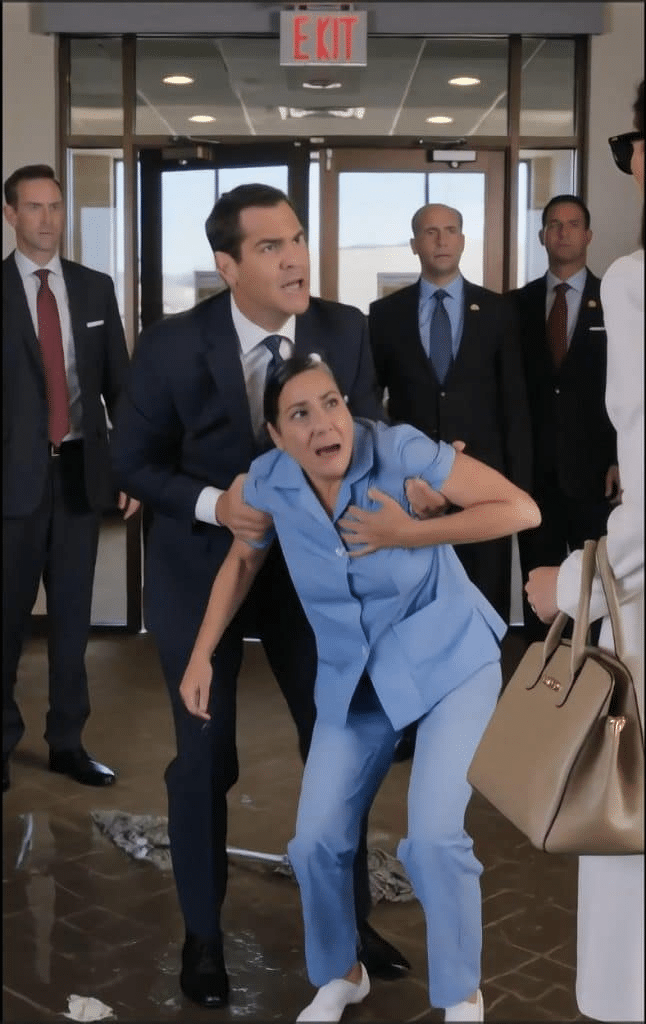
One second, sixty-two-year-old Rosa Mitchell was guiding her mop around a row of leather lounge chairs. The next, a sharp heel drove into the center of her back.
Her body lurched forward.
The mop bucket overturned with a metallic crash. Gray water spilled across the polished floor, the wringer rattled loose, and Rosa fell face-first into the mess she had been cleaning.
A cry escaped her as her palms struck the tile.
The first-class lounge went silent.
VIP travelers froze with champagne glasses halfway to their mouths. A bartender stopped pouring. Two airline attendants stared from behind the buffet counter while the yellow wet-floor sign slowly tipped onto its side.
Standing behind Rosa was Celeste Whitmore.
She wore a white cashmere coat, dark sunglasses, and heels that cost more than Rosa earned in two months. A designer handbag hung from one arm as though nothing unusual had happened.
Her face held no shock.
Only disgust.
Rosa pushed herself onto one elbow. Water soaked through the front of her uniform. One palm was scraped, her cheek pressed against the cold floor, and every breath tightened the pain in her back.
She did not ask for help.
She did not cry.
Celeste stepped closer.
“Trash,” she said. “People like you clean around us, not near us.”
A few passengers glanced at one another.
No one moved.
Rosa looked toward the mop that had skidded beneath a table. She tried to rise, but her arm trembled beneath her weight.
Celeste opened her handbag.
For one foolish moment, someone might have thought she intended to help.
Instead, she removed several bills and tossed them onto the wet floor near Rosa’s face.
The money darkened as the water reached it.
“Pick it up and crawl away.”
The lounge attendants looked horrified.
One young employee took half a step forward, but her supervisor caught her wrist. Celeste was not just another passenger. She was a platinum-status traveler, a major corporate client, and the wife of a luxury hotel owner who regularly booked entire first-class cabins.
People like Celeste were rarely told no.
She knew it.
That knowledge had shaped the way she moved through the world.
Rosa slowly lifted her eyes.
There was pain in them, but no surrender.
Celeste mistook the silence for fear.
She had no idea that Rosa had spent forty years surviving things far worse than her.
And she had no idea who was walking toward the lounge at that exact moment.
Beyond the frosted glass doors, several airline employees hurried aside.
A man in a dark suit approached with the airport director, two senior lounge managers, and a security chief.
His silver airline pin caught the light.
He was expected to inspect the lounge before an international board meeting.
He was not expected to find his mother lying on the floor.
The doors opened.
And the power in the room changed before he spoke a single word.
Act II
Adrian Mitchell saw the overturned bucket first.
Then he saw the gray hair beneath the cleaning cap.
“Mom?”
The word barely left his mouth.
He crossed the lounge so quickly that the managers behind him had to run to keep up. His briefcase struck a chair and fell, but he did not notice.
Adrian dropped to his knees in the water.
“Mom, look at me.”
Rosa blinked up at him.
The controlled authority in his face disappeared. He touched her shoulder carefully, checked her breathing, and slid one arm beneath her back.
“I’m all right,” she whispered.
“You’re on the floor.”
“I slipped.”
A lounge attendant shook her head.
“No, ma’am.”
Celeste’s posture stiffened.
Adrian turned toward the voice, then followed the employee’s gaze to the woman in the white coat.
Only then did he see the damp bills scattered beside his mother.
His expression changed.
He helped Rosa sit upright, removed his suit jacket, and placed it around her wet shoulders. Then he retrieved the mop handle and pushed it aside so no one else would trip.
He did everything slowly.
Carefully.
Only after his mother was safe did he stand.
Adrian Mitchell was forty years old and served as chief operating executive of North Continental Airlines. He oversaw airport services, premium travel, and more than sixty thousand employees across the company’s domestic network.
Most people in the lounge recognized him.
Celeste did too.
She had seen his face in business magazines, on financial news programs, and in the airline’s annual report.
But she had never seen Rosa.
Very few people had.
Rosa had raised Adrian alone in a small apartment near the airport’s eastern service road. His father disappeared before Adrian learned to walk, leaving behind unpaid bills and a last name Rosa refused to abandon.
She cleaned hotel rooms during the day and office buildings at night.
When Adrian turned sixteen, she took an additional shift cleaning aircraft between midnight and dawn. She came home smelling of disinfectant and jet fuel, slept for three hours, and then woke to make him breakfast.
Adrian once asked why she worked so hard.
Rosa answered without looking up from the stove.
“Because your life should not become small just because mine is difficult.”
He never forgot it.
She paid for his first semester of college by selling the gold bracelet her own mother had given her. When he almost dropped out, Rosa worked through pneumonia rather than admit they were behind on rent.
Adrian eventually earned scholarships, joined North Continental as a junior operations analyst, and rose through the company over eighteen years.
He offered to buy Rosa a house.
She accepted a modest one.
He offered to hire a driver.
She laughed.
He asked her to stop working.
That conversation did not go well.
“I am not ashamed of my job,” she told him.
“I know.”
“Then stop trying to rescue me from it.”
Rosa had worked at the airport for nearly twenty-five years. She knew the cleaners, baggage handlers, caterers, gate agents, mechanics, and night crews whose names senior executives rarely learned.
She also knew the first-class lounge had become a place where some travelers treated workers as invisible.
So when management outsourced the cleaning contract, Rosa stayed.
She said she wanted to know how the new company treated its employees.
Adrian suspected there was more to it.
His mother had always believed that leaders learned the truth from places where no one expected them to look.
That morning, Adrian was scheduled to announce a new employee-protection program.
Rosa knew nothing about the announcement.
Celeste knew nothing about Rosa.
And now, surrounded by witnesses, Adrian looked at the wet floor and asked the question that made Celeste’s blood run cold.
“You did this to my mother?”
The room held its breath.
But the kick was only the beginning.
Because Celeste had not targeted Rosa by accident.
And one of the airline employees had proof.
Act III
Celeste removed her sunglasses.
Her eyes moved quickly between Adrian, Rosa, and the executives gathering behind them.
“This has been completely misunderstood.”
Adrian said nothing.
Celeste forced a small laugh.
“Your mother stepped into my path. The floor was wet, and she lost her balance.”
The bartender stared at her.
“You kicked her.”
Celeste turned sharply.
“I did not.”
A lounge attendant reached beneath the counter and pressed a button.
The nearest wall monitor changed from flight information to security footage.
Celeste’s face drained.
The recording had no sound, but it did not need any.
It showed Rosa moving the wet-floor sign into place.
It showed Celeste approaching from behind.
It showed her speaking angrily, pointing at a damp mark near her suitcase, and then driving her heel into Rosa’s back.
The lounge watched the impact again.
The bucket overturned.
Rosa hit the floor.
Then Celeste threw the money.
No one spoke.
Adrian’s eyes remained on the screen.
“Why?” he asked.
Celeste swallowed.
“She ruined my coat.”
Rosa looked down at the expensive white fabric.
There was a faint water mark near the hem.
“I apologized,” Rosa said.
Celeste’s voice sharpened.
“She splashed filthy water on me.”
“The bucket was clean when you kicked her into it,” the bartender replied.
Adrian turned toward the lounge manager.
“Call airport police.”
Celeste’s composure cracked.
“Police?”
“You assaulted an airport employee.”
“This is absurd.”
“You kicked a sixty-two-year-old woman to the floor.”
“I barely touched her.”
Adrian looked at his mother’s scraped hand.
“You touched her hard enough to knock the breath out of her.”
Celeste drew herself up.
“Do you have any idea who I am?”
The question sounded ridiculous the moment it entered the room.
Adrian’s expression did not change.
“Yes.”
That answer unsettled her.
He stepped toward the reception desk and took the tablet from a lounge supervisor. After entering Celeste’s name, he opened her passenger account.
Her profile appeared immediately.
Platinum Sovereign status.
More than two hundred premium flights over five years.
Corporate travel contracts linked to Whitmore Hospitality Group.
A long list of service complaints.
Adrian scrolled.
Many were ordinary demands: meal preferences, lounge seating, delayed baggage.
Others were not.
Celeste had accused a wheelchair attendant of stealing.
She had demanded that a gate agent be fired for asking her to wait in line.
She had thrown a drink at a flight attendant during a weather delay.
In each case, the employee had been questioned.
In each case, Celeste received an apology.
There was more.
Three months earlier, a cleaning contractor named Linda Reyes had filed a report alleging that Celeste shoved her inside a restroom near Gate 42.
The complaint was closed due to lack of evidence.
Two weeks after that, a baggage handler reported that Celeste struck his hand with an umbrella.
That complaint also disappeared.
Adrian looked at the lounge manager.
“Who closed these?”
The manager hesitated.
“Our premium relations department.”
“Under whose authority?”
No one answered.
Celeste tried to regain control.
“You are looking at internal notes without context. Difficult employees make accusations against high-value clients all the time.”
Rosa’s expression hardened.
“Difficult employees?”
Celeste turned toward her.
“You people depend on travelers like me.”
Rosa slowly stood with Adrian’s help.
Her uniform was soaked. Her back hurt, and her palm stung, but her voice remained steady.
“No. People like you depend on workers like us.”
Celeste opened her mouth.
Rosa continued.
“Someone cleaned the plane you arrived on. Someone carried your luggage. Someone prepared your food, checked your passport, fueled the aircraft, and made sure you landed safely.”
She looked at the damp money on the floor.
“You saw none of them.”
The words struck more deeply than shouting could have.
Adrian lowered the tablet.
“Who else saw what happened?”
Hands rose across the lounge.
A businessman near the runway window had recorded the confrontation. So had a college student sitting near the buffet. The bartender had audio.
Then a flight attendant stepped forward.
“I saw her before today.”
Celeste turned.
The attendant’s face was pale, but she did not retreat.
“Last year, on Flight 806, she grabbed my arm because we ran out of her preferred champagne.”
Celeste stared at her.
“You said nothing.”
“I reported it.”
Adrian looked at the attendant.
“What happened?”
“I was told to apologize to her.”
Silence spread through the lounge.
Adrian finally understood.
This was not one cruel passenger.
It was a system trained to protect revenue before people.
Celeste had learned that she could abuse workers because someone above them always valued her ticket more than their dignity.
She had not created that belief alone.
The airline had rewarded it.
Adrian looked toward the executives behind him.
“This ends today.”
But Celeste was not ready to accept that the rules had changed.
She reached for her phone and made one call.
The man she summoned believed he had enough influence to save her.
Instead, his arrival exposed the secret behind years of buried complaints.
Act IV
Richard Whitmore entered the lounge seven minutes later.
He was a broad-shouldered man in his early fifties, dressed in a navy suit with a private-club tie. Two assistants followed him, one carrying a leather portfolio.
Richard owned Whitmore Hospitality Group, which managed luxury hotels in twelve major cities. His company purchased thousands of premium airline tickets every year.
The airport director greeted him cautiously.
Richard ignored everyone except Celeste.
“What happened?”
She rushed toward him.
“This employee attacked me, and now they are threatening to have me arrested.”
Adrian watched her rewrite the event without blinking.
Richard turned toward him.
“Mr. Mitchell, I’m sure this can be handled privately.”
Adrian gestured to the security screen.
Richard watched the footage.
His expression tightened, but not from shock.
From inconvenience.
“My wife made a mistake.”
“She assaulted my mother.”
Richard glanced at Rosa.
The recognition in his eyes lasted less than a second, but Adrian saw it.
Rosa saw it too.
“You know me,” she said.
Richard looked away.
Celeste frowned.
“What is she talking about?”
Rosa studied him.
“You were here when Linda Reyes filed her complaint.”
The flight attendant near the buffet inhaled sharply.
Richard’s face became cold.
“I meet many employees.”
“You told her to withdraw it.”
Adrian stepped closer.
“Is that true?”
Richard adjusted his cuff.
“I have no idea what she means.”
Rosa looked toward the lounge manager.
“Show him the service hallway footage from March eighteenth.”
The manager blinked.
“How do you know about that?”
“Linda came to me.”
Adrian turned toward his mother.
“You knew?”
Rosa nodded.
Linda Reyes had been one of the cleaners on Rosa’s night shift. After Celeste shoved her in the restroom, Linda reported the incident to the contractor.
Two days later, Richard visited the airport.
The complaint vanished.
One week after that, Linda’s schedule was cut in half.
She eventually quit.
Rosa began collecting statements.
She spoke with baggage handlers, lounge attendants, gate agents, and flight crews. She documented every case involving passengers whose status or corporate accounts seemed to shield them from consequences.
She did not tell Adrian.
She knew he would act immediately.
But she wanted to know how deep the problem went.
The answer was now standing in front of them.
Adrian ordered the archive opened.
The lounge manager resisted at first, then entered the access code.
Internal emails appeared.
Richard’s company had threatened to move its corporate travel account unless complaints against Celeste were “resolved discreetly.”
Senior airline managers complied.
Employees were pressured to retract statements.
Security videos were mislabeled.
Incident reports disappeared.
One email was addressed to a vice president in Adrian’s own division.
Keep the Whitmores happy. Staff can be replaced. Contracts cannot.
Adrian read the sentence twice.
His face went still.
Richard tried to close the tablet.
“This is confidential business correspondence.”
Adrian pulled it away.
“This is evidence.”
Richard lowered his voice.
“Think carefully. Our account is worth almost forty million dollars over the next three years.”
Rosa looked at her son.
Everyone else did too.
That was the moment the lounge expected negotiation.
Powerful people rarely faced consequences when money could offer a cleaner solution.
Adrian removed his airline pin.
For one second, Celeste seemed relieved.
Then he placed it on the counter and turned toward the airport director.
“Cancel every Whitmore corporate booking that has not departed.”
Richard stared at him.
“You cannot be serious.”
“Terminate their premium travel agreement.”
“You will lose millions.”
Adrian looked toward the employees gathered near the wet floor.
“We have already lost more than that.”
Richard’s voice rose.
“Your board will remove you.”
“Then they can explain why protecting passengers who assault employees is good business.”
Airport police entered the lounge.
Celeste backed away.
Richard tried to block them.
“This is a civil dispute.”
One officer looked at the footage.
“No, sir.”
Celeste turned to Adrian.
“I apologized.”
“You apologized after you learned who she was.”
“I didn’t know she was your mother.”
Rosa met her eyes.
“That should not have mattered.”
Celeste’s mouth trembled.
The same woman who had ordered Rosa to crawl now seemed unable to stand without her husband’s arm.
As the officers approached, she whispered the truth she still could not understand.
“Your mother…?”
Adrian stepped in front of Rosa.
“Yes.”
Then he added quietly, “But you should have treated her like a human being before you knew that.”
The officers led Celeste away.
Richard remained behind, staring at the canceled contract on the screen.
Yet the most important reversal came later.
It happened when Rosa refused the apology the airline prepared for her.
Act V
The airline’s public-relations team drafted a statement before Rosa reached the medical center.
It described the incident as “an unacceptable interaction involving a valued member of the airport community.”
Rosa read it once.
Then she tore it in half.
“Valued member?” she said. “You mean cleaner.”
Adrian sat beside her in the examination room.
The doctor had confirmed a bruised back, a strained wrist, and a mild concussion. Rosa would recover, but she was ordered to rest for several weeks.
Adrian looked exhausted.
“I’ll rewrite the statement.”
“That is not the problem.”
“What is?”
“You are trying to make what happened to me sound unusual.”
He frowned.
“It was unusual.”
“No. It was visible.”
The distinction silenced him.
Rosa told him about employees who had been insulted, threatened, touched, shoved, and humiliated by wealthy travelers. Some filed reports. Most did not.
They believed the airline would protect the passenger.
Often, they were right.
“You built a beautiful company,” she said. “But beauty at the front means nothing if workers are frightened behind the doors.”
Adrian lowered his eyes.
“I didn’t know.”
“You did not ask.”
He nodded slowly.
“What do you want me to do?”
Rosa leaned back against the pillow.
“Make it harder to hide.”
Within a week, North Continental announced an independent investigation into employee-abuse complaints across its airport network.
The findings were worse than expected.
Hundreds of cases had been downgraded to “service disputes.” Premium passengers received warnings while employees received disciplinary notes. Contractors who complained often lost shifts.
Several executives resigned.
The vice president who wrote that staff could be replaced was dismissed.
Adrian then introduced the Safe Passage Policy.
Every airport employee, including contractors, gained the right to report passenger misconduct directly through an independent system. Employees could not be punished for refusing service to someone who threatened or assaulted them.
Status no longer delayed investigation.
Revenue no longer erased evidence.
Any passenger who physically attacked a worker faced immediate suspension, regardless of loyalty tier or corporate account.
The board resisted.
Adrian brought Rosa to the meeting.
She entered wearing her cleaner’s uniform.
One director quietly suggested she change before speaking.
Adrian heard him.
“So everyone here feels comfortable?” he asked.
No one mentioned her clothes again.
Rosa stood at the end of the long table and placed several photographs before the board.
Linda Reyes.
The baggage handler struck with an umbrella.
The flight attendant forced to apologize.
A wheelchair assistant accused without evidence.
“These are not stories about difficult passengers,” Rosa said. “They are stories about what your employees learned to endure because they needed their jobs.”
She looked around the room.
“When a customer pays for first class, they are buying a better seat. They are not buying a better class of human being.”
The policy passed.
Not unanimously.
But it passed.
Celeste later pleaded guilty to assault. Her platinum status was permanently revoked, and she was banned from North Continental lounges.
Other airlines followed.
Whitmore Hospitality lost three major travel partnerships after the internal emails became public. Richard resigned as chief executive when investors learned his company had pressured airlines to suppress misconduct complaints.
Months later, Linda Reyes returned to the airport.
Not as a cleaner.
North Continental hired her to help lead the independent employee-advocacy office.
Rosa attended her first day.
“You did not have to do all this,” Linda told her.
“Yes,” Rosa replied. “Someone did.”
When Rosa finally returned to work, Adrian sent a car to her house.
She took the bus.
He waited for her in the first-class lounge, standing beside a brand-new mop bucket.
“You bought me cleaning equipment?”
“It has better wheels.”
She tried not to smile.
He handed her a small box.
Inside was an airline pin identical to his, except for one line engraved across the back.
Nothing moves without the people on the ground.
Rosa ran her thumb over the words.
“I’m not wearing this while I mop.”
“You don’t have to.”
“Good.”
She pinned it to her uniform.
The lounge had changed.
A framed notice near the entrance made the new policy clear: abuse of airport workers would result in immediate removal and possible travel suspension.
But Rosa paid less attention to the sign than to the people.
The new lounge manager greeted cleaners by name.
Travelers moved their bags when the floor needed attention.
Employees no longer looked toward supervisors before helping one another.
It was not perfect.
Rosa did not trust perfection.
But it was different.
She returned to the spot where the bucket had overturned and the money had floated in dirty water.
For a moment, she saw Celeste standing over her again.
Then a young boy approached with his father.
“Ma’am,” the boy said, “you dropped this.”
He held out a cleaning cloth that had slipped from her cart.
Rosa took it.
“Thank you.”
The father nodded to her before guiding the child toward their gate.
A small moment.
Ordinary.
That was what made it matter.
Adrian watched from across the lounge.
The world knew him as the executive who had canceled a forty-million-dollar contract to defend an employee.
But Rosa knew the truth.
He had not transformed the airline because she was his mother.
He transformed it because her humiliation forced him to see the people he should have protected all along.
Celeste had looked at Rosa’s uniform and seen someone beneath her.
She had kicked a cleaning lady.
She had expected silence.
Instead, she exposed a system, destroyed her own privilege, and reminded an entire airline of a truth no first-class ticket could erase.
Every person in that lounge had somewhere important to go.
But none of them would have gone anywhere without people like Rosa.