Act I
The slap cracked through the clinic before anyone had time to look away.
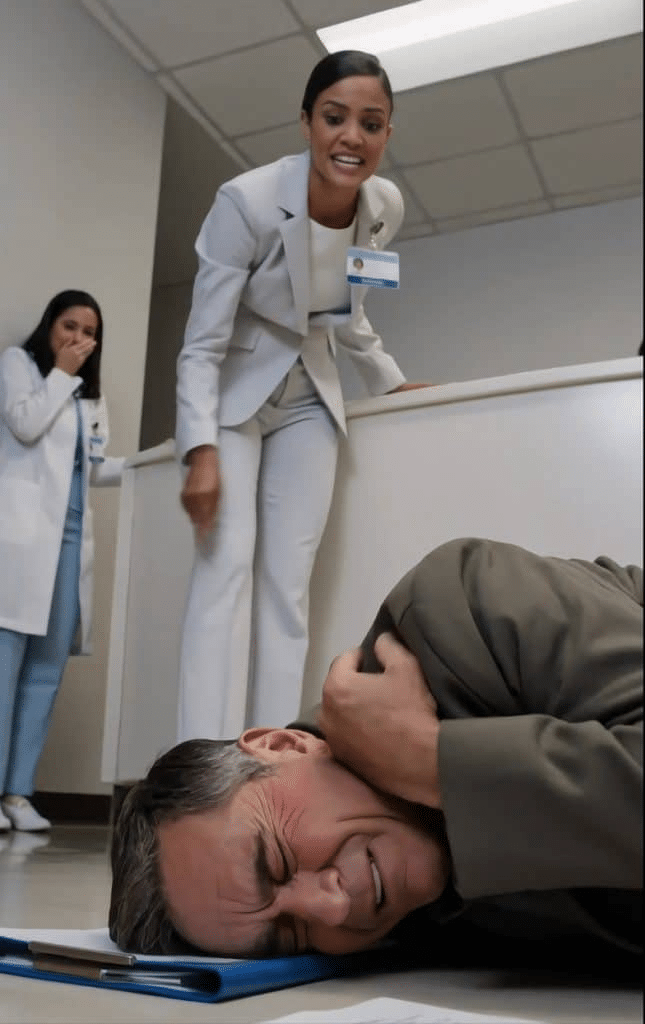
Harold Bennett spun sideways, his worn medical folder flying from his hands. Test results, appointment forms, and insurance documents scattered across the glossy white floor as his cane rolled beneath the reception counter.
For one terrible second, the seventy-four-year-old man remained standing.
Then his knees gave way.
He struck the floor beside the counter, one shoulder taking most of the fall. His faded brown coat twisted beneath him, and his palm scraped against the polished tile as he tried to keep his face from hitting the ground.
A gasp rose from the waiting area.
Nurses froze near the glass hallway. A receptionist covered her mouth. Two wealthy patients shifted in their leather chairs, stunned by what they had just witnessed.
Standing over Harold was Vanessa Cole, the clinic’s reception manager.
Her fitted white suit was spotless. Her hair was pinned neatly behind her head, and the silver badge on her lapel caught the soft medical light.
Nothing about her looked uncontrolled.
That was what made the violence worse.
She had not struck him in panic.
She had done it with the calm certainty of someone who believed no one important would object.
Vanessa looked down at Harold as though he were dirt dragged into the building on someone else’s shoe.
“Step aside, trash,” she snapped. “People like you can’t afford this clinic.”
The room fell silent.
Harold’s cheek reddened rapidly. His lower lip trembled, but he did not beg. He reached toward the papers scattered near his cane, gathering one sheet at a time with shaking fingers.
Vanessa placed the pointed toe of her shoe on the edge of his medical folder.
“You were told to leave.”
Harold looked up at her.
“I have an appointment.”
His voice was quiet, weakened by pain, but steady.
Vanessa laughed.
It was not a loud laugh. It was worse than that—a polished, dismissive sound designed to make him feel foolish for speaking.
“This is a private clinic.”
“I know.”
“Our consultations begin at fifteen hundred dollars.”
“I know that too.”
Vanessa’s smile tightened.
“Then stop wasting everyone’s time.”
She glanced around the reception area, performing for the wealthy patients who had been watching. The clinic served politicians, athletes, executives, and families whose names appeared on hospital wings.
Vanessa had spent years learning how to flatter power.
She had also learned how to punish anyone who seemed to have none.
Harold lowered his eyes and picked up another page.
At the top was the clinic’s logo.
Beneath it, in bold letters, was the name of his physician.
Dr. Daniel Bennett.
Vanessa had seen the name earlier.
She simply had not bothered to ask whether it meant anything.
Harold reached for the form, but she kicked it away.
The paper slid across the floor and stopped near the glass doors leading to the treatment corridor.
Behind those doors, hurried footsteps suddenly approached.
Vanessa did not hear them.
She was too busy enjoying the silence she had created.
But everyone else heard the door swing open.
And the man who stepped into reception went pale when he saw Harold on the floor.
Act II
Dr. Daniel Bennett was halfway through a consultation when he heard the impact.
At first, he assumed someone had dropped a tray.
Then came the gasps.
Daniel excused himself, left the examination room, and moved quickly down the glass hallway. His white coat remained unbuttoned, and a stethoscope hung loosely around his neck.
He was forty-three, one of the most respected cardiothoracic specialists in the city, and the youngest chief physician in the clinic’s history.
Patients waited months to see him.
Medical journals quoted him. Wealthy donors requested him by name. Younger doctors lowered their voices when he entered a room.
But when Daniel stepped into reception, none of that mattered.
He saw only the old man struggling to rise.
“Dad?”
The word escaped him before he could stop it.
Vanessa’s face changed.
Daniel crossed the room and dropped to his knees beside Harold.
“Dad, who did this to you?”
He touched his father’s shoulder carefully, then examined the reddening mark across his cheek.
Harold tried to wave him away.
“I’m all right.”
“You’re on the floor.”
“I lost my balance.”
Daniel looked at the scattered papers, the cane beneath the counter, and Vanessa’s shoe still resting on the folder.
His concern hardened into something colder.
“You didn’t lose your balance.”
Vanessa quickly removed her foot.
“Dr. Bennett, I can explain.”
Daniel did not look at her.
He gathered the papers first.
One by one.
Then he retrieved the cane, checked his father’s wrist, and helped him into a chair. Only after making sure Harold was steady did Daniel rise.
The waiting area seemed to shrink around him.
Vanessa’s mouth opened, but no sound came out.
She had managed the clinic’s reception floor for nearly four years. She knew Daniel as a distant, intensely private man who never brought relatives to official functions and rarely discussed his life outside medicine.
She had no idea that the poor-looking patient in the worn coat was his father.
No one did.
Harold Bennett had arrived by bus that morning.
His coat was twelve years old. His shoes had been repaired twice. The medical folder beneath his arm was held together with faded tape.
He could have called Daniel and been collected from home in a private car.
He could have entered through the physicians’ garage.
He could have asked for special treatment.
He had refused all three.
Harold had spent his life refusing privileges he believed belonged to someone else.
Long before Daniel became a famous doctor, Harold worked as a maintenance technician at a public high school. He repaired leaking pipes, broken windows, heating systems, and anything else the district could not afford to replace.
His wife, Margaret, cleaned offices in the evenings.
Together, they raised Daniel in a small apartment above a laundromat.
They did not have money, but they had rules.
Never humiliate someone for having less.
Never confuse expensive things with good character.
And never walk past a person on the floor.
When Daniel was fourteen, Margaret developed an aggressive heart condition.
The family had no specialist nearby, and their insurance delayed approval for treatment. Harold worked nights, sold his car, and borrowed money from anyone willing to help.
It was not enough.
Margaret died before the surgery could be scheduled.
Daniel never forgot the helplessness on his father’s face in the hospital corridor.
That night shaped his entire life.
He became a doctor because his mother had not received care quickly enough. Years later, he helped build the Bennett Cardiac Program, a private initiative that quietly covered treatment for patients who could not afford the clinic’s fees.
Harold was one of the trustees.
His name appeared on the founding documents.
It also appeared on the legal papers that gave the program ownership of nearly thirty percent of the clinic.
Vanessa knew none of that.
To her, Harold was simply an old man in a cheap coat occupying space meant for someone richer.
And she had just struck him in front of twelve witnesses.
But Daniel’s fury was not only about the slap.
He had been investigating complaints from the reception floor for months.
Now he finally understood who was behind them.
Act III
“Tell me what happened,” Daniel said.
His voice was quiet.
That frightened Vanessa more than shouting would have.
She forced herself to breathe.
“He became disruptive.”
Harold looked at her but said nothing.
Daniel glanced toward the receptionists.
“Was he disruptive?”
No one answered.
Vanessa turned sharply toward them.
“I asked him several times to leave. He refused.”
A young nurse near the hallway stepped forward.
“He said he had an appointment.”
Vanessa’s eyes narrowed.
The nurse continued anyway.
“He showed his confirmation letter.”
Daniel looked down at the papers in his hand.
There it was.
Harold Bennett. 10:00 a.m. Cardiac evaluation. Dr. Daniel Bennett.
The appointment had been entered into the clinic’s system three weeks earlier.
Daniel held up the form.
“He was exactly where he was supposed to be.”
Vanessa swallowed.
“There must have been confusion at check-in.”
“You called him trash.”
The words came from one of the waiting patients.
Vanessa turned.
A woman in a navy coat was holding up her phone.
“I recorded it.”
The atmosphere shifted.
Vanessa’s confidence, already cracking, began to collapse.
“I was under pressure,” she said. “He was blocking the desk, and we have VIP patients arriving.”
Harold gave a tired smile.
“I was standing in line.”
Daniel’s jaw tightened.
Vanessa tried another approach.
“Dr. Bennett, you know how important discretion is here. We cannot allow just anyone to wander into a private medical facility.”
“He had an appointment.”
“He looked confused.”
“He is not confused.”
“He was dressed inappropriately.”
The moment the words left her mouth, Vanessa knew she had made a mistake.
Daniel stared at her.
“So that was the problem.”
“No. That’s not what I meant.”
“You decided he did not belong here because of his coat.”
“I was protecting the clinic’s standards.”
“My father helped create those standards.”
Vanessa blinked.
Daniel turned toward the appointment screen behind reception.
The clinic’s digital schedule showed patient names, physician assignments, and account classifications.
Harold’s record had been altered.
The word “confirmed” had been replaced with “payment required.”
Daniel stepped behind the counter and opened the system log.
Only managers could edit payment classifications.
The change had been made at 9:42 that morning.
Vanessa Cole.
Daniel’s eyes moved slowly toward her.
“You changed his record.”
“I corrected it.”
“He was covered through the foundation.”
“I didn’t know that.”
“You did not check.”
Vanessa said nothing.
Daniel opened another section of the system.
Over the previous six months, seventeen patient files had been reclassified at reception. Most belonged to elderly people, uninsured workers, immigrants, or patients referred through the clinic’s charity program.
Some had left before receiving treatment.
Two had later been admitted to emergency rooms elsewhere.
One had died.
Daniel stared at the screen.
For months, administrators had blamed software errors.
But the edits all came from the same login.
Vanessa stepped backward.
“You’re misunderstanding the data.”
Daniel opened the security archive.
The reception cameras had recorded everything.
Not just Harold’s assault.
There were dozens of incidents.
Vanessa turning away a factory worker with chest pain.
Vanessa mocking a woman whose card was declined.
Vanessa telling a pregnant housekeeper to use the public hospital across town.
Vanessa ordering security to remove an elderly veteran because his clothes smelled of rain.
She had built a private system of exclusion inside the clinic.
And she had done it while describing herself in staff meetings as the guardian of the institution’s reputation.
Daniel looked around the room.
“How many of you knew?”
Several employees lowered their eyes.
The silence was an answer.
Harold slowly stood.
Daniel reached to support him, but his father shook his head.
“I can stand.”
His shoulder hurt. His cheek was still red. Yet he bent down and picked up the final page from the floor.
Then he faced Vanessa.
She expected anger.
What she saw was disappointment.
That was worse.
“My wife died because someone decided our family was not important enough to hurry for,” Harold said. “My son built this program so other families would not be treated that way.”
Vanessa’s polished expression finally broke.
“I didn’t know who you were.”
Harold looked at her for a long moment.
“That is the problem.”
The room went completely still.
Then the clinic’s executive director emerged from the elevator with two security officers and the head of legal affairs.
Someone had already sent him the video.
And the consequences were about to spread far beyond one cruel slap.
Act IV
Vanessa straightened her jacket.
She had survived complaints before.
Patients became emotional. Employees exaggerated. Wealthy families threatened lawsuits and then accepted apologies behind closed doors.
She believed institutions always protected the people who protected their image.
“I would like to speak privately,” she said.
The executive director, Michael Grant, stopped several feet away.
“There will be no private conversation.”
Vanessa glanced toward the patients.
“This is a personnel matter.”
“It became a criminal matter when you struck a patient.”
Her face drained.
“I was defending myself.”
The woman with the phone spoke again.
“No, you weren’t.”
A second patient raised his device.
“Neither was she.”
More recordings had been made than Vanessa realized.
Each captured a different angle.
Her hand ripping away Harold’s folder.
The slap.
His fall.
The insult.
The moment she kicked his appointment form across the floor.
There was no confusion.
No threat.
No defense.
Only contempt.
Michael turned to security.
“Remove her access badge.”
Vanessa covered it with one hand.
“You can’t fire me based on a few seconds of video.”
Daniel stepped away from the counter.
“This is not based on a few seconds.”
He turned the monitor so Michael could see the altered records.
The legal director leaned closer.
“What am I looking at?”
“Seventeen charity-program patients reclassified by her account.”
Vanessa shook her head quickly.
“That was part of a payment compliance review.”
“There was no payment compliance review,” Michael said.
“I was told to reduce unpaid admissions.”
“By whom?”
Vanessa hesitated.
Everyone saw it.
Daniel pressed further.
“Who told you?”
“No one directly.”
“Then why did you do it?”
Vanessa’s eyes flicked toward the VIP waiting area.
“Because this clinic has a reputation to maintain.”
Harold gripped his cane.
“A reputation for what?”
She did not answer.
He took one careful step toward her.
“For healing people?” he asked. “Or for making rich people comfortable while sick people are turned away?”
Vanessa’s breathing became shallow.
“You don’t understand how this place works.”
Harold’s expression hardened.
“I understand exactly how it works.”
He looked at Michael.
“When Margaret died, I promised myself that if Daniel ever built the kind of hospital he dreamed about, no frightened family would be judged at the door.”
Michael lowered his eyes.
Harold continued.
“I signed the first loan guarantee for this clinic. I mortgaged my home to help fund the charity wing. I sat in every early board meeting when no one else believed the program could survive.”
Vanessa stared at him.
For the first time, she was not seeing the worn coat.
She was seeing the name hidden in the building’s history.
Bennett.
The Bennett Cardiac Program.
The Bennett Community Fund.
The framed photograph in the executive conference room showing Daniel at graduation beside an older man in a dark suit.
She had passed that photograph dozens of times.
She had never looked closely at the man.
Michael turned to the legal director.
“Notify the police. Preserve all footage and patient records.”
Vanessa’s voice cracked.
“Police?”
“You assaulted a seventy-four-year-old patient.”
“It was one slap.”
Daniel stepped between her and his father.
“It put him on the floor.”
“He’s fine.”
Harold flinched as he adjusted his shoulder.
Daniel’s eyes became ice.
“You do not get to decide that.”
Vanessa looked around for support.
The receptionists avoided her gaze.
The nurses stood together near the corridor.
Even the security officers she had once ordered around now watched her with open disgust.
Her authority had vanished.
She turned toward Harold.
“I apologize.”
Harold said nothing.
“I made a mistake.”
“No,” he replied. “You made a decision.”
The distinction landed heavily.
Vanessa’s lips began to tremble.
“I have worked here for four years.”
“And how many people did you send away?” Daniel asked.
“I don’t know.”
“That answer will follow you longer than this job.”
Security approached.
Vanessa backed toward the blank reception wall.
Her cold smile was gone. Her posture folded. Her eyes darted from Daniel to Harold, as if she were still searching for a sentence that could restore the world she had controlled minutes earlier.
Then she whispered the only word her mind could hold.
“Dad…?”
No one answered.
The security officers took her badge.
And for the first time in years, Vanessa Cole was the person being told she no longer belonged.
But removing her did not repair the harm she had caused.
That work would require the man she had humiliated to make a decision no one expected.
Act V
Harold’s examination revealed a bruised shoulder, a strained hip, and dangerously elevated blood pressure.
Daniel insisted on admitting him for observation.
Harold complained for nearly twenty minutes.
“You’re overreacting.”
“You were hit.”
“I’ve been hit before.”
“That is not reassuring.”
“I fell off a school roof once.”
“You were forty.”
“I was fifty-eight.”
“That is even less reassuring.”
For the first time that morning, Harold laughed.
The sound released something in Daniel.
He sat beside his father’s bed and pressed both hands over his face.
Harold watched him quietly.
“You look more frightened than I was.”
“I walked into the room and saw you on the floor.”
“I’m still here.”
Daniel lowered his hands.
“What if you hadn’t been my father?”
Harold understood the question.
It was the question beneath everything that had happened.
Had Daniel not recognized him, would anyone have defended him?
Would a nurse have spoken?
Would the security footage have been reviewed?
Would Vanessa have apologized?
Or would Harold have been escorted outside with his papers stuffed back into a damaged folder?
“I was your father before she knew it,” Harold said. “And I was a patient before that.”
Daniel looked toward the window.
“I should have noticed what was happening here.”
“You were treating people.”
“I was running the clinic.”
“No. You were performing surgeries while other people ran the clinic.”
Daniel turned back.
“That sounds like an excuse.”
“It is an explanation. Do not confuse the two.”
Harold had always spoken that way.
Simple sentences.
No wasted words.
Daniel nodded.
“What do we do now?”
Harold looked at the folder on the table. A nurse had gathered every page, smoothed the creases, and replaced the damaged cover.
“We start at the door.”
Within forty-eight hours, Daniel suspended three administrators who had ignored complaints against Vanessa. The clinic hired an independent civil-rights investigator and contacted every patient whose record had been altered.
Those denied treatment were offered immediate appointments, transportation, and full financial coverage.
The family of the patient who had died received a personal visit from Daniel.
He did not send lawyers first.
He went himself.
The clinic also created a new rule: no receptionist, manager, or security employee could reject a patient for financial reasons without review by a medical professional.
But Harold demanded something more.
Every employee—from surgeons to parking attendants—would spend one day each year entering the clinic as an anonymous patient.
No badge.
No title.
No special entrance.
They would sit in the waiting room, complete the same forms, ask the same questions, and experience the institution from the vulnerable side of the counter.
Some board members called the idea unnecessary.
Harold called it memory.
“People behave differently when they forget they can also become sick, old, frightened, or poor,” he said.
The policy passed unanimously.
Vanessa was charged with assault and later pleaded guilty. Investigators uncovered additional evidence that she had accepted gifts from wealthy patients in exchange for priority appointments.
Her license as a healthcare administrator was revoked.
At sentencing, she apologized again.
This time, Harold listened.
Then he told the judge he did not want revenge.
He wanted accountability.
The court ordered community service at a public patient-advocacy center, where Vanessa would spend hundreds of hours helping people navigate the same healthcare system she had once used to humiliate them.
Some believed the punishment was too light.
Harold did not.
“Losing power teaches one lesson,” he told Daniel. “Serving people teaches another.”
Months later, the clinic reception looked almost unchanged.
The white counter remained. The appointment screen still glowed above the waiting area. Wealthy patients still arrived through the glass doors.
But beside the desk stood a new sign.
Every patient who enters here will be treated with dignity before their name, status, or ability to pay is known.
No one told Harold the sign had been installed.
He discovered it when he returned for a follow-up appointment.
He wore the same old coat.
His cane tapped softly against the floor as he entered.
The new reception manager smiled.
“Good morning, sir. How may I help you?”
“I’m here to see Dr. Bennett.”
“Of course. May I have your name?”
“Harold Bennett.”
The manager checked the screen.
“Your appointment is confirmed. Please take a seat, Mr. Bennett. Would you like help with your folder?”
Harold looked at her carefully.
There was no recognition in her face.
No sudden change because of his name.
No fear.
Only courtesy.
He handed her the folder.
“Thank you.”
Daniel appeared at the end of the glass hallway a few moments later.
He stopped when he saw his father.
“You came alone again?”
“I know how to ride a bus.”
“I sent a car.”
“I know how to ignore messages too.”
Daniel shook his head and walked toward him.
The waiting patients watched the chief doctor embrace the old man in the worn coat.
Some recognized Harold.
Others did not.
That no longer mattered.
As they headed toward the examination rooms, Harold glanced back at the white floor where his papers had once scattered.
He remembered Vanessa standing over him.
He remembered the insult and the silence that followed.
But he also remembered the young nurse who finally spoke, the patients who recorded the truth, and the employees who chose not to look away.
Cruelty had entered the clinic wearing a polished suit and an official badge.
Dignity had entered in repaired shoes, carrying a folder held together with tape.
Only one of them belonged there.