The heat had settled over the city before the sun reached its highest point.
By midday, the enormous arena was already packed with people. Wealthy merchants sat beneath shaded awnings, soldiers leaned against stone columns, noble families occupied the best seats, and ordinary citizens crowded together in the upper rows. Every Sunday, the people gathered there to witness the emperor’s punishments.
Some came out of fear. Some came out of curiosity. Others came because public cruelty had become part of life in the city, as common as market trade, taxes, and the strict laws that controlled every household.
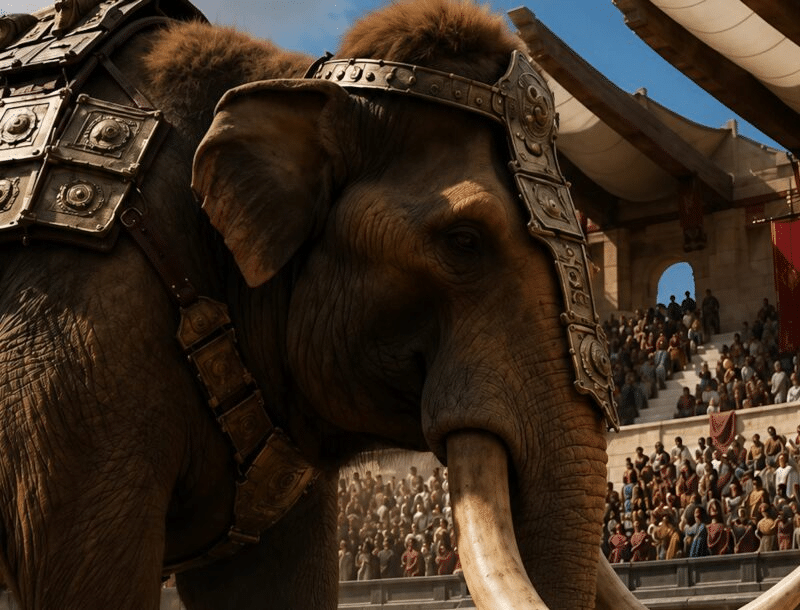
In the center of the arena stood the emperor’s most feared creature: a massive war elephant.
The animal was legendary.
Its body was covered in heavy armor, and metal ornaments hung from its tusks. With every slow step, dust rose from the sand beneath its feet. People whispered that the elephant had been used for years to execute prisoners before cheering crowds. Criminals, rebels, and enemies of the throne had all been forced into the arena, where the enormous animal carried out the emperor’s orders.
High above the sand, the emperor sat on a golden throne.
His face showed no pity. He watched the arena as if every life below him were only part of a performance. The people feared him, and many hated him in silence, but no one dared speak openly against him. In his kingdom, even a small offense could become a public warning.
The emperor believed fear was the best way to rule.
When the trumpets sounded, the crowd grew restless. The heavy gates opened, and soldiers began dragging prisoners onto the sand. One by one, the condemned were pushed forward. Some begged. Some tried to run. Others collapsed before the elephant even reached them.
There was nowhere to escape.
On one side stood the armored elephant. On the other stood soldiers holding spears and swords.
The crowd shouted, gasped, and fell silent again as the punishments continued. After a while, even the horror began to lose its power. People looked away, then looked back. Some whispered. Some ate fruit from small baskets as if nothing unusual was happening.
Then the gates opened once more.
This time, the arena changed.
A small boy was brought out.
He was thin, barefoot, and covered in dust. His clothes were torn, and his face looked pale from hunger. He could not have been more than ten or eleven years old. His hands trembled as two soldiers led him forward, and when one of them shoved him, the child fell onto his knees in the hot sand.
A murmur passed through the stands.
This was not a warrior. This was not a murderer. This was not a dangerous criminal.
This was a hungry child.
The emperor rose slowly from his throne, letting the silence spread before he spoke.
“This boy stole food from my table,” he announced.
The crowd stirred uneasily.
Soon, everyone learned the truth. The boy was an orphan. He had not eaten for days. Driven by hunger, he had slipped into the palace kitchen at night and taken a small piece of bread and meat. The guards caught him before he could escape.
For that, the emperor had sentenced him to d*e.
Some people lowered their eyes. A woman near the front covered her mouth. Even a few soldiers looked uncomfortable.
But the emperor remained cold.
“If I forgive one thief today,” he said, “tomorrow the entire city will steal.”
The boy did not speak. He only knelt in the sand, breathing quickly, his frightened eyes moving from the soldiers to the elephant.
The giant animal began walking toward him.
Its armor rattled. Its feet struck the ground with such force that the sand trembled. Each step made the boy shrink lower, as if he wanted to disappear into the earth.
Several people in the stands turned away. Others whispered that the child should be spared. But no one had the courage to challenge the emperor.
The elephant came closer.
The boy squeezed his eyes shut and began to cry.
Then something happened that no one in the arena expected.
The elephant stopped.
For several seconds, there was complete silence. The animal stood directly in front of the child, towering over him like a moving wall of armor and muscle. The crowd waited for the final command to be obeyed.
But the elephant did not attack.
Instead, it slowly lowered its head.
With surprising gentleness, the animal touched the boy’s shoulder with its trunk, as if trying to comfort him. The child opened his eyes, frozen in fear and confusion. The elephant moved closer, not to crush him, but to shield him.
A wave of shock passed through the arena.
The emperor stood abruptly.
“What is this?” he demanded.
One of the soldiers stepped forward and raised a spear, trying to force the elephant to continue. But before the man could strike, the elephant released a thunderous trumpet that echoed through the stone walls. People jumped from their seats. Birds scattered from the top of the arena.
The soldier stumbled back.
The elephant turned its massive body sideways, placing itself between the boy and the armed men.
No one could believe what they were seeing.
The emperor’s feared execution elephant — the creature that had obeyed every command for years — was refusing to harm a starving child.
The boy trembled beside the elephant’s front legs. The animal stood over him protectively, its trunk lowered, its ears spread, its entire body tense with warning. Every time a soldier moved closer, the elephant stamped the sand so hard that dust rose around them.
The crowd was no longer cheering.
They were silent.
Then, from the upper rows, an old man suddenly cried out.
“I know that child!”
Every head turned toward him.
The old man was shaking. His face had gone pale, and tears filled his eyes as he pointed toward the boy.
“That is the son of the man who saved this elephant,” he said.
The emperor frowned.
The old man continued, his voice trembling but growing stronger.
“Years ago, when the elephant was still a baby, it was found injured near the eastern road. Its mother had been killed, and soldiers wanted to leave it to d*e. But one man cared for it. He cleaned its wounds, fed it, and stayed beside it for weeks until it could stand again.”
The crowd listened in complete silence.
“That man later di*d poor,” the old man said. “His wife di8d soon after. Their son became an orphan. That boy is his child.”
The elephant let out a low rumble, almost like a sound of recognition.
The boy slowly lifted his hand and touched the animal’s trunk. The elephant did not move away. Instead, it leaned closer, as if it remembered a kindness from long ago and understood that the debt had come full circle.
The emperor’s face darkened. He had built his power on fear, but now the entire city was watching an animal show more mercy than their ruler.
That truth could not be hidden.
People began to stand.
First one, then another, then dozens. Murmurs became voices. Voices became a roar.
“Spare the boy!”
“Let him live!”
“He stole because he was hungry!”
The emperor looked over the crowd and realized something dangerous: for the first time, they were no longer afraid enough to stay silent.
The elephant remained unmoved, still protecting the child.
At last, trapped by the eyes of the entire city, the emperor raised his hand.
“Take the boy away,” he said coldly. “He will not d*e today.”
The crowd erupted.
Some cheered. Some wept. Others simply stared at the elephant in awe.
The soldiers approached carefully, but the animal did not let them near until a kind-faced keeper stepped forward and gently took the boy’s hand. Only then did the elephant relax.
The child looked back as he was led away. The elephant reached out once more with its trunk and touched him softly on the shoulder.
That day, the arena had expected another punishment.
Instead, it witnessed a lesson no one would forget.
The emperor wanted the people to believe that justice meant fear. But a starving orphan and an old war elephant showed them something stronger: mercy, memory, and the power of a kindness that survives long after the person who gave it is gone.
In the end, the elephant did not disobey because it was wild.
It disobeyed because it remembered love.


