The first time the soldier saw the snakes, he was digging a trench near the edge of the camp.
The sun was high, the ground was dry, and the work felt endless. Field life had become a cycle of orders, dust, heat, and waiting. Every day looked almost the same. Every night sounded almost the same. In that kind of routine, even the smallest unusual thing could capture a man’s attention.
That was why he noticed them.
Two small snakes slipped out from beneath a cluster of warm stones. They were thin, quick, and uncertain in their movements. Their heads lifted at every vibration. Their tiny bodies curved defensively whenever the soldier shifted his boots in the dirt.
According to camp regulations, he should have reported them immediately.
The rule was simple: any dangerous animal near sleeping quarters or personnel had to be removed at once. The commander had made that clear more than once.
“Danger near the men means action,” he had said. “No hesitation.”
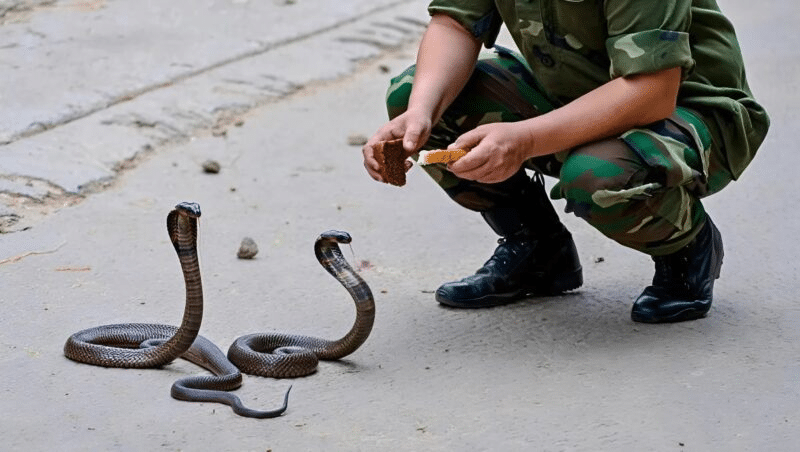
But the young soldier hesitated.
The snakes looked too small to be a threat. They did not rush toward him. They did not disappear either. They seemed almost curious, as if they were studying him as carefully as he studied them.
He told himself it was harmless.
That was his first mistake.
A Secret Distraction From Military Routine
That evening, after the day’s work ended, the soldier returned to the same area near his tent.
He carried a small piece of bread.
He knew snakes did not eat bread like dogs or birds, but he was young, bored, and curious. He tossed it on the ground near the stones and waited.
At first, nothing happened.
Then one of the snakes moved.
It approached slowly, testing the air with its tongue. The second followed. They did not eat the bread, but they came close enough that the soldier felt a strange satisfaction.
The next day, he brought bits of meat.
This time, the reaction was different.
The snakes hesitated, then moved toward the food.
The soldier smiled.
In his mind, it became a private experiment. A small, foolish game in the middle of military boredom. While other men passed time by playing cards, writing letters, checking equipment, or talking about home, he found himself watching the snakes.
He did not tell anyone.
He knew what would happen if he did.
The commander would order the snakes destroyed. The soldier might be punished for ignoring safety rules. And the strange little ritual would end.
So he kept it secret.
The Snakes Began to Return
At first, the snakes remained cautious.
They raised their heads whenever he moved too quickly. They recoiled at loud sounds. They kept their distance, approaching only after he stepped back.
But over the days, their behavior changed.
They appeared more often.
They came closer.
They stopped reacting to him as if he were an immediate threat.
The soldier crouched nearby and tossed food toward them. He watched them move through the dry grass, their bodies growing stronger and more confident. What had started as curiosity became routine.
Almost every day, he returned.
Bread.
Meat.
Scraps from meals.
Anything he could hide and carry away.
He treated them as if they were stray puppies at the edge of camp, forgetting that snakes do not become pets simply because a person feeds them. Wild animals remain wild. Dangerous creatures remain dangerous. Kindness without caution can become a serious liability.
In the world outside the military, people understand risk through insurance policies, emergency savings, safety plans, and personal responsibility. In the field, risk is even more immediate. A careless decision does not just affect one person. It can affect an entire unit.
The soldier did not understand that yet.
More Snakes Appeared
After the first week, the soldier noticed the two snakes seemed larger.
Their movements were smoother. Their bodies looked stronger. They no longer hid immediately when he approached.
Then, after the second week, he saw another snake nearby.
Then two more.
He told himself it was a coincidence. Maybe there was a nest in the area. Maybe he was simply noticing them more because he had become interested. Maybe the heat had drawn them closer to the stones.
Deep down, however, he knew the truth.
Food attracts life.
And danger rarely stays small when it is fed.
Still, he continued for a little longer.
Part of him enjoyed the secret. Part of him liked feeling that he had created a strange bond with creatures everyone else feared. Part of him believed he had control over the situation.
That belief ended one morning.
The Morning He Saw the Tracks
At dawn, the soldier stepped out of his tent and froze.
The sand around the entrance was covered in tracks.
Not one or two.
Dozens.
Thin, winding marks crossed over one another in every direction, leading from the grass, around the tent, toward the supply area, and back again.
His mouth went dry.
He had been feeding two snakes.
But far more were coming.
For the first time, real fear replaced curiosity. He imagined what would happen if another soldier stepped out barefoot or half-asleep. He imagined someone being bitten. He imagined the commander discovering the truth and demanding to know why he had ignored orders for weeks.
What had seemed like a harmless game had become a threat.
He had created the problem himself.
That night, he decided he had to fix it before anyone found out.
The Decision That Took Him Away From Camp
The soldier gathered what he thought he needed.
He waited until the camp quieted.
Then he slipped away, took a vehicle, and drove toward the area where he had often seen the snakes moving through the grass. He intended to remove them, scare them away, or somehow undo the dangerous situation he had caused.
It was a reckless decision.
Leaving his post without permission was serious. Taking a vehicle made it worse. But fear had clouded his judgment. He was no longer thinking like a soldier. He was thinking like a young man trying to hide a mistake before it destroyed him.
The night was dark and silent.
He spent hours away from camp.
By the time dawn approached, he was exhausted, anxious, and covered in dust.
He returned expecting anger, questions, and punishment.
Instead, he found silence.
The Camp Was Too Quiet
At first, he thought the unit was still asleep.
But something felt wrong.
There were no voices.
No footsteps.
No clatter from the kitchen area.
No low morning conversations.
No one calling orders.
The soldier climbed from the vehicle and walked toward the tents. The silence pressed against him harder with every step.
Then he saw the first sign of struggle.
His heart began to pound.
He rushed forward.
Inside the camp, the sight before him nearly broke him.
During the night, while he had been away dealing with the snakes, the unit had been attacked. It had happened quickly, quietly, and brutally. His fellow soldiers had been caught by surprise.
The tent where he should have been sleeping was part of the destruction.
He should have been there.
He should have died with them.
Instead, he had survived because of the very mistake he had tried to hide.
The snakes had drawn him away.
A Life Saved by a Dangerous Mistake
The realization did not bring relief.
It brought horror.
The soldier stood there, unable to understand how something so foolish had led to his survival. He had ignored orders. He had fed dangerous animals. He had created a risk near his own unit. Then, while trying to cover it up, he had accidentally avoided the attack that killed the men around him.
He had not been brave.
He had not been clever.
He had not planned an escape.
He had simply been absent for the wrong reason at the right time.
That truth haunted him more than anything.
When the attack was discovered, questions came immediately.
Where had he been?
Why had he left camp?
Why was he alive when so many others were not?
Investigators examined every detail. They questioned him for hours. They searched for connections between him and the attackers. They looked at his movements, his decisions, and his unexplained absence.
He told the truth about the snakes.
It sounded absurd.
It sounded suspicious.
But no evidence proved he had betrayed anyone.
Still, suspicion has a way of staying even when guilt cannot be proven.
The Consequences That Followed
The soldier was eventually cleared of direct involvement, but the shadow never fully lifted.
Some believed him.
Others did not.
To the families of the fallen, his survival was painful to understand. To his superiors, his actions were reckless enough to end his military career. He had left his post without authorization. He had ignored safety regulations. He had created a dangerous situation near the camp.
Even though the snakes had unintentionally saved his life, they also exposed the consequences of his poor judgment.
He was discharged and left the army forever.
Outside the military, he struggled with the weight of what had happened. Survival can feel like a gift, but it can also feel like a burden when others do not return. He replayed every choice in his mind: the first piece of bread, the hidden scraps of meat, the tracks outside the tent, the decision to leave.
He never forgot the men who died that night.
And he never forgot the snakes.
A Story About Risk, Consequences, and Fate
This story is not simply about a soldier and a group of snakes.
It is about how small decisions can grow into life-changing consequences. A moment of curiosity became a habit. A habit became a risk. A risk became a secret. And that secret led the soldier away from camp on the one night he otherwise would have been killed.
Life can turn on choices that seem insignificant at the time.
People often build safety around rules, insurance, financial planning, emergency procedures, and strict systems because risk is easier to prevent than repair. In the military, rules exist for the same reason. They are not just paperwork or discipline. They are meant to protect lives.
The soldier ignored that.
And yet, by a strange turn of fate, the very mistake that could have endangered others became the reason he survived.
That truth followed him for the rest of his life.
Some called it luck.
Some called it punishment.
Some called it a miracle.
He called it a lesson he would never escape.


