Most people have wondered about this at least once.
You walk into a public restroom, step into a stall, close the door, and immediately notice the large gap at the bottom. The door does not reach the floor, and sometimes the open space feels a little strange.
At first, it may seem like a privacy issue.
Some people assume it is only about saving money. Others think it is simply poor design. But the truth is that public restroom stall doors are built this way for several practical reasons.
The shorter design helps with cleaning, ventilation, safety, maintenance, and even restroom traffic flow.
While it may not offer the same level of privacy as a full door at home, the design serves important purposes in busy public spaces such as malls, airports, schools, offices, restaurants, stadiums, and transportation centers.
Easier and faster cleaning
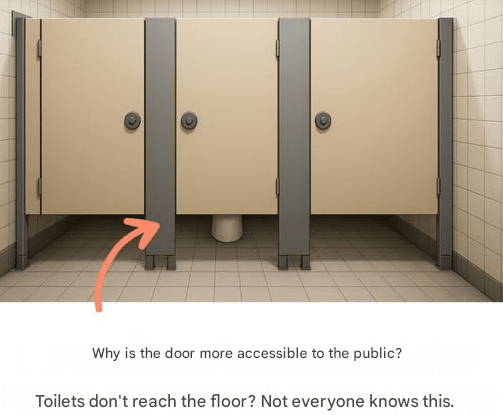
Public restrooms need frequent cleaning.
In high-traffic places, cleaning staff may need to mop floors, remove trash, disinfect surfaces, and check stalls many times a day. If every stall door reached the floor, cleaning would take longer and require more effort.
The gap under the door allows workers to mop underneath without unlocking and opening every stall individually. It also helps cleaning machines reach more of the floor surface quickly.
This matters in large facilities where restroom cleanliness affects customer experience, workplace standards, health inspections, business reputation, and even liability or insurance concerns.
A restroom that can be cleaned efficiently is easier to maintain throughout the day.
The design may look odd, but it helps keep public spaces more sanitary.
Better ventilation and odor control
Public restroom stalls are small enclosed spaces.
Without airflow, odors can become trapped quickly. The gap under the stall door allows air to circulate more freely, which helps reduce unpleasant smells and keeps the restroom from feeling overly closed in.
Ventilation does not solve every odor problem, of course. Good plumbing, regular cleaning, working exhaust fans, and proper maintenance are still essential. But stall gaps help air move more naturally through the room.
This is especially useful in busy restrooms where many people use the facilities one after another.
A full-length door would make each stall more private, but it could also make odors linger longer.
Safety during emergencies
One of the most important reasons public restroom doors do not reach the floor is safety.
If someone becomes ill, faints, falls, or experiences a medical emergency inside a stall, the gap makes it easier for others to notice that something is wrong.
For example, if a person is unconscious on the floor, someone outside may be able to see them or realize the stall has been occupied for an unusually long time. Emergency responders or staff can then act faster.
The gap may also allow someone to unlock the door from below or provide access in urgent situations.
In a public place, safety often has to be balanced with privacy. A completely sealed stall may feel more comfortable, but it can delay help if a person inside needs assistance.
Helps prevent misuse and vandalism
Public restrooms are used by many people, and not everyone treats them respectfully.
Shorter stall doors can discourage certain unwanted behavior because they reduce the feeling of complete isolation. People are less likely to vandalize, misuse the space, sleep inside, damage fixtures, or spend excessive time in the stall if they know the space is not fully hidden from the outside.
This does not mean people are being watched directly.
The purpose is not to invade privacy.
Instead, the design creates just enough visibility to help staff notice problems and maintain order in a shared public facility.
In places with heavy foot traffic, this small design feature can make restrooms safer, cleaner, and easier to manage.
Faster stall turnover
In busy public restrooms, long lines are common.
Airports, shopping centers, schools, event venues, and office buildings all need stalls to be used efficiently. The gap at the bottom helps people see whether a stall is occupied without awkwardly pulling on the handle or knocking repeatedly.
A quick glance at the floor area can often show whether someone is inside.
This reduces confusion and helps restroom lines move faster.
It also avoids those uncomfortable moments when someone tries to open a stall door that is already occupied.
While the design may reduce privacy slightly, it improves convenience in high-traffic spaces.
Lower installation and repair costs
Cost is also part of the reason.
Public restroom partitions must be installed, repaired, cleaned, and replaced over time. Doors that do not reach the floor require less material, which reduces manufacturing and installation costs.
They are also easier to fit.
Floors in public buildings are not always perfectly level. A full-length door would need more precise installation to avoid scraping against tile, sticking, or leaving uneven gaps. Shorter doors are easier to install across many types of flooring.
They also reduce damage from water, cleaning chemicals, and daily wear near the bottom edge.
For property owners, contractors, real estate managers, and facility maintenance teams, these savings matter. A public restroom must be durable, affordable to maintain, and easy to repair.
Less water damage
Public restroom floors are cleaned often and sometimes become wet from spills, mopping, leaks, or heavy use.
If stall doors reached all the way to the floor, the bottom edges would be exposed to more moisture. Over time, this could cause swelling, rust, staining, warping, or deterioration depending on the material.
Keeping the door raised helps protect it from constant contact with water and cleaning products.
This makes the partitions last longer and reduces maintenance costs.
In large commercial buildings, even small design choices can save money over years of use.
Easier communication in unusual situations
The gap can also help in minor but practical situations.
If someone runs out of toilet paper, drops something, or needs assistance, it is easier to communicate with someone outside the stall. In family settings, a parent may be able to help a child more quickly. In public buildings, staff can check whether a locked stall is empty or occupied if there is a problem.
Again, the design is not perfect from a privacy perspective.
But it does make public restrooms more manageable in real-world situations.
Why home bathrooms are different
At home, bathroom doors usually reach much closer to the floor because the needs are different.
A home bathroom is private. It is used by a small number of people. It does not need constant public cleaning, rapid turnover, or the same level of emergency visibility.
Public restrooms serve a completely different purpose.
They must handle many users, frequent cleaning, heavy wear, safety concerns, and quick maintenance. That is why the design looks less private but works better for public use.
The difference is not accidental.
It is functional.
Final thoughts
Public restroom doors do not reach the floor for several practical reasons.
The gap makes cleaning easier, improves airflow, helps with odor control, allows faster emergency response, discourages misuse, reduces maintenance costs, and makes it easier to see whether a stall is occupied.
While the design may feel unusual or slightly uncomfortable, it is not random.
It is a compromise between privacy, safety, hygiene, cost, and efficiency.
So the next time you notice the space under a public restroom stall door, remember that it is not just a strange design choice. It is a practical feature built for busy places where restrooms need to stay clean, safe, and functional for everyone.


