Some singers sound like they are reaching for every note.
Patsy Cline made it sound as if the music simply flowed through her.
Released in 1957, “Walkin’ After Midnight” became the song that introduced Patsy Cline to a national audience and changed the direction of her career forever. The recording is just over two minutes long, but it carries the kind of emotional clarity that can define a lifetime of music.
There is no strain in her voice.
No pressure.
No hard edges.
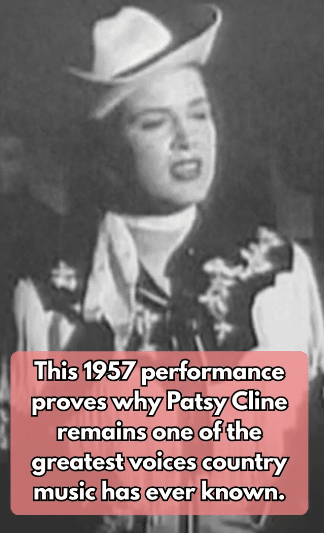
Instead, Cline sings with a natural ease that feels almost effortless. Her voice is smooth, controlled, and full of feeling, turning a simple song about loneliness into one of the most memorable country-pop recordings of the 1950s.
More than six decades later, “Walkin’ After Midnight” still feels fresh because its emotion is honest and its performance is timeless.
Before the world knew her name
Patsy Cline was born Virginia Patterson Hensley in Winchester, Virginia.
Long before she became one of the most beloved voices in American music, she was a young woman with a powerful gift and a deep determination to be heard. Raised in a working-class family, she began performing as a teenager and built her reputation through local shows, radio appearances, and regional performances.
Her rise was not instant.
She worked hard for years before her breakthrough came. She sang wherever she could, often balancing ambition with personal responsibilities and the practical challenges of trying to build a career in music.
What made her stand out was not only the beauty of her voice, but the emotion she carried inside it.
Even early in her career, Patsy Cline could make a lyric feel lived-in. She had a way of blending strength and vulnerability that made listeners believe her. That rare quality would become the foundation of her legacy.
The song she almost did not want to sing
“Walkin’ After Midnight” was written by Alan Block and Don Hecht.
At first, Patsy Cline reportedly did not think the song suited her. She was not immediately convinced it was the right material for her voice or style. But after encouragement from people around her, she agreed to perform it on Arthur Godfrey’s Talent Scouts in January 1957.
That decision changed everything.
Her televised performance captured the audience instantly. She delivered the song with confidence, charm, and emotional control. Viewers responded, and the performance helped push her into the national spotlight.
Sometimes a career turns on one moment.
For Patsy Cline, this was one of those moments.
The song she had hesitated to sing became the song that opened the door to everything that followed.
A perfect blend of country and pop
One of the reasons “Walkin’ After Midnight” became so important is that it did not fit neatly into only one category.
It had country roots, but it also had a smooth pop appeal. The melody was accessible, the production was polished, and Cline’s voice had a sophistication that could reach audiences beyond traditional country radio.
This was especially important in the 1950s, when country music was still often seen as regional by mainstream listeners.
“Walkin’ After Midnight” helped prove that country music could cross over without losing its emotional identity.
The song reached No. 2 on the country chart and No. 12 on the Billboard pop chart, a major achievement for a female country artist at the time. Its success helped position Patsy Cline as one of the early artists capable of connecting Nashville storytelling with a broader national audience.
That crossover appeal would later become a major part of country music’s growth.
Owen Bradley’s production gave it polish
The recording was shaped by producer Owen Bradley, who would become one of the key architects of the Nashville Sound.
Bradley understood how to frame Patsy Cline’s voice without overpowering it. The arrangement of “Walkin’ After Midnight” includes country elements such as steel guitar, but it also has a smoothness that made it appealing to pop listeners.
The production is elegant and uncluttered.
It creates atmosphere without becoming heavy.
Most importantly, it leaves space for Cline’s voice to lead.
That is where the magic happens.
She does not force the emotion. She lets it unfold naturally. Her phrasing is relaxed but precise, and every line carries a sense of yearning. The song is about wandering alone at night, searching for someone who is no longer there, and Cline makes that loneliness feel real without ever turning it into melodrama.
Why her voice still feels so effortless
Patsy Cline’s vocal style is one of the main reasons “Walkin’ After Midnight” remains so admired.
Her voice has power, but she never seems to push too hard. She can sound tender without becoming weak and strong without becoming harsh. That balance is incredibly difficult to achieve.
In this song, she sings with a calm confidence that makes the performance feel natural.
There is no need for vocal acrobatics.
No unnecessary drama.
No attempt to impress through volume alone.
Instead, she gives the song exactly what it needs: warmth, ache, and restraint.
That is why listeners still describe her voice as effortless. It feels as if the song belongs to her completely, as though she is not performing it so much as breathing it into existence.
A lonely story told with grace
The lyrics of “Walkin’ After Midnight” are simple.
The narrator walks alone late at night, thinking about someone she misses. She is restless, searching, and unable to let go.
That kind of loneliness is universal.
Many people know what it feels like to be awake when the world is quiet, replaying memories, wondering where someone is, or wishing life had turned out differently.
Cline captures that feeling beautifully.
She does not make the sadness sound desperate. She makes it sound familiar. That is why the song connects so deeply. It gives listeners a place to put their own loneliness.
The best country songs often do that.
They take ordinary emotions and make them unforgettable.
A breakthrough that shaped her future
After “Walkin’ After Midnight,” Patsy Cline’s career changed dramatically.
She gained national recognition, appeared on major programs, and became a more visible presence in country and pop music. Although her early record contract limited some of her creative freedom, the success of the song made it clear that audiences wanted more from her.
It was the beginning of a career that would later include classics such as “Crazy,” “I Fall to Pieces,” and “She’s Got You.”
But “Walkin’ After Midnight” was the spark.
It was the song that told the world who Patsy Cline was.
A voice of elegance.
A voice of heartbreak.
A voice that could bring country emotion to mainstream listeners without losing its soul.
The song’s lasting influence
“Walkin’ After Midnight” helped shape the future of country-pop music.
It showed that country songs could be polished, stylish, and emotionally rich while still staying true to their roots. That opened doors for future artists who wanted to reach wider audiences.
Singers such as Brenda Lee, Linda Ronstadt, and many others would later build careers that blended country, pop, and emotional storytelling.
Patsy Cline helped make that path possible.
The song has also been covered by many artists over the years, but the original remains the definitive version. Others can sing the notes, but few can match the particular balance of grace and ache that Cline brought to it.
Her recording feels timeless because it is not trapped by trend.
It is built on melody, feeling, and voice.
Why it still matters today
More than 65 years after its release, “Walkin’ After Midnight” remains one of Patsy Cline’s signature recordings.
It continues to appear on classic country playlists, oldies radio, music history collections, and lists of essential country songs. Younger listeners still discover it because great performances do not expire.
In today’s music world, where streaming numbers, touring revenue, digital promotion, music licensing, and entertainment business trends often dominate conversation, a song like this reminds us of something simple:
A truly great voice can outlast everything.
The technology may change.
The charts may change.
The industry may change.
But the feeling remains.
Final thoughts
Released in 1957, “Walkin’ After Midnight” proved that Patsy Cline was a once-in-a-generation voice.
Her performance has no strain, no forced emotion, and no harsh edges. The music seems to flow from her with natural elegance, turning a short song into a lasting piece of American music history.
It introduced her to the world.
It helped bridge country and pop.
It showed how loneliness could be sung with grace.
And it remains one of the clearest examples of why Patsy Cline’s voice is still loved today.
More than six decades later, the song still walks with us — quiet, haunting, and unforgettable.


