Las Vegas is known around the world as a city of lights, luxury, entertainment, and escape. Every year, millions of visitors arrive to walk the Strip, watch famous shows, gamble in massive casinos, dine in celebrity restaurants, and take photos beneath glowing neon signs.
Above ground, the city sells a powerful image: excitement, wealth, reinvention, and endless possibility.
But beneath that glittering surface, there is another Las Vegas — one most tourists never see.
Just below the casinos, hotels, sidewalks, and crowded streets lies a vast network of flood-control tunnels. These concrete channels were built to protect the city from dangerous flash floods, especially during sudden desert storms. Over time, however, they became more than infrastructure.
For hundreds of unhoused people, the tunnels became shelter.
This hidden community is often referred to as the “tunnel people” of Las Vegas — men and women living in darkness only feet below one of the brightest and most visited cities on Earth.
More than 200 miles of tunnels beneath the city
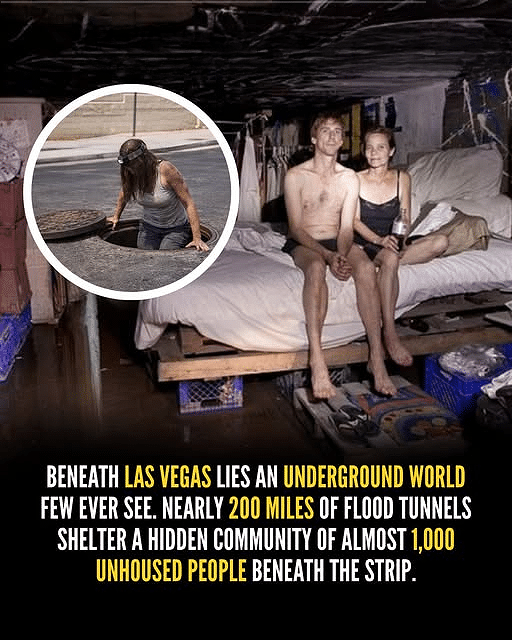
The tunnels beneath Las Vegas stretch for more than 200 miles. Their original purpose was practical and urgent: to move fast-rising stormwater away from streets, homes, hotels, and businesses.
In the desert, rain can be deceptive. A storm may seem brief or distant, but flash floods can form quickly and move with deadly force. Water from surrounding areas can rush into the city’s drainage system and travel through the tunnels with little warning.
These passageways were never meant for people to live in.
They have no proper plumbing, no safe electrical system, no natural light, no bathrooms, no heating, and no real protection from floodwater. Yet for many unhoused individuals, they offer something that can be hard to find above ground: privacy, a sense of stability, and a temporary place to belong.
Inside the tunnels, residents have built makeshift living spaces from whatever they can find. Discarded furniture becomes a bed. Cardboard and blankets become walls. Donated clothing, tarps, mattresses, crates, and storage bins help create small areas that feel, in some fragile way, like home.
Some people run extension cords from nearby outlets. Others rely on flashlights, candles, or battery-powered lamps. Personal belongings are stacked carefully on shelves or lifted off the ground in case water begins to rise.
It is not comfort.
It is survival.
Why some people choose the tunnels
To someone who has never experienced homelessness, living underground may seem impossible to understand. But many tunnel residents describe the streets above as dangerous in a different way.
Las Vegas can be brutally hot. Summer temperatures can climb past 110 degrees, making sidewalks, pavement, and exposed areas dangerous for anyone without shelter. Heat exhaustion and dehydration are constant threats.
There are also police sweeps, theft, violence, harassment, and the daily uncertainty of not knowing where it is safe to sleep.
For people living without stable housing, visibility can make them vulnerable. Being seen can mean being moved along, having belongings taken, or becoming a target.
Underground, there is danger — but also distance from the chaos above.
In the tunnels, residents may find neighbors who understand their struggle. People share food, watch one another’s belongings, pass along warnings, and help newcomers learn where it is safer to sleep. Some have lived there for years, forming relationships and routines in a place most of the city ignores.
This does not make tunnel life safe. But it helps explain why some people return even after being warned to leave.
When life above ground feels impossible, the danger below can begin to feel like a risk worth taking.
The deadly threat of flash floods
The greatest danger in the tunnels is water.
Because the tunnels were designed for flood control, a dry passageway can become a rushing river in minutes. Rain does not even have to fall directly overhead. A storm miles away can send water racing through the system without warning.
Residents have described hearing the roar before seeing the flood. By then, there may be only moments to escape.
The water can carry debris, mud, trash, and dangerous force. Makeshift homes can be destroyed instantly. Mattresses, clothing, documents, medicine, and personal possessions can vanish in seconds. In the worst cases, people have been swept away and lives have been lost.
That reality makes the tunnel community one of the most heartbreaking symbols of homelessness in America. The tunnels offer shelter from one kind of danger while exposing people to another.
No one should have to choose between sleeping in extreme heat, facing violence on the street, or living inside a flood channel that could become deadly during a storm.
A hidden crisis beneath a city of excess
The contrast is difficult to ignore.
Above ground, Las Vegas is built on spectacle. Casinos glow all night. Luxury suites sell for thousands of dollars. Tourists spend freely on entertainment, drinks, shopping, and high-end experiences. The city’s identity depends on fantasy and abundance.
Below ground, people sleep on concrete.
This hidden world raises an uncomfortable question: how can so many people become invisible in a city designed to attract attention?
The tunnel people are not part of the Las Vegas image shown in travel ads. They are not included in the polished story of luxury resorts and unforgettable vacations. Yet they are part of the city’s reality.
Their lives reveal the deep divide between wealth and poverty, appearance and truth, entertainment and survival.
Homelessness is not only a housing issue. It is connected to mental health care, addiction recovery, employment, medical debt, family breakdown, domestic violence, rising rent, limited affordable housing, and gaps in social support. For many people, one crisis can lead to another until returning to stable housing becomes extremely difficult.
Just as families carefully manage banking, insurance, loans, real estate decisions, and personal finance to protect their futures, people without housing often live without any safety net at all. One missed paycheck, one medical emergency, one eviction, or one untreated illness can push a person into survival mode.
For some in Las Vegas, survival has led underground.
Outreach workers are trying to help
Over the years, journalists, photographers, documentary creators, and outreach workers have helped bring attention to the people living beneath Las Vegas.
Local organizations and volunteers have worked to deliver supplies, offer medical care, connect residents with services, and help people transition into housing when possible. These efforts matter, but the need is much larger than the available resources.
Leaving the tunnels is not always simple.
Some residents may distrust institutions because of past trauma. Others may struggle with addiction, mental illness, lack of identification documents, criminal records, or long waiting lists for housing support. Some shelters may be full, restrictive, unsafe-feeling, or unable to meet specific needs.
That is why real solutions require more than temporary supplies. People need safe housing options, long-term support, mental health care, addiction treatment, job assistance, and compassionate outreach that treats them as human beings rather than problems to be moved out of sight.
The story Las Vegas cannot hide forever
The tunnel people of Las Vegas remind us that every city has shadows, even the brightest one.
Their existence challenges the idea that prosperity is visible everywhere just because the skyline glows. It forces a deeper look at what society chooses to notice and what it chooses to ignore.
Las Vegas is not only the casinos, the shows, the fountains, the hotels, or the bright lights. It is also the people living beneath those lights, trying to survive in spaces never meant to become homes.
Their story is not just about poverty. It is about resilience, neglect, danger, and the human need for dignity.
Perhaps the real story of Las Vegas is not found only in jackpot wins or luxury suites. Perhaps it is also found in the dark concrete tunnels beneath the Strip, where people build fragile shelters, protect one another, and keep going even when the world above refuses to look down.
In a city built on illusion, the tunnel people are a hard truth.
And real compassion may begin when we stop staring only at what shines and start paying attention to who has been left in the shadows.


