Public parks are often full of small details that many visitors overlook. A new walking trail, a renovated playground, fresh landscaping, or a modern seating area can all signal that a community is investing in its outdoor spaces. But sometimes, a new addition raises more questions than answers.
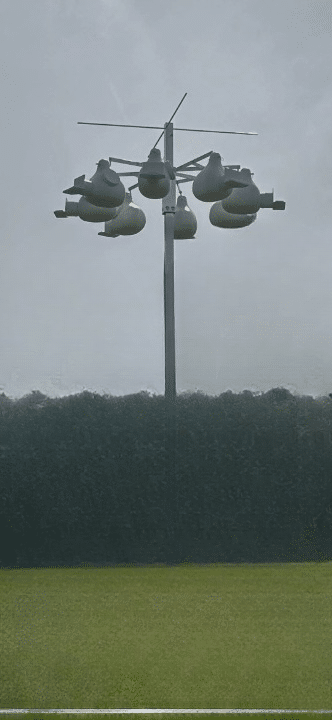
That was the case for one curious park visitor who noticed a tall pole standing in a wide-open field. At the top were several white, pod-like structures clustered together. From a distance, the installation looked almost like weather equipment, a security camera system, or some kind of public utility device. There were no visible camera lenses, no obvious wires, and no sign explaining what it was.
The answer is both simple and fascinating.
Those tall white pods are most likely nesting houses for purple martins, a remarkable migratory bird species that has developed a long and unusual relationship with humans. While the structure may look mysterious at first, it serves an important purpose in wildlife conservation, helping these birds find safe places to nest and raise their young.
Meet the Purple Martin
Purple martins are the largest members of the swallow family in North America. They are admired for their fast, graceful flight and their ability to catch insects while soaring through the air.
Adult male purple martins are especially striking. Their feathers often appear dark and glossy, with deep blue or purple tones that shine in the sunlight. Females and younger birds tend to have lighter coloring, but they share the same sleek body shape and quick movements.
These birds are also impressive travelers. Purple martins migrate thousands of miles each year between their breeding areas in North America and their wintering grounds in South America. Even after such a long journey, many return to the same nesting locations year after year.
That loyalty to nesting sites is one reason these white pod structures are so important. Once purple martins discover a safe and successful nesting location, the same colony may continue using it for many seasons.
Why Do They Need Special Houses?
Unlike many birds that build nests in trees, bushes, or on building ledges, purple martins prefer enclosed nesting cavities. In the past, they used natural openings such as hollow trees. But as landscapes changed and older trees became less common in many areas, natural nesting sites became harder to find.
Over time, purple martins adapted to using nesting structures provided by people.
Today, in many parts of North America, purple martins rely heavily on human-maintained housing. These structures give them a protected place to nest, lay eggs, and raise chicks during the breeding season.
This is why parks, nature centers, and conservation groups often install tall martin houses in open areas. The goal is not decoration. It is a practical effort to support local wildlife and improve biodiversity.
Why Are the Pods White and Shaped Like Gourds?
The pod-like shape is not random. Many purple martin houses are designed to resemble gourds, which have been used as birdhouses for centuries.
Historical accounts suggest that Indigenous communities once hung hollowed gourds to attract purple martins near their settlements. Later, settlers adopted similar practices. Over time, simple natural gourds evolved into modern nesting systems made from durable materials.
The rounded shape gives nesting birds enough space inside while keeping the entrance relatively small. This helps create a protected nesting area. The light color also helps reflect heat, which can keep the interior more comfortable during warm weather.
Modern gourd-style houses are usually built to withstand rain, sun, and wind. Many are designed for easy cleaning and inspection, which helps caretakers maintain healthier nesting conditions for the birds.
Why Are They So Tall?
The height of the pole is one of the biggest clues that the structure is meant for nesting birds rather than cameras or weather monitoring.
Purple martin houses are often placed high above the ground to help protect nests from predators. Animals such as raccoons, snakes, and other climbers may try to reach bird eggs or chicks. By mounting the homes on tall poles, caretakers make it more difficult for predators to access the nests.
Many installations also include predator guards near the bottom of the pole. These guards create a barrier that makes climbing even harder.
The open field location is also intentional. Purple martins prefer open areas where they can easily fly in and out of their nesting houses. Parks, meadows, athletic fields, and open waterfront areas can all provide the kind of space these birds need.
Purple Martins Are Social Birds
Another reason the structure includes multiple pods is that purple martins are highly social.
They often nest in colonies, meaning several bird families live close together. Each pod or compartment acts as a separate nesting space for one pair of birds, while the overall structure supports a larger colony.
This communal setup allows the birds to remain near one another while still maintaining individual nesting areas.
For park visitors, this can create an enjoyable wildlife-watching opportunity. During the active season, purple martins may be seen swooping through the air, calling to each other, and returning to their nesting compartments throughout the day.
Natural Insect Control, But Not a Miracle Solution
Purple martins are known for eating flying insects. They catch their food while in flight, making quick turns and dives as they hunt.
Because of this, many people appreciate them as part of a natural insect-control system. However, it is important not to exaggerate their impact. While they do eat many flying insects, they do not eliminate mosquitoes or replace professional pest management.
Instead, they contribute to a balanced ecosystem. Their presence supports biodiversity, adds movement and life to open spaces, and gives people a chance to observe nature more closely.
Why Parks Invest in These Projects
Installing purple martin housing is often part of a larger conservation strategy. County parks and local governments may use public funding, grants, or community partnerships to improve wildlife habitats while making green spaces more educational and enjoyable.
These projects can be a smart community investment. Healthy parks often improve quality of life, support outdoor recreation, and may even contribute to nearby real estate appeal by making neighborhoods feel more connected to nature.
Like any public improvement, these installations also require responsible planning. Park managers may consider maintenance costs, liability insurance, long-term care, and environmental benefits before adding wildlife structures to public land.
In other words, those white pods are not just random objects in a field. They are part of a thoughtful effort to protect wildlife while improving the value of shared outdoor spaces.
Hidden Features Visitors May Not Notice
Many purple martin houses include maintenance features that are not obvious from the ground.
Some poles have pulley systems or telescoping designs that allow caretakers to lower the houses safely. This makes it possible to clean compartments, check nesting activity, remove old nesting material, and inspect the structure for damage.
Regular maintenance matters. Without it, old nests, pests, or structural problems could make the housing less safe for the birds.
That behind-the-scenes care is one reason successful colonies can return to the same location year after year.
A Small Structure With a Big Purpose
At first glance, a tall pole topped with white pods may look strange, especially in a newly renovated park. It is easy to mistake it for surveillance equipment, weather tools, or a modern art piece.
But the real purpose is much more meaningful.
These structures are homes for purple martins, one of North America’s most fascinating migratory birds. They provide safe nesting spaces, support breeding success, and continue a centuries-old connection between people and wildlife.
The next time you see one of these tall white pod structures in a park, you will know it is not watching you, measuring the weather, or serving as decoration.
It is helping a remarkable bird species thrive—one nest at a time.


