The lights stay on 24 hours a day, filling concrete corridors and crowded cells with a constant fluorescent glow. There are no dark corners, no real privacy, and no moment when surveillance appears to stop.
This is life inside CECOT, El Salvador’s massive high-security prison built as part of the country’s aggressive crackdown on gang violence.
A Prison Built for Maximum Control
CECOT, officially known as the Terrorism Confinement Center, was designed to hold tens of thousands of inmates accused of links to powerful criminal gangs.
The facility has become a global symbol of strict law enforcement. Supporters see it as a bold answer to years of violence and extortion. Critics argue that its harsh conditions raise serious human rights concerns.
Inside the prison, comfort is not the priority. Control is.
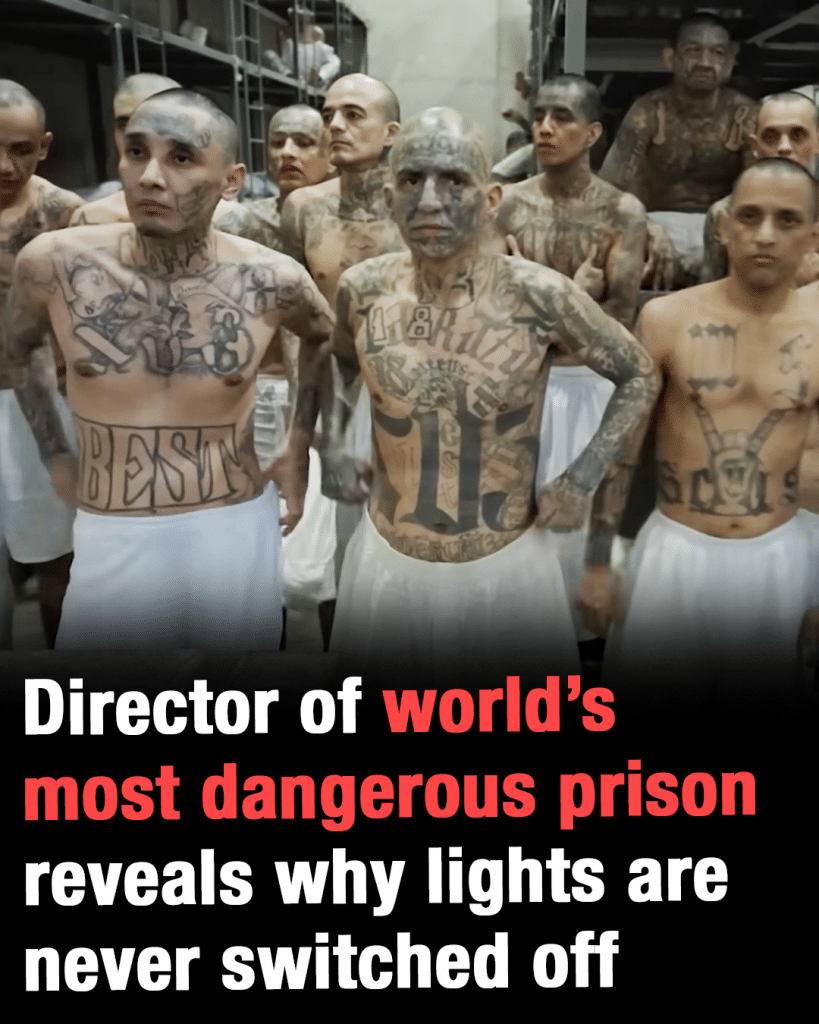
Inmates sleep on metal bunks, follow strict routines, and live under constant supervision. Access to entertainment, personal communication, books, television, and electronic devices is extremely limited or unavailable.
Every part of the prison is designed to prevent coordination, reduce violence, and keep inmates separated from the outside world.
Why the Lights Stay On All Day and Night
One of the most striking details about the prison is the lighting.
The lights reportedly remain on around the clock. Prison officials say this helps guards monitor inmates, prevent hidden activity, and reduce opportunities for violence or escape planning.
With constant light, every movement is easier to see.
But for prisoners, the experience can be mentally exhausting. Human beings are used to the natural rhythm of day and night. Without darkness, sleep can become difficult, and time may begin to feel distorted.
What most people take for granted every night — darkness, quiet, and privacy — is largely absent inside CECOT.
Life Under Constant Surveillance
Daily life inside the facility follows a rigid structure.
Prisoners are counted regularly, watched closely, and expected to follow strict rules. Most of their time is spent in controlled areas with little personal freedom.
Security systems monitor movement throughout the complex. Reinforced walls, barriers, and technology are used to limit communication and prevent escape.
For authorities, this environment represents order.
For inmates, it means living under nonstop observation.
The Debate Around El Salvador’s Crackdown
El Salvador’s government has argued that extreme measures were needed after years of gang violence that affected families, businesses, and entire communities.
Many citizens support the crackdown, saying it has made neighborhoods safer and reduced fear in daily life.
However, human rights groups have raised concerns about mass incarceration, due process, prison conditions, and the long-term psychological effects of such restrictive environments.
This debate remains deeply divided.
Some see CECOT as proof that strong action can restore public safety. Others see it as a warning about what can happen when security is placed above individual rights.
A Question With No Easy Answer
The image of inmates living under lights that never turn off is powerful because it represents more than prison design.
It reflects a larger question facing many societies:
How far should a government go to protect public safety?
For some, harsh prison conditions are a necessary response to violent crime. For others, they raise ethical concerns about punishment, dignity, and rehabilitation.
Inside CECOT, that debate is not theoretical. It is part of daily life.
Thousands of inmates live in a world where night barely exists, privacy is almost gone, and every hour is controlled by the system around them.
Final Thoughts
El Salvador’s mega-prison remains one of the most debated correctional facilities in the world.
To supporters, it is a powerful symbol of security and order. To critics, it raises urgent questions about human rights and the cost of extreme punishment.
But one detail continues to shock people everywhere: inside CECOT, the lights never go out.
And that constant brightness reveals a darker question — what price is society willing to pay for safety?