For decades, the Mariana Trench seemed like one of the last places on Earth that humanity could not reach.
Hidden in the western Pacific Ocean, its deepest known point, Challenger Deep, lies nearly 10,935 meters, or about 35,876 feet, below the ocean surface, according to NOAA. That depth is greater than Mount Everest is tall. It is a world of total darkness, near-freezing water, and crushing pressure—an environment so extreme that it feels almost separate from the rest of the planet.
But one discovery changed the way many people think about even the most remote parts of Earth.
A plastic bag was documented in the Mariana Trench at a depth of 10,898 meters, making it one of the deepest recorded pieces of plastic debris in the ocean. UNEP-WCMC reported that this single-use plastic item reached the world’s deepest ocean trench, showing a direct connection between daily human activity and one of the most isolated environments on Earth.
It was not a shipwreck.
It was not a scientific instrument.
It was not a natural object.
It was an ordinary plastic bag—the kind designed to be used briefly and thrown away.
A Small Object With a Huge Message
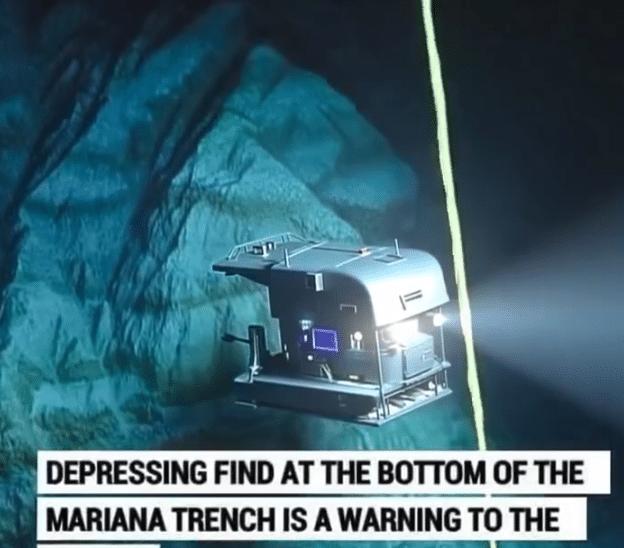
The image is unsettling because the object itself is so familiar.
A plastic bag is not rare. It is not dramatic. It is one of the most ordinary symbols of modern convenience. People use them to carry groceries, food, clothing, and household items. Many are handled for only minutes before being discarded.
Yet one of those bags ended up nearly seven miles beneath the sea.
That journey tells a larger story about plastic pollution. Waste does not disappear after it leaves our hands. It moves through drains, rivers, stormwater systems, coastlines, currents, and eventually into the open ocean. Some plastic floats for years. Some breaks into fragments. Some becomes heavy with algae and microorganisms and sinks.
Eventually, some of it reaches places humans may never personally see.
The Mariana Trench plastic bag is powerful because it forces people to confront a simple truth: there is no real “away” when we throw something away.
The Deep Ocean Is Not Empty
The Mariana Trench may sound lifeless because it is so dark and extreme, but it is not empty.
Deep-sea ecosystems are home to specialized life forms adapted to pressure, darkness, low temperatures, and scarce food. Scientists have documented organisms such as amphipods, sea cucumbers, snailfish, microbial communities, and other creatures capable of surviving where most surface life could not.
These species live slowly compared with many shallow-water animals. Some grow gradually, reproduce slowly, and depend on stable environmental conditions. That means pollution in the deep sea may have long-lasting consequences.
When plastic enters these habitats, it does more than look out of place. It can interact with marine life, alter the seafloor, carry chemicals, and eventually break down into smaller particles that are difficult to remove.
Plastic Is Now a Deep-Sea Problem
The plastic bag in the Mariana Trench was not an isolated discovery.
A 2018 study based on JAMSTEC’s Deep-sea Debris Database examined records from 5,010 dives and counted 3,425 pieces of human-made debris. More than one-third of the debris was macroplastic, and 89% of that macroplastic consisted of single-use products. In areas deeper than 6,000 meters, those proportions increased even more.
That matters because single-use plastic is not designed for long-term value. A wrapper, bag, bottle, or food container may serve a person for minutes, but it can persist in the environment for decades or longer.
The same study found that deep-sea organisms appeared in 17% of images containing plastic debris, including cases where plastic was entangled with sensitive deep-sea communities.
In other words, the deep ocean is not simply receiving trash. Living organisms are encountering it.
How Does Plastic Reach Such Depths?
The path from a city street to the deepest ocean trench can be surprisingly direct.
Plastic waste can be blown by wind, washed by rain, carried through rivers, or swept into storm drains. Once it reaches the ocean, currents can move it across enormous distances. Over time, many plastic items become coated with biological material, making them heavier. They may then sink through the water column.
Deep-sea currents can also transport debris along the seafloor and into trenches, where it can accumulate. Woods Hole Oceanographic Institution explains that plastics that are not consumed can eventually land on the seafloor, where currents may sweep them into trenches.
That means the Mariana Trench is not protected by distance.
It is connected to the same planetary systems that connect every coastline, river, and city.
Why Plastic Lasts So Long
Plastic’s usefulness comes from its durability. Unfortunately, that durability also makes it dangerous when plastic enters nature.
Most conventional plastics do not biodegrade the way food scraps, leaves, or paper may break down. Instead, they fragment into smaller pieces, eventually becoming microplastics and even smaller particles.
In the deep sea, where sunlight is absent and biological processes can be slow, plastic may persist for an especially long time. A single bag may become brittle, tear apart, or collect sediment, but its fragments can remain in the environment.
These fragments can be mistaken for food by marine organisms. They may also carry chemical additives or absorb pollutants from surrounding water. Scientists are still studying the full effects of plastic contamination in deep-sea ecosystems, but the presence of debris at such depths is already a warning sign.
A Symbol of Human Convenience
The plastic bag in the Mariana Trench is not shocking because it is unusual.
It is shocking because it is ordinary.
It represents millions of small choices made every day: accepting a disposable bag, buying overpackaged products, throwing away items without thinking about where they go, and assuming waste management systems will handle everything.
Individual people are not the only cause of plastic pollution. The problem also involves product design, corporate packaging decisions, weak waste systems, poor recycling infrastructure, and policy failures. But individual choices still matter, especially when multiplied across billions of people.
A reusable bag may seem insignificant.
So may a refillable bottle.
So may refusing unnecessary plastic packaging.
But the reverse is also true: one disposable item may seem insignificant until it becomes part of a global pattern that reaches the deepest point in the sea.
What Can Be Done?
Solving plastic pollution requires action at many levels.
Governments can restrict unnecessary single-use plastics, strengthen waste management systems, improve recycling rules, and support international agreements. Businesses can redesign packaging, reduce plastic use, and invest in refillable or reusable systems. Scientists can continue studying how plastic moves through the ocean and how it affects marine life.
Consumers can also help by reducing single-use plastic when practical, disposing of waste properly, supporting businesses with better packaging, and choosing reusable items when possible.
No single action solves the crisis alone.
But the scale of the problem should not become an excuse for doing nothing.
Final Thoughts
The Mariana Trench once felt like a place beyond human reach.
Now, a plastic bag on its seafloor reminds us that even Earth’s deepest wilderness is connected to everyday life at the surface.
That discovery is not just an environmental fact. It is a mirror.
It shows how convenience can travel farther than we imagine. It shows how waste can outlive its purpose by generations. And it shows that no ecosystem, no matter how remote, is truly separate from human choices.
The deep ocean may be dark, distant, and mysterious, but it is not disconnected from us.
The plastic bag in the Mariana Trench carries a message from the bottom of the world:
What we discard does not vanish.
It travels.
And sometimes, it waits for us in the places we thought were untouched.


