Rick had never been a noisy dog.
For eight years, he had been calm, loyal, and almost strangely well-mannered. He did not bark at passing cars. He did not chase shadows. He did not jump on furniture. If he growled, there was always a reason.
That was why his behavior started to frighten me.
It began with small things.
At night, Rick would stand in the kitchen, staring up at the cabinets. His ears would lift, his body would stiffen, and a low growl would roll from his throat. At first, I thought he had heard mice in the walls or a cat outside the window.
But then he started climbing.
Somehow, my obedient old dog began pulling himself onto chairs, counters, and even the upper cupboards, places he had never touched before. Each time, he fixed his eyes on the ceiling near the ventilation grille and barked like he was warning me.
“Rick,” I whispered one night, exhausted, “what do you see?”
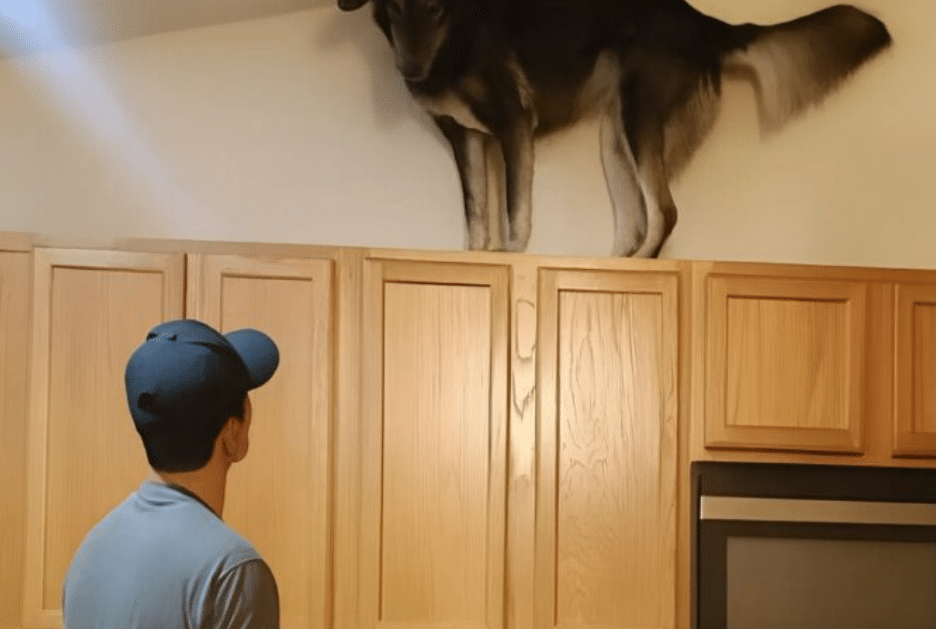
He turned toward me for only a second.
Then his head snapped back to the vent.
His bark was short and sharp.
Not playful.
Not confused.
A warning.
I Tried to Ignore It
For weeks, I told myself there had to be a normal explanation.
Maybe the building was settling. Maybe the pipes were rattling. Maybe Rick was getting older and more sensitive to sound. I even blamed stress, thinking perhaps he had noticed my own anxiety and was reacting to it.
But deep down, I knew this was different.
Rick was not scared.
He was guarding.
Every night, he placed himself between me and the kitchen wall. Every time I moved too close to the cabinets, he barked louder, as if telling me not to get careless.
One evening, after another night of broken sleep, I finally reached my limit.
I grabbed a flashlight from the drawer, pulled on my jacket, and dragged the old folding ladder from the storage closet.
Rick stood beside me, silent now.
That scared me more than the barking.
It felt like he had been waiting for me to understand.
The Vent Was Slightly Open
I set the ladder beneath the cabinets and climbed carefully.
The kitchen seemed too quiet. The only sound was my own breathing and the faint hum of the refrigerator. Rick stood below, watching the ceiling with his tail stiff behind him.
When I raised the flashlight, I noticed something I had never paid attention to before.
The ventilation grille was crooked.
One corner hung loose, barely separated from the wall. It looked like someone had moved it and pushed it back into place in a hurry.
My stomach tightened.
“Probably a mouse,” I whispered, trying to calm myself.
But Rick growled.
I reached up and pulled the grille free.
The smell hit me first.
Dust.
Stale air.
Something human.
Then my flashlight landed on a face.
Someone Was Inside the Wall
I nearly fell from the ladder.
A man was curled inside the ventilation duct, pressed into the narrow space behind the wall. His clothes were filthy, his face was streaked with dust, and his eyes widened when the light hit him.
For one frozen second, neither of us moved.
Then he tried to shift backward deeper into the duct.
I scrambled down the ladder so fast I almost dropped the flashlight.
Rick rushed forward and planted himself beneath the opening, barking with a force I had never heard from him before. The sound filled the kitchen like an alarm.
My hands shook as I grabbed my phone and called emergency services.
“There’s someone inside my ventilation system,” I told the dispatcher. “There is a man hiding in my wall.”
The dispatcher told me to leave the apartment immediately and stay on the line.
I did exactly what she said.
Rick stayed at my side the entire time, his body pressed against my leg as we waited in the hallway.
The Police Found More Than a Trespasser
Officers arrived within minutes.
They entered carefully, checked the apartment, and pulled the man out of the duct. He looked weak and disoriented, but he was alive. Inside his pockets, police found items that did not belong to me: a woman’s bracelet, a keychain, a wallet, and several small pieces of jewelry.
One officer asked if I recognized any of them.
I did not.
But my neighbors soon did.
As police began checking the building, the truth became even more disturbing. Several residents had reported missing items over the past few weeks. Nothing large. Nothing obvious. A ring from a bathroom counter. Cash from a drawer. A necklace from a nightstand. A spare key that someone thought they had misplaced.
No doors had been forced open.
No windows were broken.
Everyone assumed they had simply lost things.
But the man had been moving through parts of the building’s ventilation and maintenance spaces, entering when people were asleep or away, taking only small items he thought would not be noticed.
Rick had noticed.
My Dog Had Been Protecting Me
That night, after the officers finished taking my statement, I sat on the floor with Rick and cried.
Not because I was weak.
Because I finally understood.
Every growl. Every bark. Every time he broke the rules and climbed where he knew he should not go—he had been trying to tell me someone was there.
He had heard movement I could not hear.
Smelled a stranger I could not smell.
Sensed danger long before I was willing to believe it.
I wrapped my arms around him, and he leaned his heavy head against my shoulder as if comforting me.
“I’m sorry,” I whispered. “You were right.”
His tail thumped once against the floor.
The Home Never Felt the Same
In the days that followed, building management inspected every vent, crawlspace, and maintenance access point. Locks were changed. Cameras were installed. Residents were warned to report unusual noises, missing items, or signs of tampering immediately.
The police continued their investigation.
I never learned how long the man had been moving through the building before Rick found him. Maybe weeks. Maybe longer.
But I knew one thing for certain: without my dog, I might never have checked that vent.
I had been annoyed by the barking.
I had thought Rick was acting strangely.
I had almost ignored the only warning that mattered.
Listen When a Loyal Dog Warns You
People often say dogs bark at nothing.
Sometimes they do.
But sometimes “nothing” is only something we cannot see yet.
Rick was not being disobedient. He was not being dramatic. He was not losing his mind.
He was protecting his home.
Protecting me.
Now, when he stops suddenly and stares at a corner, I pay attention. When he growls at a sound I cannot hear, I do not dismiss it. I check carefully, safely, and never alone if something feels wrong.
Because that night taught me a lesson I will never forget.
A dog’s loyalty does not always look soft.
Sometimes it looks like growling at a wall for weeks.
Sometimes it looks like breaking the rules to get your attention.
And sometimes, it looks like standing beneath an open vent, barking at the danger hiding above your head.


