I never believed in warnings from the heart.
I was the kind of woman who trusted facts, explanations, and ordinary logic. If there was no evidence, I told myself there was no reason to worry. That was how I handled most things in life, including my marriage.
But on the afternoon I came home two hours earlier than usual, something felt wrong before I even opened the door.
I could not explain it.
The apartment hallway looked the same. The familiar key turned in the familiar lock. The grocery bags in my hands were filled with ingredients for dinner, the kind of small surprise I thought might bring a little warmth back into our home.
Still, my chest tightened.
For months, my husband had been different. He was distant, impatient, and easily annoyed. He spent more time alone, kept his phone facing down, and seemed irritated whenever I asked simple questions.
He blamed work.
Stress, deadlines, difficult clients, office politics.
I believed him because believing him was easier than admitting I was afraid.
That day, my meeting ended early. I decided not to call ahead. I wanted to surprise him, cook dinner, maybe open a bottle of wine, and remind ourselves that we were still the people we used to be.
Instead, I walked into a truth I was not prepared to see.
The Apartment Was Not Quiet
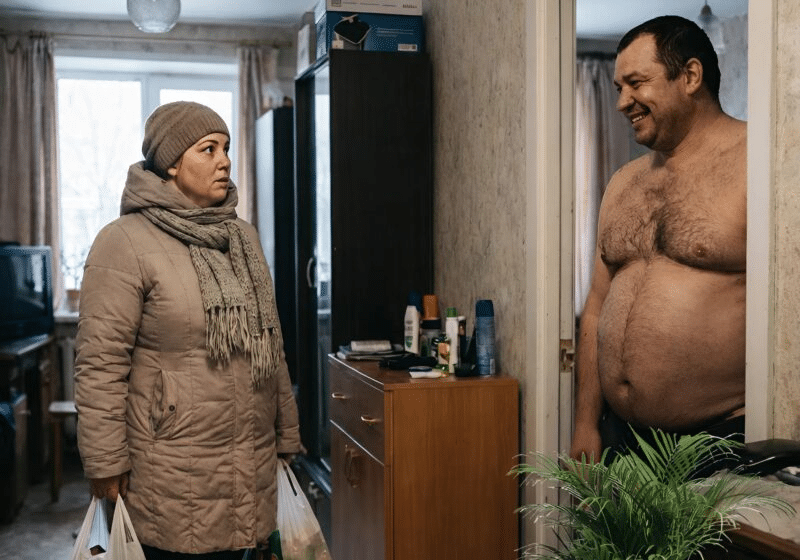
The first thing I noticed was sound.
Not loud enough to be clear, but enough to stop me in the hallway.
At first, I thought someone had broken in. There were voices coming from the bedroom, low and strange, mixed with a faint electronic hum.
My hands tightened around the grocery bags.
I set them down as quietly as I could and moved toward the bedroom.
Every step felt heavier than the last.
By the time I reached the door, my heart was beating so hard I could hear it in my ears.
I pushed the door open.
My husband stepped into view.
He was completely undressed.
But strangely, that was not the part that made me freeze.
It was the bedroom behind him.
Our Room Had Become a Set
The bed had been moved.
A tripod stood near the dresser, holding a camera pointed directly toward the center of the room. Two bright lights had been positioned at angles, their glare making the space look harsh and unfamiliar. A microphone rested on a small stand. His phone was mounted nearby with a streaming app open on the screen.
Our bedroom no longer looked like a private room.
It looked staged.
Prepared.
Used.
For several seconds, I could not speak.
My husband did not look guilty in the way I expected. He did not rush to explain, cover anything, or apologize. He simply stood there, watching me with an expression that was almost calm.
That calmness hurt more than panic would have.
“What is this?” I finally asked.
He sighed, as if I had interrupted something inconvenient.
“It’s not what you think.”
I almost laughed.
People only say that when it is exactly what you think—or worse.
There Was No Other Woman
I looked past him, expecting someone else to appear.
A stranger.
A lover.
A secret relationship hidden behind months of excuses.
But the room was empty.
There was no woman in the closet, no hurried footsteps in the bathroom, no perfume in the air that did not belong to me.
There was only equipment.
Lights.
Camera.
Microphone.
And my husband, standing in the middle of a private world he had built without telling me.
“Who were you talking to?” I asked.
He looked toward the phone.
“Viewers.”
The word landed heavily between us.
He explained everything in a voice so controlled that it felt rehearsed.
He had lost his job months earlier.
He had not told me.
Every morning, he put on work clothes, carried his bag, kissed me goodbye, and left the apartment as if nothing had changed. Sometimes he sat in cafés. Sometimes he drove around. Sometimes he came home after I left and spent the day online, searching for ways to make money without admitting he had failed.
Then he found one.
Private livestreaming.
Subscription platforms.
People willing to pay for access, attention, conversation, and carefully staged “realness.”
He described it like a business plan.
No emotion.
No shame.
No understanding that every word was cutting through the life I thought we shared.
The Betrayal Was Not Just the Content
He insisted it was not cheating.
“There’s nobody here,” he said. “It’s just online.”
Just online.
As if strangers watching from screens made it harmless.
As if the bedroom we shared had not been turned into a performance space.
As if the lies did not matter because the people on the other side of the camera were not physically present.
I looked at the bed where we had slept for years.
The bed where I had cried after miscarrying our first pregnancy.
The bed where he once held my hand and promised we would always tell each other the truth.
Now it had been rearranged under lights for people whose names I would never know.
“You used our bedroom,” I said quietly.
He crossed his arms.
“I had to do something.”
“You could have told me you lost your job.”
His jaw tightened.
“I didn’t want you looking at me like a failure.”
I shook my head.
“So you chose this instead? Months of lies?”
He looked away.
That was the closest thing to guilt I saw.
Consent Was the Line He Crossed
The more he talked, the clearer the real damage became.
It was not only that he had created private online content. It was not only that he had hidden his unemployment. It was not even only that he had been speaking to strangers while pretending to be at work.
It was that he had used our shared home without my knowledge.
He had brought an audience into a space that was supposed to be private.
I asked him if I had ever appeared in the background.
He hesitated.
That hesitation answered before he did.
“Only once or twice,” he said. “Nothing serious. You were just walking past the door.”
My stomach turned.
To him, it was nothing.
To me, it was everything.
Privacy is not something another person gets to redefine because they are embarrassed, broke, or desperate. Marriage does not erase consent. A shared home does not give one spouse permission to expose the other’s life to strangers.
In that moment, I understood that he had not merely hidden a secret.
He had made decisions about my dignity without asking me.
I Walked Out of the Bedroom
I did not scream.
I wanted to.
I wanted to throw the lights, break the tripod, demand passwords, demand names, demand every detail.
But something inside me went quiet.
I turned around, walked into the hallway, picked up my grocery bags, and placed them on the kitchen counter.
The apartment smelled like bread, onions, and cold fear.
He followed me, suddenly less confident.
“Don’t make this bigger than it is,” he said.
That was when I looked at him and finally saw the truth.
He was not sorry he had done it.
He was sorry I had come home early.
I took my keys, my purse, and the folder where I kept copies of our important documents. Then I left.
He called my name from the doorway, but I did not turn back.
The Truth Came in Pieces
I spent that night at my sister’s apartment.
The next morning, I contacted an attorney. Then I reviewed our bank records.
The financial picture was worse than I expected.
He had missed several payments. He had borrowed money from a credit card I rarely used. He had hidden notices, ignored bills, and used parts of our savings while pretending his salary was still coming in.
His online income had not saved us.
It had only helped him delay the truth.
My attorney advised me to document everything and secure my accounts. I changed passwords, checked whether any private images or recordings had been shared without my consent, and made a plan before speaking to him again.
That part was important.
Pain makes people want immediate confrontation.
But protection requires clarity.
The Marriage Had Been Replaced by an Audience
When we finally talked, he cried.
He apologized for lying about the job.
He apologized for the money.
He apologized for “not thinking” about how I would feel.
But I noticed what he did not say.
He did not say he understood that our home had been violated.
He did not say my consent mattered.
He did not say he would delete everything and prove it.
Instead, he kept returning to his own humiliation.
His failure.
His fear.
His need to feel seen.
That was when I realized something painful: he had chosen an audience over honesty because strangers online allowed him to perform control. With me, he would have had to be vulnerable.
He chose performance.
I chose peace.
Leaving Was Not Dramatic
People imagine endings as explosions.
Sometimes they are quiet.
Mine happened through paperwork, changed locks, separate accounts, and difficult conversations with family. It happened through mornings when I woke up grieving the man I thought I had married and evenings when I felt relieved not to hear his key in the door.
It happened slowly.
But it happened.
I eventually moved into a smaller apartment with white curtains, a kitchen that smelled like coffee, and a bedroom that belonged only to me.
No cameras.
No lights.
No secrets humming in the corner.
For a long time, I checked every reflection, every open laptop, every phone screen. Trust, once damaged, leaves echoes.
But healing came in small ways.
I began sleeping through the night.
I cooked dinner for myself.
I learned that being alone in an honest room felt better than being married inside a lie.
The Real Horror in the Bedroom
When I came home early that day, I thought the worst thing I could find was another woman.
I was wrong.
The real shock was discovering that my husband had turned our private life into something I had never agreed to share.
There are betrayals that involve another person.
And there are betrayals that involve a screen, an audience, and a thousand small lies told over breakfast while someone pretends everything is normal.
I once believed trust was broken by one dramatic act.
Now I know it can also be broken by staging lights in a bedroom, setting up a camera, and assuming your spouse will never come home early enough to see the truth.
That afternoon ended my marriage.
But it also gave me something back.
My voice.
My privacy.
And the right to decide who gets access to my life.


