A livestream stunt near a Texas lake sparked widespread outrage after a social media personality allegedly offered a woman $20 to jump into the water, then failed to help when the woman appeared to struggle.
The incident, reported in May 2024, involved online creator Natalie Reynolds and took place near Lady Bird Lake in Austin, Texas. According to multiple reports, Reynolds was livestreaming what appeared to be a scavenger-hunt-style challenge when she encouraged a woman to enter the water for money. The woman reportedly said she could not swim before jumping in.
What began as content for an online audience quickly became a disturbing example of how digital entertainment can cross ethical lines.
A Stunt That Quickly Went Wrong
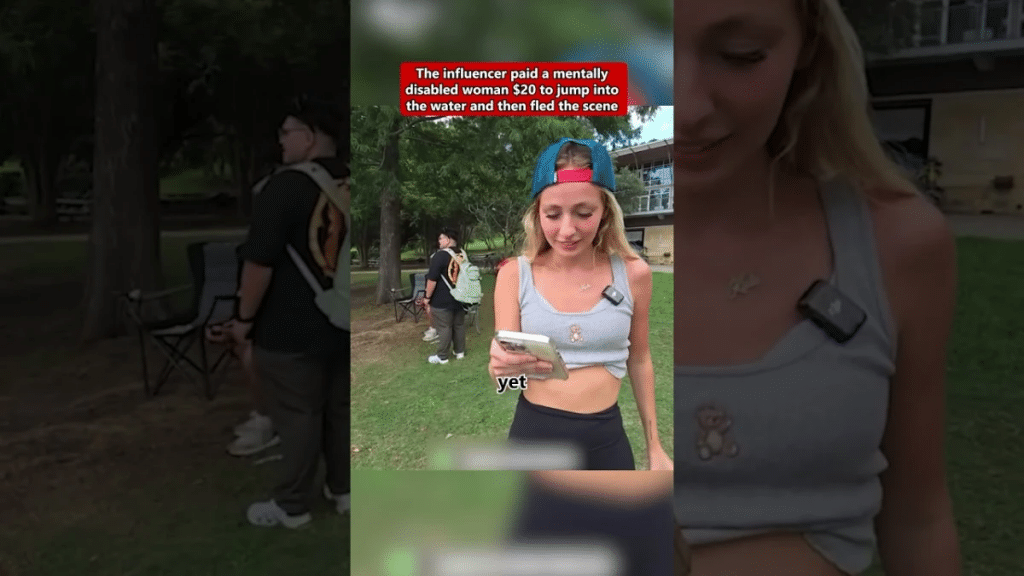
The footage drew attention because the woman appeared hesitant before entering the lake. Reports said Reynolds offered her $20 and encouraged her to jump in as part of the livestream. Once the woman entered the water, she reportedly struggled and called for help.
Instead of immediately assisting, Reynolds and her group were criticized for laughing, arguing, and eventually leaving the area as the situation escalated. Firefighters were called, and the woman was pulled from the water, according to reporting on the incident.
The woman’s full condition and personal circumstances were not publicly confirmed in reliable detail. Some viral posts described her as homeless or vulnerable, while others claimed she had a disability. Because those details were not consistently verified, they should be treated carefully.
What is clear is that the woman was placed in a frightening situation for the sake of livestream content.
Viewers Reacted With Anger
The backlash was immediate.
Clips from the livestream circulated across social media, where viewers condemned the stunt as reckless and cruel. Many questioned why anyone would encourage a stranger to enter deep water, especially after that person reportedly said she could not swim. Others criticized the broader culture of prank content, where vulnerable people can be treated as props rather than human beings.
The strongest criticism focused on responsibility.
Livestreamers often perform in real time for attention, donations, comments, and engagement. But the presence of an audience does not remove the duty to consider someone else’s safety.
In this case, critics argued that the woman’s distress should have ended the broadcast immediately and triggered direct action to help her.
The Problem With “Content at Any Cost”
This incident became part of a larger conversation about influencer culture.
Online creators are rewarded for shock, novelty, and viral moments. The more extreme the stunt, the more likely it is to be clipped, shared, and discussed. That incentive can push some creators toward behavior that would be unacceptable offline.
A prank may seem harmless to the person filming it, but the target may experience humiliation, fear, injury, or real danger.
The lake incident showed how quickly a “challenge” can become an emergency.
When money is offered to a stranger in a vulnerable situation, the ethical responsibility becomes even greater. A person may agree to something unsafe because they need cash, feel pressured, or do not fully understand the risk.
That is why consent in viral content should never be reduced to a quick “yes” on camera.
Platform Accountability Became Part of the Debate
After the incident spread online, reports later said Reynolds faced major consequences on TikTok, including an account ban. Coverage of her later appearance outside TikTok’s Los Angeles headquarters described the ban as connected in public discussion to the lake incident, though the exact internal platform reasoning was not always publicly confirmed.
For many viewers, a platform ban was not enough.
Commenters called for stronger rules around livestreamed stunts involving strangers, especially when the person being filmed may be vulnerable. Others argued that platforms should act faster when dangerous behavior is broadcast live.
The issue is not only one creator.
It is the system that rewards risky behavior with attention.
If dangerous videos continue generating views, shares, and discussion, other creators may copy them in pursuit of the same visibility.
Legal Questions Remained Complicated
Many viewers demanded criminal charges after watching the clips. However, public outrage does not automatically translate into a clear legal case.
The law often depends on specific facts: what was said, what the person understood, whether force or fraud was involved, what injuries occurred, and whether a prosecutor can prove criminal intent or recklessness beyond a reasonable doubt.
That said, the absence of immediate legal consequences does not make the conduct acceptable.
A person can behave in a way that is morally indefensible even if the legal system does not respond quickly or publicly.
A Reminder About Human Dignity
The most troubling part of the incident was not simply that a stunt went wrong.
It was the way a stranger’s fear appeared to become part of the entertainment.
When someone is struggling in water, the correct response is not laughter, denial, or concern about how the stream looks. The correct response is to call for help, alert nearby adults, contact emergency services, and assist only if it can be done safely.
The woman in the water was not a prop.
She was a human being whose safety mattered more than views, comments, or online clout.
The Lesson for Creators and Viewers
For creators, the lesson is simple: do not build content around pressuring strangers into risky situations. Money, jokes, and livestream excitement do not erase responsibility.
For viewers, the lesson is also important. Audiences should not reward cruelty with engagement. Sharing a clip to condemn it may still spread the creator’s name and content. Reporting dangerous videos, supporting responsible creators, and refusing to normalize humiliation can help shift incentives.
For platforms, the incident is another reminder that livestreaming requires serious moderation tools. Harm can unfold in real time, and once a video spreads, the damage is difficult to undo.
Final Thoughts
The lake incident became viral because it exposed an uncomfortable truth about modern internet culture.
Some online personalities chase attention so aggressively that they forget the real people standing in front of them.
A stranger was reportedly offered $20 to enter the water. She struggled. Emergency responders had to intervene. The internet responded with anger because the situation appeared avoidable from the beginning.
Viral fame is not worth someone else’s safety.
Entertainment should never come at the expense of human dignity.
And no livestream should matter more than a life.


