Most drivers are familiar with the basic markings on a gear selector.
In a manual car, the shift pattern usually shows numbered forward gears and an “R” for reverse. In an automatic vehicle, many drivers expect to see “P,” “R,” “N,” and “D,” meaning Park, Reverse, Neutral, and Drive. Some vehicles also include additional settings such as “L” for Low gear, which can help keep the transmission in lower gear ranges for situations like steep hills or slow-speed control.
But every now and then, someone looks inside an older car and sees a letter that feels completely unfamiliar:
E.
For newer drivers, that small letter can be surprisingly confusing. It does not appear on most modern shift patterns, and it is easy to assume it must mean something complicated, technical, or rare.
In many older vehicles, however, the answer is much simpler.
The “E” usually stood for Economy—or, in some cases, Efficiency—and it was designed to help the car use less fuel.
The “E” Was About Saving Fuel
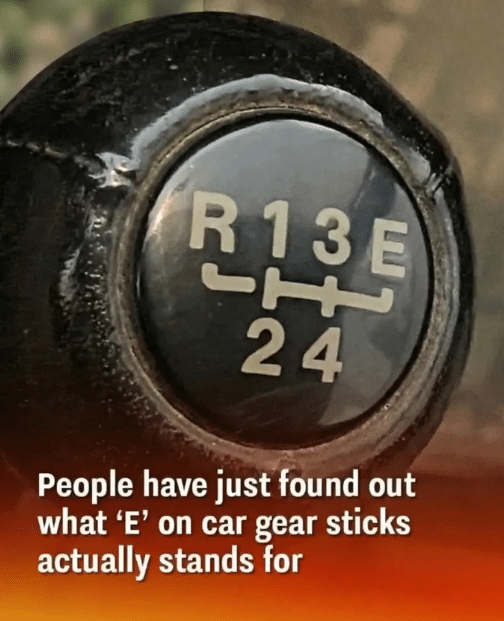
The purpose of the “E” setting was to prioritize fuel economy instead of quick acceleration.
In older manual cars, especially certain European models, the “E” position often worked like a tall overdrive gear. In simple terms, it allowed the engine to run at lower revolutions per minute during steady cruising. Lower engine speed at highway speeds can reduce noise, decrease engine strain, and improve fuel efficiency when used properly. Volkswagen’s modern explanation of manual gearing makes the same general point: a higher top gear reduces engine revs at higher speed, which can help save fuel.
That made the “E” gear useful on open roads, long commutes, and steady-speed driving.
It was not meant for racing, towing heavy loads, or climbing steep hills. It was meant for smoother, more economical driving when the vehicle did not need maximum power.
Volkswagen Helped Make the Letter Famous
One of the best-known examples came from Volkswagen’s fuel-saving “Formula E” models.
Volkswagen’s own newsroom identifies a 1983 Passat B2 CL Formula E and states directly that the “E” stood for “Economy,” with the car featuring consumption-reducing measures such as a start-stop system.
That detail is important because it shows the “E” was not just a random marking. It reflected a real engineering trend from an era when automakers were trying to improve fuel mileage with mechanical solutions.
Some older Volkswagens used “3+E” or “4+E” gearboxes. Instead of labeling the highest gear as a normal numbered gear, the automaker marked it as an economy-focused cruising gear. It was essentially a way to tell the driver: this position is for saving fuel, not for strong acceleration.
For people interested in used cars, vintage vehicles, and car maintenance history, that little letter tells a bigger story about how automakers responded to rising fuel costs and changing consumer priorities.
Automatic Cars Used the Idea Differently
The “E” did not always work the same way in every vehicle.
In some automatic or semi-automatic systems, “E” referred to an economy driving program rather than a physical gear. Instead of the driver selecting a separate overdrive gear, the car’s transmission programming would shift earlier, keep engine speed lower, and reduce aggressive acceleration.
Mercedes-Benz, for example, has used driving programs where “E” means Economy. In its owner-support material for the E-Class, Mercedes-Benz describes “E” as a particularly economical driving style, while “S” stands for Sport and “C” for Comfort.
This is why the exact meaning of “E” depends on the vehicle.
On one old car, it may be a tall manual overdrive gear. On another, it may be a transmission mode. On a newer vehicle, the same idea may appear as “Eco Mode” instead of a separate gear marking.
Why the “E” Gear Disappeared
The “E” marking became less common as automotive technology improved.
Modern vehicles no longer need a separate letter on the shift knob to remind drivers to choose an economy gear. Today’s cars use electronic fuel injection, computer-controlled transmissions, adaptive shift programs, engine-management software, and selectable drive modes to balance power and fuel efficiency automatically.
Many newer vehicles now offer an Eco Mode button or drive-mode selector instead of an “E” gear. These systems can adjust throttle response, transmission behavior, climate-control operation, and other settings to reduce fuel use during normal driving. CarParts.com describes “E” or Economy settings as shifting earlier and conserving fuel, which is similar to how many modern eco-focused drive programs are explained.
In other words, the idea did not disappear.
Only the old-fashioned gear marking did.
It Is Not the Same as “Electric”
Today, many people associate the letter “E” with electric vehicles.
That makes sense. Modern car marketing uses “E” everywhere: EV, e-tron, e-Drive, e-Power, e-Hybrid, and similar names.
But the “E” on an older gear stick usually did not mean electric.
It referred to fuel economy, efficiency, or an extra-high cruising gear. These cars were typically gasoline or diesel vehicles, not electric cars.
That distinction matters because a vintage “E” gear belongs to a different chapter of automotive history. It was a mechanical answer to a fuel-efficiency problem long before modern battery-electric vehicles and advanced hybrid systems became common.
How Drivers Were Supposed to Use It
In a manual car with an “E” gear, the driver would normally use the lower numbered gears to accelerate, then shift into “E” once the car reached a steady cruising speed.
The car might feel slower to respond in “E” because the engine was turning at lower RPM. Pressing the accelerator hard in that gear might not produce strong acceleration. In many cases, a driver would need to downshift before passing another vehicle, climbing a hill, or carrying extra load.
Used correctly, the “E” gear could make driving quieter and more efficient.
Used at the wrong time, it could make the engine feel sluggish.
That is why understanding the shift pattern matters, especially for anyone buying a classic car or learning to drive an older manual transmission.
A Small Letter With a Big Personal Finance Lesson
The “E” gear is also a reminder that fuel economy has always been part of personal finance.
Drivers care about performance, comfort, and style, but they also care about ownership costs. Fuel expenses, auto insurance, maintenance, repairs, and vehicle loans all affect the true cost of driving.
A car that saves fuel on the highway can make a real difference over time, especially for commuters or families managing a tight budget.
The old “E” gear may seem like a tiny detail, but it represented the same concern drivers still have today: how to get where they need to go without spending more money than necessary.
The Bottom Line
So what does the “E” on an older gear shift mean?
In most cases, it stands for Economy or Efficiency.
On some manual cars, it functioned like a higher cruising gear designed to lower engine RPM and improve fuel economy. On some automatic vehicles, it referred to an economy driving program that encouraged smoother, earlier shifts.
It was not mysterious.
It was not a hidden performance mode.
And it usually had nothing to do with electric vehicles.
It was simply an old-school fuel-saving feature from a time when automakers used clever mechanical solutions to help drivers reduce fuel consumption.
Today, the “E” gear has mostly been replaced by Eco Mode, smarter transmissions, and advanced engine software. But for anyone who spots that letter on a vintage gear stick, it is a fascinating reminder of how quickly car technology changes.
A single letter on a shift knob can tell the story of fuel prices, engineering decisions, driver habits, and the long history of making cars more efficient.


