It began like any ordinary day at the Cincinnati Zoo. Families moved from one exhibit to another, children laughed as they pointed at animals they had only seen in books, and parents took photos to remember a sunny afternoon together. Nothing about the day seemed unusual.
But within minutes, one unexpected accident would turn a peaceful zoo visit into a story discussed around the world.
A young boy slipped away from his family and somehow made his way past the barrier surrounding the gorilla exhibit. Before anyone could stop him, he fell into the enclosure below. The drop was frightening, the crowd gasped, and panic spread quickly among visitors who realized a child was now inside the habitat of one of the zoo’s most powerful animals.
Below stood Harambe, a 17-year-old silverback gorilla weighing hundreds of pounds.
For everyone watching, time seemed to stop.
The moment everything changed
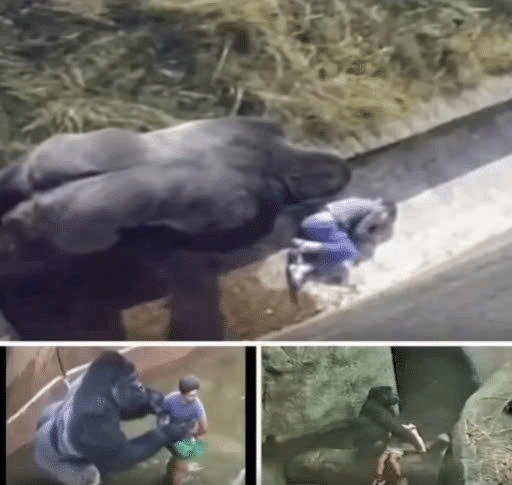
The boy landed in the shallow water inside the enclosure. Screams rose from the crowd as Harambe moved toward him. Some people shouted for help. Others stood frozen, unsure what to do. Phones came out, recording a moment that would soon be replayed and debated across the internet.
Harambe approached the child and appeared to study him. The scene was difficult to understand. At moments, the gorilla seemed curious. At other moments, his strength and sudden movements made the situation look terrifying. He touched the child and then pulled him through the water.
To some viewers, Harambe appeared protective, almost as though he were responding to the child as something fragile. To others, the danger was undeniable. A gorilla’s strength is enormous, and even an action that is not meant to harm can become deadly in seconds.
That uncertainty made the situation even more frightening.
Zoo staff faced an impossible decision. They had to act fast. The child was in immediate danger, the crowd was loud, and the animal’s behavior could change at any moment. Tranquilizing Harambe was not considered a safe option because a sedative would take time to work and could make the gorilla more agitated before taking effect.
There were no easy choices.
In the end, officials made the decision to shoot Harambe in order to save the child.
The boy survived.
Harambe did not.
A tragedy with no simple answer
News of the incident spread rapidly. Video from the enclosure circulated online, and millions of people watched the same footage while reaching very different conclusions.
Some praised the zoo for acting quickly to protect a child’s life. To them, the decision was heartbreaking but necessary. They argued that when a child’s safety is at risk, there is no room to gamble with uncertainty.
Others were devastated by Harambe’s death. They believed the gorilla had not intended to hurt the boy and saw him as an innocent animal placed in an impossible situation created by human error. Many questioned the design of the enclosure, the responsibility of the adults present, and the ethics of keeping intelligent wild animals in captivity.
The public debate became intense. People argued about parenting, zoo safety, animal rights, and whether the outcome could have been avoided. The child’s mother became the target of harsh criticism online, while others defended her by pointing out how quickly toddlers can move and how even a brief moment of distraction can lead to disaster.
What made the story so powerful was that it resisted an easy explanation.
There was a frightened child.
There was a powerful animal under stress.
There were zoo workers forced to make a life-or-death decision in real time.
No matter which side people took, the outcome was painful.
Why Harambe’s story affected so many people
Harambe’s death became more than a local zoo incident. It turned into a global conversation about how humans interact with wildlife.
Many people began asking difficult questions. Should animals as intelligent as gorillas live in enclosures for public viewing? Are modern zoos still necessary for education and conservation? How can public safety and animal welfare be balanced? What responsibilities do visitors, parents, and institutions share?
These questions did not have simple answers.
Zoos often argue that they help protect endangered species, fund conservation programs, and educate the public about wildlife. Critics argue that captivity can never fully meet the emotional and physical needs of complex animals, especially great apes.
Harambe’s story forced many people to think more deeply about both sides.
It also reminded the public that animals in captivity are still wild animals. They may seem calm, familiar, or even gentle from behind a barrier, but they do not think or respond like humans. Their strength, instincts, and reactions can be unpredictable, especially when a loud crowd, fear, and confusion are involved.
The internet turned grief into a symbol
As the story spread, Harambe became one of the most recognizable animal names in modern internet culture. His image appeared across social media, sometimes in serious tributes and sometimes in memes.
For some, the online attention kept his memory alive and helped draw awareness to animal welfare. For others, the jokes and viral posts felt disrespectful, turning a real tragedy into entertainment.
Still, behind the memes and arguments was something deeper. People were struggling with guilt, sadness, anger, and helplessness. Harambe became a symbol of all the complicated ways humans relate to animals: admiration, control, affection, entertainment, and responsibility.
His name became tied to debates about safety barriers, zoo policies, parenting in public spaces, and the moral weight of decisions made under pressure.
Lessons from a heartbreaking moment
In the years after the incident, many zoos reviewed safety procedures and enclosure designs. The story became a reminder that even one weak point in public safety can have devastating consequences.
For parents, it became a painful warning about how quickly children can move in crowded public places. For animal lovers, it became a call to think more carefully about the lives of animals kept in captivity. For zoo professionals, it became a reminder of the heavy responsibility they carry every day.
But perhaps the biggest lesson is that compassion must be broad enough to hold more than one truth at the same time.
It is possible to be grateful that the boy survived and still mourn Harambe.
It is possible to understand why the zoo acted and still wish the situation had never happened.
It is possible to feel anger, sadness, and empathy all at once.
That is why the story remains so unforgettable.
A legacy that still raises questions
Harambe’s story continues to be remembered because it touches something deeply human. It is not simply about a child falling into an enclosure or a gorilla losing his life. It is about the fragile boundary between humans and nature, and what happens when that boundary fails.
It asks us to consider how close we should come to wild animals, what we owe them, and how we make decisions when every option carries loss.
There were no true winners that day. A child lived, but an animal died. A family was spared unimaginable grief, while the world mourned a gorilla who became a symbol of innocence, power, and tragedy.
What began as a normal day at the zoo became a moment that challenged millions of people to think about safety, accountability, and respect for life.
Harambe’s legacy is not only found in viral posts or old headlines. It lives in stronger barriers, more careful conversations, and the ongoing debate about how humans should share the world with creatures we admire but do not fully understand.
In the end, the story of Harambe is not just about a gorilla and a boy.
It is about responsibility.
It is about compassion.
And it is about learning from a tragedy that still leaves the world searching for the right answer.


