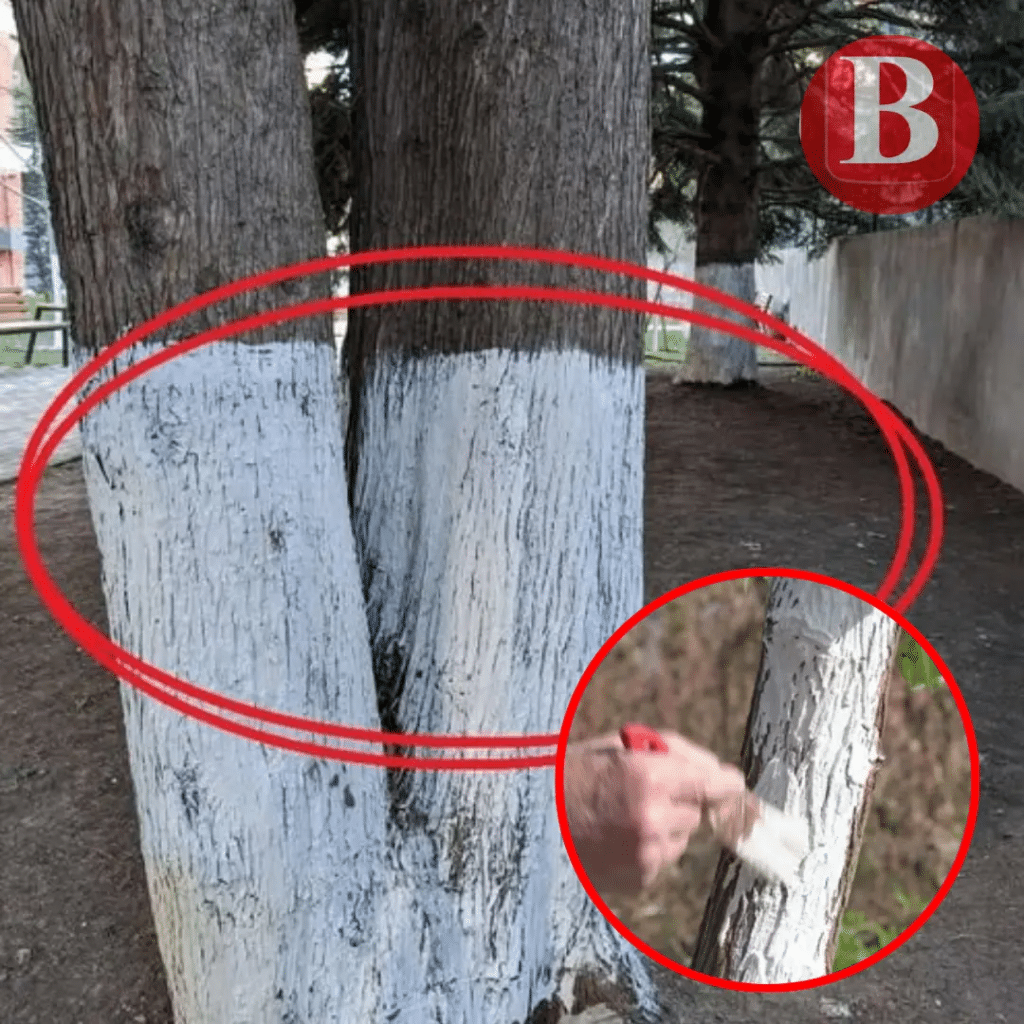
Have you ever driven down a country road or walked through an orchard and noticed trees with their lower trunks painted white?
For many people, it’s a familiar sight that often raises questions.
Is it a special marking?
A pest control measure?
A way to identify certain trees?
The truth is both simple and fascinating.
In many cases, that white coating serves an important purpose: helping protect trees from environmental stress and damage.
Far from being decorative, it is a practical technique used by gardeners, orchard owners, landscapers, and tree-care professionals around the world.
The Challenge Trees Face During Winter
Trees may appear dormant during colder months, but they continue responding to changes in their environment.
One common problem occurs when winter sunlight warms the trunk during the day.
As the bark heats up, it expands slightly.
When temperatures drop rapidly after sunset, the bark cools and contracts.
This repeated cycle of expansion and contraction can place stress on the tree.
In some cases, it may lead to bark splitting or cracking, a condition often referred to as sunscald or frost cracking.
These injuries can weaken a tree and create openings that allow insects, fungi, and diseases to enter.
Why White Paint Helps
The solution is surprisingly straightforward.
A thin layer of white paint reflects sunlight instead of absorbing it.
Because the trunk remains cooler during sunny winter days, temperature fluctuations become less severe.
This helps reduce stress on the bark and lowers the risk of cracking.
The white coating essentially acts as a protective barrier against sudden temperature changes.
Many tree-care experts compare it to sunscreen for trees.
Rather than preventing sunburn on skin, it helps prevent bark damage caused by excessive heating and cooling.
Which Trees Benefit Most?
Not every tree requires this treatment.
White trunk coatings are most commonly used on:
- Young fruit trees
- Newly planted trees
- Thin-barked species
- Trees growing in exposed locations
Examples often include:
- Apple trees
- Peach trees
- Cherry trees
- Pear trees
Young trees are especially vulnerable because their bark is thinner and less able to withstand extreme temperature swings.
How the Process Works
When tree trunks are painted, professionals typically use a diluted water-based latex paint.
The mixture is usually made by combining equal parts paint and water.
This creates a breathable coating that protects the bark without trapping moisture.
Important guidelines include:
- Using water-based latex paint only
- Avoiding oil-based products
- Applying a thin, even coating
- Covering the trunk from the base upward
The goal is protection, not complete coverage.
Other Benefits of White Tree Trunks
In addition to reducing sunscald, white trunk coatings may offer several secondary benefits.
These can include:
Improved Visibility
In orchards and agricultural areas, white trunks are easier to see, reducing accidental damage from equipment.
Reduced Insect Activity
Some insects are less likely to settle on treated bark, although paint alone is not considered a primary pest-control method.
Protection for Young Trees
Recently planted trees often face multiple environmental stresses. White coatings provide an additional layer of defense during their most vulnerable years.
More Than Maintenance
For many gardeners and orchard owners, painting tree trunks represents more than routine maintenance.
It reflects long-term care and investment in the health of the landscape.
Trees often require years—even decades—to reach maturity. Small preventive actions taken today can help ensure stronger growth and healthier trees in the future.
That’s why this simple practice continues to be used across farms, orchards, parks, and residential properties.
A Tradition Rooted in Tree Care
Although modern tree-care techniques continue to evolve, the practice of painting trunks white remains a trusted method for protecting vulnerable trees.
What may appear unusual at first glance is actually based on a straightforward scientific principle: reducing temperature stress on the bark.
So the next time you notice rows of white-painted trees along a road or in an orchard, you’ll know there’s a practical reason behind the appearance.
It’s not a warning sign.
It’s not decoration.
It’s simply one way people help trees stay healthy through challenging seasonal conditions.
And sometimes, the smallest acts of care can make the biggest difference.


