When shopping for new tires, most people focus on the brand, tread design, size, and price.
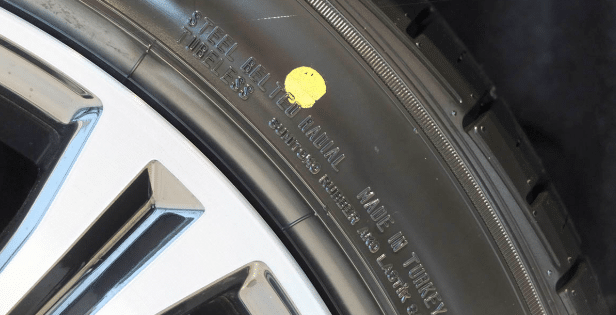
But if you’ve ever looked closely at a new tire, you may have noticed small colored dots—usually red, yellow, or sometimes both—on the sidewall.
Many drivers assume these markings are random factory labels or inspection marks.
In reality, they serve an important purpose that helps improve tire installation, balance, ride comfort, and overall vehicle performance.
Why Tire Balance Matters
Even with modern manufacturing technology, no tire is perfectly uniform.
Tiny variations in weight and construction occur during production.
Although these differences are extremely small, they can affect:
- Ride smoothness
- Tire wear
- Steering feel
- Fuel efficiency
- Vehicle vibrations
To compensate for these minor variations, tire manufacturers use colored reference marks that help technicians mount and balance tires more accurately.
That’s where the red and yellow dots come into play.
What Does the Yellow Dot Mean?
The yellow dot typically identifies the tire’s lightest point.
Every tire has a slightly lighter section due to natural manufacturing variations.
When installing the tire, technicians often align the yellow dot with the wheel’s heaviest point, which is usually near the valve stem.
This helps reduce the amount of balancing weight needed after installation.
Benefits of proper alignment include:
- Smoother driving
- Reduced vibration
- More even tire wear
- Improved balancing efficiency
For most vehicles, the yellow dot is the primary reference mark used during mounting.
What Does the Red Dot Mean?
The red dot serves a different purpose.
It generally indicates the tire’s highest point of radial force variation or its most uniform point relative to the tire’s shape.
In simpler terms, it identifies a specific area of the tire that helps technicians achieve optimal uniformity when matching the tire to the wheel.
On wheels that have a designated low point mark, technicians may align the red dot with that location.
This process is known as match mounting.
Proper match mounting can:
- Minimize road-force vibration
- Improve ride quality
- Enhance overall tire performance
Why Some Tires Have Both Dots
Occasionally, you’ll see both a yellow and red dot on the same tire.
This often confuses consumers.
In most cases:
- Yellow dot = lightest point by weight
- Red dot = highest point of radial variation
If both marks are present, tire manufacturers typically provide guidance on which mark should take priority during installation.
Professional tire technicians follow manufacturer recommendations based on the specific tire and wheel combination.
Understanding the DOT Number
Beyond the colored dots, every tire also includes an important code stamped into the sidewall.
This is known as the DOT code.
The DOT number contains information about:
- Manufacturing location
- Production specifications
- Tire identification
- Manufacturing date
One of the most useful details for consumers is the production date.
How to Read a Tire’s Manufacturing Date
The final four digits of the DOT code indicate when the tire was produced.
For example:
3524
means:
- Week 35
- Year 2024
This tells you the tire was manufactured during the 35th week of 2024.
Checking this information can help ensure you’re purchasing relatively fresh tires rather than older inventory that has been sitting in storage for extended periods.
Why Tire Age Matters
Even when unused, tires gradually age over time.
Rubber compounds naturally deteriorate due to:
- Heat exposure
- Sunlight
- Oxygen
- Environmental conditions
For this reason, many experts recommend checking the manufacturing date when purchasing replacement tires.
Newer tires generally provide better performance and a longer service life.
Common Myths About Tire Dots
Several misconceptions surround the colored markings.
Myth: The Dots Show Tire Quality
False.
The dots do not indicate higher or lower quality.
They are reference points used during installation.
Myth: Drivers Need to Align the Dots Themselves
False.
Professional tire installers handle alignment during mounting and balancing.
Myth: The Dots Mean the Tire Is Defective
False.
The markings are part of the normal manufacturing and quality-control process.
Small Marks, Big Importance
Although the red and yellow dots may appear insignificant, they help technicians optimize tire performance and ride quality.
Combined with proper balancing and installation, these markings contribute to:
- Better handling
- Increased comfort
- Reduced tire wear
- Longer tire life
The Next Time You Buy Tires…
Take a moment to look at the sidewall.
Those tiny colored dots aren’t random markings.
They’re part of a carefully engineered system designed to improve tire performance from the moment the tire is installed.
Understanding these small details can help you become a more informed vehicle owner—and ensure you’re getting the most from every mile on the road.