A relaxing day at the park can quickly become memorable when nature decides to provide an unexpected lesson.
That’s exactly what happened during a recent family outing when one of the children spotted a small creature crawling across a path.
Excited by the discovery, the child ran over to show the adults.
From a distance, it appeared harmless.
But a closer look revealed something remarkable—and potentially dangerous.
The Surprising Discovery
As the adults gathered around, one family member immediately noticed something unusual.
The creature wasn’t alone.
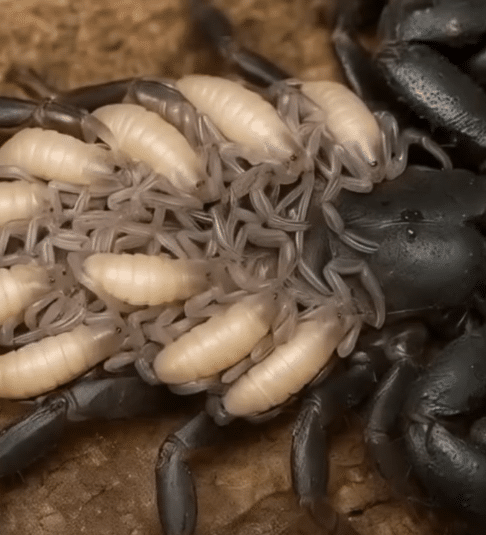
Its back appeared to be covered with dozens of tiny pale-colored shapes.
What initially looked like bumps or markings were actually baby scorpions.
The adult scorpion was carrying her young.
The children were quickly asked to keep a safe distance while the adults observed from afar.
While fascinating to see, it was also a reminder that wildlife should always be respected and left undisturbed.
Why Baby Scorpions Ride on Their Mother’s Back
Many people are surprised to learn that scorpions are among the few arthropods that provide extensive care for their offspring.
Unlike many insects that lay eggs and leave them behind, female scorpions give birth to live young.
After birth, the babies—known as scorplings—immediately climb onto their mother’s back.
There they remain for approximately 10 to 20 days.
During this time, the mother’s body serves as both transportation and protection while the young develop.
A Critical Stage of Development
When baby scorpions are born, their exoskeletons are soft and vulnerable.
Without protection, they would be easy targets for predators and environmental hazards.
Remaining on their mother’s back helps them survive this fragile stage of life.
After undergoing their first molt, the young scorpions develop a stronger outer shell and become capable of surviving independently.
At that point, they leave their mother’s back and begin life on their own.
Why You Should Never Pick Up a Scorpion
Although many scorpion species pose little threat to humans, some can deliver painful stings and certain species have medically significant venom.
Because it can be difficult to identify species in the wild, experts recommend avoiding direct contact with any scorpion.
If you encounter one:
- Keep a safe distance.
- Do not attempt to touch or capture it.
- Supervise children and pets closely.
- Observe only from a safe location.
Most scorpions prefer to avoid people and will only sting when they feel threatened or trapped.
Nature’s Remarkable Parenting Strategy
The sight of dozens of tiny scorpions riding on their mother’s back may seem alarming at first, but it is actually one of nature’s most fascinating examples of parental care.
For a brief period, the mother provides shelter, transportation, and protection while her young develop the strength they need to survive on their own.
It’s a strategy that has helped scorpions thrive for hundreds of millions of years.
A Memorable Wildlife Encounter
What began as a simple park outing turned into an unforgettable educational moment.
The experience served as a reminder that even small creatures can have extraordinary behaviors that many people never get the chance to witness.
It also highlighted the importance of respecting wildlife and maintaining a safe distance when encountering animals in their natural environment.
Sometimes the most fascinating discoveries are the ones that remind us how much there is still to learn about the natural world.
And in this case, one tiny creature carrying dozens of babies certainly left a lasting impression on everyone who saw it.